AI Generated Quiz

Primary 6 PSLE Mathematics Addition Subtraction Quiz

Free AI-Generated Qwen3.7 Plus Primary 6 PSLE Mathematics Addition Subtraction quiz with questions and answers for Singapore students. This page is rendered as a direct URL so the questions and answers can be discovered without pressing in-page buttons.

These static practice materials are generated from the site's syllabus and paper-generation workflow, with source and model context shown so students and parents can evaluate the material before use.

Primary 6 PSLE Mathematics AI Generated Generated by Qwen3.7 Plus Updated 2026-06-04

Questions

<!-- TuitionGoWhere generation metadata: stage=5-1; model=qwen/qwen3.7-plus; model_label=Qwen3.7 Plus; generated=2026-06-04; Sources: Stage 4-0 LLM templates, syllabus context, and Stage 2 evidence where available. -->

Primary 6 PSLE Mathematics Quiz - Addition Subtraction

Name: __________________________
Class: __________________________
Date: __________________________
Score: ________ / 50

Duration: 1 hour 15 minutes
Total Marks: 50

Instructions to Candidates:

  1. This quiz consists of 20 questions.
  2. Answer all questions.
  3. Write your answers in the spaces provided.
  4. For questions requiring working, show your working clearly. Marks may be awarded for method marks even if the final answer is incorrect.
  5. Unless otherwise stated, give your answers in the simplest form or to 2 decimal places where appropriate.
  6. The use of calculators is not allowed.

Section A: Whole Numbers and Decimals (Questions 1–5)

Each question carries 2 marks.

1. Find the sum of 45,098 and 12,305. Give your answer in the nearest thousand.

Answer: __________________________

2. Subtract 8,009 from 50,000.

Answer: __________________________

3. Calculate 14.53.28+0.714.5 - 3.28 + 0.7.

Answer: __________________________

4. What is the difference between the value of the digit 6 in 64,210 and the value of the digit 6 in 16,905?

Answer: __________________________

5. A warehouse had 12,500 boxes of apples. In the morning, 3,450 boxes were sold. In the afternoon, 2,180 more boxes were sold. How many boxes were left?

Answer: __________________________


Section B: Fractions (Questions 6–12)

Questions 6–9 carry 2 marks each. Questions 10–12 carry 3 marks each.

6. Express 34+25\frac{3}{4} + \frac{2}{5} as a mixed number in its simplest form.

Answer: __________________________

7. Subtract 2132\frac{1}{3} from 5125\frac{1}{2}. Give your answer as a mixed number in its simplest form.

Answer: __________________________

8. Mrs. Tan had 56\frac{5}{6} kg of flour. She used 14\frac{1}{4} kg to bake a cake and 13\frac{1}{3} kg to make cookies. How much flour did she have left?

Answer: __________________________

9. Find the value of 78(12+14)\frac{7}{8} - \left( \frac{1}{2} + \frac{1}{4} \right).

Answer: __________________________

10. There were some students in a hall. 25\frac{2}{5} of them were boys. After 12 boys and 8 girls left the hall, the number of boys and girls remaining was equal. How many students were there in the hall at first?

Answer: __________________________

11. Ali saved 38\frac{3}{8} of his allowance. He spent 14\frac{1}{4} of the remaining money on a book and the rest on food. If he spent $15 on food, how much was his total allowance?

Answer: __________________________

12. Container A had 12 litres of water. Container B had 8 litres of water. Some water was poured from Container A to Container B until Container B had twice as much water as Container A. How much water was poured from Container A to Container B?

Answer: __________________________


Section C: Percentage and Ratio (Questions 13–17)

Each question carries 3 marks.

13. In a school library, 40% of the books are fiction. The rest are non-fiction. If there are 360 non-fiction books, how many fiction books are there?

Answer: __________________________

14. The price of a watch was $200. During a sale, the price was reduced by 15%. After the sale, the price was increased by 10% of the sale price. What was the final price of the watch?

Answer: __________________________

15. The ratio of the number of red marbles to blue marbles was 3:5. After 10 red marbles were added and 5 blue marbles were removed, the ratio became 2:3. How many red marbles were there at first?

Answer: __________________________

16. Mr. Lim spent 30% of his salary on rent and 14\frac{1}{4} of the remainder on food. He saved the rest. If he saved $2,100, what was his total salary?

Answer: __________________________

17. Box A and Box B contained some beads. The number of beads in Box A was 60% of the number of beads in Box B. After 20 beads were transferred from Box B to Box A, both boxes had an equal number of beads. How many beads were there in Box B at first?

Answer: __________________________


Section D: Advanced Problem Solving (Questions 18–20)

Each question carries 4 marks.

18. The total age of Amy, Ben, and Cindy is 45 years. Amy is 3 years older than Ben. Cindy is twice as old as Ben. How old is Amy?

Answer: __________________________

19. A tank was 13\frac{1}{3} filled with water. After adding 10 litres of water, the tank became 12\frac{1}{2} filled. What is the capacity of the tank?

Answer: __________________________

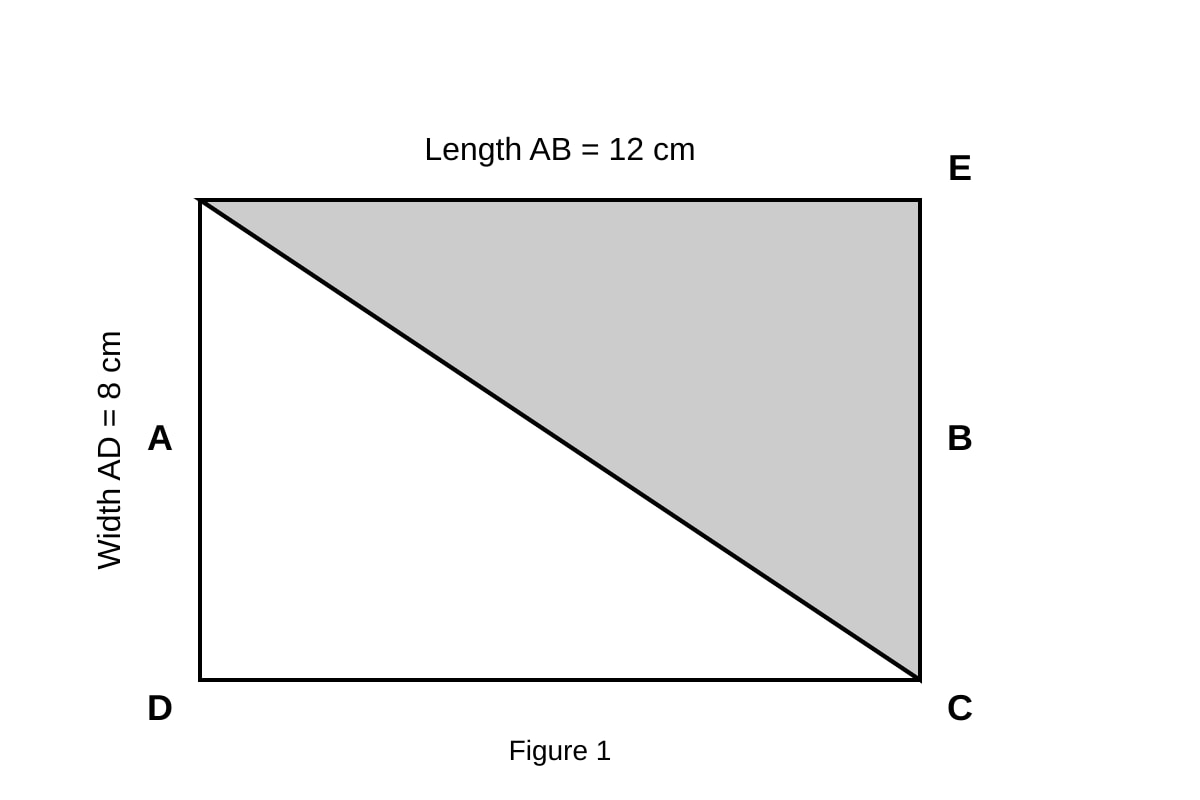
20. <image_placeholder> id: Q20-fig1 type: diagram linked_question: Q20 description: A rectangle ABCD with length 12 cm and width 8 cm. Inside the rectangle, there is a shaded triangle ABE where E is a point on side CD. The base of the triangle is side AB. The height of the triangle is the perpendicular distance from E to AB, which is equal to the width of the rectangle (8 cm). labels: A, B, C, D, E; Length AB = 12 cm; Width AD = 8 cm values: AB=12, AD=8 must_show: Rectangle ABCD, Point E on CD, Triangle ABE shaded. </image_placeholder>

In the figure above, ABCD is a rectangle. E is a point on CD. The area of the unshaded region is 48 cm². What is the area of the shaded triangle ABE?

Answer: __________________________

Answers

<!-- TuitionGoWhere generation metadata: stage=5-1; model=qwen/qwen3.7-plus; model_label=Qwen3.7 Plus; generated=2026-06-04; Sources: Stage 4-0 LLM templates, syllabus context, and Stage 2 evidence where available. -->

Primary 6 PSLE Mathematics Quiz - Addition Subtraction (Answer Key)

General Note: This answer key provides step-by-step working and explanations. Students should be encouraged to show their logical steps, especially for word problems.


Section A: Whole Numbers and Decimals

1. Find the sum of 45,098 and 12,305. Give your answer in the nearest thousand.

  • Step 1: Calculate the exact sum. 45,098+12,305=57,40345,098 + 12,305 = 57,403
  • Step 2: Round to the nearest thousand. The hundreds digit is 4, which is less than 5, so we round down. 57,40357,00057,403 \approx 57,000
  • Answer: 57,000
  • Marks: 2 (1 for correct sum, 1 for correct rounding)

2. Subtract 8,009 from 50,000.

  • Step 1: Set up the subtraction. Note the borrowing across zeros. 50,0008,00950,000 - 8,009
  • Step 2: Calculate. 50,0008,000=42,00050,000 - 8,000 = 42,000 42,0009=41,99142,000 - 9 = 41,991
  • Answer: 41,991
  • Marks: 2

3. Calculate 14.53.28+0.714.5 - 3.28 + 0.7.

  • Step 1: Align decimal points. 14.503.28=11.2214.50 - 3.28 = 11.22
  • Step 2: Add 0.7. 11.22+0.70=11.9211.22 + 0.70 = 11.92
  • Answer: 11.92
  • Marks: 2

4. What is the difference between the value of the digit 6 in 64,210 and the value of the digit 6 in 16,905?

  • Step 1: Identify values. In 64,210, the 6 is in the ten-thousands place: 60,00060,000. In 16,905, the 6 is in the thousands place: 6,0006,000.
  • Step 2: Find the difference. 60,0006,000=54,00060,000 - 6,000 = 54,000
  • Answer: 54,000
  • Marks: 2

5. A warehouse had 12,500 boxes of apples. In the morning, 3,450 boxes were sold. In the afternoon, 2,180 more boxes were sold. How many boxes were left?

  • Method 1: Subtract sequentially. 12,5003,450=9,05012,500 - 3,450 = 9,050 9,0502,180=6,8709,050 - 2,180 = 6,870
  • Method 2: Add sales first. Total sold = 3,450+2,180=5,6303,450 + 2,180 = 5,630 Left = 12,5005,630=6,87012,500 - 5,630 = 6,870
  • Answer: 6,870
  • Marks: 2

Section B: Fractions

6. Express 34+25\frac{3}{4} + \frac{2}{5} as a mixed number in its simplest form.

  • Step 1: Find common denominator (LCM of 4 and 5 is 20). 3×520+2×420=1520+820\frac{3 \times 5}{20} + \frac{2 \times 4}{20} = \frac{15}{20} + \frac{8}{20}
  • Step 2: Add numerators. 2320\frac{23}{20}
  • Step 3: Convert to mixed number. 13201 \frac{3}{20}
  • Answer: 13201 \frac{3}{20}
  • Marks: 2

7. Subtract 2132\frac{1}{3} from 5125\frac{1}{2}. Give your answer as a mixed number in its simplest form.

  • Step 1: Convert to improper fractions or use common denominators. LCM of 2 and 3 is 6. 512=5365\frac{1}{2} = 5\frac{3}{6} 213=2262\frac{1}{3} = 2\frac{2}{6}
  • Step 2: Subtract whole numbers and fractions. 52=35 - 2 = 3 3626=16\frac{3}{6} - \frac{2}{6} = \frac{1}{6}
  • Step 3: Combine. 3163 \frac{1}{6}
  • Answer: 3163 \frac{1}{6}
  • Marks: 2

8. Mrs. Tan had 56\frac{5}{6} kg of flour. She used 14\frac{1}{4} kg to bake a cake and 13\frac{1}{3} kg to make cookies. How much flour did she have left?

  • Step 1: Calculate total used. LCM of 4 and 3 is 12. 14+13=312+412=712 kg\frac{1}{4} + \frac{1}{3} = \frac{3}{12} + \frac{4}{12} = \frac{7}{12} \text{ kg}
  • Step 2: Subtract from initial amount. Initial: 56=1012\frac{5}{6} = \frac{10}{12} Left: 1012712=312\frac{10}{12} - \frac{7}{12} = \frac{3}{12}
  • Step 3: Simplify. 312=14 kg\frac{3}{12} = \frac{1}{4} \text{ kg}
  • Answer: 14\frac{1}{4} kg
  • Marks: 2

9. Find the value of 78(12+14)\frac{7}{8} - \left( \frac{1}{2} + \frac{1}{4} \right).

  • Step 1: Solve brackets first. 12+14=24+14=34\frac{1}{2} + \frac{1}{4} = \frac{2}{4} + \frac{1}{4} = \frac{3}{4}
  • Step 2: Subtract from 78\frac{7}{8}. Convert 34\frac{3}{4} to eighths: 68\frac{6}{8}. 7868=18\frac{7}{8} - \frac{6}{8} = \frac{1}{8}
  • Answer: 18\frac{1}{8}
  • Marks: 2

10. There were some students in a hall. 25\frac{2}{5} of them were boys. After 12 boys and 8 girls left the hall, the number of boys and girls remaining was equal. How many students were there in the hall at first?

  • Step 1: Define units. Let total students be 5u5u. Boys = 2u2u, Girls = 3u3u.
  • Step 2: Apply changes. Boys remaining = 2u122u - 12 Girls remaining = 3u83u - 8
  • Step 3: Equate remaining amounts. 2u12=3u82u - 12 = 3u - 8 3u2u=1283u - 2u = 12 - 8 1u=41u = 4
  • Step 4: Find total. Total = 5u=5×4=205u = 5 \times 4 = 20
  • Answer: 20 students
  • Marks: 3

11. Ali saved 38\frac{3}{8} of his allowance. He spent 14\frac{1}{4} of the remaining money on a book and the rest on food. If he spent $15 on food, how much was his total allowance?

  • Step 1: Analyze fractions. Saved = 38\frac{3}{8}. Remaining = 138=581 - \frac{3}{8} = \frac{5}{8}.
  • Step 2: Analyze spending from remainder. Spent on book = 14\frac{1}{4} of remainder. Spent on food = 34\frac{3}{4} of remainder.
  • Step 3: Calculate value of remainder. 34\frac{3}{4} of Remainder = 1515 14\frac{1}{4} of Remainder = 15÷3=515 \div 3 = 5 Total Remainder = 5×4=205 \times 4 = 20
  • Step 4: Calculate total allowance. 58\frac{5}{8} of Total = 2020 18\frac{1}{8} of Total = 20÷5=420 \div 5 = 4 Total = 4×8=324 \times 8 = 32
  • Answer: $32
  • Marks: 3

12. Container A had 12 litres of water. Container B had 8 litres of water. Some water was poured from Container A to Container B until Container B had twice as much water as Container A. How much water was poured from Container A to Container B?

  • Step 1: Total water is constant. Total = 12+8=2012 + 8 = 20 litres.
  • Step 2: Determine final ratio. Ratio A : B = 1 : 2. Total units = 3.
  • Step 3: Calculate final amounts. 1 unit = 20÷3=20320 \div 3 = \frac{20}{3} litres. Final A = 203\frac{20}{3} litres.
  • Step 4: Calculate amount poured. Poured = Initial A - Final A Poured = 12203=363203=163=51312 - \frac{20}{3} = \frac{36}{3} - \frac{20}{3} = \frac{16}{3} = 5\frac{1}{3} litres.
  • Answer: 5135\frac{1}{3} litres
  • Marks: 3

Section C: Percentage and Ratio

13. In a school library, 40% of the books are fiction. The rest are non-fiction. If there are 360 non-fiction books, how many fiction books are there?

  • Step 1: Find percentage of non-fiction. 100%40%=60%100\% - 40\% = 60\%
  • Step 2: Find value of 1%. 60%=36060\% = 360 1%=360÷60=61\% = 360 \div 60 = 6
  • Step 3: Find fiction books (40%). 40×6=24040 \times 6 = 240
  • Answer: 240
  • Marks: 3

14. The price of a watch was $200. During a sale, the price was reduced by 15%. After the sale, the price was increased by 10% of the sale price. What was the final price of the watch?

  • Step 1: Calculate sale price. Discount = 15%15\% of 200=0.15×200=30200 = 0.15 \times 200 = 30 Sale Price = 20030=170200 - 30 = 170
  • Step 2: Calculate increased price. Increase = 10%10\% of 170=17170 = 17 Final Price = 170+17=187170 + 17 = 187
  • Answer: $187
  • Marks: 3

15. The ratio of the number of red marbles to blue marbles was 3:5. After 10 red marbles were added and 5 blue marbles were removed, the ratio became 2:3. How many red marbles were there at first?

  • Step 1: Set up equation with units. Red = 3u3u, Blue = 5u5u. New Red = 3u+103u + 10, New Blue = 5u55u - 5.
  • Step 2: Use new ratio. 3u+105u5=23\frac{3u + 10}{5u - 5} = \frac{2}{3}
  • Step 3: Cross multiply. 3(3u+10)=2(5u5)3(3u + 10) = 2(5u - 5) 9u+30=10u109u + 30 = 10u - 10 10u9u=30+1010u - 9u = 30 + 10 1u=401u = 40
  • Step 4: Find initial red marbles. Red = 3u=3×40=1203u = 3 \times 40 = 120
  • Answer: 120
  • Marks: 3

16. Mr. Lim spent 30% of his salary on rent and 14\frac{1}{4} of the remainder on food. He saved the rest. If he saved $2,100, what was his total salary?

  • Step 1: Analyze remainder after rent. Rent = 30%. Remainder = 70%.
  • Step 2: Analyze food and savings from remainder. Food = 14\frac{1}{4} of Remainder. Savings = 34\frac{3}{4} of Remainder.
  • Step 3: Calculate value of Remainder. 34\frac{3}{4} of Remainder = 2,1002,100 14\frac{1}{4} of Remainder = 700700 Total Remainder = 2,8002,800
  • Step 4: Calculate total salary. 70% of Salary = 2,8002,800 10% of Salary = 400400 100% of Salary = 4,0004,000
  • Answer: $4,000
  • Marks: 3

17. Box A and Box B contained some beads. The number of beads in Box A was 60% of the number of beads in Box B. After 20 beads were transferred from Box B to Box A, both boxes had an equal number of beads. How many beads were there in Box B at first?

  • Step 1: Set up ratio/units. A=0.6BA = 0.6B or A:B=3:5A:B = 3:5. Let A=3uA = 3u, B=5uB = 5u.
  • Step 2: Apply transfer. New A = 3u+203u + 20 New B = 5u205u - 20
  • Step 3: Equate. 3u+20=5u203u + 20 = 5u - 20 2u=402u = 40 1u=201u = 20
  • Step 4: Find initial B. B=5u=5×20=100B = 5u = 5 \times 20 = 100
  • Answer: 100
  • Marks: 3

Section D: Advanced Problem Solving

18. The total age of Amy, Ben, and Cindy is 45 years. Amy is 3 years older than Ben. Cindy is twice as old as Ben. How old is Amy?

  • Step 1: Define variables based on Ben. Let Ben's age = bb. Amy's age = b+3b + 3. Cindy's age = 2b2b.
  • Step 2: Form equation. b+(b+3)+2b=45b + (b + 3) + 2b = 45 4b+3=454b + 3 = 45 4b=424b = 42 b=10.5b = 10.5
  • Step 3: Find Amy's age. Amy = 10.5+3=13.510.5 + 3 = 13.5
  • Answer: 13.5 years old
  • Marks: 4

19. A tank was 13\frac{1}{3} filled with water. After adding 10 litres of water, the tank became 12\frac{1}{2} filled. What is the capacity of the tank?

  • Step 1: Find the fraction represented by 10 litres. Difference in fraction = 1213\frac{1}{2} - \frac{1}{3} LCM of 2 and 3 is 6. 3626=16\frac{3}{6} - \frac{2}{6} = \frac{1}{6}
  • Step 2: Calculate capacity. 16\frac{1}{6} of Capacity = 10 litres Capacity = 10×6=6010 \times 6 = 60 litres
  • Answer: 60 litres
  • Marks: 4

20. In the figure above, ABCD is a rectangle. E is a point on CD. The area of the unshaded region is 48 cm². What is the area of the shaded triangle ABE?

  • Step 1: Calculate Area of Rectangle ABCD. Length = 12 cm, Width = 8 cm. Area = 12×8=96 cm212 \times 8 = 96 \text{ cm}^2.
  • Step 2: Understand the relationship between Triangle ABE and Rectangle ABCD. Base of Triangle = AB = 12 cm. Height of Triangle = Perpendicular distance from E to AB = Width of rectangle = 8 cm. Area of Triangle ABE = 12×Base×Height=12×12×8=48 cm2\frac{1}{2} \times \text{Base} \times \text{Height} = \frac{1}{2} \times 12 \times 8 = 48 \text{ cm}^2.
  • Step 3: Verify with unshaded region. Unshaded Area = Total Area - Shaded Area 48=96Shaded Area48 = 96 - \text{Shaded Area} Shaded Area = 9648=48 cm296 - 48 = 48 \text{ cm}^2. (Note: The question states unshaded is 48, which confirms the geometry. The triangle area is always half the rectangle area if the base is the full side and the vertex is on the opposite side.)
  • Answer: 48 cm²
  • Marks: 4