From Real Exams Quiz
Primary 6 PSLE Mathematics Volume Quiz
Free P6 PSLE Maths Volume quiz, Exam version, with questions, answers, and PSLE-focused practice for Singapore students.
These static practice materials are generated from the site's syllabus and paper-generation workflow, with source and model context shown so students and parents can evaluate the material before use.
Questions
Free quiz and exam paper access
Enter your details to view this paper
Your access is remembered on this device.
Answers
Primary 6 PSLE Mathematics Quiz - Volume: Answer Key
Total Marks: 40
Section A: Multiple-Choice Questions (Questions 1 to 5)
(2 marks each)
1. Answer: B) 3 cm
- Working: Height = Volume ÷ (Length × Width) = 120 cm³ ÷ (8 cm × 5 cm) = 120 cm³ ÷ 40 cm² = 3 cm.
- Concept: To find a missing dimension of a cuboid when the volume and the other two dimensions are known, divide the volume by the product of the two known dimensions.
- Common Mistake: Students might multiply all three numbers instead of dividing.
2. Answer: A) 4 cm
- Working: Edge length = ∛Volume = ∛64 cm³ = 4 cm.
- Concept: The volume of a cube is edge × edge × edge (edge³). To find the edge length from the volume, find the cube root. 4 × 4 × 4 = 64.
- Common Mistake: Students might find the square root (8) instead of the cube root.
3. Answer: C) 4 cm
- Working: Height = Volume ÷ Base Area = 240 cm³ ÷ 60 cm² = 4 cm.
- Concept: The volume of a cuboid is Base Area × Height. Therefore, Height = Volume ÷ Base Area.
- Common Mistake: Students might try to find the length and width separately, which is unnecessary.
4. Answer: C) 9000 cm³
- Working: Volume = Length × Width × Height = 30 cm × 20 cm × 15 cm = 9000 cm³.
- Concept: The volume of a rectangular tank is found by multiplying its length, width, and height.
- Common Mistake: Students might forget to multiply all three dimensions or make a calculation error (e.g., 30 × 20 = 600, 600 × 15 = 9000).
5. Answer: C) 6 cm
- Working: Area of square base = side × side = 6 cm × 6 cm = 36 cm². Height = Volume ÷ Base Area = 216 cm³ ÷ 36 cm² = 6 cm.
- Concept: First find the area of the square base, then use the formula Height = Volume ÷ Base Area.
- Common Mistake: Students might assume the height is the same as the side of the square base without calculating.
Section B: Short-Answer Questions (Questions 6 to 15)
(2 marks each)
6. Answer: 6 cm
- Working: Width = Volume ÷ (Length × Height) = 360 cm³ ÷ (12 cm × 5 cm) = 360 cm³ ÷ 60 cm² = 6 cm.
- Concept: To find a missing dimension, divide the volume by the product of the other two dimensions.
- Marking: 1 mark for correct method, 1 mark for correct answer.
7. Answer: 150 cm²
- Working: Edge length = ∛125 cm³ = 5 cm. Area of one face = 5 cm × 5 cm = 25 cm². Total surface area = 6 × 25 cm² = 150 cm².
- Concept: A cube has 6 identical square faces. First find the edge length using the cube root, then find the area of one face, and finally multiply by 6.
- Marking: 1 mark for finding edge length, 1 mark for correct total surface area.
8. Answer: 12 000 cm³
- Working: Volume of water = Length × Width × Depth of water = 40 cm × 25 cm × 12 cm = 12 000 cm³.
- Concept: When finding the volume of water in a tank, use the depth of the water as the height.
- Marking: 1 mark for correct method, 1 mark for correct answer.
9. Answer: 6 cm
- Working: Height = Volume ÷ (Length × Width) = 480 cm³ ÷ (10 cm × 8 cm) = 480 cm³ ÷ 80 cm² = 6 cm.
- Concept: To find a missing dimension, divide the volume by the product of the other two dimensions.
- Marking: 1 mark for correct method, 1 mark for correct answer.
10. Answer: 729 cm³
- Working: Volume = Edge × Edge × Edge = 9 cm × 9 cm × 9 cm = 729 cm³.
- Concept: The volume of a cube is found by cubing the edge length.
- Marking: 1 mark for correct method, 1 mark for correct answer.
11. Answer: 30 litres
- Working: Volume in cm³ = 50 cm × 30 cm × 20 cm = 30 000 cm³. Volume in litres = 30 000 cm³ ÷ 1000 cm³/litre = 30 litres.
- Concept: 1 litre = 1000 cm³. To convert from cm³ to litres, divide by 1000.
- Marking: 1 mark for correct volume in cm³, 1 mark for correct conversion to litres.
12. Answer: 7 cm
- Working: Height = Volume ÷ Base Area = 343 cm³ ÷ 49 cm² = 7 cm.
- Concept: The volume of a cuboid is Base Area × Height. Therefore, Height = Volume ÷ Base Area.
- Marking: 1 mark for correct method, 1 mark for correct answer.
13. Answer: 40 cm
- Working: Volume of water in first tank = 60 cm × 40 cm × 25 cm = 60 000 cm³. Height in second tank = Volume ÷ (Length × Width) = 60 000 cm³ ÷ (50 cm × 30 cm) = 60 000 cm³ ÷ 1500 cm² = 40 cm.
- Concept: The volume of water remains the same when poured into another tank. Use the new base area to find the new height.
- Marking: 1 mark for correct volume, 1 mark for correct height.
14. Answer: 1200 cm³
- Working: Volume = Length × Width × Height = 15 cm × 10 cm × 8 cm = 1200 cm³.
- Concept: The volume of a cuboid is found by multiplying its length, width, and height.
- Marking: 1 mark for correct method, 1 mark for correct answer.
15. Answer: 6 cm
- Working: Edge length = ∛216 cm³ = 6 cm.
- Concept: The volume of a cube is edge³. To find the edge length from the volume, find the cube root. 6 × 6 × 6 = 216.
- Marking: 1 mark for correct method, 1 mark for correct answer.
Section C: Problem-Solving Questions (Questions 16 to 20)
(4 marks each)
16. Answer (a): 36 000 cm³ Answer (b): 24 000 cm³
- Working:
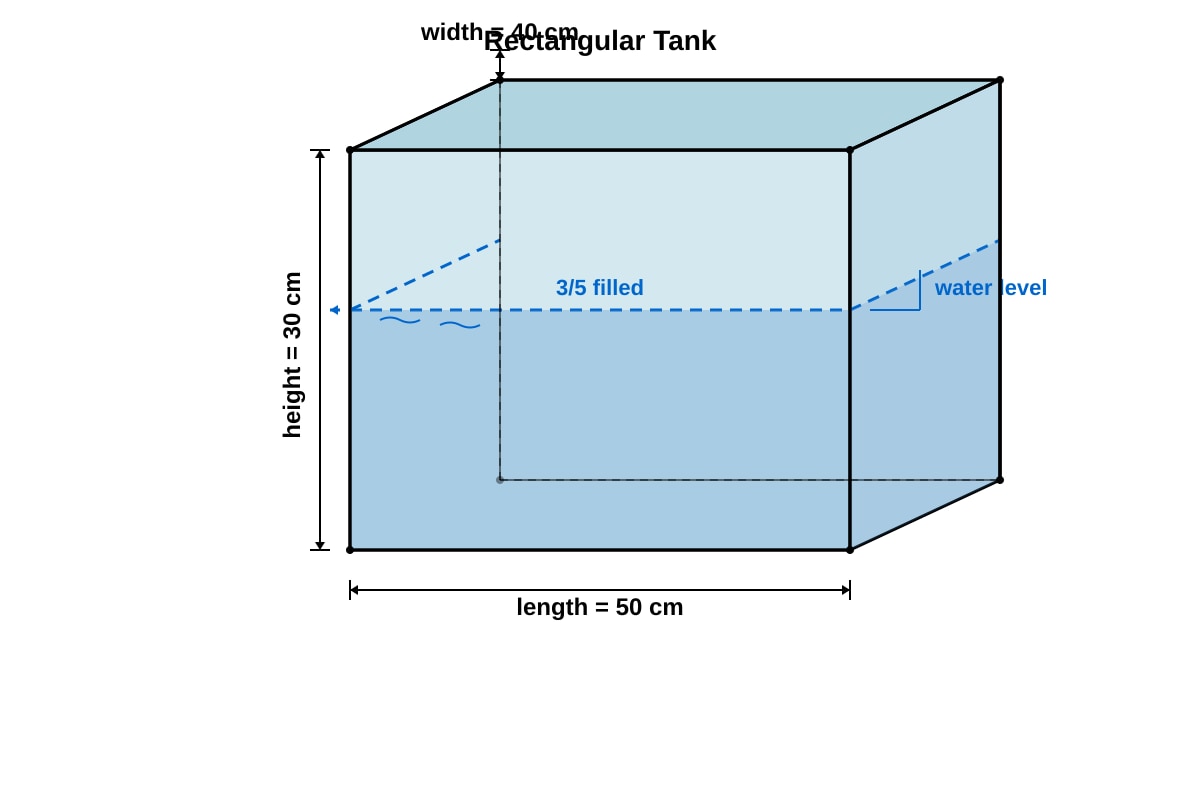
- (a) Total volume of tank = 50 cm × 40 cm × 30 cm = 60 000 cm³. Volume of water = (3/5) × 60 000 cm³ = 36 000 cm³.
- (b) Volume needed = Total volume - Volume of water = 60 000 cm³ - 36 000 cm³ = 24 000 cm³.
- Concept: To find a fraction of a volume, multiply the total volume by the fraction. The remaining volume is the total minus the filled part.
- Marking: (a) 1 mark for total volume, 1 mark for water volume. (b) 1 mark for correct method, 1 mark for correct answer.
17. Answer (a): 16 000 cm³ Answer (b): 25.2 cm (or 25 cm if using cube root of 16000)
- Working:
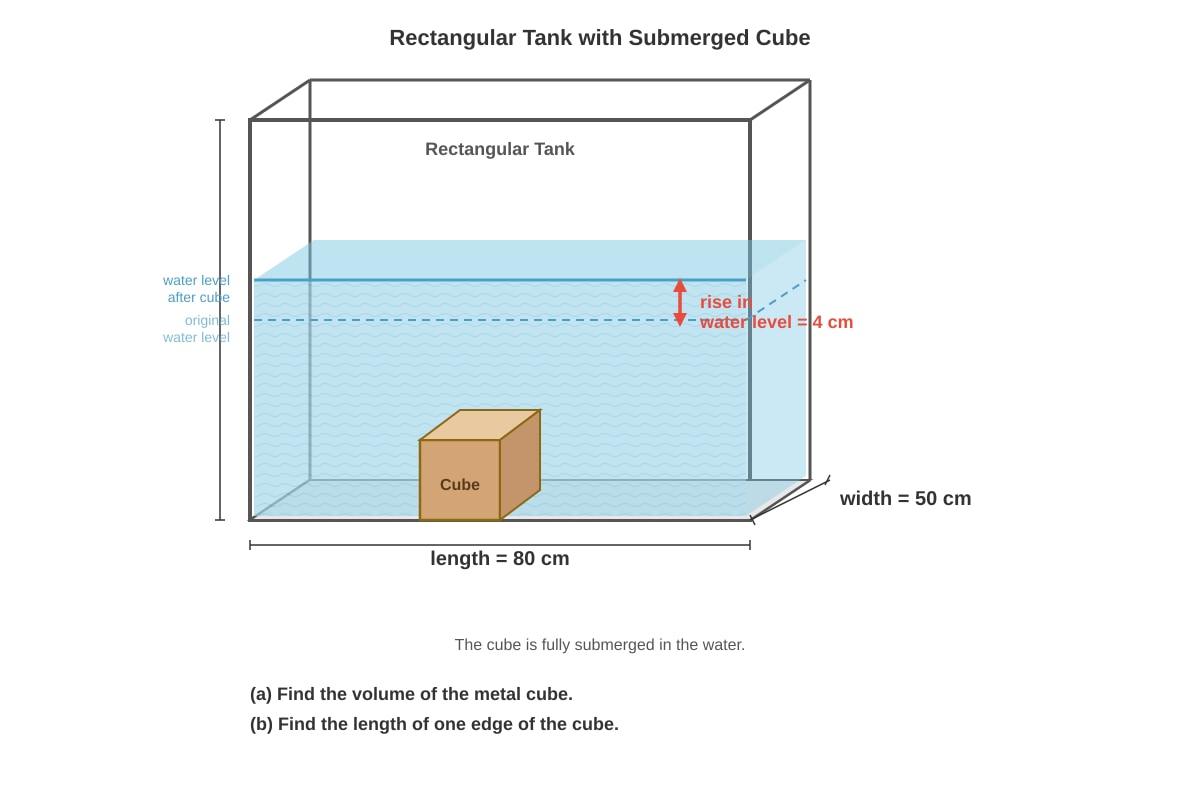
- (a) Volume of cube = Volume of water displaced = Length × Width × Rise in water level = 80 cm × 50 cm × 4 cm = 16 000 cm³.
- (b) Edge length = ∛16 000 cm³. Since 25³ = 15 625 and 26³ = 17 576, the edge length is approximately 25.2 cm. (Note: For P6, they may be expected to leave it as ∛16 000 or give a decimal approximation. The exact cube root is not a whole number.)
- Concept: When an object is submerged, it displaces a volume of water equal to its own volume. The displaced water volume is calculated as the base area of the tank multiplied by the rise in water level.
- Marking: (a) 1 mark for correct method, 1 mark for correct answer. (b) 1 mark for correct method, 1 mark for correct answer (accept ∛16 000 or 25.2 cm).
18. Answer (a): 24 000 cm³ Answer (b): 33 minutes
- Working:
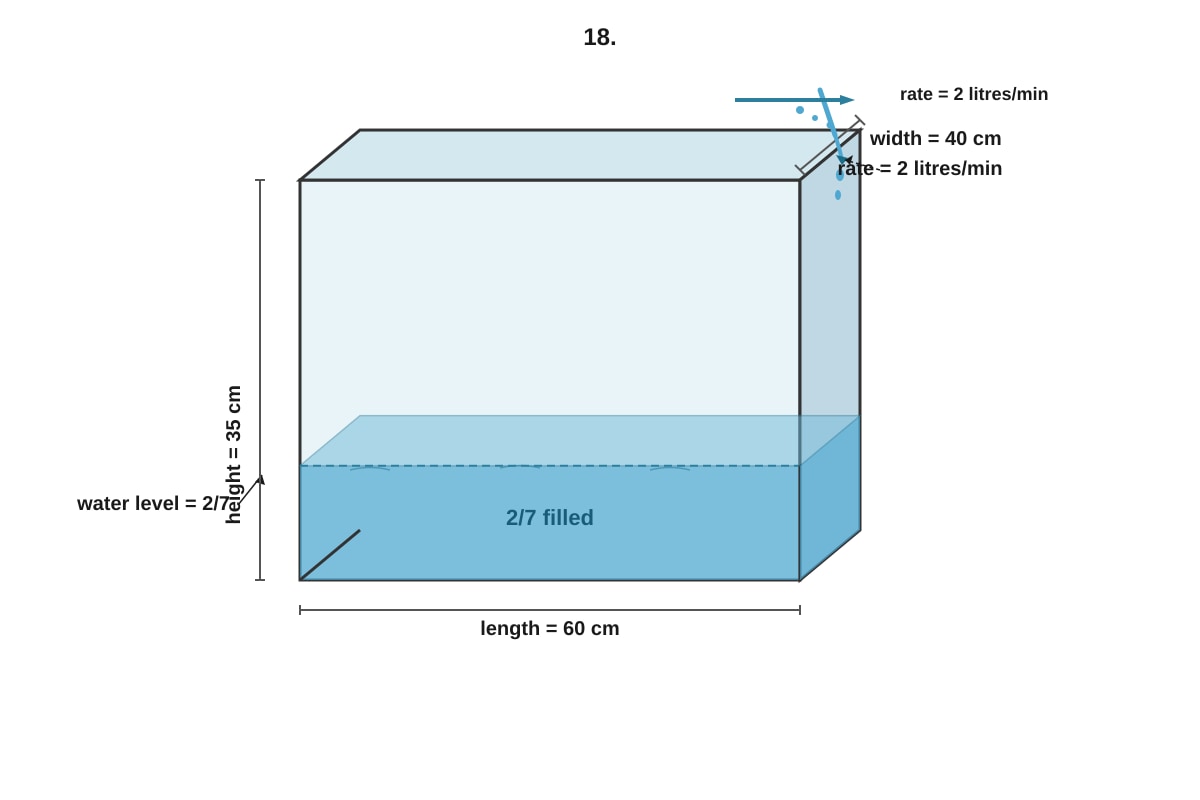
- (a) Total volume = 60 cm × 40 cm × 35 cm = 84 000 cm³. Initial water volume = (2/7) × 84 000 cm³ = 24 000 cm³.
- (b) Volume needed to fill = 84 000 cm³ - 24 000 cm³ = 60 000 cm³. Rate = 2 litres/min = 2000 cm³/min. Time = 60 000 cm³ ÷ 2000 cm³/min = 30 minutes.
- Concept: Find the remaining volume to be filled. Ensure units are consistent (convert litres to cm³). Time = Volume ÷ Rate.
- Marking: (a) 1 mark for total volume, 1 mark for initial water volume. (b) 1 mark for remaining volume and conversion, 1 mark for correct time.
19. Answer (a): 81 000 cm³ Answer (b): 81 containers
- Working:
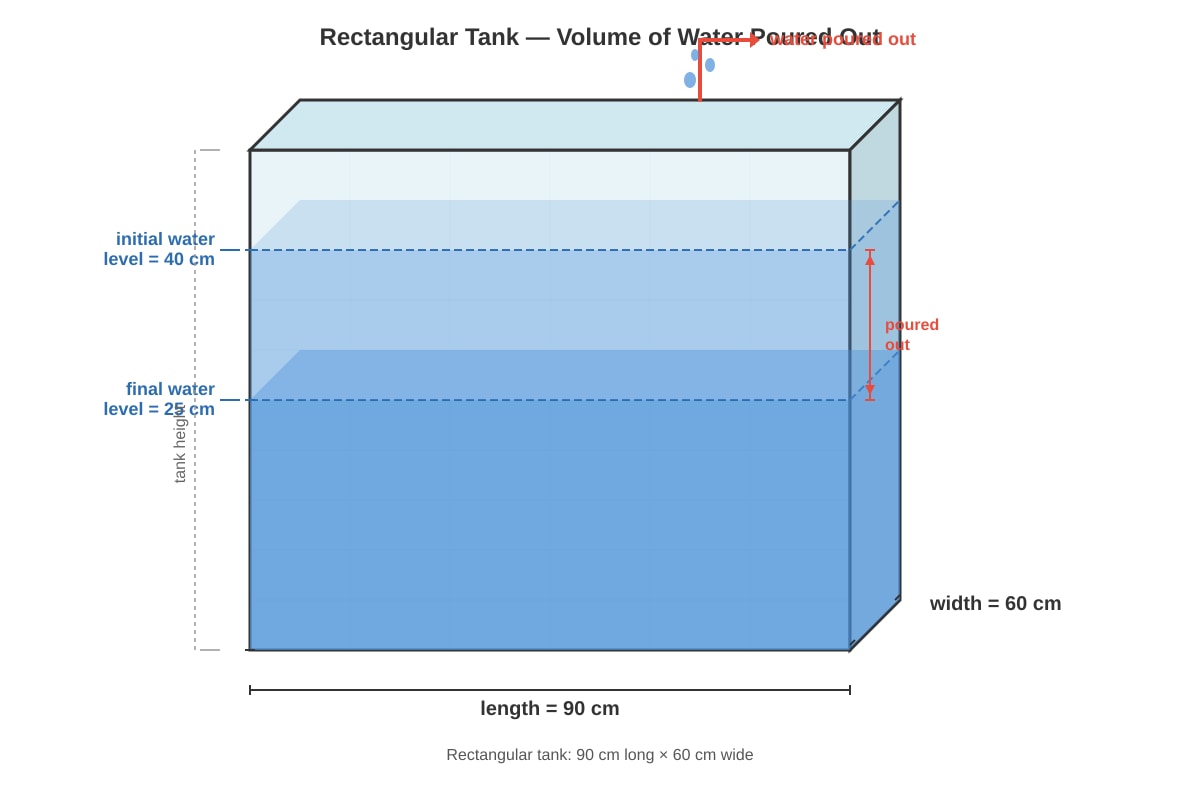
- (a) Drop in water level = 40 cm - 25 cm = 15 cm. Volume poured out = 90 cm × 60 cm × 15 cm = 81 000 cm³.
- (b) Volume of one cubical container = 10 cm × 10 cm × 10 cm = 1000 cm³. Number of containers = 81 000 cm³ ÷ 1000 cm³ = 81.
- Concept: The volume of water poured out is the volume of the "slice" of water removed. Then divide the total volume by the volume of one container.
- Marking: (a) 1 mark for drop in water level, 1 mark for volume. (b) 1 mark for volume of one container, 1 mark for correct number of containers.
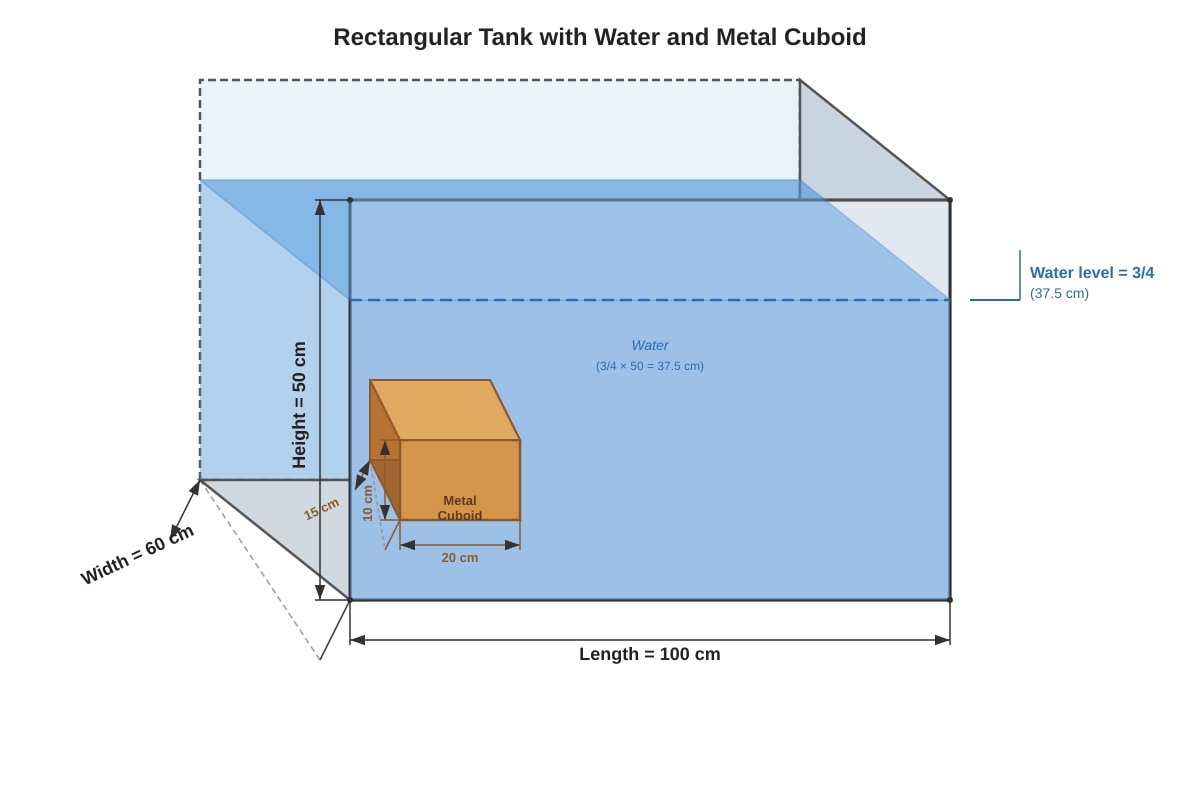
20. Answer (a): 225 000 cm³ Answer (b): 38 cm
- Working:
- (a) Total volume = 100 cm × 60 cm × 50 cm = 300 000 cm³. Initial water volume = (3/4) × 300 000 cm³ = 225 000 cm³.
- (b) Volume of metal cuboid = 20 cm × 15 cm × 10 cm = 3000 cm³. New total volume of water + cuboid = 225 000 cm³ + 3000 cm³ = 228 000 cm³. New water level height = New volume ÷ Base area of tank = 228 000 cm³ ÷ (100 cm × 60 cm) = 228 000 cm³ ÷ 6000 cm² = 38 cm.
- Concept: When an object is submerged, the water level rises because the object takes up space. The new total volume (water + object) divided by the base area gives the new height.
- Marking: (a) 1 mark for total volume, 1 mark for initial water volume. (b) 1 mark for volume of cuboid and new total volume, 1 mark for correct new height.