From Real Exams Quiz
Primary 6 PSLE Mathematics PSLE Revision Quiz
Free P6 PSLE Maths PSLE Revision quiz, Exam version, with questions, answers, and PSLE-focused practice for Singapore students.
These static practice materials are generated from the site's syllabus and paper-generation workflow, with source and model context shown so students and parents can evaluate the material before use.
Questions
Free quiz and exam paper access
Enter your details to view this paper
Your access is remembered on this device.
Answers
Answer Key: Primary 6 PSLE Mathematics Quiz - Psle Revision
Section A: Multiple-Choice Questions (10 × 2 marks = 20 marks)
1. C) 6
- Working:
- Explanation: Dividing by a fraction is the same as multiplying by its reciprocal (flip the second fraction upside down). So, becomes . Multiply the numerators (3 × 8 = 24) and the denominators (4 × 1 = 4), giving , which simplifies to 6.
- Common mistake: Some students might multiply the fractions directly without flipping, getting .
2. C) $50.00
- Working: 100% - 10% = 90%. The discounted price represents 90% of the original price. So, 90% → $45. 1% → $45 ÷ 90 = $0.50. 100% → $0.50 × 100 = $50.
- Explanation: After a 10% discount, the shirt costs 90% of its original price. Since $45 is 90% of the original, we find 1% by dividing $45 by 90, which gives $0.50. Then, multiply by 100 to find the original price (100%), which is $50.
- Common mistake: A common error is to find 10% of $45 and add it back, which gives $49.50. This is incorrect because the discount is calculated on the original price, not the discounted price.
3. D) 64
- Working: Boys : Girls = 3 : 5. 3 units = 24 boys. 1 unit = 24 ÷ 3 = 8. Total units = 3 + 5 = 8 units. Total students = 8 × 8 = 64.
- Explanation: The ratio 3 : 5 means that for every 3 boys, there are 5 girls. We can think of the class as being divided into 8 equal "units". If 3 units represent 24 boys, then 1 unit is 24 ÷ 3 = 8 students. The total number of students is 8 units × 8 students/unit = 64 students.
- Common mistake: Some students might find the number of girls (5 ×
<stage3_quiz_answers_md>
Answer Key: Primary 6 PSLE Mathematics Quiz - Psle Revision
Section A: Multiple-Choice Questions (10 × 2 marks = 20 marks)
1. C) 6
- Working:
- Explanation: Dividing by a fraction is the same as multiplying by its reciprocal (flip the second fraction upside down). So, becomes . Multiply the numerators (3 × 8 = 24) and the denominators (4 × 1 = 4), giving , which simplifies to 6.
- Common mistake: Some students might multiply the fractions directly without flipping, getting .
2. C) $50.00
- Working: 100% - 10% = 90%. The discounted price represents 90% of the original price. So, 90% → $45. 1% → $45 ÷ 90 = $0.50. 100% → $0.50 × 100 = $50.
- Explanation: After a 10% discount, the shirt costs 90% of its original price. Since $45 is 90% of the original, we find 1% by dividing $45 by 90, which gives $0.50. Then, multiply by 100 to find the original price (100%), which is $50.
- Common mistake: A common error is to find 10% of $45 and add it back, which gives $49.50. This is incorrect because the discount is calculated on the original price, not the discounted price.
3. D) 64
- Working: Boys : Girls = 3 : 5. 3 units = 24 boys. 1 unit = 24 ÷ 3 = 8. Total units = 3 + 5 = 8 units. Total students = 8 × 8 = 64.
- Explanation: The ratio 3 : 5 means that for every 3 boys, there are 5 girls. We can think of the class as being divided into 8 equal "units". If 3 units represent 24 boys, then 1 unit is 24 ÷ 3 = 8 students. The total number of students is 8 units × 8 students/unit = 64 students.
- Common mistake: Some students might find the number of girls (5 × 8 = 40) and then add it to the boys (24 + 40 = 64) correctly, but others might incorrectly add 3 + 5 = 8 and then multiply by 24, getting 192.
4. B) 8
- Working: . Subtract 7 from both sides: .
- Explanation: To solve for , we need to isolate it. Since 7 is added to , we subtract 7 from both sides of the equation to keep it balanced. This gives .
- Common mistake: Some students might add 7 to 15 instead of subtracting, getting 22.
5. C) 154 cm²
- Working: Area of circle = cm².
- Explanation: The formula for the area of a circle is , where is the radius. Substituting cm and , we get . Since , this simplifies to cm².
- Common mistake: Some students might use the circumference formula () instead, getting 44 cm. Others might forget to square the radius.
6. B) 6 cm
- Working: Volume of cuboid = length × breadth × height. So, . . cm.
- Explanation: The volume of a cuboid is found by multiplying its length, breadth, and height. We are given the volume (240 cm³), length (8 cm), and breadth (5 cm). To find the height, we divide the volume by the product of length and breadth: cm.
- Common mistake: Some students might add the dimensions instead of multiplying, or they might divide incorrectly.
7. D) 60
- Working: Average = Total ÷ Number of items. So, Total = Average × Number of items = 15 × 4 = 60.
- Explanation: The average of a set of numbers is found by dividing the total sum by the count of numbers. To find the total, we multiply the average by the count: .
- Common mistake: Some students might divide 15 by 4, getting 3.75, which is incorrect.
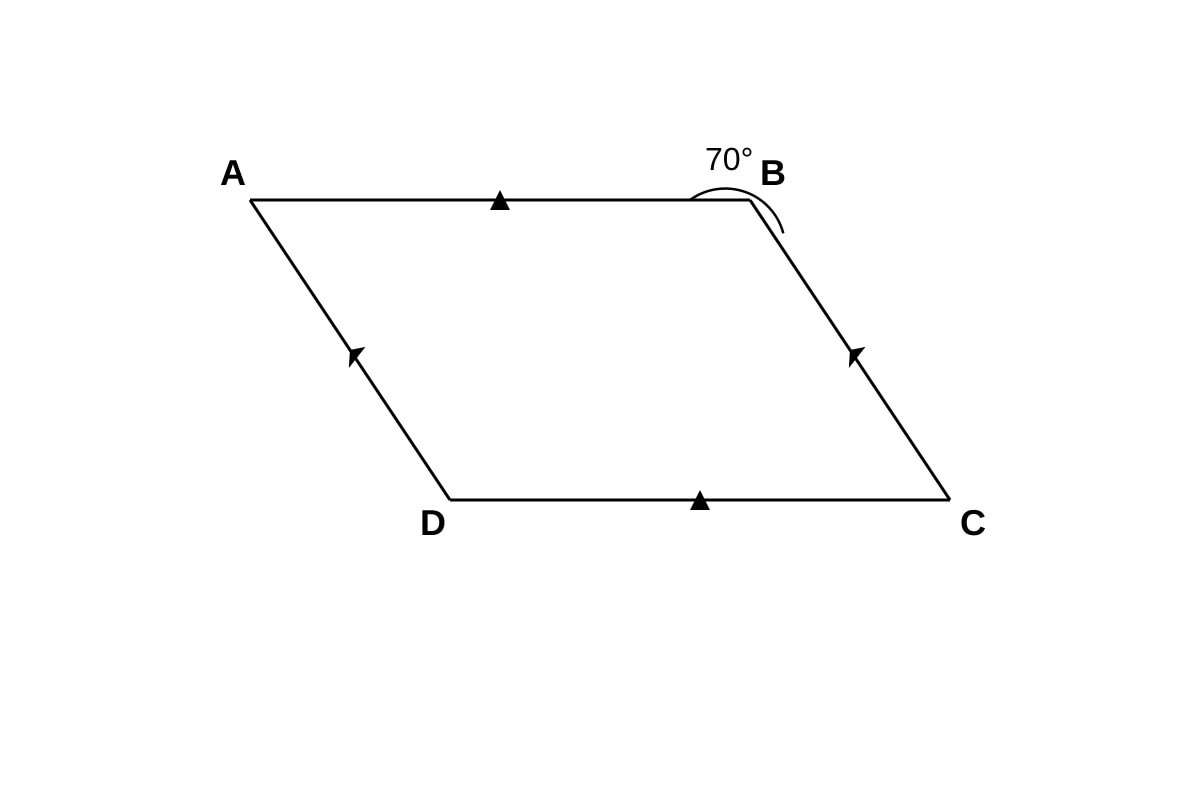
8. C) 110°
- Working: In a parallelogram, consecutive angles are supplementary (add up to 180°). So, .
- Explanation: In a parallelogram, opposite angles are equal, and adjacent (consecutive) angles are supplementary. Since and are consecutive angles (they share side BC), their sum is 180°. Therefore, .
- Common mistake: Some students might think opposite angles are supplementary, or they might assume all angles are equal.
9. B)
- Working: .
- Explanation: We combine like terms. The terms and both have the variable , so we add their coefficients: . The constant term 4 remains unchanged. Thus, the expression simplifies to .
- Common mistake: Some students might add the 4 to the coefficients, getting , or they might incorrectly combine and as .
10. B) 150 km
- Working: Distance = Speed × Time = 60 km/h × 2.5 h = 150 km.
- Explanation: The formula for distance is speed multiplied by time. Substituting the given values: km.
- Common mistake: Some students might multiply incorrectly (e.g., and forget the 0.5), or they might divide instead of multiply.
Section B: Short-Answer Questions (10 × 3 marks = 30 marks)
11. Answer:
- Working: .
- Explanation: Combine like terms by adding or subtracting their coefficients: , then . The variable remains.
- Marking: 1 mark for correct method, 2 marks for correct answer.
12. Answer: 1 : 4
- Working: Convert 1 kg to grams: 1 kg = 1000 g. Ratio = 250 g : 1000 g. Divide both by 250: 250 ÷ 250 = 1, 1000 ÷ 250 = 4. So, the ratio is 1 : 4.
- Explanation: To simplify a ratio, both quantities must be in the same unit. Since 1 kg = 1000 g, the ratio becomes 250 : 1000. Dividing both sides by their greatest common factor (250) gives 1 : 4.
- Marking: 1 mark for converting units, 2 marks for correct simplified ratio.
13. Answer: 44 cm
- Working: Circumference = diameter = cm.
- Explanation: The circumference of a circle is calculated using the formula , where is the diameter. Substituting cm and , we get cm.
- Marking: 1 mark for correct formula, 2 marks for correct answer.
14. Answer: 36,000 cm³ (or 36 litres)
- Working: Volume of tank = 50 × 40 × 30 = 60,000 cm³. Water volume = cm³.
- Explanation: First, find the total volume of the tank by multiplying its dimensions: cm³. Since the tank is filled, the water volume is of the total: cm³. (Note: 1 litre = 1000 cm³, so this is 36 litres.)
- Marking: 1 mark for total volume, 1 mark for fraction multiplication, 1 mark for correct answer.
15. Answer:
- Working: . Add 6 to both sides: . Divide both sides by 4: .
- Explanation: To solve for , first isolate the term with by adding 6 to both sides: . Then, divide both sides by 4 to get .
- Marking: 1 mark for adding 6, 1 mark for dividing by 4, 1 mark for correct answer.
16. Answer: $24
- Working: Ratio Ahmad : Bala = 2 : 5. Difference in units = 5 - 2 = 3 units. 3 units = $36. 1 unit = $36 ÷ 3 = $12. Ahmad's money = 2 units = 2 × $12 = $24.
- Explanation: The difference in the ratio parts (5 - 2 = 3) corresponds to the actual difference of $36. So, 1 unit = $36 ÷ 3 = $12. Ahmad has 2 units, so he has 2 × $12 = $24.
- Marking: 1 mark for finding the difference in units, 1 mark for finding 1 unit, 1 mark for correct answer.
17. Answer: 48
- Working: Let the original number be . After a 25% increase, the new number is . So, . .
- Explanation: A 25% increase means the new number is 125% of the original. So, original = 60. Dividing both sides by 1.25 gives the original number: .
- Marking: 1 mark for setting up the equation, 1 mark for correct division, 1 mark for correct answer.
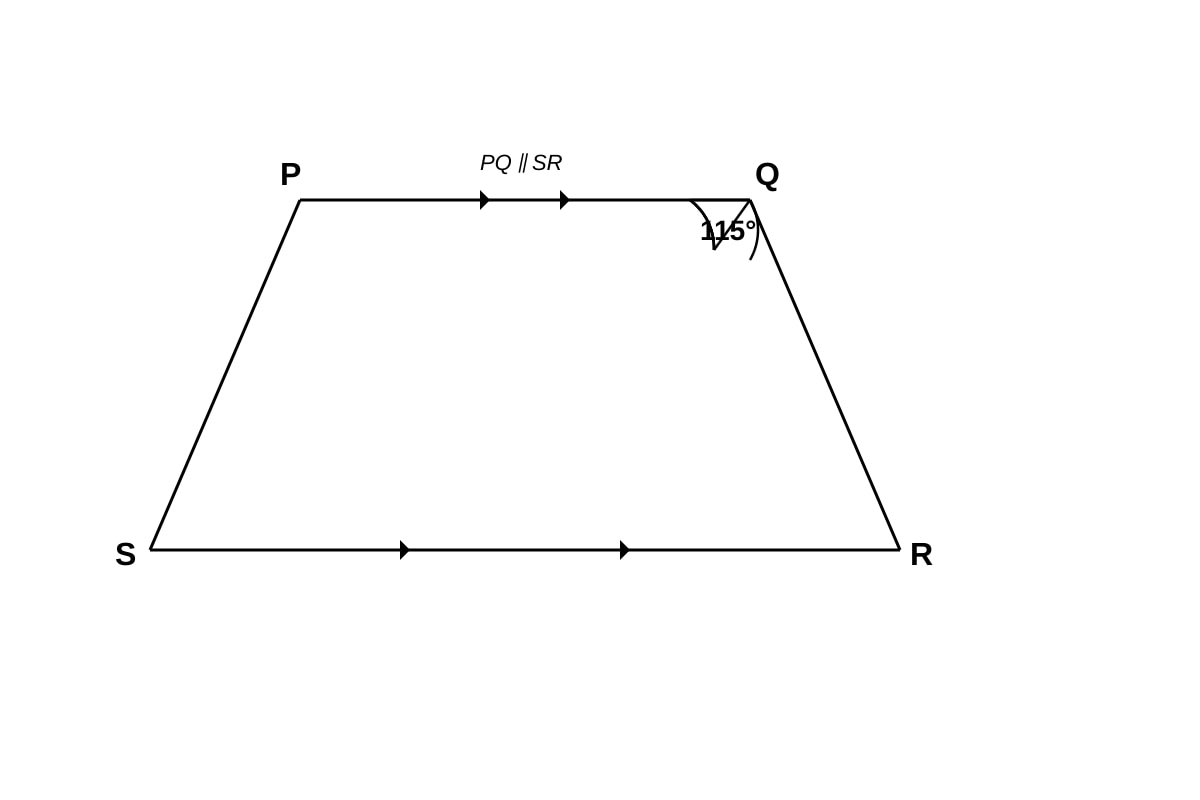
18. Answer: 65°
- Working: In a trapezium, angles on the same side of a leg are supplementary. So, . Therefore, .
- Explanation: Since is parallel to , the line is a transversal. The interior angles on the same side of the transversal ( and ) are supplementary (sum to 180°). Thus, .
- Marking: 1 mark for identifying supplementary angles, 1 mark for correct subtraction, 1 mark for correct answer.
19. Answer: 10
- Working: Total of 5 numbers = 5 × 12 = 60. Total of remaining 4 numbers = 60 - 20 = 40. Average of remaining 4 = 40 ÷ 4 = 10.
- Explanation: The average of 5 numbers is 12, so their total is . If one number is 20, the sum of the other 4 is . The average of these 4 numbers is .
- Marking: 1 mark for total of 5 numbers, 1 mark for total of remaining 4, 1 mark for correct average.
20. Answer: 875 m²
- Working: Perimeter = 2 × (length + breadth). So, 120 = 2 × (35 + breadth). 60 = 35 + breadth. Breadth = 60 - 35 = 25 m. Area = length × breadth = 35 × 25 = 875 m².
- Explanation: The perimeter of a rectangle is . Given the perimeter (120 m) and length (35 m), we first find the breadth: , so , giving m. Then, the area is m².
- Marking: 1 mark for finding breadth, 1 mark for area formula, 1 mark for correct answer.
END OF ANSWER KEY