From Real Exams Quiz
Primary 6 PSLE Mathematics PSLE Revision Quiz
Free P6 PSLE Maths PSLE Revision quiz, Exam version, with questions, answers, and PSLE-focused practice for Singapore students.
These static practice materials are generated from the site's syllabus and paper-generation workflow, with source and model context shown so students and parents can evaluate the material before use.
Questions
Free quiz and exam paper access
Enter your details to view this paper
Your access is remembered on this device.
Answers
Answer Key: Primary 6 PSLE Mathematics Quiz - Psle Revision
Total Marks: 60
Section A: Multiple-Choice Questions (10 marks)
1. Answer: D) (2 marks)
- Working: Flour used for cakes = . Remaining = . Flour used for cookies = . Total flour used = . Flour left = .
- Teaching Note: This is a "fraction of remainder" problem. The key is to track the remaining amount after each step. The second fraction () applies to the remainder after the first use, not the original whole. A common mistake is to add the fractions directly (), which is incorrect because they refer to different wholes.
- Marking: 2 marks for correct answer. 1 mark for correct method but arithmetic error.
2. Answer: C) 1440 (2 marks)
- Working: Ratio difference = 7 - 5 = 2 parts. 2 parts = 240 students. 1 part = 240 ÷ 2 = 120 students. Total parts = 5 + 7 = 12 parts. Total students = 12 × 120 = 1440.
- Teaching Note: In ratio problems, the difference between the parts corresponds to the actual difference given. Find the value of one part first, then multiply by the total number of parts.
- Marking: 2 marks for correct answer. 1 mark for correct method but arithmetic error.
3. Answer: C) $51 (2 marks)
- Working: Discount = 15% of \frac{15}{100} \times 60 = $960 - 51.
- Teaching Note: "15% discount" means you pay 100% - 15% = 85% of the original price. Alternatively, sale price = 85% × 60 = $51. Both methods are correct.
- Marking: 2 marks for correct answer. 1 mark for correct method but arithmetic error.
4. Answer: B) 14 cm (2 marks)
- Working: Circumference = . . . cm.
- Teaching Note: Remember the formula for circumference: . To find the radius from the circumference, divide the circumference by .
- Marking: 2 marks for correct answer. 1 mark for correct method but arithmetic error.
5. Answer: B) 45 000 cm³ (2 marks)
- Working: Volume of tank = cm³. Volume of water = cm³.
- Teaching Note: First find the total volume of the tank using . Then multiply by the fraction that is filled.
- Marking: 2 marks for correct answer. 1 mark for correct method but arithmetic error.
Section B: Short-Answer Questions (30 marks)
6. Answer: (3 marks)
- Working: Group like terms: and . So the simplified expression is .
- Teaching Note: "Like terms" have the same variable part. You can only add or subtract coefficients of like terms. and are like terms (both have ). and are like terms (both have ).
- Marking: 3 marks for correct answer. 2 marks for correct grouping but one sign error. 1 mark for attempting to group like terms.
7. Answer: (3 marks)
- Working: . Subtract 7 from both sides: . Divide both sides by 3: .
- Teaching Note: To solve an equation, isolate the variable by performing inverse operations. Addition and subtraction are inverse operations; multiplication and division are inverse operations. Always perform the same operation on both sides of the equation to maintain balance.
- Marking: 3 marks for correct answer. 2 marks for correct method but arithmetic error. 1 mark for attempting to isolate .
8. Answer: 4 km (3 marks)
- Working: Scale 1 : 50 000 means 1 cm on map = 50 000 cm in real life. Actual distance = cm. Convert to km: km.
- Teaching Note: Remember the conversion: 1 km = 1000 m = 100 000 cm. When converting from cm to km, divide by 100 000.
- Marking: 3 marks for correct answer. 2 marks for correct method but unit conversion error. 1 mark for attempting to use the scale.
9. Answer: 30 kg (3 marks)
- Working: Total mass of 5 children = kg. Total mass of 6 children = kg. Mass of sixth child = kg.
- Teaching Note: The average is the total divided by the number of items. To find the total, multiply the average by the number of items. The difference in totals gives the value of the new item.
- Marking: 3 marks for correct answer. 2 marks for correct method but arithmetic error. 1 mark for attempting to find totals.
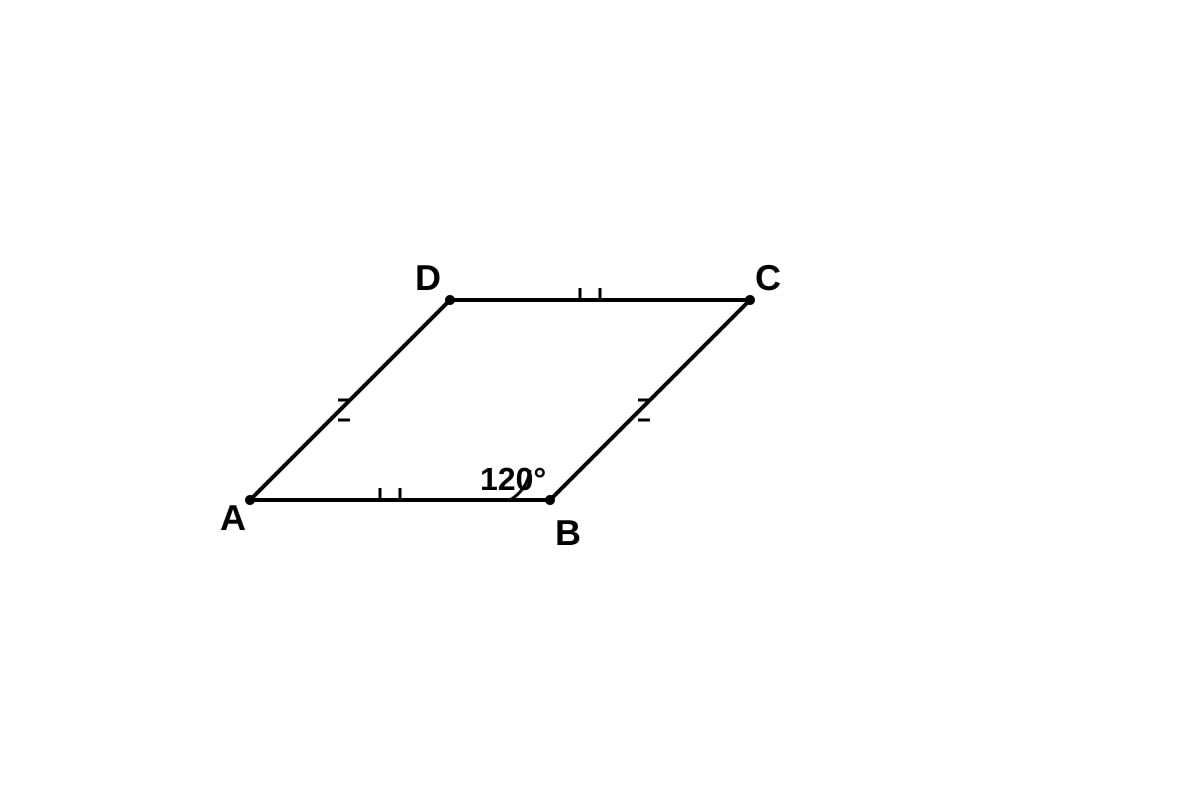
10. Answer: 60° (3 marks)
- Working: In a parallelogram, adjacent angles are supplementary (add up to 180°). Angle ABC + angle BCD = 180°. So angle BCD = 180° - 120° = 60°.
- Teaching Note: Key properties of a parallelogram: (1) Opposite sides are parallel. (2) Opposite angles are equal. (3) Adjacent angles are supplementary (sum to 180°). Here, angles ABC and BCD are adjacent, so they sum to 180°.
- Marking: 3 marks for correct answer. 2 marks for correct method but arithmetic error. 1 mark for stating a relevant property.
11. Answer: $12.50 (3 marks)
- Working: Cost of 1 pen = \frac{2.50}{3}15 \times \frac{2.50}{3} = 5 \times 2.50 = $12.50$.
- Teaching Note: Find the unit cost first (cost per pen), then multiply by the required quantity. Alternatively, find how many groups of 3 pens are in 15 pens (15 ÷ 3 = 5 groups), then multiply the cost per group by the number of groups.
- Marking: 3 marks for correct answer. 2 marks for correct method but arithmetic error. 1 mark for attempting to find unit cost.
12. Answer: 13 (3 marks)
- Working: Let the number be . . .
- Teaching Note: This is a simple algebraic equation. The inverse of multiplication is division. To find the unknown number, divide the product by the known factor.
- Marking: 3 marks for correct answer. 2 marks for correct method but arithmetic error.
13. Answer: 35% (3 marks)
- Working: .
- Teaching Note: To convert a fraction to a percentage, find an equivalent fraction with a denominator of 100. Alternatively, divide the numerator by the denominator and multiply by 100: .
- Marking: 3 marks for correct answer. 2 marks for correct method but arithmetic error.
14. Answer: 6 cm (3 marks)
- Working: Volume of cuboid = base area × height. . cm.
- Teaching Note: The volume of a cuboid is . Since base area = , we can also write . To find the height, divide the volume by the base area.
- Marking: 3 marks for correct answer. 2 marks for correct method but arithmetic error. 1 mark for stating the formula.
15. Answer: 50 years old (3 marks)
- Working: Let Ali's age be and Ben's age be . In 10 years: Ali's age = , Ben's age = . Ratio is 2 : 3, so . Cross-multiply: . . . . Ben's age now = years old.
- Teaching Note: When dealing with "future age" ratio problems, represent the current ages using the given ratio and a common multiplier (). Then add the number of years to each age to form the new ratio. Solve the resulting equation.
- Marking: 3 marks for correct answer. 2 marks for correct equation setup but arithmetic error. 1 mark for attempting to set up the equation.
Section C: Problem-Solving Questions (20 marks)
16. Answer: 54 apples (4 marks)
- Working: Let the original number of apples be and oranges be . After buying more: apples = , oranges = . New ratio: . Cross-multiply: . . . . Original apples = .
- Teaching Note: This is a ratio transformation problem. Use a common multiplier () to represent the original quantities. Then add the changes and set up the new ratio as an equation. Solve for to find the original amounts.
- Marking: 4 marks for correct answer with clear working. 3 marks for correct method but arithmetic error. 2 marks for correct equation setup. 1 mark for attempting to use algebra.
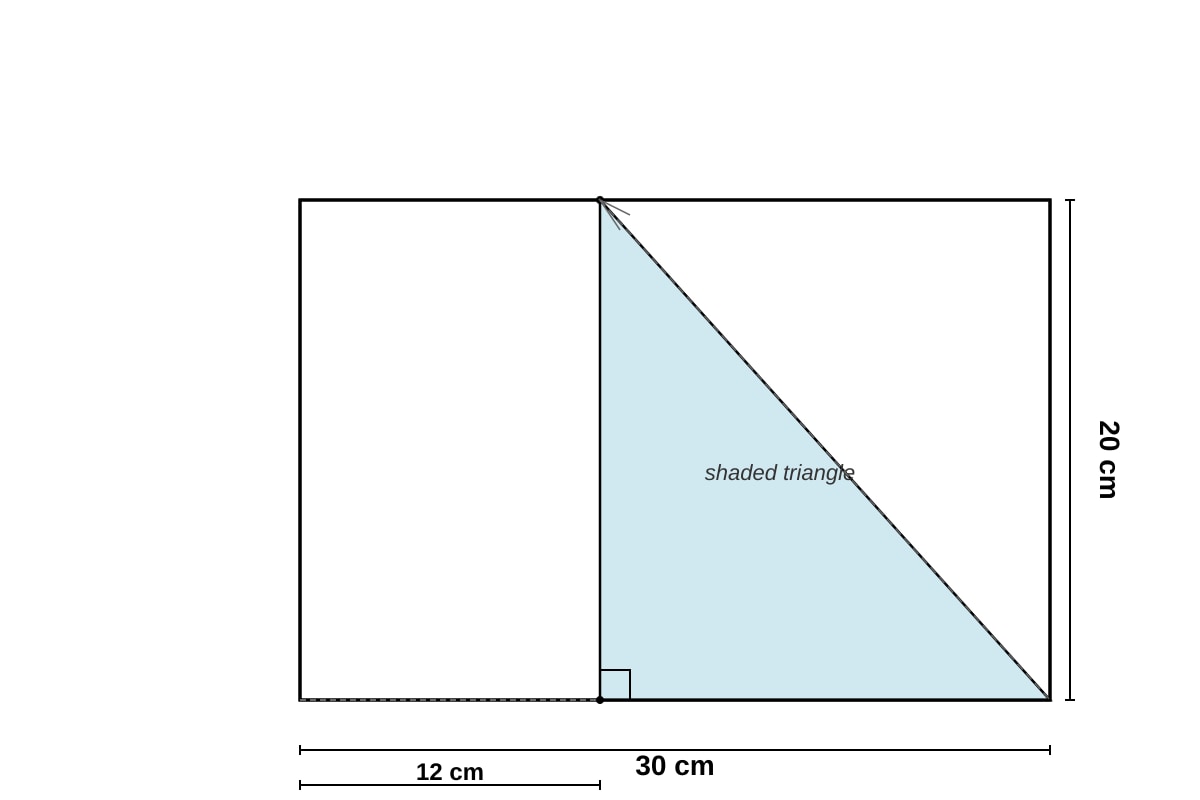
17. Answer: 120 cm² (4 marks)
- Working: The triangle has a base of 12 cm (given) and a height equal to the height of the rectangle, which is 20 cm. Area of triangle = cm².
- Teaching Note: The area of a triangle is half the product of its base and height. The height is the perpendicular distance from the base to the opposite vertex. In this case, the height of the triangle is the same as the height of the rectangle because the apex touches the top edge.
- Marking: 4 marks for correct answer with clear working. 3 marks for correct method but arithmetic error. 2 marks for identifying base and height correctly. 1 mark for stating the area formula.
18. Answer: 12 friends (4 marks)
- Working: Let the number of friends be and the cost per person be . Total cost = . If 4 more friends: . If 3 fewer friends: . Expand first equation: (Equation 1) Expand second equation: (Equation 2) Multiply Equation 1 by 3: Multiply Equation 2 by 4: Add the two equations: .
- Teaching Note: This is a challenging simultaneous equation problem. The key insight is that the total cost remains the same regardless of the number of friends. Set up two equations based on the given conditions and solve them simultaneously.
- Marking: 4 marks for correct answer with clear working. 3 marks for correct equations but arithmetic error. 2 marks for setting up one correct equation. 1 mark for attempting to use algebra.
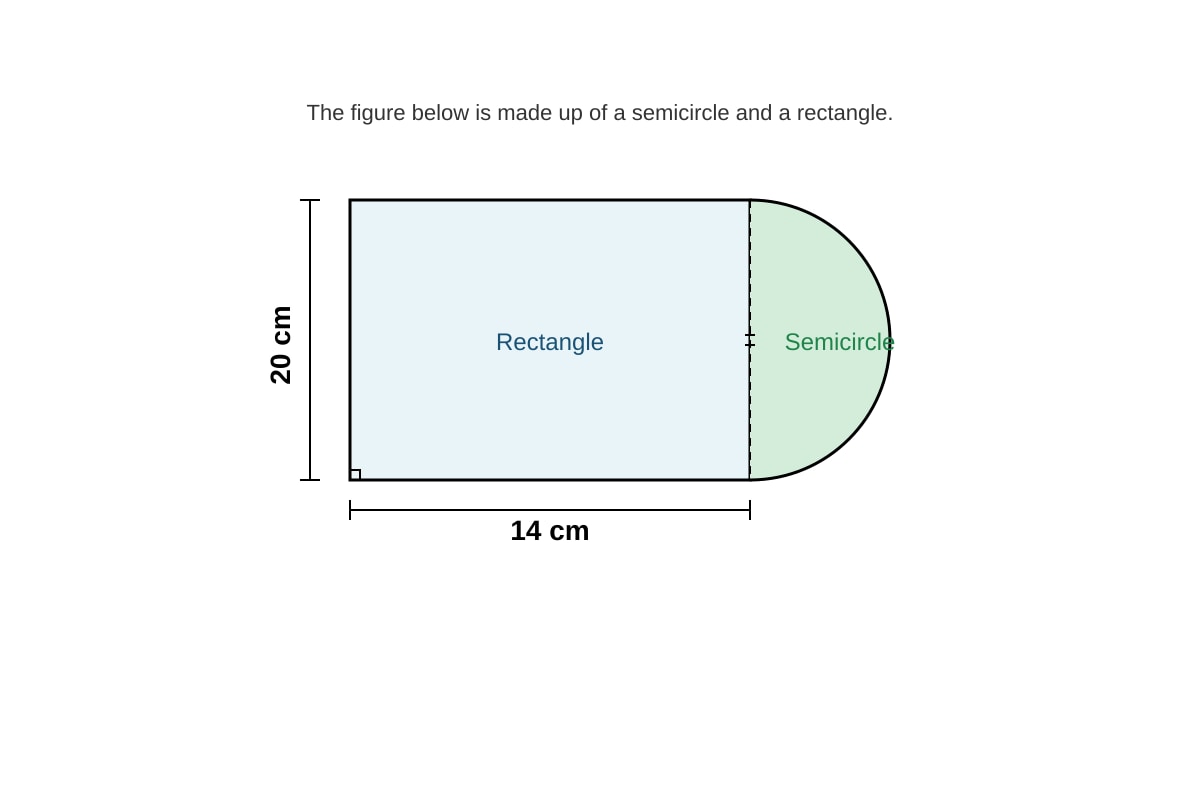
19. Answer: 78 cm (4 marks)
- Working: The perimeter consists of the curved part of the semicircle and three sides of the rectangle (the side with the semicircle is not included). Curved part of semicircle = cm. Rectangle sides: two lengths (20 cm each) and one width (14 cm) = cm. Total perimeter = cm.
- Teaching Note: When finding the perimeter of a composite figure, carefully identify which sides are on the outside of the figure. The side where the semicircle is attached to the rectangle is not part of the perimeter because it is inside the figure.
- Marking: 4 marks for correct answer with clear working. 3 marks for correct method but arithmetic error. 2 marks for correctly calculating the semicircle arc length. 1 mark for attempting to find the perimeter.
20. Answer: 11 00 (4 marks)
- Working: Train A starts at 08 30. By 09 00, it has travelled for 30 minutes (0.5 hours). Distance covered by Train A by 09 00 = km. Remaining distance between the trains at 09 00 = km. Combined speed of both trains = km/h. Time to meet after 09 00 = hours = 2 hours 13.33 minutes. Meeting time = 09 00 + 2 hours 13 minutes = 11 13.
- Teaching Note: This is a speed-distance-time problem with a staggered start. First, calculate the head start of the first train. Then, find the remaining distance and the combined speed of both trains. The time to meet is the remaining distance divided by the combined speed. Add this time to the later start time.
- Marking: 4 marks for correct answer with clear working. 3 marks for correct method but arithmetic error. 2 marks for calculating the head start correctly. 1 mark for attempting to use the speed-distance-time formula.
End of Answer Key