From Real Exams Quiz
Primary 6 PSLE Mathematics Problem Solving Heuristics Quiz
Free P6 PSLE Maths Problem Solving Heuristics quiz, Exam version, with questions, answers, and PSLE-focused practice for Singapore students.
These static practice materials are generated from the site's syllabus and paper-generation workflow, with source and model context shown so students and parents can evaluate the material before use.
Questions
Free quiz and exam paper access
Enter your details to view this paper
Your access is remembered on this device.
Answers
Answer Key: Primary 6 PSLE Mathematics Quiz - Problem Solving Heuristics
Total Marks: 50
Section A: Short Answer Questions (Questions 1 to 10)
(2 marks each)
1. Answer: 100 eggs
Working:
- Eggs used for cakes: eggs
- Remainder after cakes: eggs
- Eggs used for cookies: eggs
- Eggs left: eggs
Teaching Note: This is a "fraction of remainder" problem. Always find the remainder after the first fraction before applying the second fraction. A common mistake is to calculate of the original 240 eggs instead of the remainder.
Marking: 1 mark for correct method, 1 mark for correct answer.
2. Answer: 480 students
Working:
- Ratio difference: units
- 2 units = 120 students
- 1 unit = students
- Total units: units
- Total students: students
Teaching Note: In ratio problems, the difference between the parts corresponds to the difference in actual amounts. Find the value of 1 unit first, then multiply by the total number of units.
Marking: 1 mark for finding 1 unit, 1 mark for correct total.
3. Answer: $57.50
Working:
- Profit amount: 15\% \times 50 = 0.15 \times 50 = \7.50$
- Selling price: 50 + 7.50 = \57.50$
Teaching Note: Profit percentage is calculated on the cost price. Selling price = Cost price + Profit. Alternatively, selling price = of cost price. So, 1.15 \times 50 = \57.50$.
Marking: 1 mark for correct profit amount, 1 mark for correct selling price.
4. Answer: 6000 cm³
Working:
- Volume of tank: cm³
- Volume of water: cm³
Teaching Note: Volume of a cuboid = length × width × height. To find a fraction of a volume, multiply the total volume by the fraction.
Marking: 1 mark for correct total volume, 1 mark for correct water volume.
5. Answer: 60°
Working:
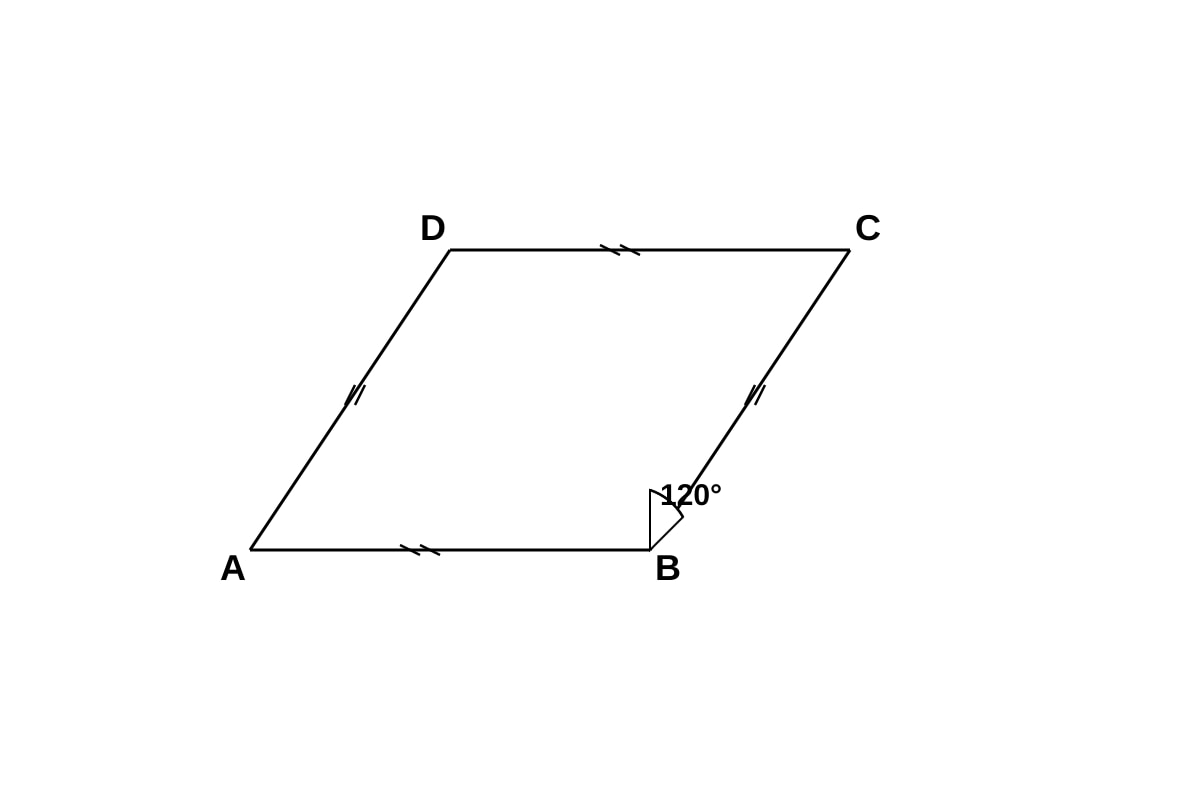
- In a parallelogram, adjacent angles are supplementary (sum to 180°).
- Angle ABC + angle BCD = 180°
- 120° + angle BCD = 180°
- Angle BCD = 180° - 120° = 60°
Teaching Note: Properties of a parallelogram: opposite sides are parallel, opposite angles are equal, adjacent angles are supplementary (add up to 180°). Here, angle ABC and angle BCD are adjacent angles.
Marking: 1 mark for stating adjacent angles sum to 180°, 1 mark for correct answer.
6. Answer: 2.5 hours (or 2 hours 30 minutes)
Working:
- Time = Distance ÷ Speed
- Time = hours
Teaching Note: Use the formula: Distance = Speed × Time. Rearranging: Time = Distance ÷ Speed. 2.5 hours = 2 hours 30 minutes.
Marking: 1 mark for correct formula/operation, 1 mark for correct answer.
7. Answer:
Working:
- Group like terms:
- Simplify:
Teaching Note: In algebra, only like terms (terms with the same variable) can be added or subtracted. and .
Marking: 1 mark for correct grouping, 1 mark for correct simplified expression.
8. Answer: 16
Working:
- Total of 4 numbers:
- Sum of three known numbers:
- Fourth number:
Teaching Note: Average = Total ÷ Number of items. So Total = Average × Number of items. Find the total first, then subtract the known values to find the unknown.
Marking: 1 mark for correct total, 1 mark for correct fourth number.
9. Answer: 30 cm
Working:
- Length of each piece in metres: m
- Convert to cm: cm
Teaching Note: When dividing a length into equal parts, divide the total length by the number of parts. Remember to convert units: 1 m = 100 cm.
Marking: 1 mark for correct division, 1 mark for correct conversion to cm.
10. Answer: 16 boys
Working:
- Number of girls: girls
- Number of boys: boys
Teaching Note: Percentage of boys = 100% - 60% = 40%. Alternatively, number of boys = 40% of 40 = 0.4 × 40 = 16.
Marking: 1 mark for correct number of girls, 1 mark for correct number of boys.
Section B: Structured Questions (Questions 11 to 15)
(4 marks each)
11. Answer: 200 apples
Working: Let the number of apples at first be and oranges be .
- ... (1)
- Apples sold: , apples left:
- Oranges sold: , oranges left:
- ... (2)
- Multiply (2) by 20: ... (3)
- Multiply (1) by 12: ... (4)
- Subtract (4) from (3): , so
Alternative method (model drawing):
- Draw models for apples and oranges.
- Apples: 5 units (2 sold, 3 left)
- Oranges: 4 units (1 sold, 3 left)
- Total: 5 units + 4 units = 9 units = 360, so 1 unit = 40
- Apples at first: 5 × 40 = 200
Teaching Note: This problem can be solved using algebra or model drawing. The key is to correctly express the remaining quantities after selling fractions.
Marking:
- 1 mark for setting up equations or model
- 1 mark for correct method to find one unknown
- 1 mark for correct calculation
- 1 mark for correct final answer
12. Answer: 175 stamps
Working: Let Ali's stamps be and Ben's stamps be at first.
- After transfer: Ali has , Ben has
- New ratio:
- Ben's stamps at first:
- Ben's stamps in the end:
Teaching Note: When a ratio changes after a transfer, set up an equation using the new ratio. The total number of stamps remains the same. Check: Total = 3×15 + 7×15 = 45 + 105 = 150. After transfer: Ali has 25, Ben has 125. Ratio 25:125 = 1:5. ✓
Marking:
- 1 mark for expressing initial amounts in units
- 1 mark for setting up the ratio equation
- 1 mark for solving for u
- 1 mark for correct final answer
13. Answer: 3080 cm³
Working:
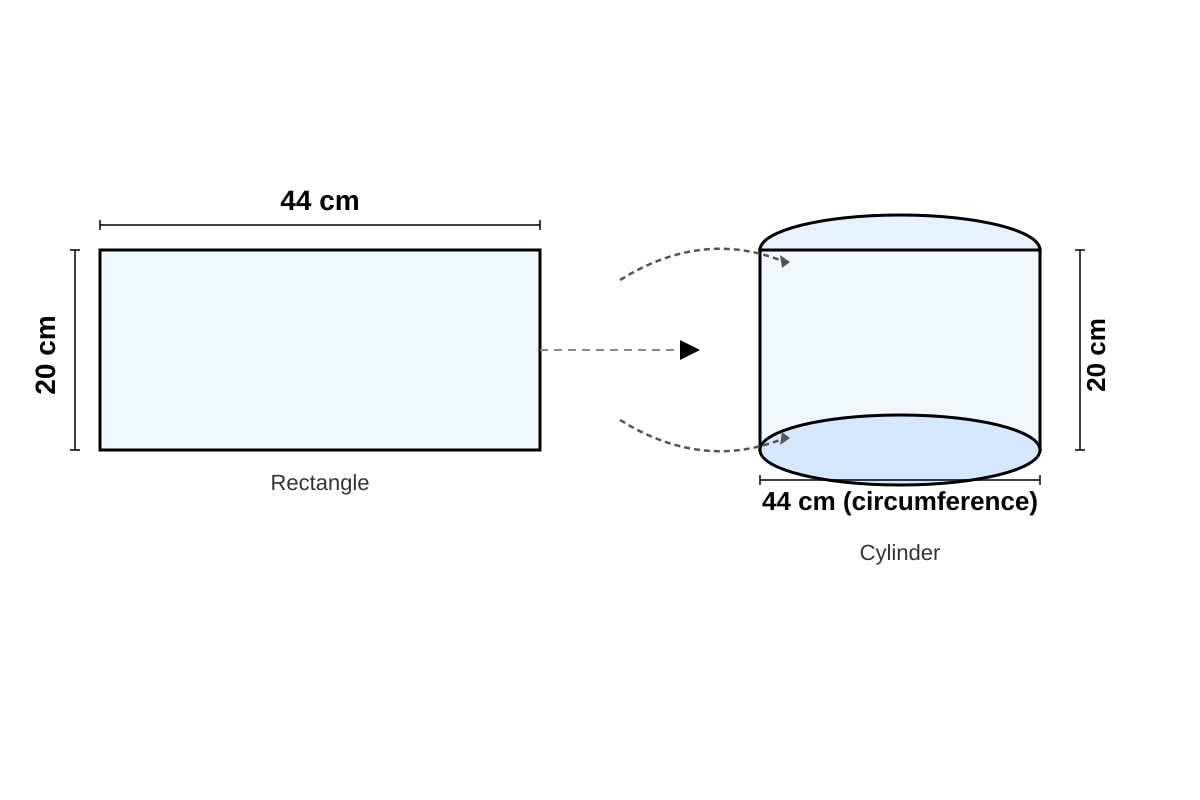
- Circumference of base = 44 cm
- cm
- Height of cylinder = 20 cm
- Volume =
- Volume = cm³
Teaching Note: When a rectangle is folded into a cylinder, the length becomes the circumference and the width becomes the height. Use the circumference to find the radius, then calculate the volume.
Marking:
- 1 mark for finding radius from circumference
- 1 mark for correct formula for volume
- 1 mark for correct substitution
- 1 mark for correct final answer
14. Answer: 3 pens
Working: Let the number of pens be and pencils be .
- ... (1)
- ... (2)
- Multiply (1) by 1.5: ... (3)
- Subtract (3) from (2):
Alternative method (guess and check):
- Try 5 pens (10 pens? No, total items is 15)
- If 5 pens: 5×2 + 10×1.5 = 10 + 15 = 25 (too high)
- If 3 pens: 3×2 + 12×1.5 = 6 + 18 = 24 ✓
Teaching Note: This is a "two unknowns, two conditions" problem. Use algebra or systematic guess and check. The total number of items and total cost give two equations.
Marking:
- 1 mark for setting up equations
- 1 mark for correct method to eliminate one variable
- 1 mark for correct calculation
- 1 mark for correct final answer
15. Answer: 64 cm
Working:
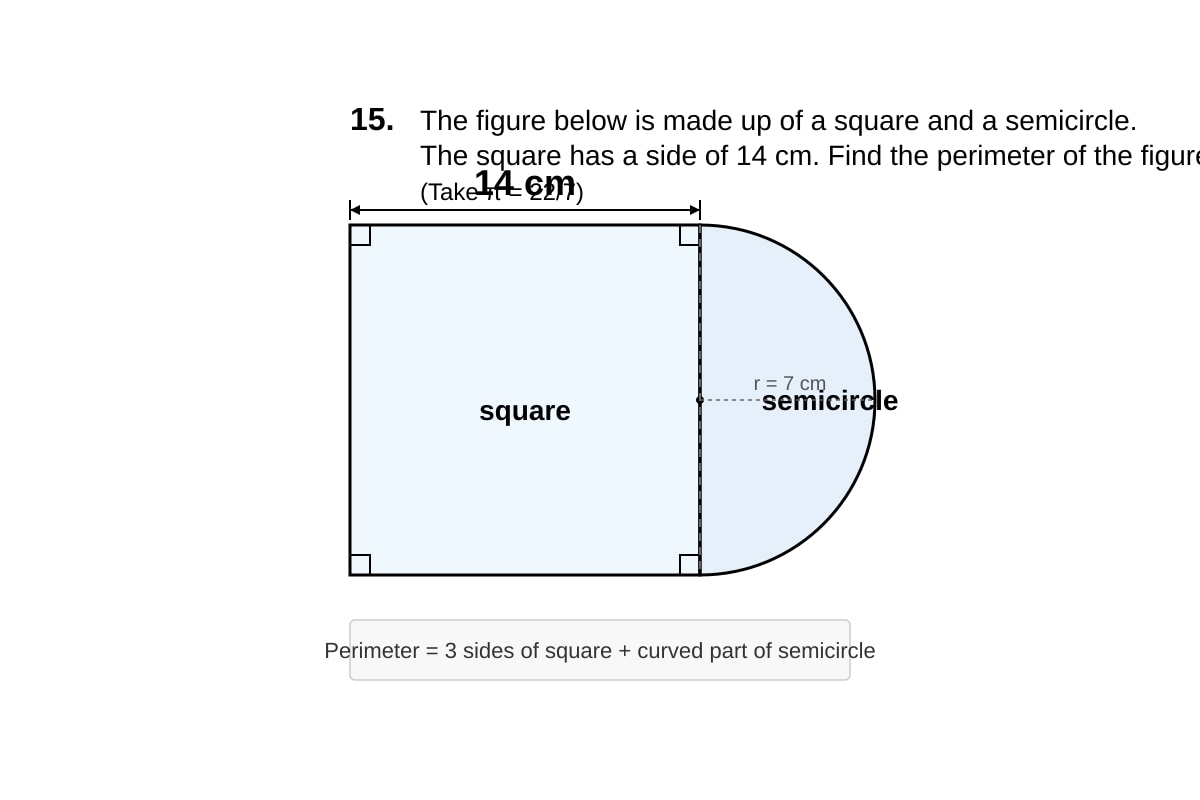
- Perimeter consists of 3 sides of the square and the curved part of the semicircle.
- Three sides of square: cm
- Circumference of full circle: cm
- Curved part of semicircle: cm
- Total perimeter: cm
Teaching Note: The perimeter of a composite figure is the total distance around the outside. Do not include the side where the semicircle meets the square as it is inside the figure. The curved part of a semicircle is half the circumference of a full circle.
Marking:
- 1 mark for identifying the parts of the perimeter
- 1 mark for correct calculation of square sides
- 1 mark for correct calculation of semicircle arc
- 1 mark for correct total perimeter
Section C: Problem Solving (Questions 16 to 20)
(5 marks each)
16. Answer: 120 loaves
Working: Let the total number of loaves be .
- Loaves sold in morning:
- Remainder after morning:
- Loaves sold in afternoon:
- Loaves left:
Alternative method (working backwards):
- Afternoon: sold of remainder, so of remainder = 36
- Remainder after morning:
- Morning: sold , so of total = 48
- Total:
Teaching Note: This is a multi-step fraction problem. Working backwards is often easier: start from the final amount and reverse each operation. When working backwards, divide by the fraction that remains (not the fraction that was taken).
Marking:
- 1 mark for correct expression of fractions
- 1 mark for correct method (algebra or working backwards)
- 1 mark for correct intermediate steps
- 1 mark for correct final answer
- 1 mark for clear working shown
17. Answer: 40 red marbles
Working: Let red marbles at first be and blue marbles be .
- After changes: red = , blue =
- New ratio:
- Red marbles at first: ... wait, let's check.
Let me re-check. and with ratio 3:4. Red at first:
Check: Blue at first: . After: red = 162, blue = 216. Ratio 162:216 = 162÷54 : 216÷54 = 3:4. ✓
Answer: 132 red marbles
Teaching Note: When a ratio changes after adding and removing items, set up an equation using the new ratio. The value of 1 unit (u) represents the original ratio unit, not the final amounts.
Marking:
- 1 mark for expressing initial amounts in units
- 1 mark for setting up the ratio equation
- 1 mark for solving for u correctly
- 1 mark for correct final answer
- 1 mark for clear working
18. Answer: 12 people
Working: Let the number of people at first be .
- Cost per person at first:
- Cost per person with 3 more:
- Difference:
- Multiply both sides by :
- Divide by 12:
- (since cannot be negative)
Check: 12 people: 720 \div 12 = \60720 \div 15 = $4860 - 48 = $12$. ✓
Teaching Note: This problem involves inverse proportion: as the number of people increases, the cost per person decreases. Set up the equation using the difference in cost per person. Factor the quadratic to find the positive solution.
Marking:
- 1 mark for expressing cost per person in both scenarios
- 1 mark for setting up the difference equation
- 1 mark for correct algebraic manipulation
- 1 mark for solving the quadratic
- 1 mark for correct final answer
19. Answer: 45 containers
Working:
- Volume of tank: cm³
- Volume of water: cm³
- Volume of one cubical container: cm³
- Number of containers needed:
Teaching Note: First find the total volume of the tank, then find the volume of water (which is a fraction of the tank). Then divide by the volume of one container. Since the containers are identical, the number needed is the total water volume divided by the container volume.
Marking:
- 1 mark for correct tank volume
- 1 mark for correct water volume
- 1 mark for correct container volume
- 1 mark for correct division
- 1 mark for correct final answer
20. Answer: 120 cm²
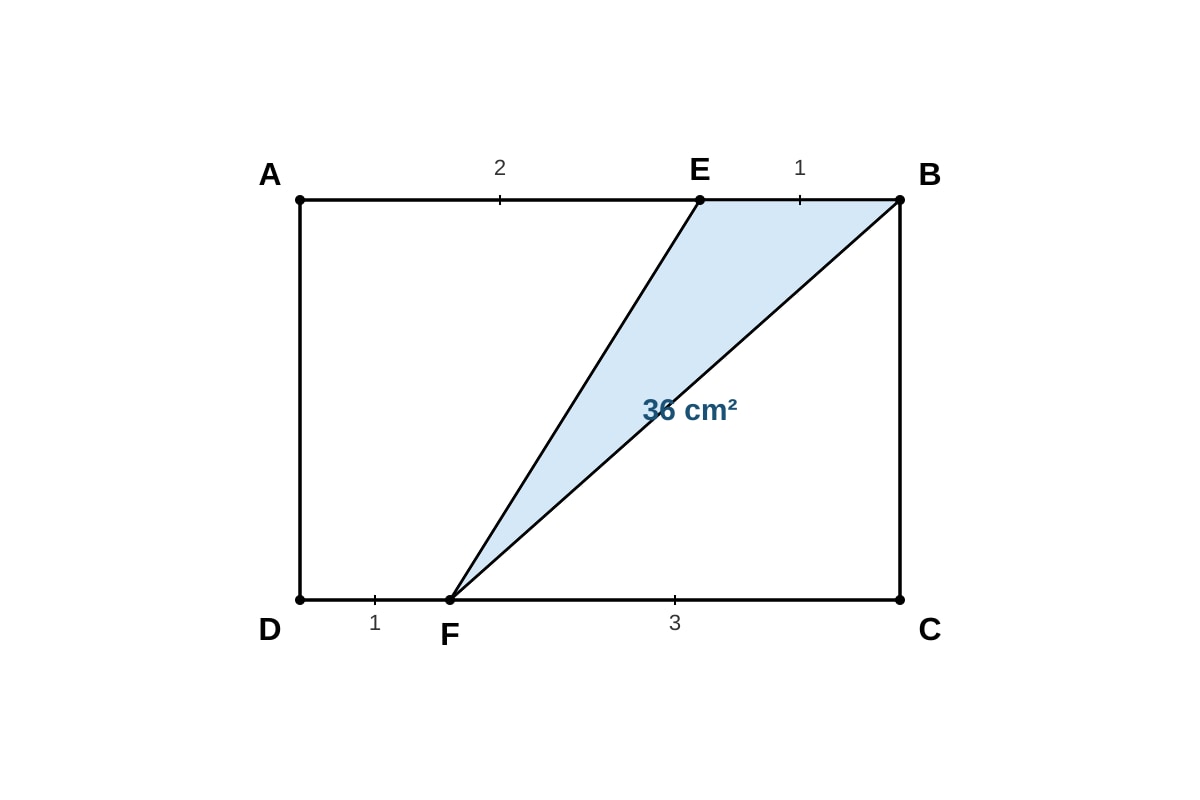
Working: Let the length of AB be (since AE:EB = 2:1, total 3 parts). Let the length of DC also be (since ABCD is a rectangle, AB = DC). Let the height of the rectangle (AD = BC) be .
- AE = , EB =
- DF = , FC =
- Area of triangle EBF = Area of rectangle - (Area of triangle AEF + Area of triangle BCF + Area of triangle EDF)
Actually, let's use a more direct approach.
Area of triangle EBF = (height from F to AB)
The height from F to AB is the same as the height of the rectangle, . Area of triangle EBF = So
Area of rectangle ABCD = cm²
Wait, let me reconsider. The height from F to AB is not necessarily the full height of the rectangle because F is on DC. Actually, since F is on DC and AB is parallel to DC, the perpendicular distance from F to AB is indeed the height of the rectangle.
Answer: 216 cm²
Check: If area of rectangle is 216 cm², and AB = 3u, h = 72/u. Area of triangle EBF = ½ × u × (72/u) = ½ × 72 = 36. ✓
Teaching Note: In geometry problems involving ratios on the sides of a rectangle, use variables to represent the unknown lengths. The area of a triangle is ½ × base × height. The height of triangle EBF is the same as the height of the rectangle because F lies on the opposite side.
Marking:
- 1 mark for expressing lengths in terms of u
- 1 mark for identifying the base and height of triangle EBF
- 1 mark for setting up the area equation
- 1 mark for finding the product u × h
- 1 mark for correct final answer
End of Answer Key