From Real Exams Quiz

Primary 6 PSLE Mathematics Multiplication Division Quiz

Free Exam-Derived Kimi K2 6 Free Primary 6 PSLE Mathematics Multiplication Division quiz with questions and answers for Singapore students. This page is rendered as a direct URL so the questions and answers can be discovered without pressing in-page buttons.

These static practice materials are generated from the site's syllabus and paper-generation workflow, with source and model context shown so students and parents can evaluate the material before use.

Primary 6 PSLE Mathematics From Real Exams Generated by Kimi K2 6 Free Updated 2026-06-07

Questions

<!-- TuitionGoWhere generation metadata: stage=3-0; model=moonshotai/kimi-k2.6:free; model_label=Kimi K2.6 Free; generated=2026-06-07; Sources: Stage 2-1 real exam-derived templates and Stage 2-2 exam-enriched syllabus. -->

Primary 6 PSLE Mathematics Quiz - Multiplication Division

Name: _________________________________ Class: _______ Date: ___________

Duration: 40 minutes
Total Marks: 40 marks

Instructions:

  • Answer all questions.
  • Show your working clearly in the spaces provided.
  • Write your answers in simplest form where applicable.
  • Use of calculators is not allowed.

Section A: Short Answer (Questions 1-10, 1 mark each)

Answer each question. Write your answer in the box provided.


1. Calculate 4×384 \times \frac{3}{8}.

Answer: xxxxxx\boxed{\phantom{xxxxxx}}


2. Find the value of 56×9\frac{5}{6} \times 9.

Answer: xxxxxx\boxed{\phantom{xxxxxx}}


3. What is 7÷147 \div \frac{1}{4}?

Answer: xxxxxx\boxed{\phantom{xxxxxx}}


4. Calculate 23÷4\frac{2}{3} \div 4.

Answer: xxxxxx\boxed{\phantom{xxxxxx}}


5. Find the value of 34÷18\frac{3}{4} \div \frac{1}{8}.

Answer: xxxxxx\boxed{\phantom{xxxxxx}}


6. A packet of biscuits weighs 35\frac{3}{5} kg. What is the total weight of 8 such packets?

Answer: xxxxxx\boxed{\phantom{xxxxxx}} kg


7. How many 16\frac{1}{6} m pieces can be cut from a string that is 5 m long?

Answer: xxxxxx\boxed{\phantom{xxxxxx}}


8. Calculate 214×232\frac{1}{4} \times \frac{2}{3}. Give your answer as a mixed number.

Answer: xxxxxx\boxed{\phantom{xxxxxx}}


9. Find the value of 312÷1343\frac{1}{2} \div 1\frac{3}{4}.

Answer: xxxxxx\boxed{\phantom{xxxxxx}}


10. 58\frac{5}{8} of a number is 40. What is the number?

Answer: xxxxxx\boxed{\phantom{xxxxxx}}


Section B: Structured Problems (Questions 11-20, 3 marks each)

Show all your working clearly.


11. A rectangular tank has a base area of 710\frac{7}{10} m². The height of the water in the tank is 56\frac{5}{6} m.

(a) Calculate the volume of water in the tank. [2]

(b) If 35\frac{3}{5} of the water is poured out, what is the remaining volume of water? [1]

Working:


12. Mrs Tan bought 910\frac{9}{10} kg of flour. She used 23\frac{2}{3} of it to bake cakes.

(a) How much flour did she use? [2]

(b) How much flour was left? [1]

Working:


13. A pipe is 152\frac{15}{2} m long. It is cut into pieces, each 34\frac{3}{4} m long.

(a) How many complete pieces can be obtained? [2]

(b) What is the length of the remaining piece? [1]

Working:


14. Raj had 360 stickers. He gave 25\frac{2}{5} of them to his brother and 13\frac{1}{3} of the remainder to his sister.

(a) How many stickers did he give to his brother? [1]

(b) How many stickers did he give to his sister? [1]

(c) How many stickers did Raj have left? [1]

Working:


15. A recipe requires 34\frac{3}{4} cup of milk for 6 cupcakes.

(a) How much milk is needed for 1 cupcake? [1]

(b) How much milk is needed for 15 cupcakes? [2]

Working:


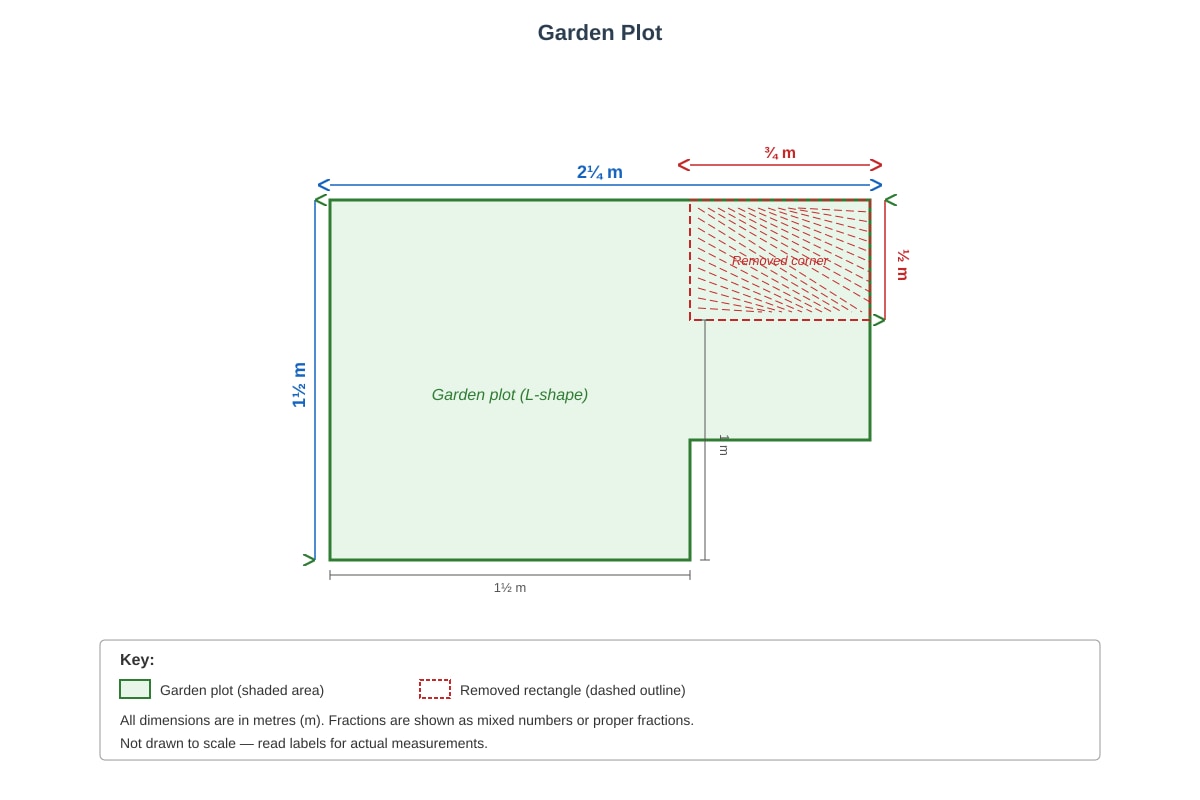
16. <image_placeholder> id: Q16-fig1 type: diagram linked_question: Q16 description: A composite shape consisting of a rectangle with a smaller rectangle removed from one corner, forming an L-shape. Dimensions are given as fractions. labels: Large rectangle: length 2 1/4 m, width 1 1/2 m. Small removed rectangle: length 3/4 m, width 1/2 m, located at top-right corner. values: Dimensions as fractions of metres must_show: Both rectangles clearly labelled with their fractional dimensions; the L-shape formed by the removal must be clear; indicate that the shape represents a garden plot </image_placeholder>

The diagram shows a garden plot.

(a) Find the area of the whole large rectangle before the corner was removed. [1]

(b) Find the area of the small rectangle that was removed. [1]

(c) Find the area of the actual garden plot. [1]

Working:


17. A school has 840 pupils. 38\frac{3}{8} of the pupils are boys. 25\frac{2}{5} of the girls wear spectacles.

(a) How many boys are there? [1]

(b) How many girls are there? [1]

(c) How many girls wear spectacles? [1]

Working:


18. A tank contains 4124\frac{1}{2} litres of water. The water is poured equally into 6 bottles.

(a) How much water is in each bottle? [2]

(b) If 2 bottles are poured into a jug, how much water is in the jug? [1]

Working:


19. Sulin spent 25\frac{2}{5} of her money on a book. She spent 13\frac{1}{3} of her remaining money on a pen. She had $24 left.

(a) What fraction of her money was left after buying the book? [1]

(b) What fraction of her original money was left after buying both items? [1]

(c) How much money did Sulin have at first? [1]

Working:


20. Three friends shared a pizza. Andy ate 14\frac{1}{4} of the pizza. Ben ate 23\frac{2}{3} of the remainder. Caleb ate the rest.

(a) What fraction of the pizza did Ben eat? [1]

(b) What fraction of the pizza did Caleb eat? [1]

(c) If the pizza was cut into 24 equal slices, how many slices did Caleb eat? [1]

Working:


END OF QUIZ


Quiz Information

ItemValue
LevelPrimary 6 PSLE
SubjectMathematics
TopicMultiplication and Division of Fractions
Version1 of 5
Assessment FolderSA2
Duration40 minutes
Total Marks40 (Section A: 10, Section B: 30)
Question Count20

Answers

<!-- TuitionGoWhere generation metadata: stage=3-0; model=moonshotai/kimi-k2.6:free; model_label=Kimi K2.6 Free; generated=2026-06-07; Sources: Stage 2-1 real exam-derived templates and Stage 2-2 exam-enriched syllabus. -->

Primary 6 PSLE Mathematics Quiz - Answer Key

Multiplication Division

Total Marks: 40


Section A: Short Answer (1 mark each)


Q1. Calculate 4×384 \times \frac{3}{8}

Answer: 1121\frac{1}{2} or 32\frac{3}{2}

Working:

  • When multiplying a whole number by a fraction, treat the whole number as having denominator 1: 4=414 = \frac{4}{1}
  • 4×38=41×38=1284 \times \frac{3}{8} = \frac{4}{1} \times \frac{3}{8} = \frac{12}{8}
  • Simplify by dividing numerator and denominator by 4: 12÷48÷4=32=112\frac{12 \div 4}{8 \div 4} = \frac{3}{2} = 1\frac{1}{2}

Teaching note: A common mistake is to multiply whole number with denominator instead of numerator. Remember: whole number × numerator, keep the denominator, then simplify.


Q2. Find the value of 56×9\frac{5}{6} \times 9

Answer: 7127\frac{1}{2} or 152\frac{15}{2}

Working:

  • 56×9=56×91=456\frac{5}{6} \times 9 = \frac{5}{6} \times \frac{9}{1} = \frac{45}{6}
  • Simplify: divide numerator and denominator by 3: 152=712\frac{15}{2} = 7\frac{1}{2}

Alternative method: Simplify before multiplying — 562×931=5×32=152\frac{5}{\cancel{6}_2} \times \frac{\cancel{9}^3}{1} = \frac{5 \times 3}{2} = \frac{15}{2}


Q3. What is 7÷147 \div \frac{1}{4}?

Answer: 28

Working:

  • Dividing by a fraction = multiplying by its reciprocal
  • Reciprocal of 14\frac{1}{4} is 41\frac{4}{1} = 4
  • 7÷14=7×4=287 \div \frac{1}{4} = 7 \times 4 = 28

Teaching note: Think practically: "How many quarters are in 7 wholes?" Since there are 4 quarters in 1 whole, there are 7×4=287 \times 4 = 28 quarters in 7 wholes.


Q4. Calculate 23÷4\frac{2}{3} \div 4

Answer: 16\frac{1}{6}

Working:

  • Dividing by whole number 4 = multiplying by reciprocal 14\frac{1}{4}
  • 23÷4=23×14=212=16\frac{2}{3} \div 4 = \frac{2}{3} \times \frac{1}{4} = \frac{2}{12} = \frac{1}{6}

Common mistake: Students sometimes write 23÷4=20.75\frac{2}{3 \div 4} = \frac{2}{0.75} which is incorrect. Always convert to multiplication by reciprocal.


Q5. Find the value of 34÷18\frac{3}{4} \div \frac{1}{8}

Answer: 6

Working:

  • Reciprocal of 18\frac{1}{8} is 81\frac{8}{1} = 8
  • 34÷18=34×8=3×84=244=6\frac{3}{4} \div \frac{1}{8} = \frac{3}{4} \times 8 = \frac{3 \times 8}{4} = \frac{24}{4} = 6

Teaching note: "How many eighths fit into three-quarters?" Since 18×6=68=34\frac{1}{8} \times 6 = \frac{6}{8} = \frac{3}{4}, the answer is 6.


Q6. A packet of biscuits weighs 35\frac{3}{5} kg. What is the total weight of 8 such packets?

Answer: 4454\frac{4}{5} kg or 245\frac{24}{5} kg

Working:

  • 35×8=3×85=245=445\frac{3}{5} \times 8 = \frac{3 \times 8}{5} = \frac{24}{5} = 4\frac{4}{5} kg

Q7. How many 16\frac{1}{6} m pieces can be cut from a string that is 5 m long?

Answer: 30

Working:

  • Number of pieces = total length ÷ length of each piece
  • 5÷16=5×6=305 \div \frac{1}{6} = 5 \times 6 = 30

Teaching note: This is a "how many fit into" question — classic division by fraction context.


Q8. Calculate 214×232\frac{1}{4} \times \frac{2}{3}. Give your answer as a mixed number.

Answer: 1121\frac{1}{2}

Working:

  • Convert mixed number to improper fraction: 214=942\frac{1}{4} = \frac{9}{4}
  • 94×23=1812=32=112\frac{9}{4} \times \frac{2}{3} = \frac{18}{12} = \frac{3}{2} = 1\frac{1}{2}

Common mistake: Multiplying whole and fraction parts separately: (2×23)+(14×23)(2 \times \frac{2}{3}) + (\frac{1}{4} \times \frac{2}{3}) — this distributive approach works but is more complex and error-prone. Always convert to improper fraction first for safer calculation.


Q9. Find the value of 312÷1343\frac{1}{2} \div 1\frac{3}{4}

Answer: 2

Working:

  • Convert both to improper fractions: 312=723\frac{1}{2} = \frac{7}{2} and 134=741\frac{3}{4} = \frac{7}{4}
  • 72÷74=72×47=2814=2\frac{7}{2} \div \frac{7}{4} = \frac{7}{2} \times \frac{4}{7} = \frac{28}{14} = 2

Teaching note: Notice the cancellation opportunity: 72×47=42=2\frac{\cancel{7}}{2} \times \frac{4}{\cancel{7}} = \frac{4}{2} = 2


Q10. 58\frac{5}{8} of a number is 40. What is the number?

Answer: 64

Working:

  • Let the number be nn
  • 58×n=40\frac{5}{8} \times n = 40
  • n=40÷58=40×85=3205=64n = 40 \div \frac{5}{8} = 40 \times \frac{8}{5} = \frac{320}{5} = 64

Verification: 58×64=3208=40\frac{5}{8} \times 64 = \frac{320}{8} = 40


Section B: Structured Problems (3 marks each)


Q11. Rectangular tank with base area 710\frac{7}{10} m² and water height 56\frac{5}{6} m

(a) Volume of water [2 marks]

Answer: 712\frac{7}{12}

Working:

  • Volume = base area × height
  • V=710×56=3560=712V = \frac{7}{10} \times \frac{5}{6} = \frac{35}{60} = \frac{7}{12}

Marking: [1] for correct formula/method, [1] for correct answer with simplification

(b) Remaining volume after pouring out 35\frac{3}{5} [1 mark]

Answer: 730\frac{7}{30}

Working:

  • Fraction remaining = 135=251 - \frac{3}{5} = \frac{2}{5}
  • Remaining volume = 712×25=1460=730\frac{7}{12} \times \frac{2}{5} = \frac{14}{60} = \frac{7}{30}

Marking: [1] for correct answer (method may be implied)


Q12. Mrs Tan's flour

(a) Flour used [2 marks]

Answer: 35\frac{3}{5} kg

Working:

  • Flour used = 910×23=1830=35\frac{9}{10} \times \frac{2}{3} = \frac{18}{30} = \frac{3}{5} kg

Marking: [1] for correct multiplication setup, [1] for correct simplified answer

(b) Flour left [1 mark]

Answer: 310\frac{3}{10} kg

Working:

  • Flour left = 91035=910610=310\frac{9}{10} - \frac{3}{5} = \frac{9}{10} - \frac{6}{10} = \frac{3}{10} kg
  • Or: 910×13=930=310\frac{9}{10} \times \frac{1}{3} = \frac{9}{30} = \frac{3}{10} kg (since 23\frac{2}{3} used means 13\frac{1}{3} left)

Q13. Pipe cutting

(a) Number of complete pieces [2 marks]

Answer: 10

Working:

  • Pipe length = 152\frac{15}{2} m = 7.5 m; each piece = 34\frac{3}{4} m = 0.75 m
  • Number = 152÷34=152×43=606=10\frac{15}{2} \div \frac{3}{4} = \frac{15}{2} \times \frac{4}{3} = \frac{60}{6} = 10

Marking: [1] for correct division setup, [1] for answer

(b) Length of remaining piece [1 mark]

Answer: 0 m (or no remainder)

Working:

  • Since 152÷34=10\frac{15}{2} \div \frac{3}{4} = 10 exactly, there is no remainder.
  • Check: 10×34=304=15210 \times \frac{3}{4} = \frac{30}{4} = \frac{15}{2}

Teaching note: This exact division is designed to show students that not all division problems have remainders — a common assumption after working with whole number division.


Q14. Raj's stickers

(a) To brother [1 mark]

Answer: 144 stickers

Working:

  • 25×360=7205=144\frac{2}{5} \times 360 = \frac{720}{5} = 144

(b) To sister [1 mark]

Answer: 72 stickers

Working:

  • Remainder after giving to brother: 360144=216360 - 144 = 216
  • To sister: 13×216=72\frac{1}{3} \times 216 = 72

(c) Left [1 mark]

Answer: 144 stickers

Working:

  • Left: 21672=144216 - 72 = 144
  • Or: 23×216=144\frac{2}{3} \times 216 = 144 (since 13\frac{1}{3} given away, 23\frac{2}{3} remains)

Teaching note: This is a classic "fraction of remainder" problem. The key trap is applying 13\frac{1}{3} to the original 360 instead of the remainder 216.


Q15. Recipe milk

(a) Milk for 1 cupcake [1 mark]

Answer: 18\frac{1}{8} cup

Working:

  • 34÷6=34×16=324=18\frac{3}{4} \div 6 = \frac{3}{4} \times \frac{1}{6} = \frac{3}{24} = \frac{1}{8} cup

(b) Milk for 15 cupcakes [2 marks]

Answer: 1781\frac{7}{8} cups or 158\frac{15}{8} cups

Working:

  • Method 1: 18×15=158=178\frac{1}{8} \times 15 = \frac{15}{8} = 1\frac{7}{8} cups
  • Method 2: 34×156=34×52=158\frac{3}{4} \times \frac{15}{6} = \frac{3}{4} \times \frac{5}{2} = \frac{15}{8} cups (scaling factor approach)

Marking: [1] for correct method, [1] for correct final answer


Q16. Composite L-shaped garden plot

Key visual features expected from image placeholder:

  • Large rectangle: 2¼ m × 1½ m
  • Small removed rectangle at top-right: ¾ m × ½ m

(a) Area of large rectangle [1 mark]

Answer: 278\frac{27}{8} m² or 3383\frac{3}{8}

Working:

  • 214×112=94×32=278=3382\frac{1}{4} \times 1\frac{1}{2} = \frac{9}{4} \times \frac{3}{2} = \frac{27}{8} = 3\frac{3}{8}

(b) Area of small rectangle [1 mark]

Answer: 38\frac{3}{8}

Working:

  • 34×12=38\frac{3}{4} \times \frac{1}{2} = \frac{3}{8}

(c) Area of garden plot [1 mark]

Answer: 3 m²

Working:

  • Garden area = large area − small area
  • 27838=248=3\frac{27}{8} - \frac{3}{8} = \frac{24}{8} = 3

Teaching note: This demonstrates subtraction of fractions with common denominators — a simpler case than finding common denominators first.


Q17. School pupils

(a) Number of boys [1 mark]

Answer: 315 boys

Working:

  • 38×840=25208=315\frac{3}{8} \times 840 = \frac{2520}{8} = 315

(b) Number of girls [1 mark]

Answer: 525 girls

Working:

  • 840315=525840 - 315 = 525
  • Or: 58×840=525\frac{5}{8} \times 840 = 525

(c) Girls who wear spectacles [1 mark]

Answer: 210 girls

Working:

  • 25×525=10505=210\frac{2}{5} \times 525 = \frac{1050}{5} = 210

Q18. Tank and bottles

(a) Water in each bottle [2 marks]

Answer: 34\frac{3}{4} litre

Working:

  • 412÷6=92÷6=92×16=912=344\frac{1}{2} \div 6 = \frac{9}{2} \div 6 = \frac{9}{2} \times \frac{1}{6} = \frac{9}{12} = \frac{3}{4} litre

Marking: [1] for correct conversion to improper fraction and division setup, [1] for correct simplification

(b) Water in jug [1 mark]

Answer: 1121\frac{1}{2} litres

Working:

  • 2×34=64=1122 \times \frac{3}{4} = \frac{6}{4} = 1\frac{1}{2} litres

Q19. Sulin's money (Fraction of remainder problem)

(a) Fraction left after book [1 mark]

Answer: 35\frac{3}{5}

Working:

  • 125=351 - \frac{2}{5} = \frac{3}{5}

(b) Fraction left after both items [1 mark]

Answer: 25\frac{2}{5}

Working:

  • After book: 35\frac{3}{5} remains
  • Spent 13\frac{1}{3} of remainder on pen, so 23\frac{2}{3} of remainder left
  • Fraction left: 35×23=615=25\frac{3}{5} \times \frac{2}{3} = \frac{6}{15} = \frac{2}{5}

(c) Original amount [1 mark]

Answer: $60

Working:

  • 25\frac{2}{5} of original = $24
  • Original = 24÷25=24×52=1202=6024 \div \frac{2}{5} = 24 \times \frac{5}{2} = \frac{120}{2} = 60

Verification:

  • Book: 25×60=24\frac{2}{5} \times 60 = 24, remaining 36
  • Pen: 13×36=12\frac{1}{3} \times 36 = 12, remaining 24 ✓

Teaching note: This is a PSLE-style fraction-of-remainder problem. The critical step is recognizing that 13\frac{1}{3} applies to the remainder, not the original. Drawing a bar model is highly recommended: [whole] → [2/5 spent|3/5 remains] → [1/3 of 3/5 spent|2/3 of 3/5 left].


Q20. Pizza sharing

(a) Ben's fraction [1 mark]

Answer: 12\frac{1}{2}

Working:

  • After Andy: 114=341 - \frac{1}{4} = \frac{3}{4} remains
  • Ben ate 23\frac{2}{3} of 34=23×34=612=12\frac{3}{4} = \frac{2}{3} \times \frac{3}{4} = \frac{6}{12} = \frac{1}{2}

(b) Caleb's fraction [1 mark]

Answer: 14\frac{1}{4}

Working:

  • Caleb's fraction = 11412=141 - \frac{1}{4} - \frac{1}{2} = \frac{1}{4}
  • Or: After Ben, remaining = 3412=3424=14\frac{3}{4} - \frac{1}{2} = \frac{3}{4} - \frac{2}{4} = \frac{1}{4} (Caleb ate all that remained)

(c) Caleb's slices [1 mark]

Answer: 6 slices

Working:

  • 14×24=6\frac{1}{4} \times 24 = 6 slices

END OF ANSWER KEY