From Real Exams Quiz
Primary 6 PSLE Mathematics Measurement Quiz
Free P6 PSLE Maths Measurement quiz, LongCat Exam version, with questions, answers, and PSLE-focused practice for Singapore students.
These static practice materials are generated from the site's syllabus and paper-generation workflow, with source and model context shown so students and parents can evaluate the material before use.
Questions
Free quiz and exam paper access
Enter your details to view this paper
Your access is remembered on this device.
Answers
Primary 6 PSLE Mathematics Quiz - Measurement
Answer Key
Section A: Short Answer Questions (2 marks each)
1. Convert 4.75 km to metres.
Working:
4.75 km × 1000 = 4750 m
Answer: 4750 m
[2 marks]
Marking: 1 mark for correct conversion factor, 1 mark for correct answer.
Common mistake: Multiplying by 100 instead of 1000.
2. A rectangular tank measures 50 cm by 40 cm by 60 cm. Find the volume of the tank in litres.
Working:
Volume = 50 × 40 × 60 = 120,000 cm³
1 ℓ = 1000 cm³
120,000 ÷ 1000 = 120 ℓ
Answer: 120 ℓ
[2 marks]
Marking: 1 mark for correct volume in cm³, 1 mark for correct conversion to litres.
3. Express 3 ⅝ as a decimal.
Working:
⅝ = 5 ÷ 8 = 0.625
3 + 0.625 = 3.625
Answer: 3.625
[2 marks]
Marking: 1 mark for correct fraction-to-decimal conversion, 1 mark for correct final answer.
4. The mass of a watermelon is 2.45 kg. Express this mass in grams.
Working:
2.45 kg × 1000 = 2450 g
Answer: 2450 g
[2 marks]
Marking: 1 mark for correct conversion factor, 1 mark for correct answer.
5. Find the area of a circle with radius 14 cm. (Take π = 22/7)
Working:
Area = π × r² = 22/7 × 14 × 14 = 22/7 × 196 = 22 × 28 = 616 cm²
Answer: 616 cm²
[2 marks]
Marking: 1 mark for correct substitution, 1 mark for correct answer.
Section B: Short Answer Questions (3 marks each)
6. A cuboid has a length of 12 cm, a breadth of 8 cm, and a volume of 960 cm³. Find the height of the cuboid.
Working:
Volume = l × b × h
960 = 12 × 8 × h
960 = 96 × h
h = 960 ÷ 96 = 10 cm
Answer: 10 cm
[3 marks]
Marking: 1 mark for correct formula, 1 mark for correct substitution, 1 mark for correct answer.
7. The circumference of a circle is 88 cm. Find the diameter of the circle. (Take π = 22/7)
Working:
Circumference = π × d
88 = 22/7 × d
d = 88 × 7/22 = 616/22 = 28 cm
Answer: 28 cm
[3 marks]
Marking: 1 mark for correct formula, 1 mark for correct substitution, 1 mark for correct answer.
8. A rectangular container measures 30 cm by 20 cm by 15 cm. It is filled with water to a height of 10 cm. How many litres of water are in the container?
Working:
Volume of water = 30 × 20 × 10 = 6000 cm³
6000 ÷ 1000 = 6 ℓ
Answer: 6 ℓ
[3 marks]
Marking: 1 mark for correct volume calculation, 1 mark for correct conversion, 1 mark for correct answer.
9. The figure is made up of a square of side 10 cm with a semicircle on one side. Find the area of the figure. (Take π = 3.14)
Working:
Area of square = 10 × 10 = 100 cm²
Diameter of semicircle = 10 cm, so radius = 5 cm
Area of semicircle = ½ × 3.14 × 5 × 5 = ½ × 3.14 × 25 = 39.25 cm²
Total area = 100 + 39.25 = 139.25 cm²
Answer: 139.25 cm²
[3 marks]
Marking: 1 mark for area of square, 1 mark for area of semicircle, 1 mark for total.
10. A car travels at a speed of 72 km/h. How far does it travel in 45 minutes?
Working:
45 minutes = 45/60 hours = 3/4 hour
Distance = Speed × Time = 72 × 3/4 = 54 km
Answer: 54 km
[3 marks]
Marking: 1 mark for correct time conversion, 1 mark for correct formula, 1 mark for correct answer.
Section C: Structured / Word Problem Questions (3–4 marks each)
11. A rectangular tank with a square base of side 25 cm contains 30 ℓ of water.
(a) What is the height of the water in the tank?
Working:
30 ℓ = 30,000 cm³
Base area = 25 × 25 = 625 cm²
Height = Volume ÷ Base area = 30,000 ÷ 625 = 48 cm
Answer: 48 cm
[2 marks]
Marking: 1 mark for correct conversion to cm³, 1 mark for correct height.
(b) An iron cube of side 10 cm is placed into the tank and is completely submerged. What is the new height of the water level?
Working:
Volume of cube = 10 × 10 × 10 = 1000 cm³
New total volume of water = 30,000 + 1000 = 31,000 cm³
New height = 31,000 ÷ 625 = 49.6 cm
Answer: 49.6 cm
[2 marks]
Marking: 1 mark for correct volume of cube, 1 mark for correct new height.
12. The figure is made up of two identical circles inside a rectangle. The length of the rectangle is 28 cm and the breadth is 14 cm. Find the area of the shaded region. (Take π = 22/7)
Working:
Diameter of each circle = 14 cm (same as breadth), radius = 7 cm
Area of rectangle = 28 × 14 = 392 cm²
Area of two circles = 2 × 22/7 × 7 × 7 = 2 × 22 × 7 = 308 cm²
Shaded area = 392 − 308 = 84 cm²
Answer: 84 cm²
[3 marks]
Marking: 1 mark for area of rectangle, 1 mark for area of two circles, 1 mark for shaded area.
13. Tank A is completely filled with 48 ℓ of water. Tank B is empty. Water is poured from Tank A into Tank B. Tank A has a base area of 400 cm². Tank B has a base area of 600 cm². After pouring, the water level in both tanks is the same.
(a) Find the total base area of both tanks.
Working:
Total base area = 400 + 600 = 1000 cm²
Answer: 1000 cm²
[1 mark]
(b) Find the height of water in each tank after pouring.
Working:
48 ℓ = 48,000 cm³
Height = Total volume ÷ Total base area = 48,000 ÷ 1000 = 48 cm
Answer: 48 cm
[2 marks]
Marking: 1 mark for correct conversion to cm³, 1 mark for correct height.
14. A rectangular piece of cardboard measures 60 cm by 40 cm. Four squares of side 5 cm are cut from the four corners. The cardboard is then folded to form an open box.
(a) Find the dimensions of the box.
Working:
Length = 60 − 5 − 5 = 50 cm
Breadth = 40 − 5 − 5 = 30 cm
Height = 5 cm
Answer: Length = 50 cm, Breadth = 30 cm, Height = 5 cm
[2 marks]
Marking: 1 mark for correct length and breadth, 1 mark for correct height.
(b) Find the volume of the box.
Working:
Volume = 50 × 30 × 5 = 7500 cm³
Answer: 7500 cm³
[1 mark]
15. The diameter of a bicycle wheel is 70 cm. The wheel rotates at a speed of 200 revolutions per minute. How far does the bicycle travel in 10 minutes? Give your answer in kilometres. (Take π = 22/7)
Working:
Circumference = π × d = 22/7 × 70 = 220 cm
Distance per minute = 220 × 200 = 44,000 cm/min
Distance in 10 minutes = 44,000 × 10 = 440,000 cm
440,000 cm = 440,000 ÷ 100,000 = 4.4 km
Answer: 4.4 km
[4 marks]
Marking: 1 mark for circumference, 1 mark for distance per minute, 1 mark for total distance in cm, 1 mark for conversion to km.
Section D: Problem Sums (4 marks each)
16. A rectangular tank measuring 40 cm by 25 cm by 30 cm was filled with water to a height of 12 cm. Tap A, which fills the tank at a rate of 2 ℓ per minute, was turned on. Tap B, which drains the tank at a rate of 0.5 ℓ per minute, was also turned on at the same time.
(a) How much water was in the tank at first?
Working:
Volume = 40 × 25 × 12 = 12,000 cm³ = 12 ℓ
Answer: 12 ℓ
[1 mark]
(b) How long did it take for the tank to be completely filled?
Working:
Total capacity of tank = 40 × 25 × 30 = 30,000 cm³ = 30 ℓ
Remaining volume to fill = 30 − 12 = 18 ℓ
Net fill rate = 2 − 0.5 = 1.5 ℓ/min
Time = 18 ÷ 1.5 = 12 minutes
Answer: 12 minutes
[3 marks]
Marking: 1 mark for remaining volume, 1 mark for net rate, 1 mark for correct time.
17. The figure below shows a rectangular piece of paper ABCD where AB = 20 cm and BC = 14 cm. A semicircle is cut away from the rectangle along side AB.
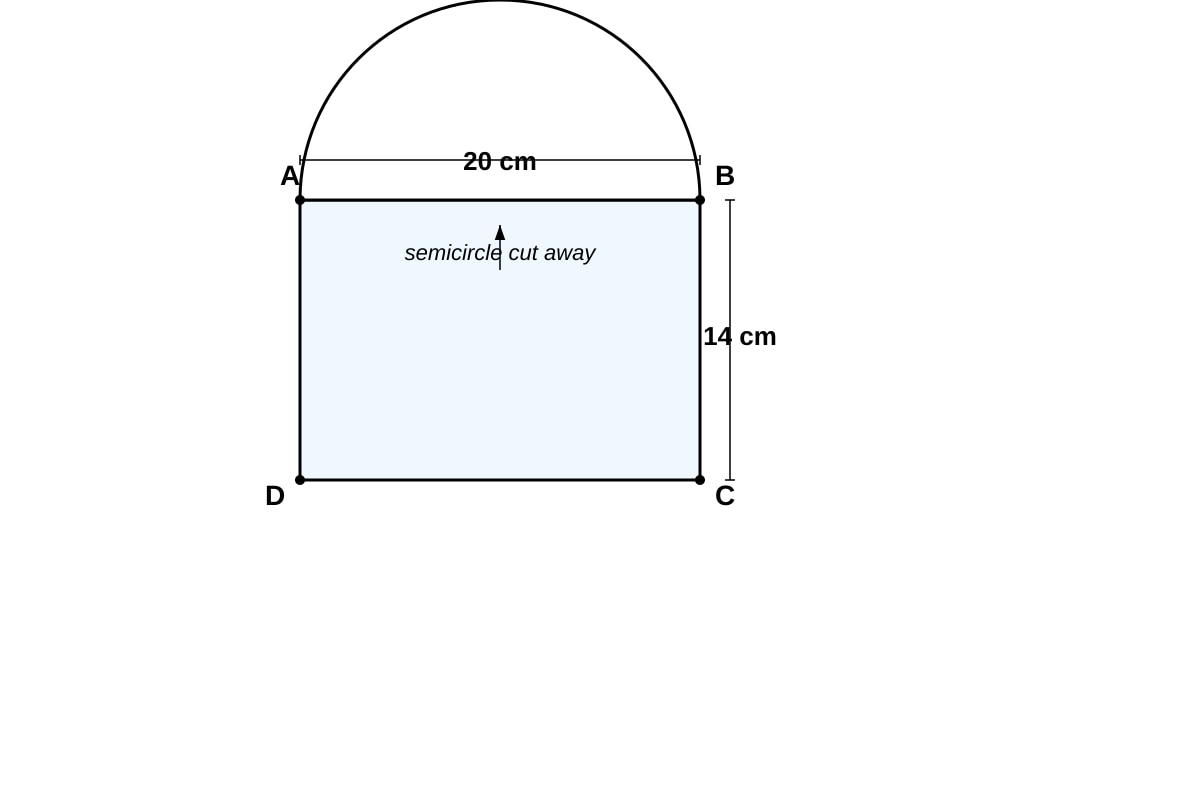
Generated figure for this question.
(a) Find the area of the remaining paper. (Take π = 22/7)
Working:
Area of rectangle = 20 × 14 = 280 cm²
Diameter of semicircle = 20 cm, radius = 10 cm
Area of semicircle = ½ × 22/7 × 10 × 10 = ½ × 2200/7 = 1100/7 ≈ 157.14 cm²
Remaining area = 280 − 157.14 = 122.86 cm²
(Accept 122.86 cm² or 860/7 cm²)
Answer: 860/7 cm² or 122.86 cm²
[2 marks]
Marking: 1 mark for area of rectangle minus semicircle set-up, 1 mark for correct answer.
(b) Find the perimeter of the remaining paper. (Take π = 22/7)
Working:
Perimeter = BC + CD + AD + curved edge of semicircle
= 14 + 20 + 14 + (½ × 22/7 × 20)
= 48 + 220/7
= 48 + 31.43
= 79.43 cm
(Accept 556/7 cm² or 79.43 cm)
Answer: 556/7 cm or 79.43 cm
[2 marks]
Marking: 1 mark for identifying the curved perimeter correctly, 1 mark for correct total.
18. A swimming pool is 50 m long, 25 m wide, and 2 m deep. Two taps are used to fill the pool. Tap A fills the pool at a rate of 120 ℓ/min and Tap B fills the pool at a rate of 80 ℓ/min. Both taps are turned on at the same time.
(a) Find the volume of the swimming pool in litres.
Working:
Volume = 50 × 25 × 2 = 2500 m³
1 m³ = 1000 ℓ
2500 m³ = 2500 × 1000 = 2,500,000 ℓ
Answer: 2,500,000 ℓ
[2 marks]
Marking: 1 mark for volume in m³, 1 mark for conversion to litres.
(b) How long does it take to fill the pool completely?
Working:
Combined rate = 120 + 80 = 200 ℓ/min
Time = 2,500,000 ÷ 200 = 12,500 minutes
Answer: 12,500 minutes
[2 marks]
Marking: 1 mark for combined rate, 1 mark for correct time.
19. A solid metal cube of side 8 cm is placed into a rectangular tank measuring 20 cm by 15 cm by 12 cm. The tank was originally filled with water to a height of 10 cm.
(a) Find the volume of water in the tank before the cube was placed in.
Working:
Volume = 20 × 15 × 10 = 3000 cm³
Answer: 3000 cm³
[1 mark]
(b) Find the volume of the metal cube.
Working:
Volume = 8 × 8 × 8 = 512 cm³
Answer: 512 cm³
[1 mark]
(c) Find the new height of the water level after the cube is completely submerged.
Working:
New total volume = 3000 + 512 = 3512 cm³
Base area of tank = 20 × 15 = 300 cm²
New height = 3512 ÷ 300 = 11.71 cm (to 2 d.p.)
Answer: 11.71 cm (or 878/75 cm)
[2 marks]
Marking: 1 mark for correct total volume, 1 mark for correct height.
20. The figure is made up of a rectangle and two identical quarter circles at opposite corners. The rectangle has a length of 20 cm and a breadth of 14 cm. The quarter circles each have a radius of 7 cm.
(a) Find the area of the shaded region. (Take π = 22/7)
Working:
Area of rectangle = 20 × 14 = 280 cm²
Two quarter circles = one semicircle
Area of semicircle = ½ × 22/7 × 7 × 7 = ½ × 154 = 77 cm²
Shaded area = 280 − 77 = 203 cm²
Answer: 203 cm²
[2 marks]
Marking: 1 mark for recognising two quarter circles = one semicircle, 1 mark for correct shaded area.
(b) Find the perimeter of the shaded region. (Take π = 22/7)
Working:
Perimeter = two straight sides of rectangle + arc of semicircle
= 20 + 14 + 20 + 14 − (two cut straight edges) + curved edge
Note: The two quarter circles remove two radii from the perimeter and add curved edges.
Perimeter = 20 + 14 + 20 + 14 + (curved edge of semicircle) − (7 + 7)
Curved edge = ½ × 22/7 × 14 = 22 cm
Perimeter = 68 − 14 + 22 = 76 cm
Answer: 76 cm
[2 marks]
Marking: 1 mark for correct curved edge, 1 mark for correct total perimeter.
END OF ANSWER KEY