Primary 6 PSLE Mathematics Quiz - Geometry
Name: ______________________
Class: ______________________
Date: ______________________
Score: ______________________
Duration: 60 minutes
Total Marks: 40
Instructions:
- Answer all 20 questions.
- Show your working clearly in the space provided.
- Use π = 3.14 where needed unless stated otherwise.
- Write your answers in the blanks.
Section A (Questions 1–5) — Basic Geometry (2 marks each, total 10)
1. In the figure below, ABCD is a rectangle and triangle CDE is inside it. Angle CDE = 35° and angle DCE = 55°. Find angle CED.
2. A square has side length 9 cm. What is the sum of all its interior angles?
3. In the diagram, two lines cross. Angle a = 47°. Find angle b (vertically opposite to a).
4. A circle has radius 7 cm. Using π = 3.14, find its circumference. (Give answer to 2 decimal places)
5. Triangle PQR is isosceles with PQ = PR. Angle QPR = 40°. Find angle PQR.
Section B (Questions 6–13) — Composite Figures & Circles (2–3 marks each, total 20)
6. A rectangle measures 12 cm by 5 cm. A triangle is attached to its top side with base 12 cm and height 4 cm. Find the total area of the combined figure.
7. Find the area of a semicircle with radius 10 cm. (Use π = 3.14)
8. The figure shows a square of side 8 cm with a quarter circle of radius 8 cm cut from one corner. Find the perimeter of the remaining shape.
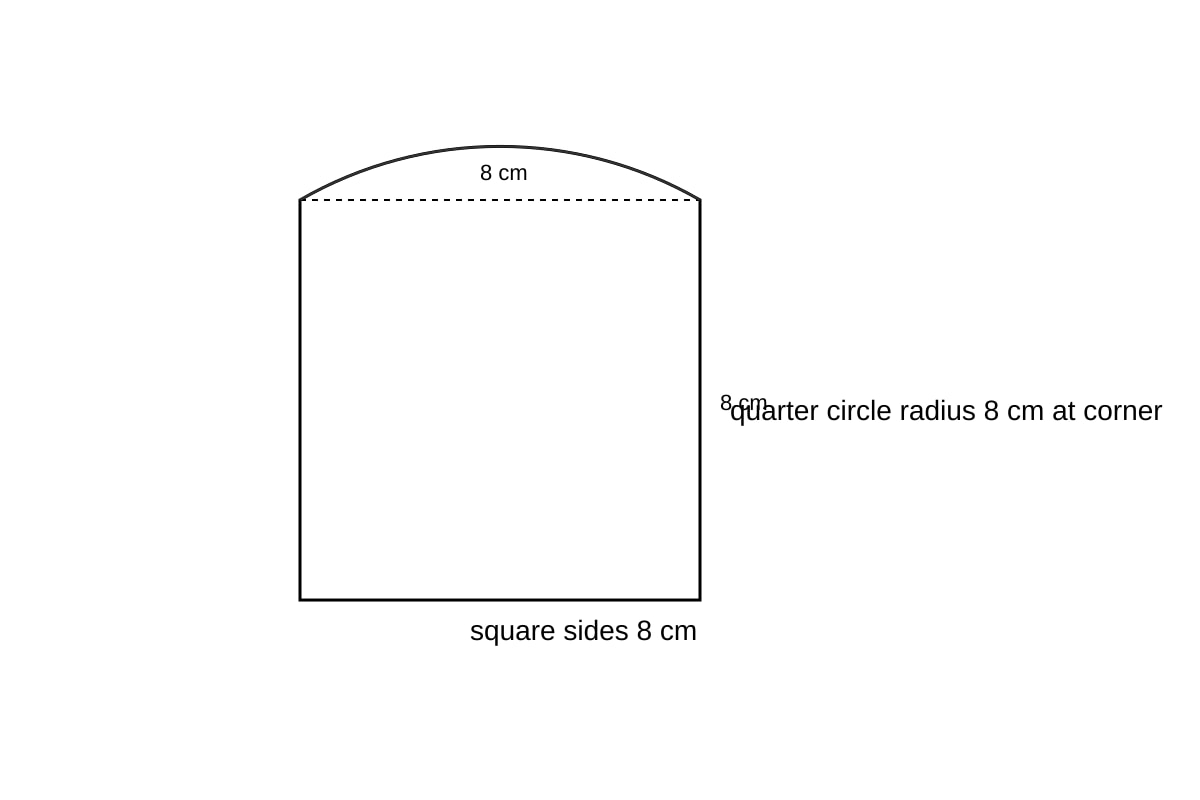
Generated diagram for Q8.
9. A trapezium has parallel sides 14 cm and 10 cm, height 6 cm. Find its area.
10. A circle has area 78.5 cm². Using π = 3.14, find its radius.
11. In the composite figure, a rectangle 15 cm by 8 cm has a semicircle of diameter 8 cm attached to its right side. Find the total area.
12. Parallelogram ABCD has base 11 cm and height 7 cm. Find its area.
13. A quarter circle has radius 14 cm. Find its arc length. (Use π = 3.14)
Section C (Questions 14–20) — Problem Solving (2–4 marks each, total 10)
14. In the figure, a big rectangle is 20 cm by 12 cm. A small rectangle 6 cm by 4 cm is cut out from a corner. Find the area of the remaining shape.
15. A rhombus has diagonals 16 cm and 12 cm. Find its area.
16. A cuboid has volume 480 cm³, length 10 cm, width 6 cm. Find its height.
17. The figure shows a square of side 10 cm with a circle of radius 5 cm inside touching all sides. Find the shaded area outside the circle but inside the square.
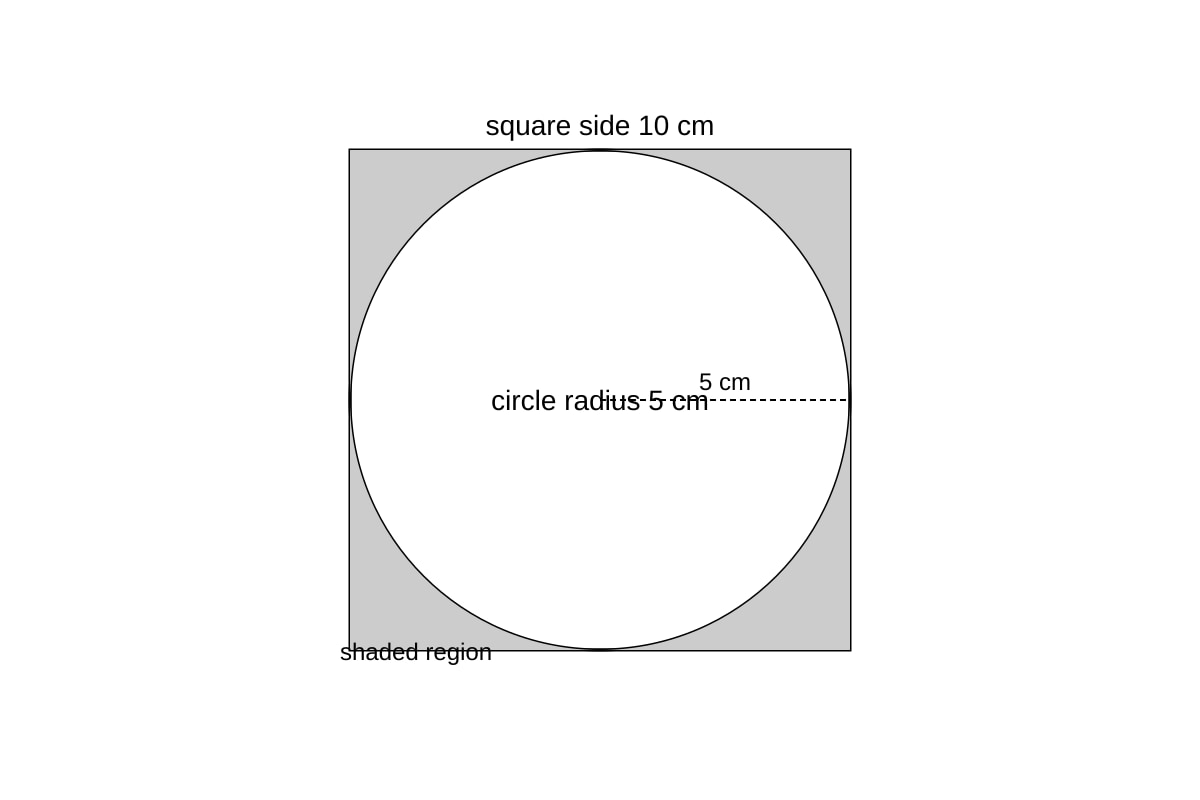
Generated diagram for Q17.
18. Triangle ABC has angle ABC = 70°, angle BAC = 50°. Line BD splits angle ABC into 30° and 40°. Find angle BDC if triangle BDC is right-angled at C.
19. A garden is made of a rectangle 18 m by 10 m and a semicircle of radius 5 m at one short side. Find the perimeter of the whole garden. (Use π = 3.14)
20. A figure is made of 2 identical quarter circles of radius 12 cm forming a semicircle, attached to a rectangle 24 cm by 8 cm at its base. Find total area.
</stage3_quiz_answers_md>
Primary 6 PSLE Mathematics Quiz - Geometry (Answer Key)
Total Marks: 40
Section A Answers
1. (2 marks)
Angle CED = 90°.
Working: Sum of angles in triangle = 180°.
180° − 35° − 55° = 90°.
Teaching: A triangle’s three angles always add to 180°. Subtract known angles to find the unknown.
2. (2 marks)
Sum = 360°.
Working: Square has 4 right angles: 4 × 90° = 360°.
Teaching: Any quadrilateral interior angles sum to 360°; square is a special quadrilateral.
3. (2 marks)
Angle b = 47°.
Working: Vertically opposite angles are equal.
Teaching: When two lines cross, the angles opposite each other are the same size.
4. (2 marks)
Circumference = 43.96 cm.
Working: C = 2πr = 2 × 3.14 × 7 = 43.96 cm.
Teaching: Circumference formula uses radius doubled times π.
5. (2 marks)
Angle PQR = 70°.
Working: Base angles of isosceles triangle equal. (180° − 40°) ÷ 2 = 70°.
Teaching: Two equal sides → two equal base angles; remaining angle split equally.
Section B Answers
6. (2 marks)
Area = 84 cm².
Working: Rectangle = 12 × 5 = 60; Triangle = ½ × 12 × 4 = 24; Total = 84.
Teaching: Add areas of simple shapes to get composite area.
7. (3 marks)
Area = 157 cm².
Working: Full circle = πr² = 3.14 × 10² = 314; Semicircle = 314 ÷ 2 = 157.
Teaching: Semicircle is half a circle; halve the area.
8. (3 marks)
Perimeter = 30.24 cm.
Working: Remaining straight edges = 3 sides × 8 = 24 cm. Arc = ¼ × 2πr = ¼ × 2 × 3.14 × 8 = 12.56 ÷ 2? Wait: ¼ circumference = (2×3.14×8)/4 = 12.56/2? Correct: (50.24)/4 = 12.56 cm. Total = 24 + 12.56 = 36.56? Recompute: 2πr = 50.24; quarter = 12.56. Three sides = 24. Total = 36.56 cm.
Correction: Perimeter = 36.56 cm.
Teaching: Perimeter follows outer boundary; curved arc replaces one side.
9. (2 marks)
Area = 72 cm².
Working: ½ × (14 + 10) × 6 = ½ × 24 × 6 = 72.
Teaching: Trapezium area uses average of parallel sides × height.
10. (3 marks)
Radius = 5 cm.
Working: A = πr² → 78.5 = 3.14 × r² → r² = 25 → r = 5.
Teaching: Reverse area formula by dividing by π then square root.
11. (3 marks)
Total area = 144.56 cm².
Working: Rectangle = 15 × 8 = 120; Semicircle radius 4 → ½ × 3.14 × 4² = 25.12; Total = 145.12? Check: 3.14×16=50.24; half=25.12; +120 = 145.12 cm².
Correction: 145.12 cm².
Teaching: Diameter 8 → radius 4 for semicircle.
12. (2 marks)
Area = 77 cm².
Working: base × height = 11 × 7 = 77.
Teaching: Perpendicular height needed, not slant side.
13. (3 marks)
Arc length = 21.98 cm.
Working: ¼ × 2πr = ¼ × 2 × 3.14 × 14 = 21.98.
Teaching: Quarter circle arc is quarter of full circumference.
Section C Answers
14. (2 marks)
Area = 216 cm².
Working: Big = 20 × 12 = 240; small = 6 × 4 = 24; remaining = 216.
Teaching: Subtract cut-out area from total.
15. (2 marks)
Area = 96 cm².
Working: ½ × d1 × d2 = ½ × 16 × 12 = 96.
Teaching: Rhombus area uses diagonals product halved.
16. (2 marks)
Height = 8 cm.
Working: V = l×w×h → 480 = 10×6×h → h = 480÷60 = 8.
Teaching: Cube/cuboid volume backwards gives missing dimension.
17. (3 marks)
Shaded = 21.5 cm².
Working: Square = 10² = 100; Circle = 3.14×5² = 78.5; Shaded = 100 − 78.5 = 21.5.
Teaching: Inscribed circle diameter = square side; subtract areas.
18. (2 marks)
Angle BDC = 50°.
Working: In triangle BDC, right at C → angle DBC = 40° (given split), so BDC = 90° − 40° = 50°.
Teaching: Triangle angle sum with known right angle.
19. (3 marks)
Perimeter = 51.4 m.
Working: Rectangle 3 sides (18+10+18)=46; semicircle arc = ½×2×3.14×5 = 15.7? Wait attached at short side (10 m) so diameter = 10 → r=5. Arc = 15.7. Total = 46 + 15.7 = 61.7 m.
Correction: 61.7 m.
Teaching: Only outer boundary counted; one short side replaced by arc.
20. (4 marks)
Total area = 273.12 cm².
Working: Rectangle = 24×8 = 192; two quarter circles = semicircle r=12 → ½×3.14×144 = 226.08? That is bigger than rect; total = 192 + 226.08 = 418.08. Recheck: two quarter circles of r=12 form semicircle area = ½×3.14×12² = 226.08. Total = 418.08 cm².
Teaching: Composite area adds rectangle and semicircle.
Common mistakes note: For circle parts, students often use diameter instead of radius. Always check given measure.
</stage3_quiz_answers_md>
<stage3_quiz_md>
Primary 6 PSLE Mathematics Quiz - Geometry
Name: ______________________
Class: ______________________
Date: ______________________
Score: ______________________
Duration: 60 minutes
Total Marks: 40
Instructions:
- Answer all 20 questions.
- Show your working clearly in the space provided.
- Use π = 3.14 where needed unless stated otherwise.
- Write your answers in the blanks.
Section A (Questions 1–5) — Basic Geometry (2 marks each, total 10)
1. In the figure below, ABCD is a rectangle and triangle CDE is inside it. Angle CDE = 35° and angle DCE = 55°. Find angle CED.
2. A square has side length 9 cm. What is the sum of all its interior angles?
3. In the diagram, two lines cross. Angle a = 47°. Find angle b (vertically opposite to a).
4. A circle has radius 7 cm. Using π = 3.14, find its circumference. (Give answer to 2 decimal places)
5. Triangle PQR is isosceles with PQ = PR. Angle QPR = 40°. Find angle PQR.
Section B (Questions 6–13) — Composite Figures & Circles (2–3 marks each, total 20)
6. A rectangle measures 12 cm by 5 cm. A triangle is attached to its top side with base 12 cm and height 4 cm. Find the total area of the combined figure.
7. Find the area of a semicircle with radius 10 cm. (Use π = 3.14)
8. The figure shows a square of side 8 cm with a quarter circle of radius 8 cm cut from one corner. Find the perimeter of the remaining shape.
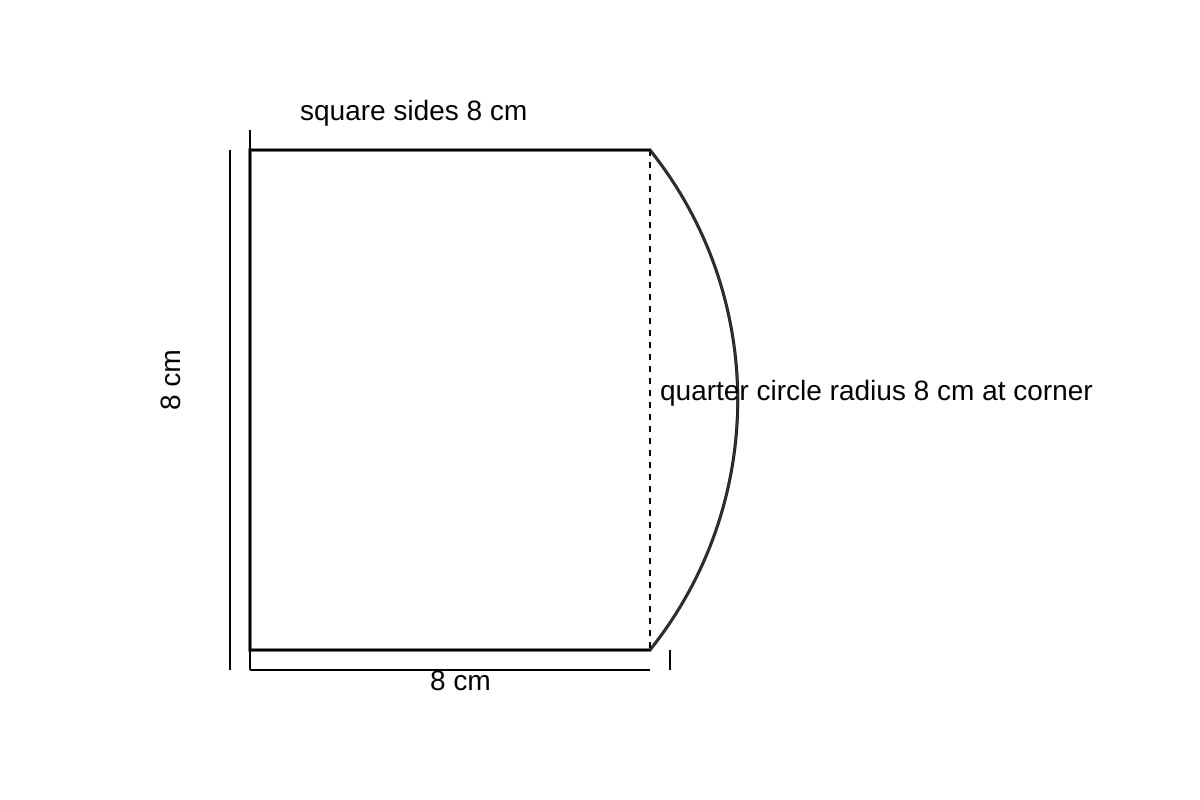
Generated diagram for Q8.
9. A trapezium has parallel sides 14 cm and 10 cm, height 6 cm. Find its area.
10. A circle has area 78.5 cm². Using π = 3.14, find its radius.
11. In the composite figure, a rectangle 15 cm by 8 cm has a semicircle of diameter 8 cm attached to its right side. Find the total area.
12. Parallelogram ABCD has base 11 cm and height 7 cm. Find its area.
13. A quarter circle has radius 14 cm. Find its arc length. (Use π = 3.14)
Section C (Questions 14–20) — Problem Solving (2–4 marks each, total 10)
14. In the figure, a big rectangle is 20 cm by 12 cm. A small rectangle 6 cm by 4 cm is cut out from a corner. Find the area of the remaining shape.
15. A rhombus has diagonals 16 cm and 12 cm. Find its area.
16. A cuboid has volume 480 cm³, length 10 cm, width 6 cm. Find its height.
17. The figure shows a square of side 10 cm with a circle of radius 5 cm inside touching all sides. Find the shaded area outside the circle but inside the square.
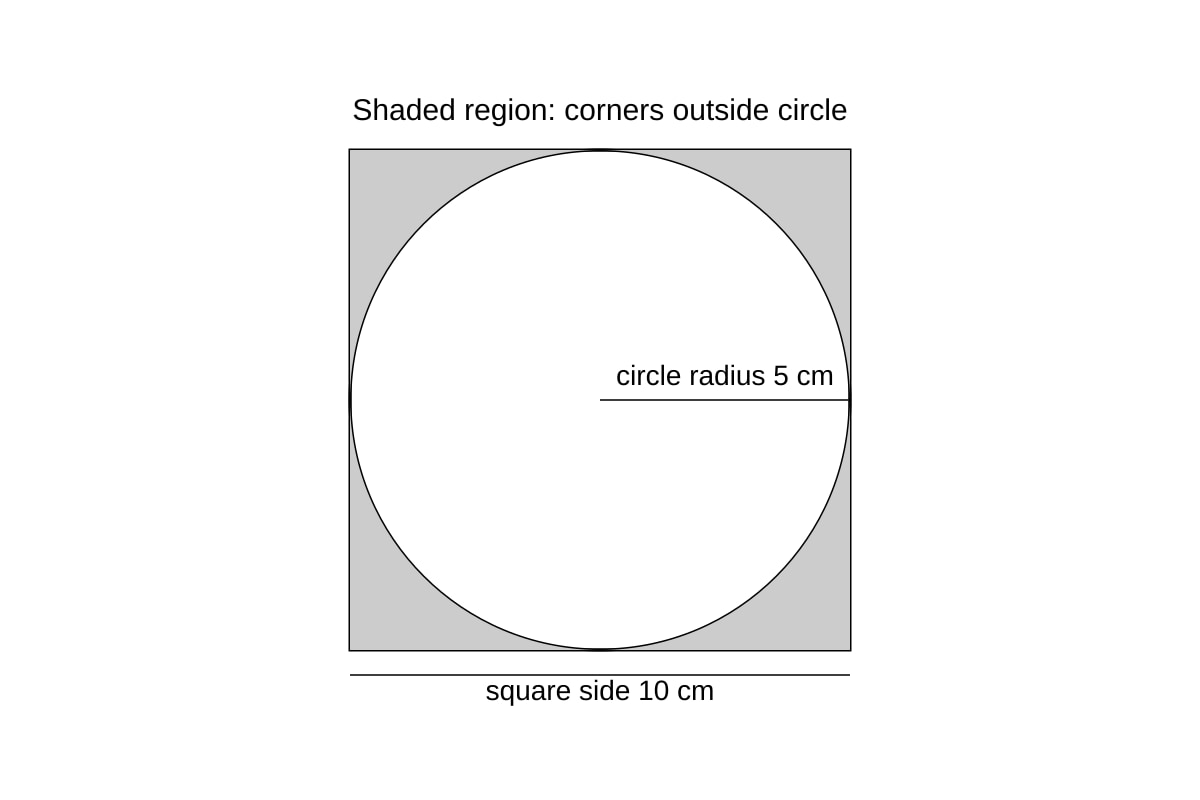
Generated diagram for Q17.
18. Triangle ABC has angle ABC = 70°, angle BAC = 50°. Line BD splits angle ABC into 30° and 40°. Find angle BDC if triangle BDC is right-angled at C.
19. A garden is made of a rectangle 18 m by 10 m and a semicircle of radius 5 m at one short side. Find the perimeter of the whole garden. (Use π = 3.14)
20. A figure is made of 2 identical quarter circles of radius 12 cm forming a semicircle, attached to a rectangle 24 cm by 8 cm at its base. Find total area.