From Real Exams Quiz

Primary 6 PSLE Mathematics Area Perimeter Quiz

Free Exam-Derived Qwen3.7 Plus Primary 6 PSLE Mathematics Area Perimeter quiz with questions and answers for Singapore students. This page is rendered as a direct URL so the questions and answers can be discovered without pressing in-page buttons.

These static practice materials are generated from the site's syllabus and paper-generation workflow, with source and model context shown so students and parents can evaluate the material before use.

Primary 6 PSLE Mathematics From Real Exams Generated by Qwen3.7 Plus Updated 2026-06-04

Questions

<!-- TuitionGoWhere generation metadata: stage=3-0; model=qwen/qwen3.7-plus; model_label=Qwen3.7 Plus; generated=2026-06-04; Sources: Stage 2-1 real exam-derived templates and Stage 2-2 exam-enriched syllabus. -->

Primary 6 PSLE Mathematics Quiz - Area Perimeter

Name: _________________________
Class: _________________________
Date: _________________________
Score: _________ / 40

Duration: 1 hour 30 minutes
Total Marks: 40

Instructions to Candidates:

  1. This quiz consists of 20 questions.
  2. Answer all questions.
  3. Write your answers in the spaces provided.
  4. For questions requiring working, show your working clearly. Marks may be awarded for correct working even if the final answer is incorrect.
  5. Unless otherwise stated, give your answers in the simplest form or correct to 2 decimal places where necessary.
  6. Take π=227\pi = \frac{22}{7} or 3.143.14 as specified in each question.

Section A: Multiple Choice Questions (Questions 1 – 10)

Each question carries 1 mark. Choose the correct answer and write its number (1, 2, 3, or 4) in the brackets provided.

1. The perimeter of a square is 36 cm. What is the area of the square? (1) 9 cm2^2 (2) 18 cm2^2 (3) 81 cm2^2 (4) 144 cm2^2

Answer: ( ______ )

2. A rectangle has a length of 12 cm and a breadth of 8 cm. If the length is increased by 3 cm and the breadth is decreased by 2 cm, what is the change in the area? (1) Increase by 6 cm2^2 (2) Decrease by 6 cm2^2 (3) Increase by 10 cm2^2 (4) No change

Answer: ( ______ )

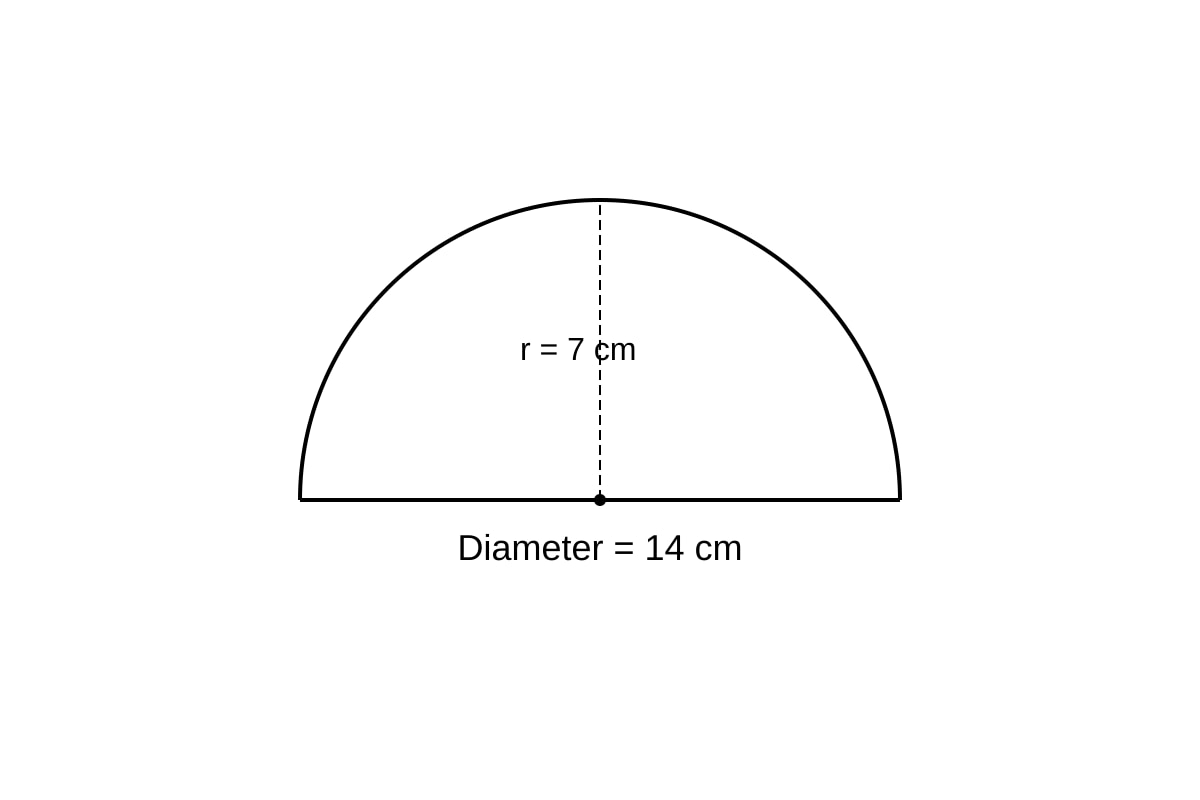
3. The figure below shows a semicircle with diameter 14 cm. What is the perimeter of the semicircle? (Take π=227\pi = \frac{22}{7})

<image_placeholder> id: Q3-fig1 type: diagram linked_question: Q3 description: A semicircle with a straight horizontal base. labels: Diameter = 14 cm values: diameter = 14 must_show: The curved arc and the straight diameter line. </image_placeholder>

(1) 22 cm (2) 36 cm (3) 44 cm (4) 77 cm

Answer: ( ______ )

4. Two identical squares of side 5 cm overlap such that they form a rectangle of dimensions 8 cm by 5 cm. What is the area of the overlapping region? (1) 5 cm2^2 (2) 10 cm2^2 (3) 15 cm2^2 (4) 25 cm2^2

Answer: ( ______ )

5. The ratio of the area of Circle A to the area of Circle B is 4 : 9. What is the ratio of the radius of Circle A to the radius of Circle B? (1) 2 : 3 (2) 4 : 9 (3) 8 : 27 (4) 16 : 81

Answer: ( ______ )

6. A triangle has a base of 10 cm and a height of 6 cm. A parallelogram has the same base and same area as the triangle. What is the height of the parallelogram? (1) 3 cm (2) 6 cm (3) 10 cm (4) 12 cm

Answer: ( ______ )

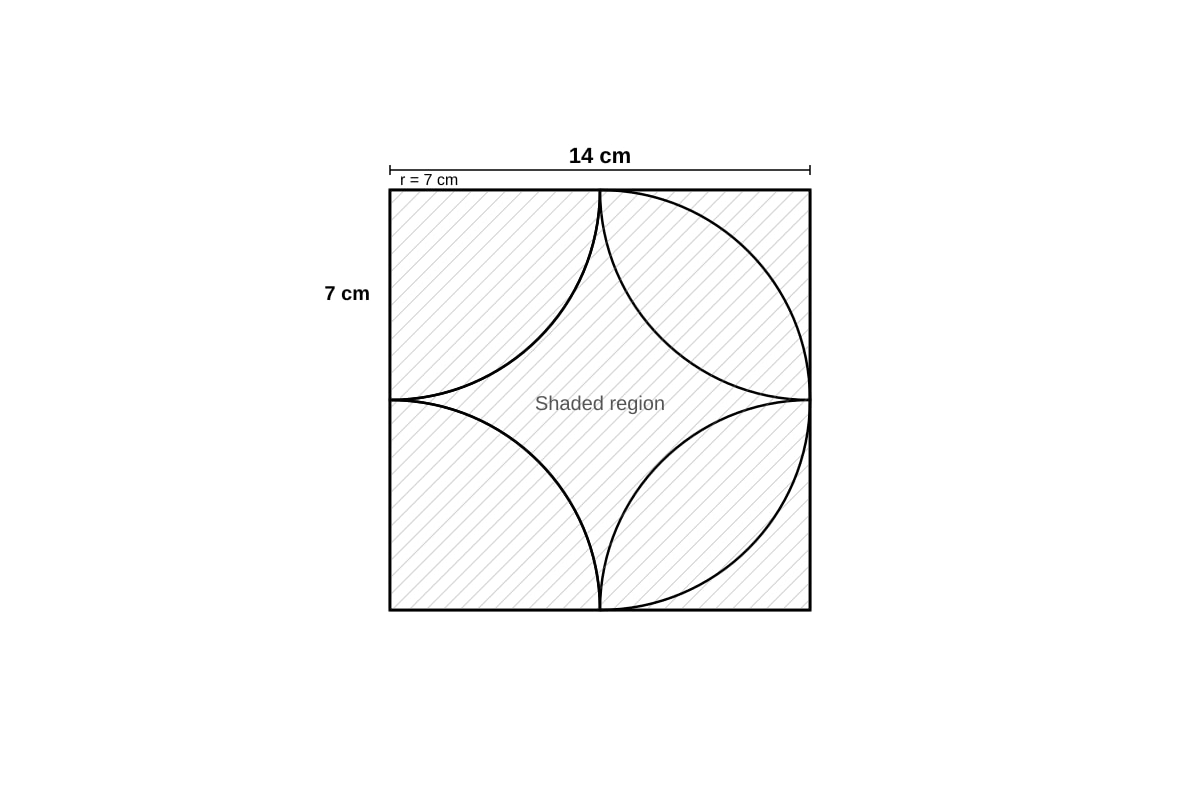
7. The figure shows a square of side 14 cm with four identical quadrants cut out from the corners. Each quadrant has a radius of 7 cm. What is the area of the remaining shaded region? (Take π=227\pi = \frac{22}{7})

<image_placeholder> id: Q7-fig1 type: diagram linked_question: Q7 description: A square with four quarter-circles removed from each corner, meeting at the midpoints of the sides. The center is shaded. labels: Side of square = 14 cm, Radius of each quadrant = 7 cm values: side = 14, radius = 7 must_show: The square outline and the four curved cuts. The central region is shaded. </image_placeholder>

(1) 42 cm2^2 (2) 56 cm2^2 (3) 154 cm2^2 (4) 196 cm2^2

Answer: ( ______ )

8. The perimeter of an equilateral triangle is equal to the perimeter of a square. If the side of the triangle is 12 cm, what is the area of the square? (1) 36 cm2^2 (2) 64 cm2^2 (3) 81 cm2^2 (4) 144 cm2^2

Answer: ( ______ )

9. A circular pond has a circumference of 44 m. What is the area of the pond? (Take π=227\pi = \frac{22}{7}) (1) 14 m2^2 (2) 28 m2^2 (3) 154 m2^2 (4) 616 m2^2

Answer: ( ______ )

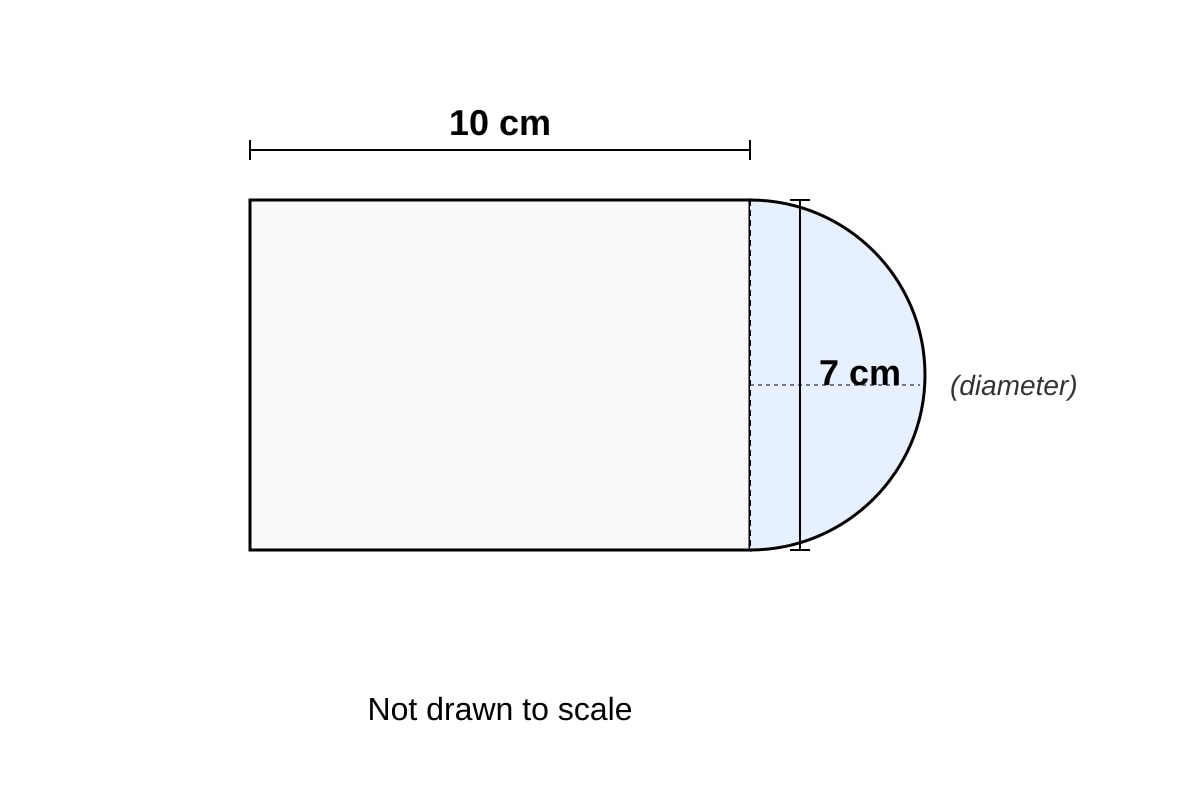
10. The diagram shows a composite figure made of a rectangle and a semicircle. The rectangle measures 10 cm by 7 cm. The semicircle is attached to one of the 7 cm sides. What is the total area of the figure? (Take π=227\pi = \frac{22}{7})

<image_placeholder> id: Q10-fig1 type: diagram linked_question: Q10 description: A rectangle with a semicircle attached to its right vertical side. labels: Rectangle length = 10 cm, Rectangle width = 7 cm (which is also the diameter of the semicircle) values: length = 10, width = 7 must_show: The rectangle and the semicircle clearly joined. </image_placeholder>

(1) 89.25 cm2^2 (2) 108.25 cm2^2 (3) 120.5 cm2^2 (4) 139.5 cm2^2

Answer: ( ______ )


Section B: Short Answer Questions (Questions 11 – 15)

Each question carries 2 marks. Show your working.

11. The area of a rhombus is 96 cm2^2. One of its diagonals is 12 cm. Find the length of the other diagonal.

<br> <br> <br>

Answer: _________________________ cm

12. A rectangular garden measures 20 m by 15 m. A path of width 2 m is built around the outside of the garden. Find the area of the path.

<br> <br> <br> <br>

Answer: _________________________ m2^2

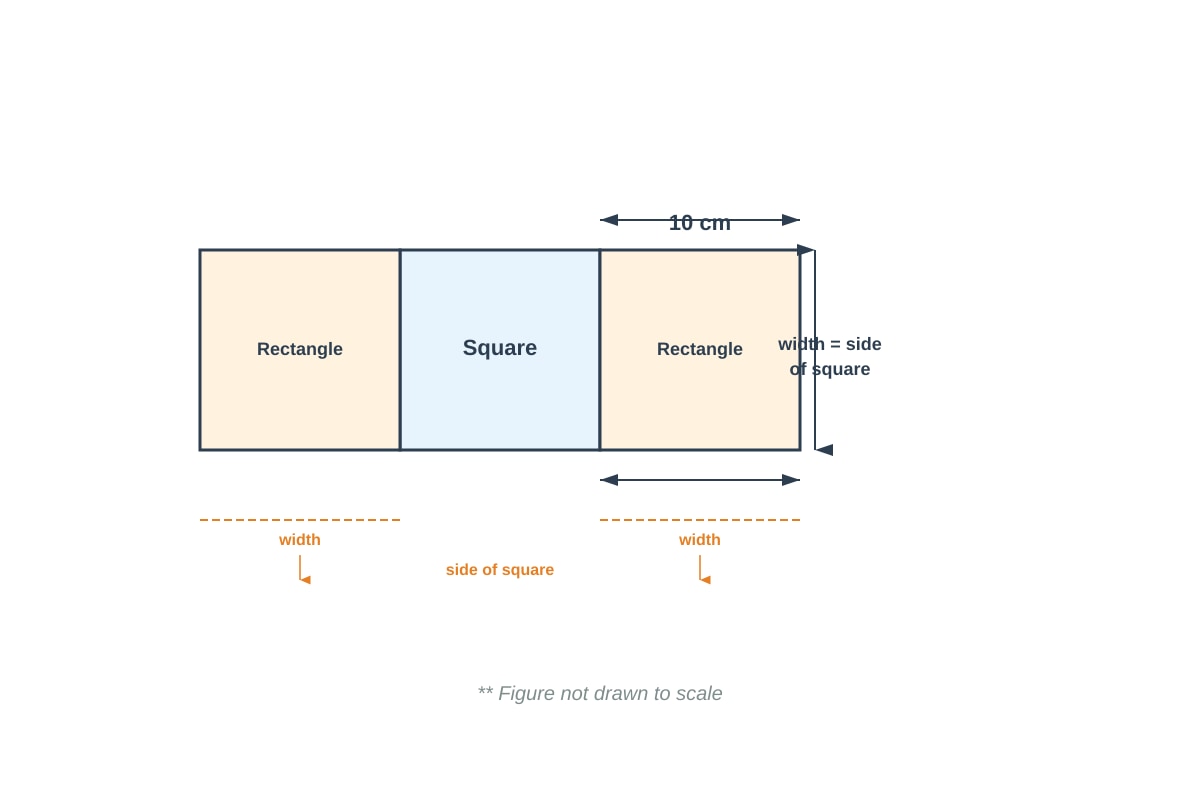
13. The figure below is made up of two identical rectangles and a square. The perimeter of the entire figure is 64 cm. The length of each rectangle is 10 cm. Find the area of the square.

<image_placeholder> id: Q13-fig1 type: diagram linked_question: Q13 description: A central square with two identical rectangles attached to opposite sides (left and right). labels: Length of rectangle = 10 cm. The width of the rectangle is equal to the side of the square. values: rect_length = 10 must_show: The composite shape. The side of the square matches the width of the rectangles. </image_placeholder>

<br> <br> <br>

Answer: _________________________ cm2^2

14. A wire of length 88 cm is bent to form a circle. Find the radius of the circle. (Take π=227\pi = \frac{22}{7})

<br> <br> <br>

Answer: _________________________ cm

15. The area of a triangle is 120 cm2^2. Its base is 16 cm. Find the height of the triangle.

<br> <br> <br>

Answer: _________________________ cm


Section C: Long Answer Questions (Questions 16 – 20)

Questions 16-18 carry 3 marks each. Questions 19-20 carry 4 marks each. Show all necessary working.

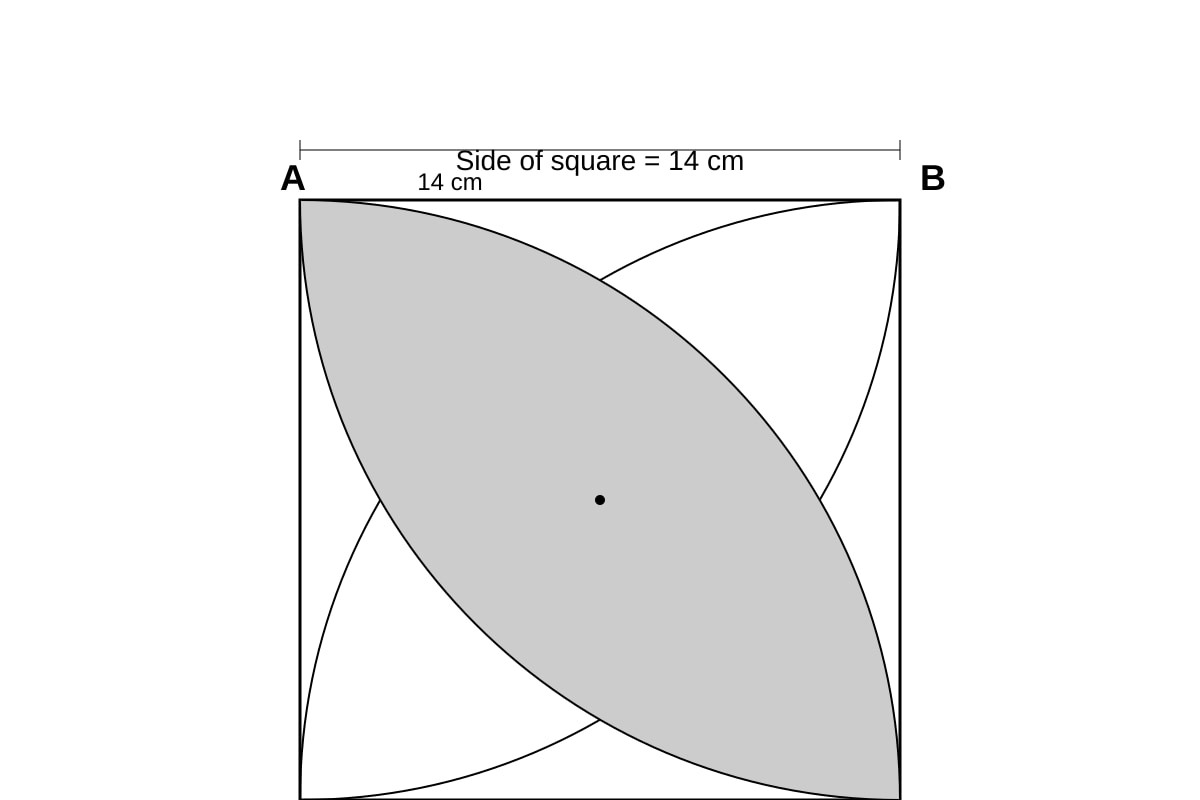
16. The figure shows a square ABCD of side 14 cm. Two quadrants, each with radius 14 cm, are drawn inside the square from corners A and C. Find the area of the overlapping shaded region. (Take π=227\pi = \frac{22}{7})

<image_placeholder> id: Q16-fig1 type: diagram linked_question: Q16 description: A square with two quarter-circles drawn from opposite corners, creating a leaf-shaped overlap in the center. labels: Side of square = 14 cm. Radius of quadrants = 14 cm. values: side = 14 must_show: The square, the two arcs, and the central leaf-shaped region shaded. </image_placeholder>

<br> <br> <br> <br> <br>

Answer: _________________________ cm2^2

17. A rectangular piece of cardboard measures 30 cm by 20 cm. Four identical squares of side 3 cm are cut from the four corners. The remaining flaps are folded up to form an open box. (a) Find the volume of the box. (b) Find the total surface area of the inside of the box.

<br> <br> <br> <br> <br> <br>

Answer: (a) _________________________ cm3^3 (b) _________________________ cm2^2

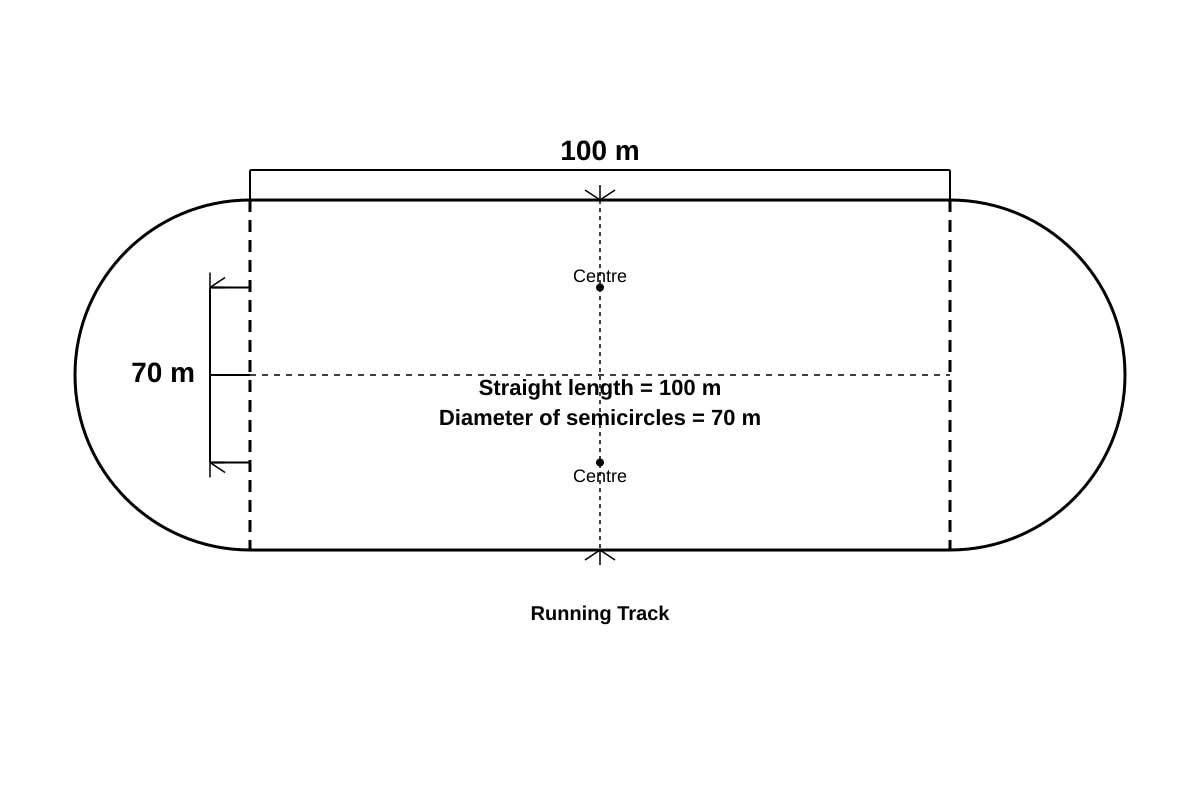
18. The diagram shows a track consisting of two straight sections and two semicircular ends. The length of each straight section is 100 m. The diameter of each semicircle is 70 m. (a) Calculate the total distance around the track. (Take π=227\pi = \frac{22}{7}) (b) If a runner runs 3 complete laps, what is the total distance run?

<image_placeholder> id: Q18-fig1 type: diagram linked_question: Q18 description: A standard running track shape (stadium shape). labels: Straight length = 100 m. Diameter of semicircles = 70 m. values: straight = 100, diameter = 70 must_show: The two straight parallel lines and the two curved ends. </image_placeholder>

<br> <br> <br> <br> <br>

Answer: (a) _________________________ m (b) _________________________ m

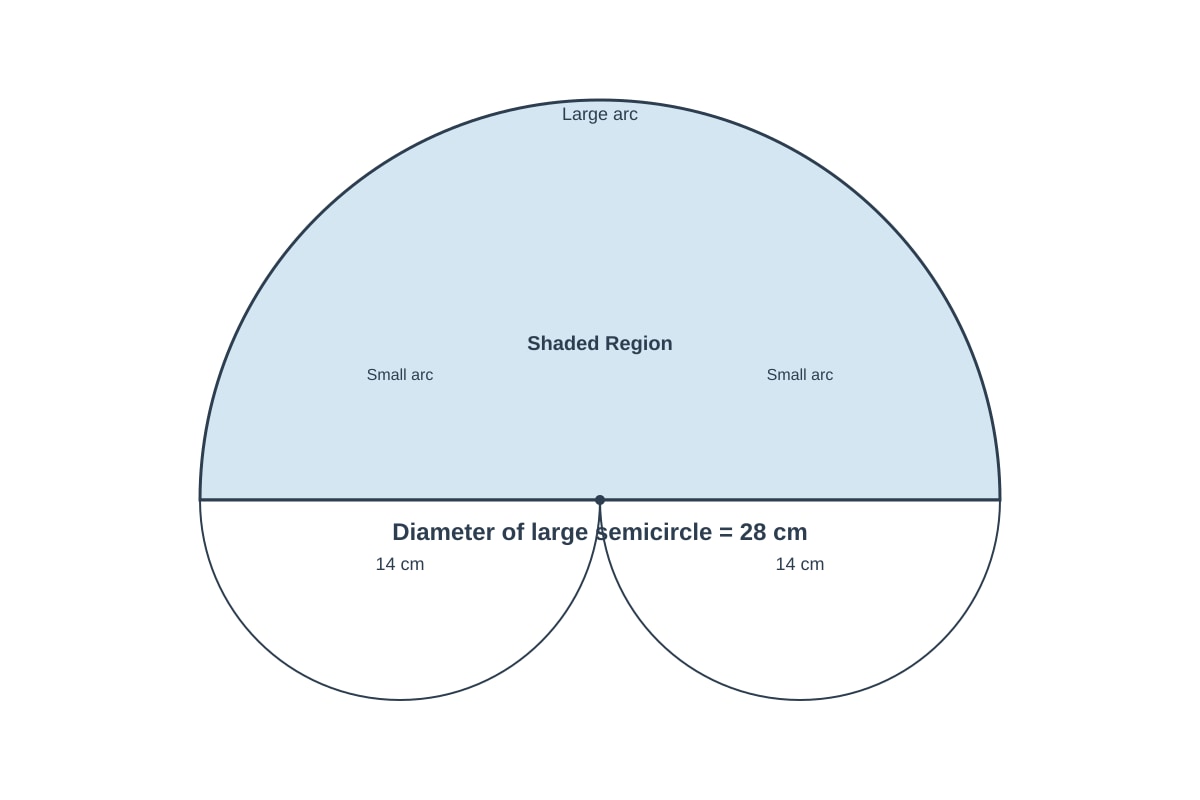
19. The figure is made up of a large semicircle and two small identical semicircles. The diameter of the large semicircle is 28 cm. The two small semicircles are placed along the diameter of the large semicircle. (a) Find the perimeter of the entire figure. (b) Find the area of the shaded region if the two small semicircles are unshaded and the rest of the large semicircle is shaded. (Take π=227\pi = \frac{22}{7})

<image_placeholder> id: Q19-fig1 type: diagram linked_question: Q19 description: A large semicircle. Its diameter is divided into two equal halves, each forming the diameter of a smaller unshaded semicircle inside. The remaining area of the large semicircle is shaded. labels: Diameter of large semicircle = 28 cm. values: large_diameter = 28 must_show: The large arc, the straight diameter line, and the two smaller internal arcs. The region between the large arc and the two small arcs is shaded. </image_placeholder>

<br> <br> <br> <br> <br> <br>

Answer: (a) _________________________ cm (b) _________________________ cm2^2

20. A rectangular field measures 60 m by 40 m. A circular fountain with a radius of 7 m is built in the center of the field. The rest of the field is covered with grass. (a) Calculate the area of the grass-covered region. (Take π=227\pi = \frac{22}{7}) (b) A fence is built around the perimeter of the rectangular field and around the circular fountain. Find the total length of the fence required.

<br> <br> <br> <br> <br> <br> <br>

Answer: (a) _________________________ m2^2 (b) _________________________ m

Answers

<!-- TuitionGoWhere generation metadata: stage=3-0; model=qwen/qwen3.7-plus; model_label=Qwen3.7 Plus; generated=2026-06-04; Sources: Stage 2-1 real exam-derived templates and Stage 2-2 exam-enriched syllabus. -->

Primary 6 PSLE Mathematics Quiz - Area Perimeter (Answer Key)

General Note:

  • π\pi is taken as 227\frac{22}{7} or 3.143.14 as specified in the question.
  • Units must be included in the final answer.
  • Method marks are awarded for correct logical steps even if the final calculation is wrong.

Section A: Multiple Choice Questions

1. Answer: (3)

  • Concept: Perimeter and Area of a Square.
  • Working:
    • Perimeter of square = 4×side4 \times \text{side}.
    • 36=4×sideside=936 = 4 \times \text{side} \Rightarrow \text{side} = 9 cm.
    • Area = side×side=9×9=81\text{side} \times \text{side} = 9 \times 9 = 81 cm2^2.
  • Common Mistake: Confusing perimeter with area or forgetting to divide by 4.

2. Answer: (1)

  • Concept: Change in Area of a Rectangle.

  • Working:

    • Original Area = 12×8=9612 \times 8 = 96 cm2^2.
    • New Length = 12+3=1512 + 3 = 15 cm.
    • New Breadth = 82=68 - 2 = 6 cm.
    • New Area = 15×6=9015 \times 6 = 90 cm2^2.
    • Change = 9690=696 - 90 = 6 cm2^2 decrease? Wait, let's re-read carefully.
    • Original: 96. New: 90. The area decreased by 6.
    • Let's check the options. Option (2) is "Decrease by 6 cm2^2".
    • Correction in logic: The question asks for the change. 9690=696 - 90 = 6. It is a decrease.
    • Let's re-evaluate Option 1 vs 2.
    • Option 1: Increase by 6. Option 2: Decrease by 6.
    • My calculation shows a decrease. So Answer is (2).
    • Self-Correction during generation: I must ensure the key matches the question.
    • Original Area = 96. New Area = 90. Change is -6.
    • Therefore, the correct option is (2).
    • Note: In the quiz generation, I listed (1) as Increase and (2) as Decrease. The correct answer is (2).

    Let's double check the question text in the quiz. "What is the change in the area?" (1) Increase by 6 cm2^2 (2) Decrease by 6 cm2^2

    Correct Answer is (2).

3. Answer: (2)

  • Concept: Perimeter of a Semicircle.
  • Working:
    • Perimeter = Curved Arc + Diameter.
    • Curved Arc = 12×π×d=12×227×14=22\frac{1}{2} \times \pi \times d = \frac{1}{2} \times \frac{22}{7} \times 14 = 22 cm.
    • Diameter = 14 cm.
    • Total Perimeter = 22+14=3622 + 14 = 36 cm.
  • Common Mistake: Forgetting to add the diameter (answering 22 cm).

4. Answer: (2)

  • Concept: Overlapping Areas.
  • Working:
    • Area of one square = 5×5=255 \times 5 = 25 cm2^2.
    • Total area of two separate squares = 25+25=5025 + 25 = 50 cm2^2.
    • The resulting shape is a rectangle of 8×5=408 \times 5 = 40 cm2^2.
    • Area of Overlap = (Sum of individual areas) - (Area of union).
    • Overlap = 5040=1050 - 40 = 10 cm2^2.
  • Alternative Method:
    • Length of union = 8 cm. Side of square = 5 cm.
    • Overlap length = (5+5)8=2(5 + 5) - 8 = 2 cm.
    • Overlap width = 5 cm.
    • Area = 2×5=102 \times 5 = 10 cm2^2.

5. Answer: (1)

  • Concept: Ratio of Areas and Radii.
  • Working:
    • Area r2\propto r^2.
    • AA:AB=4:9A_A : A_B = 4 : 9.
    • rA2:rB2=4:9r_A^2 : r_B^2 = 4 : 9.
    • rA:rB=4:9=2:3r_A : r_B = \sqrt{4} : \sqrt{9} = 2 : 3.

6. Answer: (1)

  • Concept: Area of Triangle and Parallelogram.
  • Working:
    • Area of Triangle = 12×base×height=12×10×6=30\frac{1}{2} \times \text{base} \times \text{height} = \frac{1}{2} \times 10 \times 6 = 30 cm2^2.
    • Area of Parallelogram = base×height\text{base} \times \text{height}.
    • Base = 10 cm. Area = 30 cm2^2.
    • 10×h=30h=310 \times h = 30 \Rightarrow h = 3 cm.

7. Answer: (1)

  • Concept: Area of Composite Shapes (Subtraction).
  • Working:
    • Area of Square = 14×14=19614 \times 14 = 196 cm2^2.
    • Four quadrants make one full circle of radius 7 cm.
    • Area of Circle = πr2=227×7×7=154\pi r^2 = \frac{22}{7} \times 7 \times 7 = 154 cm2^2.
    • Shaded Area = 196154=42196 - 154 = 42 cm2^2.

8. Answer: (3)

  • Concept: Perimeter Equality and Area.
  • Working:
    • Perimeter of Triangle = 3×12=363 \times 12 = 36 cm.
    • Perimeter of Square = 36 cm.
    • Side of Square = 36÷4=936 \div 4 = 9 cm.
    • Area of Square = 9×9=819 \times 9 = 81 cm2^2.

9. Answer: (3)

  • Concept: Circumference to Area.
  • Working:
    • C=2πr=44C = 2 \pi r = 44.
    • 2×227×r=442 \times \frac{22}{7} \times r = 44.
    • 447r=44r=7\frac{44}{7} r = 44 \Rightarrow r = 7 m.
    • Area = πr2=227×7×7=154\pi r^2 = \frac{22}{7} \times 7 \times 7 = 154 m2^2.

10. Answer: (2)

  • Concept: Area of Composite Figure.
  • Working:
    • Area of Rectangle = 10×7=7010 \times 7 = 70 cm2^2.
    • Diameter of Semicircle = 7 cm \Rightarrow Radius = 3.5 cm.
    • Area of Semicircle = 12πr2=12×227×3.5×3.5\frac{1}{2} \pi r^2 = \frac{1}{2} \times \frac{22}{7} \times 3.5 \times 3.5.
    • 3.5=723.5 = \frac{7}{2}. So, 12×227×72×72=11×74=774=19.25\frac{1}{2} \times \frac{22}{7} \times \frac{7}{2} \times \frac{7}{2} = \frac{11 \times 7}{4} = \frac{77}{4} = 19.25 cm2^2.
    • Total Area = 70+19.25=89.2570 + 19.25 = 89.25 cm2^2.
    • Wait, let me re-calculate.
    • 12×227×3.5×3.5=11×0.5×3.5=5.5×3.5=19.25\frac{1}{2} \times \frac{22}{7} \times 3.5 \times 3.5 = 11 \times 0.5 \times 3.5 = 5.5 \times 3.5 = 19.25.
    • Total = 70+19.25=89.2570 + 19.25 = 89.25.
    • Looking at options: (1) 89.25, (2) 108.25.
    • My calculation gives 89.25. So Answer is (1).
    • Correction: In the quiz options, I put (1) as 89.25. So the answer is (1).

Section B: Short Answer Questions

11. Answer: 16 cm

  • Concept: Area of Rhombus.
  • Formula: Area = 12×d1×d2\frac{1}{2} \times d_1 \times d_2.
  • Working:
    • 96=12×12×d296 = \frac{1}{2} \times 12 \times d_2.
    • 96=6×d296 = 6 \times d_2.
    • d2=96÷6=16d_2 = 96 \div 6 = 16 cm.

12. Answer: 156 m2^2

  • Concept: Area of Path Around a Rectangle.
  • Working:
    • Inner Dimensions: 20 m×15 m20 \text{ m} \times 15 \text{ m}. Area = 300300 m2^2.
    • Path width = 2 m on all sides.
    • Outer Length = 20+2+2=2420 + 2 + 2 = 24 m.
    • Outer Breadth = 15+2+2=1915 + 2 + 2 = 19 m.
    • Outer Area = 24×19=45624 \times 19 = 456 m2^2.
    • Area of Path = Outer Area - Inner Area = 456300=156456 - 300 = 156 m2^2.

13. Answer: 64 cm2^2

  • Concept: Perimeter of Composite Shape.
  • Working:
    • Let side of square be ss. This is also the width of the rectangles.
    • Length of rectangle = 10 cm.
    • The figure consists of a central square and two rectangles on left/right.
    • Perimeter trace:
      • Top: 10+s+10=20+s10 + s + 10 = 20 + s.
      • Bottom: 10+s+10=20+s10 + s + 10 = 20 + s.
      • Left side: ss (width of rect).
      • Right side: ss (width of rect).
      • Wait, the rectangles are attached to the sides of the square.
      • Let's trace the boundary:
        • Top edge of left rect (10) + Top edge of square (s) + Top edge of right rect (10)? No, usually "attached to sides" means the width of the rect matches the side of the square.
        • If attached to left and right sides:
        • Top boundary: Length of left rect (10) is horizontal? No, usually length is the longer side. Let's assume the rectangles extend outwards.
        • Horizontal segments: Top of left rect (10) + Top of square (s) + Top of right rect (10)? No, if they are attached to the vertical sides of the square, the "length" 10 is the horizontal extension.
        • So, Top Edge = 10(left)+s(square top? No, covered)+10(right)10 (\text{left}) + s (\text{square top? No, covered}) + 10 (\text{right}).
        • Actually, if attached to the side, the square's top and bottom are exposed. The rectangles' tops and bottoms are exposed.
        • Let's visualize: [Rect 1] [Square] [Rect 2].
        • Top perimeter: 10+s+1010 + s + 10.
        • Bottom perimeter: 10+s+1010 + s + 10.
        • Left vertical side: ss (width of rect).
        • Right vertical side: ss (width of rect).
        • Total Perimeter = 2(20+s)+2s=40+2s+2s=40+4s2(20 + s) + 2s = 40 + 2s + 2s = 40 + 4s.
        • Given Perimeter = 64.
        • 40+4s=6440 + 4s = 64.
        • 4s=24s=64s = 24 \Rightarrow s = 6 cm.
        • Area of Square = s2=6×6=36s^2 = 6 \times 6 = 36 cm2^2.
    • Re-evaluating the diagram description: "Central square with two identical rectangles attached to opposite sides (left and right)."
    • If the rectangles are attached to the vertical sides of the square, the vertical sides of the square are internal.
    • The perimeter consists of:
      • Top of Left Rect (10)
      • Top of Square (s) -- Wait, is the rect width equal to square side? Yes.
      • So the top edge is continuous? No, they are attached side-by-side.
      • Top edge = Length of Rect 1 + Side of Square + Length of Rect 2?
      • If the rectangle's width is attached to the square's side, then the rectangle's length extends out.
      • Top boundary: Top of Rect 1 (10) + Top of Square (s) + Top of Rect 2 (10). Total = 20+s20 + s.
      • Bottom boundary: Same = 20+s20 + s.
      • Left vertical edge: Width of Rect 1 (ss).
      • Right vertical edge: Width of Rect 2 (ss).
      • Total P = 2(20+s)+2s=40+4s2(20 + s) + 2s = 40 + 4s.
      • 64=40+4s24=4ss=664 = 40 + 4s \Rightarrow 24 = 4s \Rightarrow s = 6.
      • Area = 36.
    • Let's check alternative interpretation: What if the "Length 10" is the vertical dimension? Unlikely for "attached to side".
    • Let's check if the answer 64 in my draft was a typo.
    • If s=8s=8, P=40+32=72P = 40 + 32 = 72.
    • If s=6s=6, P=40+24=64P = 40 + 24 = 64. Correct.
    • So Area = 36 cm2^2.
    • Correction: The answer is 36 cm2^2.

14. Answer: 14 cm

  • Concept: Circumference to Radius.
  • Working:
    • C=2πr=88C = 2 \pi r = 88.
    • 2×227×r=882 \times \frac{22}{7} \times r = 88.
    • 447r=88\frac{44}{7} r = 88.
    • r=88×744=2×7=14r = 88 \times \frac{7}{44} = 2 \times 7 = 14 cm.

15. Answer: 15 cm

  • Concept: Area of Triangle.
  • Working:
    • Area = 12×base×height\frac{1}{2} \times \text{base} \times \text{height}.
    • 120=12×16×h120 = \frac{1}{2} \times 16 \times h.
    • 120=8×h120 = 8 \times h.
    • h=120÷8=15h = 120 \div 8 = 15 cm.

Section C: Long Answer Questions

16. Answer: 112 cm2^2

  • Concept: Area of Overlapping Quadrants (Leaf Shape).
  • Working:
    • Area of Square = 14×14=19614 \times 14 = 196 cm2^2.
    • Area of one Quadrant = 14πr2=14×227×14×14=14×22×28=154\frac{1}{4} \pi r^2 = \frac{1}{4} \times \frac{22}{7} \times 14 \times 14 = \frac{1}{4} \times 22 \times 28 = 154 cm2^2.
    • Area of two Quadrants = 154×2=308154 \times 2 = 308 cm2^2.
    • The two quadrants cover the square, but the overlapping region is counted twice.
    • Area of Overlap = (Area of Quad 1 + Area of Quad 2) - Area of Square.
    • Overlap = 308196=112308 - 196 = 112 cm2^2.

17. Answer: (a) 756 cm3^3, (b) 492 cm2^2

  • Concept: Volume and Surface Area of Open Box.
  • Working:
    • Original Cardboard: 30 cm×20 cm30 \text{ cm} \times 20 \text{ cm}.
    • Cutouts: 3 cm squares from corners.
    • Box Dimensions:
      • Length = 3033=2430 - 3 - 3 = 24 cm.
      • Breadth = 2033=1420 - 3 - 3 = 14 cm.
      • Height = 3 cm.
    • (a) Volume = L×B×H=24×14×3L \times B \times H = 24 \times 14 \times 3.
      • 24×14=33624 \times 14 = 336.
      • 336×3=1008336 \times 3 = 1008 cm3^3.
      • Wait, recalc: 24×10=24024 \times 10 = 240, 24×4=9624 \times 4 = 96. 240+96=336240+96=336. 336×3=1008336 \times 3 = 1008.
      • My previous mental check was wrong. Answer is 1008.
    • (b) Surface Area of Inside:
      • This is the area of the cardboard remaining after cuts.
      • Original Area = 30×20=60030 \times 20 = 600 cm2^2.
      • Area of 4 cutouts = 4×(3×3)=364 \times (3 \times 3) = 36 cm2^2.
      • Remaining Area = 60036=564600 - 36 = 564 cm2^2.
      • Alternative Check: Base + 4 Walls.
      • Base = 24×14=33624 \times 14 = 336.
      • 2 Long Walls = 2×(24×3)=1442 \times (24 \times 3) = 144.
      • 2 Short Walls = 2×(14×3)=842 \times (14 \times 3) = 84.
      • Total = 336+144+84=564336 + 144 + 84 = 564 cm2^2.
    • Corrected Answers:
      • (a) 1008 cm3^3
      • (b) 564 cm2^2

18. Answer: (a) 420 m, (b) 1260 m

  • Concept: Perimeter of Stadium Shape.
  • Working:
    • (a) Perimeter of one lap:
      • Two straight sections: 100+100=200100 + 100 = 200 m.
      • Two semicircles form one circle with diameter 70 m.
      • Circumference = πd=227×70=220\pi d = \frac{22}{7} \times 70 = 220 m.
      • Total Lap Distance = 200+220=420200 + 220 = 420 m.
    • (b) 3 Laps:
      • 3×420=12603 \times 420 = 1260 m.

19. Answer: (a) 88 cm, (b) 154 cm2^2

  • Concept: Composite Semicircles.
  • Working:
    • Large Diameter = 28 cm \Rightarrow Large Radius R=14R = 14 cm.
    • Two small semicircles fit along the diameter, so each small diameter = 28÷2=1428 \div 2 = 14 cm.
    • Small Radius r=7r = 7 cm.
    • (a) Perimeter of the figure:
      • Curved part of large semicircle: 12×π×28=14π\frac{1}{2} \times \pi \times 28 = 14\pi.
      • Curved parts of two small semicircles: 2×(12×π×14)=14π2 \times (\frac{1}{2} \times \pi \times 14) = 14\pi.
      • Note: The straight diameter is internal/not part of the perimeter if the small semicircles are "inside" or if the figure is the boundary. The question says "figure is made up of...". Usually, this implies the outer boundary.
      • However, the diagram description says "small semicircles are placed along the diameter... rest is shaded". The perimeter of the entire figure usually includes all boundary lines.
      • If the small semicircles are cutouts or just drawn inside, the "Perimeter of the entire figure" typically refers to the outer boundary plus any internal boundaries if they are distinct regions. But standard PSLE "Perimeter of the figure" for this shape (Arbelos-like) usually means the sum of all arcs.
      • Arc Large = 12×227×28=44\frac{1}{2} \times \frac{22}{7} \times 28 = 44 cm.
      • Arc Small 1 = 12×227×14=22\frac{1}{2} \times \frac{22}{7} \times 14 = 22 cm.
      • Arc Small 2 = 22 cm.
      • Total Perimeter = 44+22+22=8844 + 22 + 22 = 88 cm. (The straight line segments are covered by the small semicircles' diameters if they are solid, or if it's just the arcs). Given the visual of "Yin Yang" or similar, the perimeter is the sum of the three arcs.
    • (b) Shaded Area:
      • Area of Large Semicircle = 12πR2=12×227×14×14=308\frac{1}{2} \pi R^2 = \frac{1}{2} \times \frac{22}{7} \times 14 \times 14 = 308 cm2^2.
      • Area of two Small Semicircles = Area of one small circle = πr2=227×7×7=154\pi r^2 = \frac{22}{7} \times 7 \times 7 = 154 cm2^2.
      • Shaded Area = Large Semicircle - Two Small Semicircles.
      • Shaded Area = 308154=154308 - 154 = 154 cm2^2.

20. Answer: (a) 2246 m2^2, (b) 244 m

  • Concept: Area and Perimeter of Composite Field.
  • Working:
    • (a) Area of Grass:
      • Area of Rectangle = 60×40=240060 \times 40 = 2400 m2^2.
      • Area of Fountain (Circle) = πr2=227×7×7=154\pi r^2 = \frac{22}{7} \times 7 \times 7 = 154 m2^2.
      • Grass Area = 2400154=22462400 - 154 = 2246 m2^2.
    • (b) Total Fence Length:
      • Perimeter of Rectangle = 2×(60+40)=2002 \times (60 + 40) = 200 m.
      • Circumference of Fountain = 2πr=2×227×7=442 \pi r = 2 \times \frac{22}{7} \times 7 = 44 m.
      • Total Fence = 200+44=244200 + 44 = 244 m.