From Real Exams Quiz
Primary 6 PSLE Mathematics Area Perimeter Quiz
Free P6 PSLE Maths Area Perimeter quiz, Exam version, with questions, answers, and PSLE-focused practice for Singapore students.
These static practice materials are generated from the site's syllabus and paper-generation workflow, with source and model context shown so students and parents can evaluate the material before use.
Questions
Free quiz and exam paper access
Enter your details to view this paper
Your access is remembered on this device.
Answers
Primary 6 PSLE Mathematics Quiz - Area Perimeter: Answer Key
Total Marks: 60
Section A: Multiple Choice Questions (5 × 2 marks = 10 marks)
1. Answer: B) 40 cm
- Working: Perimeter of rectangle = 2 × (length + width) = 2 × (12 + 8) = 2 × 20 = 40 cm.
- Explanation: Perimeter is the total distance around the outside of a shape. For a rectangle, opposite sides are equal, so we add the length and width and multiply by 2.
- Common mistake: Option D (40 cm²) uses area units (cm²) instead of perimeter units (cm). Option C (96 cm²) is the area (12 × 8 = 96 cm²).
2. Answer: C) 81 cm²
- Working: Perimeter of square = 4 × side. So side = 36 ÷ 4 = 9 cm. Area of square = side × side = 9 × 9 = 81 cm².
- Explanation: A square has 4 equal sides. First find the side length from the perimeter, then calculate the area.
- Common mistake: Option A (9 cm) is the side length, not the area. Option B (36 cm²) confuses perimeter value with area.
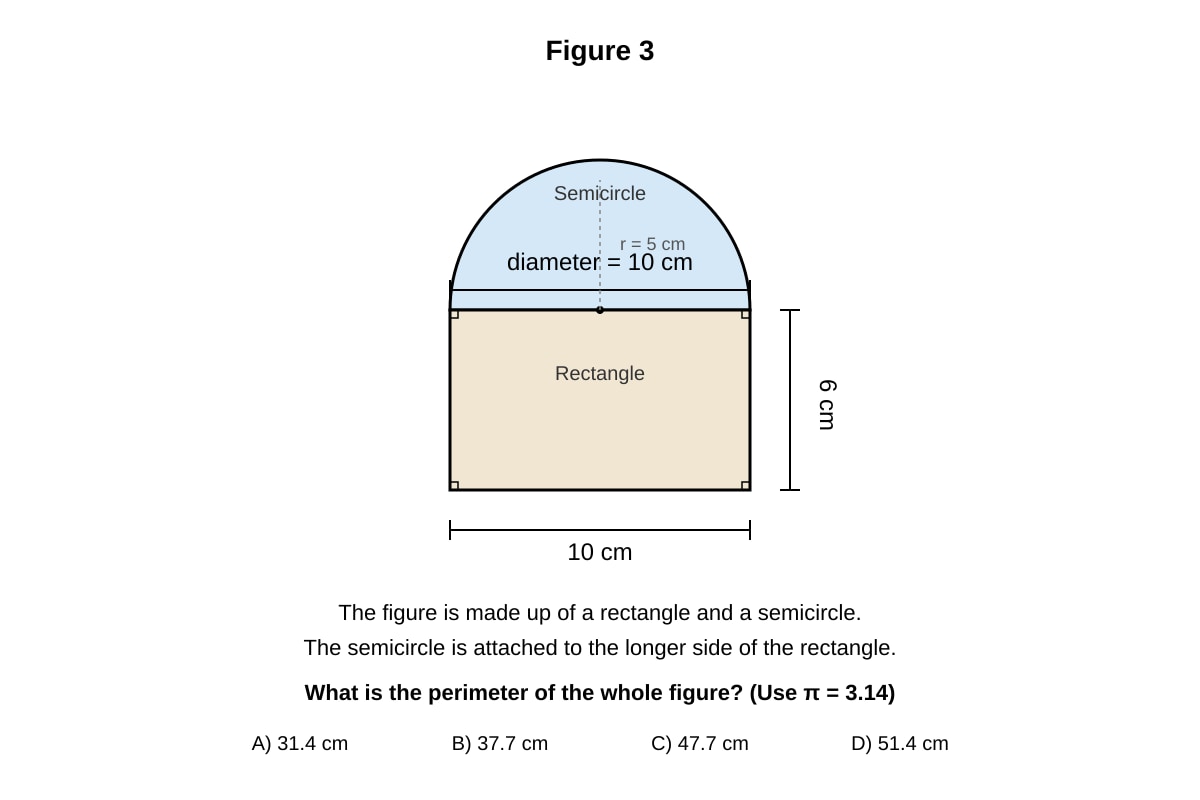
3. Answer: C) 47.7 cm
- Working: Perimeter = rectangle perimeter (excluding the side where semicircle is attached) + semicircle arc length.
- Rectangle: two sides of 6 cm each + one side of 10 cm (the bottom) = 6 + 6 + 10 = 22 cm. (The top side is replaced by the semicircle.)
- Semicircle arc length = (π × diameter) ÷ 2 = (3.14 × 10) ÷ 2 = 31.4 ÷ 2 = 15.7 cm.
- Total perimeter = 22 + 15.7 = 37.7 cm.
- Explanation: When a semicircle is attached to a rectangle, the side of the rectangle where it attaches is no longer part of the outer perimeter. We add the arc length of the semicircle instead.
- Common mistake: Option D (51.4 cm) includes the full circumference of the circle instead of half. Option A (31.4 cm) only calculates the arc length.
4. Answer: B) 154 cm²
- Working: Area of circle = π × r² = (22/7) × 7 × 7 = 22 × 7 = 154 cm².
- Explanation: The formula for the area of a circle is πr². When using π = 22/7 and r = 7, the calculation simplifies nicely.
- Common mistake: Option A (44 cm²) is the circumference (2πr). Option C (308 cm²) uses 2πr². Option D (616 cm²) uses πd².
5. Answer: B) 40 cm²
- Working: Area of triangle = (1/2) × base × height = (1/2) × 10 × 8 = 40 cm².
- Explanation: A triangle's area is half the area of a rectangle with the same base and height.
- Common mistake: Option C (80 cm²) forgets to multiply by 1/2. Option D (160 cm²) multiplies base and height and then doubles it.
Section B: Short-Answer Questions (10 × 3 marks = 30 marks)
6. Answer: 54 m²
- Working:
- Outer rectangle (garden + path): length = 15 + 1 + 1 = 17 m, width = 12 + 1 + 1 = 14 m.
- Area of outer rectangle = 17 × 14 = 238 m².
- Area of garden = 15 × 12 = 180 m².
- Area of path = 238 - 180 = 58 m².
- Explanation: The path runs around the outside, so it adds 1 m to each side. The area of the path is the difference between the area of the larger rectangle (garden + path) and the area of the garden itself.
- Marking scheme: 1 mark for correct outer dimensions, 1 mark for correct area calculations, 1 mark for final answer.
- Common mistake: Forgetting to add the path width to both sides (only adding 1 m instead of 2 m to each dimension).
7. Answer: 35.7 cm
- Working:
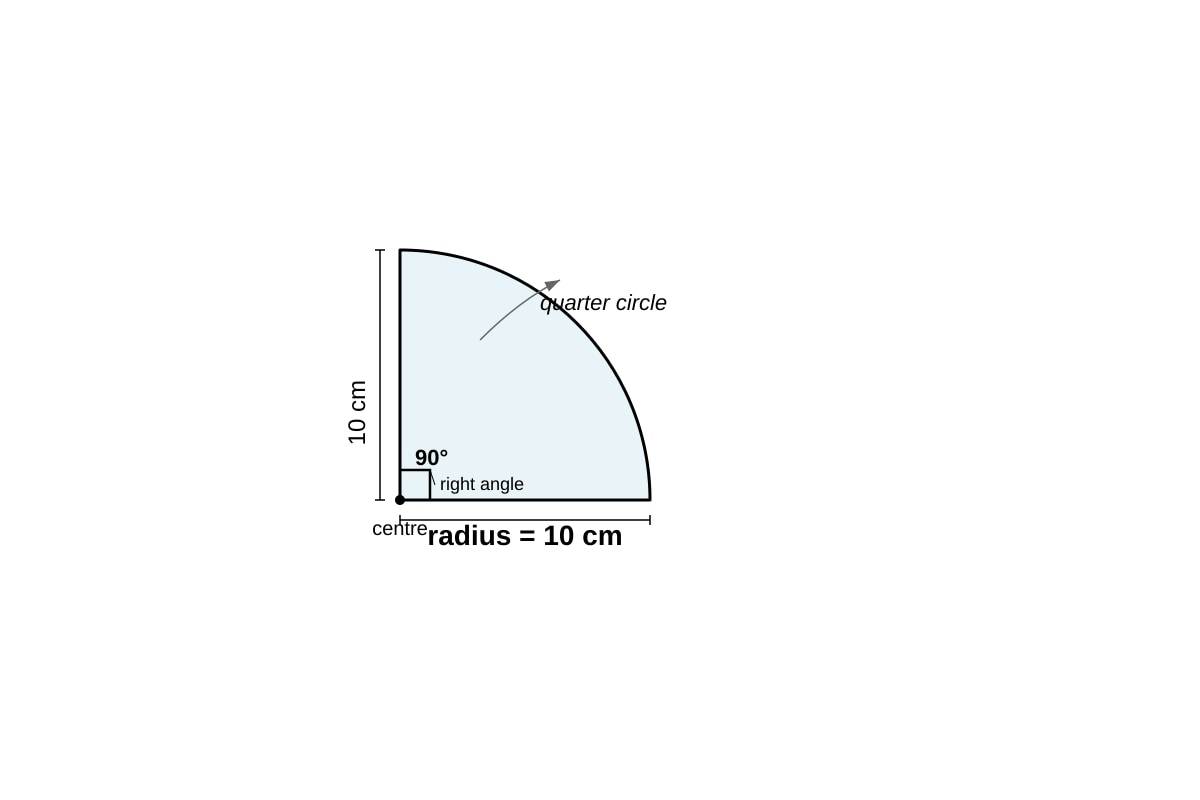
- Quarter circle arc length = (2 × π × r) ÷ 4 = (2 × 3.14 × 10) ÷ 4 = 62.8 ÷ 4 = 15.7 cm.
- Two straight sides (radii) = 10 + 10 = 20 cm.
- Total perimeter = 15.7 + 20 = 35.7 cm.
- Explanation: The perimeter of a quarter circle consists of the curved arc (one quarter of the full circumference) plus the two straight radii.
- Marking scheme: 1 mark for arc length, 1 mark for straight sides, 1 mark for final answer.
- Common mistake: Forgetting to include the two straight sides.
8. Answer: 54 cm²
- Working: Area of parallelogram = base × height = 9 × 6 = 54 cm².
- Explanation: The area of a parallelogram is calculated the same way as a rectangle: base times perpendicular height.
- Marking scheme: 1 mark for correct formula, 1 mark for correct substitution, 1 mark for final answer.
- Common mistake: Using the slanted side length instead of the perpendicular height.
9. Answer: 100 cm
- Working:
- Original perimeter of rectangle = 2 × (30 + 20) = 100 cm.
- When squares are cut from corners, the perimeter does not change. Each cut removes a corner but adds two new edges of the same total length.
- Therefore, perimeter remains 100 cm.
- Explanation: Cutting squares from corners creates an indentation, but the total perimeter remains the same as the original rectangle because the removed edges are replaced by new edges of equal total length.
- Marking scheme: 1 mark for understanding perimeter remains unchanged, 1 mark for correct reasoning, 1 mark for final answer.
- Common mistake: Trying to calculate the new perimeter by subtracting the cut-out parts.
10. Answer: 8 cm
- Working: Area of triangle = (1/2) × base × height. So 48 = (1/2) × 12 × height. 48 = 6 × height. Height = 48 ÷ 6 = 8 cm.
- Explanation: Rearrange the formula to find the unknown height. Multiply both sides by 2 first: 96 = 12 × height, then divide by 12.
- Marking scheme: 1 mark for correct formula, 1 mark for correct rearrangement, 1 mark for final answer.
- Common mistake: Forgetting to multiply by 2 first (doing 48 ÷ 12 = 4 cm).
11. Answer: 10 cm
- Working: Circumference = 2 × π × r. So 62.8 = 2 × 3.14 × r. 62.8 = 6.28 × r. r = 62.8 ÷ 6.28 = 10 cm.
- Explanation: The circumference formula is C = 2πr. To find the radius, divide the circumference by 2π.
- Marking scheme: 1 mark for correct formula, 1 mark for correct rearrangement, 1 mark for final answer.
- Common mistake: Using C = πd and forgetting to divide by 2 again.
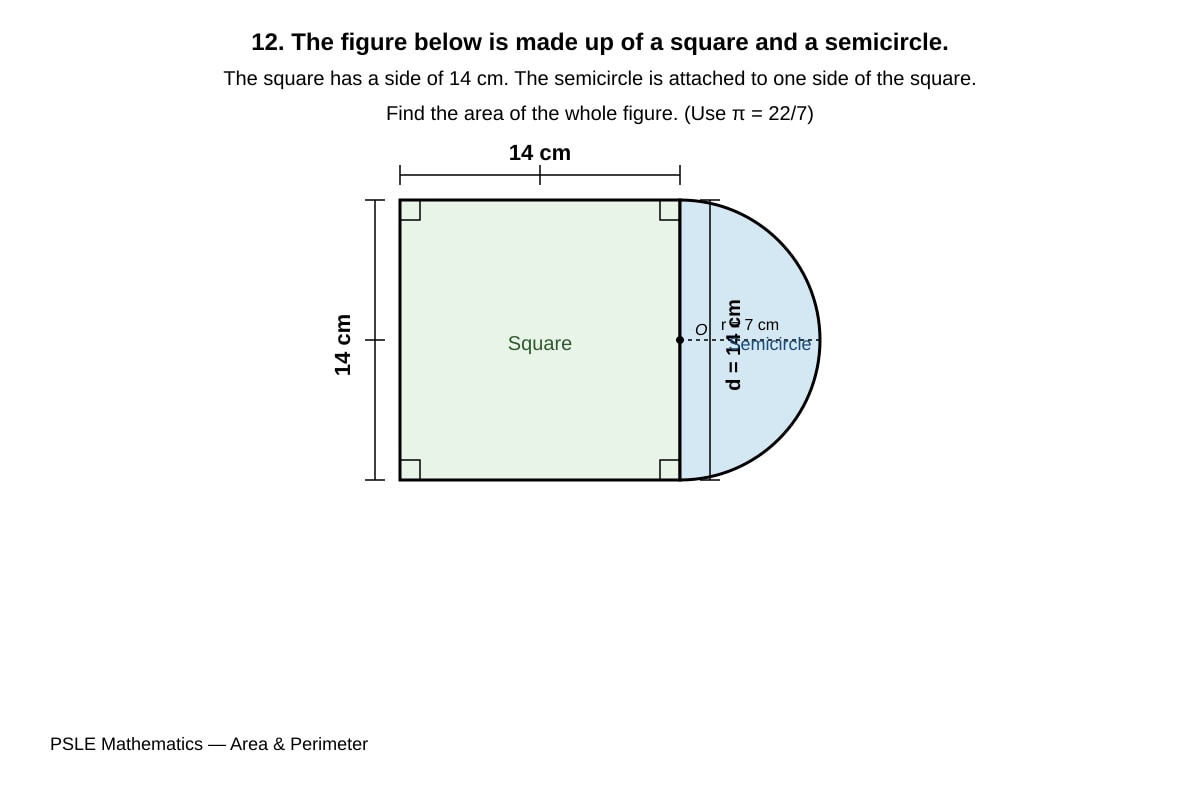
12. Answer: 273 cm²
- Working:
- Area of square = 14 × 14 = 196 cm².
- Area of semicircle = (π × r²) ÷ 2 = (22/7 × 7 × 7) ÷ 2 = (22 × 7) ÷ 2 = 154 ÷ 2 = 77 cm².
- Total area = 196 + 77 = 273 cm².
- Explanation: The figure is a composite shape. Calculate the area of each part separately and add them together. The semicircle has a diameter of 14 cm, so its radius is 7 cm.
- Marking scheme: 1 mark for square area, 1 mark for semicircle area, 1 mark for final answer.
- Common mistake: Using the diameter instead of the radius in the circle area formula.
13. Answer: 50 cm²
- Working: Area of trapezium = (1/2) × (sum of parallel sides) × height = (1/2) × (8 + 12) × 5 = (1/2) × 20 × 5 = 10 × 5 = 50 cm².
- Explanation: The formula for the area of a trapezium is the average of the parallel sides multiplied by the height.
- Marking scheme: 1 mark for correct formula, 1 mark for correct substitution, 1 mark for final answer.
- Common mistake: Forgetting to multiply by 1/2.
14. Answer: 1500 cm²
- Working: The water surface is a rectangle with the same length and width as the tank. Area = 50 × 30 = 1500 cm².
- Explanation: The area of the water surface depends only on the length and width of the tank, not on the water depth. The depth (25 cm) is extra information not needed for this question.
- Marking scheme: 1 mark for identifying correct dimensions, 1 mark for correct calculation, 1 mark for final answer.
- Common mistake: Including the water depth in the calculation (e.g., calculating volume instead).
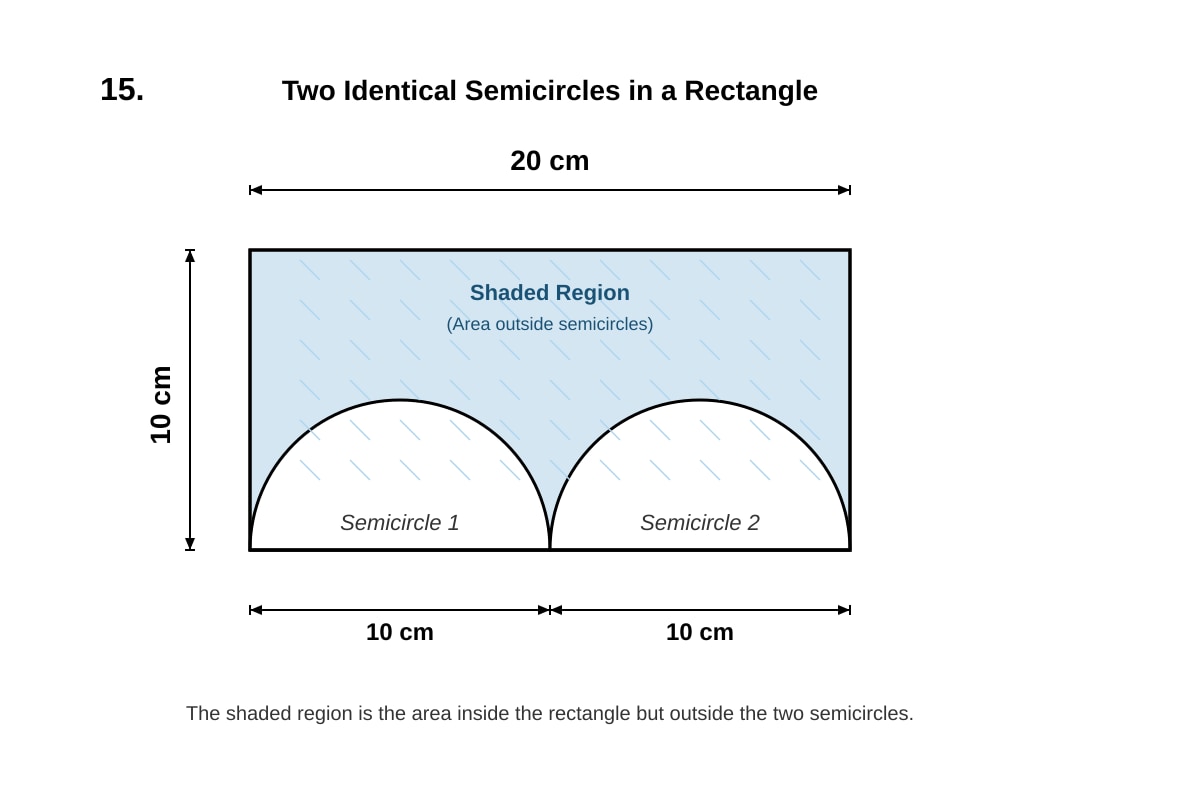
15. Answer: 121 cm²
- Working:
- Area of rectangle = 20 × 10 = 200 cm².
- Area of one semicircle = (π × r²) ÷ 2 = (3.14 × 5 × 5) ÷ 2 = 78.5 ÷ 2 = 39.25 cm².
- Area of two semicircles = 39.25 × 2 = 78.5 cm².
- Area of shaded region = 200 - 78.5 = 121.5 cm².
- Explanation: The two semicircles together form one full circle of radius 5 cm. The shaded area is the rectangle minus the area of the circle (two semicircles).
- Marking scheme: 1 mark for rectangle area, 1 mark for semicircles/circle area, 1 mark for final answer.
- Common mistake: Calculating the area of each semicircle separately and making arithmetic errors.
Section C: Problem-Solving Questions (5 × 4 marks = 20 marks)
16. Answer: 225 cm²
- Working:
- Perimeter of rectangle = 2 × (18 + 12) = 2 × 30 = 60 cm.
- This is the length of the wire. When bent into a square, the square's perimeter is also 60 cm.
- Side of square = 60 ÷ 4 = 15 cm.
- Area of square = 15 × 15 = 225 cm².
- Explanation: The wire's length doesn't change when reshaped. First find the perimeter of the rectangle (which equals the wire length), then use that to find the square's side length, then calculate the area.
- Marking scheme: 1 mark for rectangle perimeter, 1 mark for square side, 1 mark for square area, 1 mark for correct final answer with units.
- Common mistake: Calculating the area of the rectangle instead of using the perimeter to find the square's dimensions.
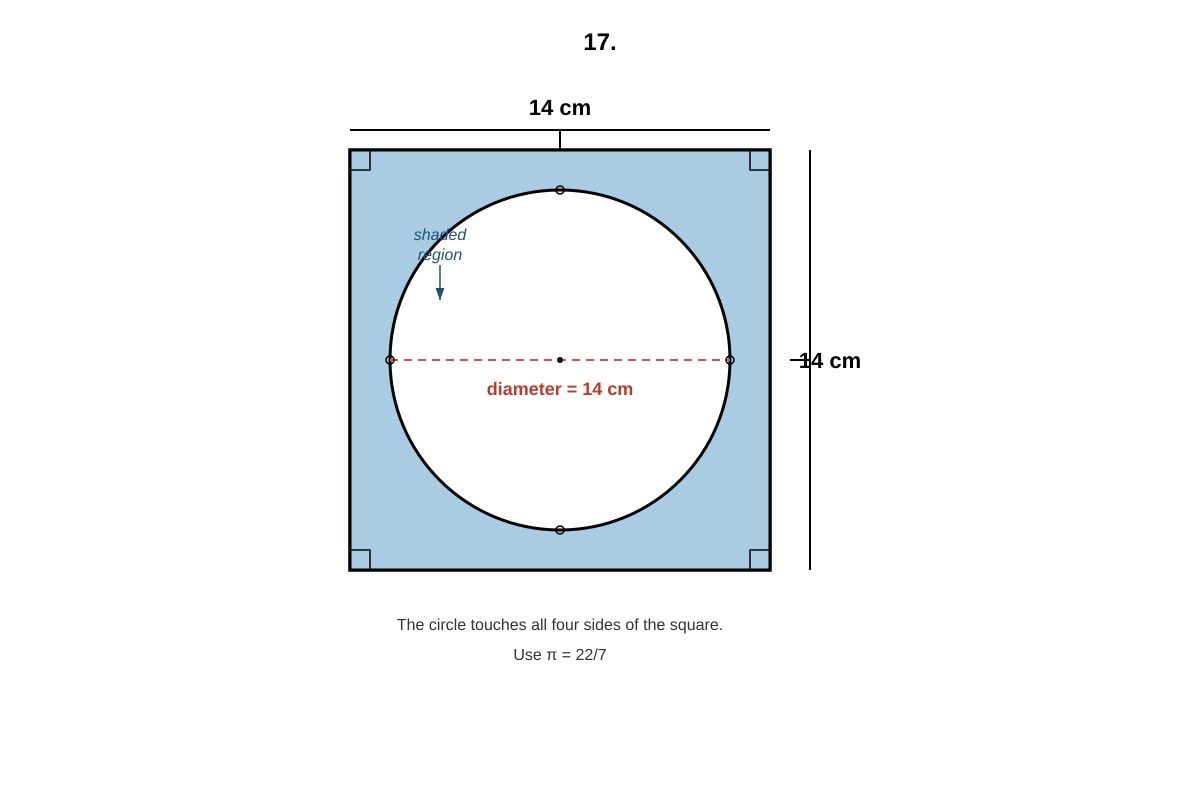
17. Answer: 42 cm²
- Working:
- Area of square = 14 × 14 = 196 cm².
- Radius of circle = 14 ÷ 2 = 7 cm.
- Area of circle = π × r² = (22/7) × 7 × 7 = 22 × 7 = 154 cm².
- Area of shaded region = 196 - 154 = 42 cm².
- Explanation: When a circle is inscribed in a square, the diameter of the circle equals the side of the square. The shaded area is the difference between the square area and the circle area.
- Marking scheme: 1 mark for square area, 1 mark for circle radius, 1 mark for circle area, 1 mark for final answer.
- Common mistake: Using the side of the square as the radius of the circle instead of the diameter.
18. Answer: 2 m
- Working:
- Let the width of the path be x m.
- Inner rectangle (field without path): length = 60 - 2x, width = 40 - 2x.
- Area of inner rectangle = (60 - 2x)(40 - 2x).
- Area of path = Area of field - Area of inner rectangle = 544.
- 60 × 40 - (60 - 2x)(40 - 2x) = 544.
- 2400 - (2400 - 120x - 80x + 4x²) = 544.
- 2400 - 2400 + 200x - 4x² = 544.
- 200x - 4x² = 544.
- Divide by 4: 50x - x² = 136.
- Rearrange: x² - 50x + 136 = 0.
- (x - 4)(x - 34) = 0.
- x = 4 or x = 34.
- Since the path runs inside the field, x must be less than half the width (20 m), so x = 4 m.
- Explanation: The path runs inside the field, so the inner rectangle is smaller. Set up an equation using the area difference and solve the quadratic equation. Reject the impossible solution (34 m is larger than the field dimensions).
- Marking scheme: 1 mark for setting up inner dimensions, 1 mark for correct equation, 1 mark for solving quadratic, 1 mark for selecting correct answer.
- Common mistake: Forgetting to subtract 2x (path on both sides) instead of just x.
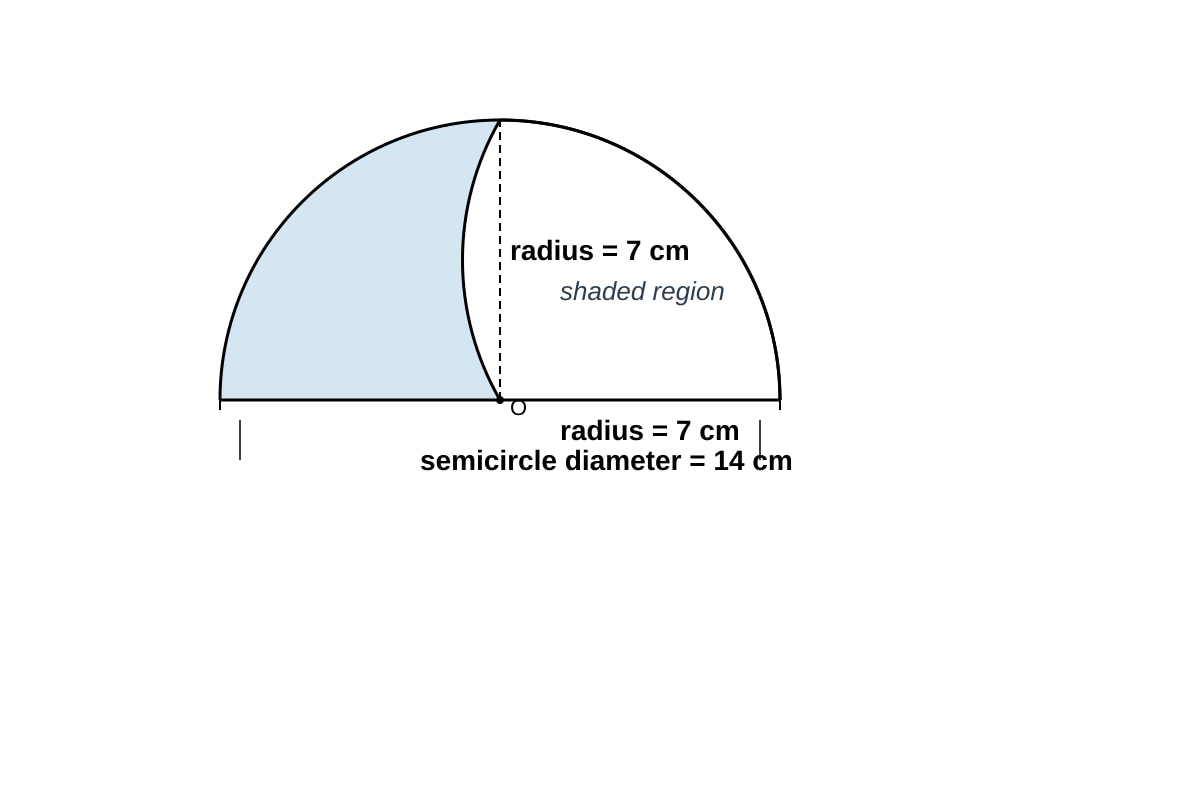
19. Answer: 44 cm
- Working:
- Semicircle arc length = (2 × π × 7) ÷ 2 = 2 × (22/7) × 7 ÷ 2 = 22 cm.
- Quarter circle arc length = (2 × π × 7) ÷ 4 = 2 × (22/7) × 7 ÷ 4 = 11 cm.
- The perimeter of the shaded region consists of:
- The semicircle arc (22 cm)
- The quarter circle arc (11 cm)
- One radius of the semicircle (7 cm) - the other radius is inside the quarter circle
- Total perimeter = 22 + 11 + 7 = 40 cm.
- Explanation: The shaded region is the area between the semicircle and the quarter circle. Its perimeter includes the outer arc (semicircle), the inner arc (quarter circle), and the straight line segment (radius) connecting them.
- Marking scheme: 1 mark for semicircle arc, 1 mark for quarter circle arc, 1 mark for identifying all boundary parts, 1 mark for final answer.
- Common mistake: Forgetting to include the straight line segment (radius) in the perimeter.
20. Answer: 886 cm²
- Working:
- Area of rectangle = 40 × 30 = 1200 cm².
- Area of one circle = π × r² = 3.14 × 5 × 5 = 78.5 cm².
- Area of four circles = 78.5 × 4 = 314 cm².
- Area of remaining cardboard = 1200 - 314 = 886 cm².
- Explanation: The circles cut out from the corners do not overlap. The remaining area is simply the rectangle area minus the total area of the four circles.
- Marking scheme: 1 mark for rectangle area, 1 mark for one circle area, 1 mark for total circles area, 1 mark for final answer.
- Common mistake: Thinking the circles overlap or that the remaining shape has a different perimeter.