From Real Exams Quiz
Primary 6 PSLE Mathematics Area Perimeter Quiz
Free P6 PSLE Maths Area Perimeter quiz, Exam version, with questions, answers, and PSLE-focused practice for Singapore students.
These static practice materials are generated from the site's syllabus and paper-generation workflow, with source and model context shown so students and parents can evaluate the material before use.
Questions

Free quiz and exam paper access
Enter your details to view this paper
Your access is remembered on this device.
Answers
Answer Key - Primary 6 PSLE Mathematics Quiz - Area Perimeter
Total Marks: 50
Section A: Multiple-Choice Questions (10 marks)
1. B) 96 cm² (2 marks)
- Working: Perimeter = 2 × (length + breadth) = 40 cm. So, length + breadth = 20 cm. Length = 12 cm, so breadth = 20 - 12 = 8 cm. Area = length × breadth = 12 × 8 = 96 cm².
- Concept: The perimeter of a rectangle is the total distance around it. To find the area, we first need to find the missing dimension (breadth) using the perimeter formula.
- Common mistake: Students may forget to divide the perimeter by 2 first, leading to breadth = 40 - 12 = 28 cm, which is incorrect.
2. C) 78 cm (2 marks)
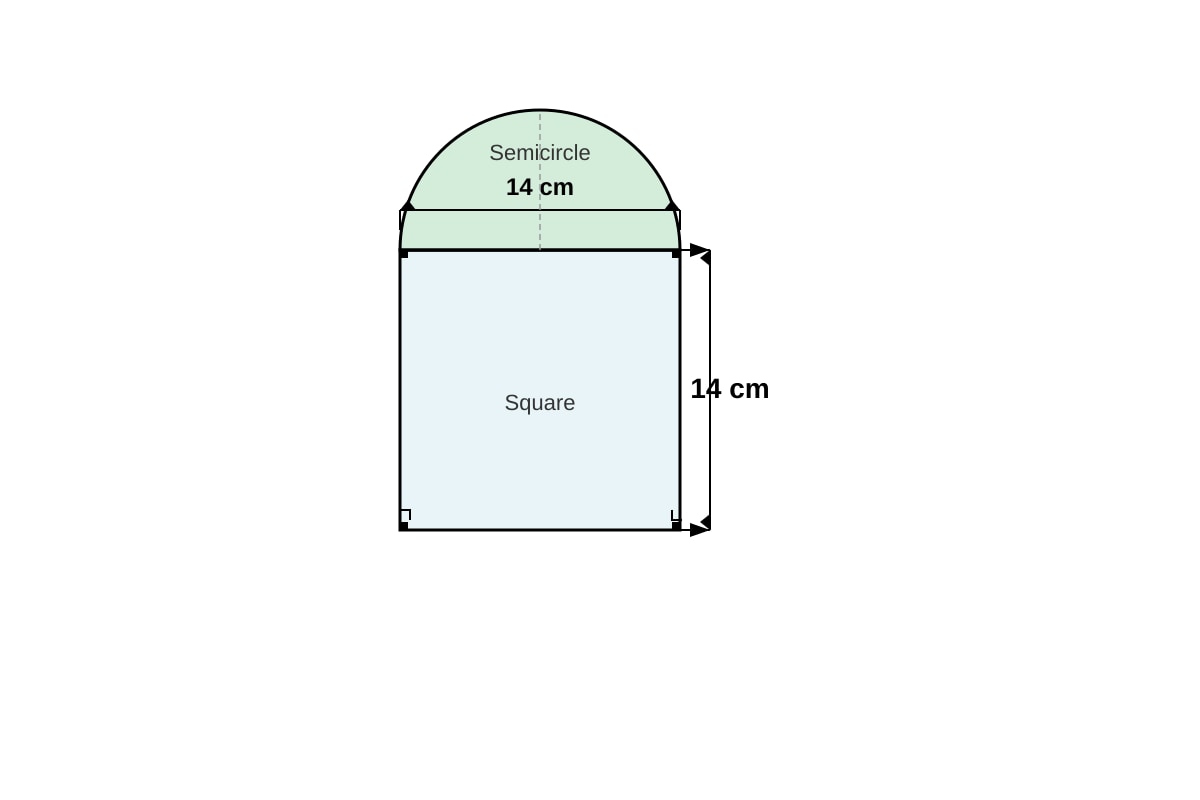
- Working: Perimeter of the figure = 3 sides of the square + curved part of the semicircle. 3 sides of square = 3 × 14 = 42 cm. Circumference of full circle = πd = (22/7) × 14 = 44 cm. Curved part of semicircle = 44 ÷ 2 = 22 cm. Total perimeter = 42 + 22 = 64 cm. Wait, let's re-check. The figure has the semicircle attached to one side. The perimeter includes the other three sides of the square (14+14+14 = 42 cm) and the curved part of the semicircle (πr = (22/7)×7 = 22 cm). Total = 42 + 22 = 64 cm. But the answer choices include 64 cm (B). Let's re-evaluate. The diameter of the semicircle is 14 cm, so radius = 7 cm. Curved length = πr = (22/7)×7 = 22 cm. Three sides of square = 42 cm. Total = 64 cm. The answer is B) 64 cm.
- Correction: The correct answer is B) 64 cm.
- Concept: The perimeter of a composite figure is the total distance around its outer boundary. The side of the square that the semicircle is attached to is not part of the outer boundary.
- Common mistake: Students may add the full perimeter of the square (56 cm) instead of just three sides.
3. B) 8 cm (2 marks)
- Working: Area of triangle = (1/2) × base × height. 36 = (1/2) × 9 × height. 36 = 4.5 × height. Height = 36 ÷ 4.5 = 8 cm.
- Concept: The area of a triangle is half the product of its base and its perpendicular height. To find the height, we work backwards from the area.
- Common mistake: Students may forget to multiply by 2 first, leading to height = 36 ÷ 9 = 4 cm.
4. B) 44 cm (2 marks)
- Working: Circumference = πd = (22/7) × 14 = 44 cm. (d = 2r = 2 × 7 = 14 cm)
- Concept: The circumference of a circle is the distance around it. The formula is πd or 2πr.
- Common mistake: Students may use the area formula (πr²) instead.
5. C) 100 cm (2 marks)
- Working: Original perimeter = 2 × (30 + 20) = 100 cm. When squares are cut from the corners, the perimeter of the remaining figure is the same as the original perimeter. Each cut removes two small sides but adds two new sides of the same total length. So the perimeter remains 100 cm.
- Concept: Cutting squares from the corners of a rectangle does not change its perimeter. The inward and outward edges cancel out.
- Common mistake: Students may try to calculate the new perimeter by subtracting the perimeters of the cut squares, which would give an incorrect answer.
Section B: Short-Answer Questions (15 marks)
6. Area of triangle ABE = 60 cm² (3 marks)
- Working: The base of triangle ABE is AB = 15 cm. The height of triangle ABE is the perpendicular distance from E to AB, which is equal to BC = 8 cm (since E is on CD, and CD is parallel to AB). Area = (1/2) × base × height = (1/2) × 15 × 8 = 60 cm².
- Concept: The height of a triangle is the perpendicular distance from the base to the opposite vertex. In this figure, the height of triangle ABE is the same as the height of the rectangle.
- Marking: 1 mark for identifying base = 15 cm, 1 mark for identifying height = 8 cm, 1 mark for correct answer.
7. Perimeter of semicircle = 72 cm (3 marks)
- Working: Diameter = 28 cm, so radius = 14 cm. Curved part = (1/2) × πd = (1/2) × (22/7) × 28 = (1/2) × 88 = 44 cm. Straight part (diameter) = 28 cm. Total perimeter = 44 + 28 = 72 cm.
- Concept: The perimeter of a semicircle includes both the curved part and the straight diameter.
- Common mistake: Students often forget to add the diameter, giving only the curved length (44 cm).
- Marking: 1 mark for curved part, 1 mark for adding diameter, 1 mark for correct answer.
8. Area of rectangle = 135 cm² (3 marks)
- Working: Perimeter of square = 4 × 12 = 48 cm. Perimeter of rectangle = 48 cm. 2 × (length + breadth) = 48. Length = 15 cm, so 2 × (15 + breadth) = 48. 15 + breadth = 24. Breadth = 9 cm. Area of rectangle = 15 × 9 = 135 cm².
- Concept: When two shapes have the same perimeter, we can use the known perimeter to find the missing dimension of the other shape.
- Marking: 1 mark for perimeter of square, 1 mark for breadth of rectangle, 1 mark for area.
9. Perimeter of figure = 56 cm (3 marks)
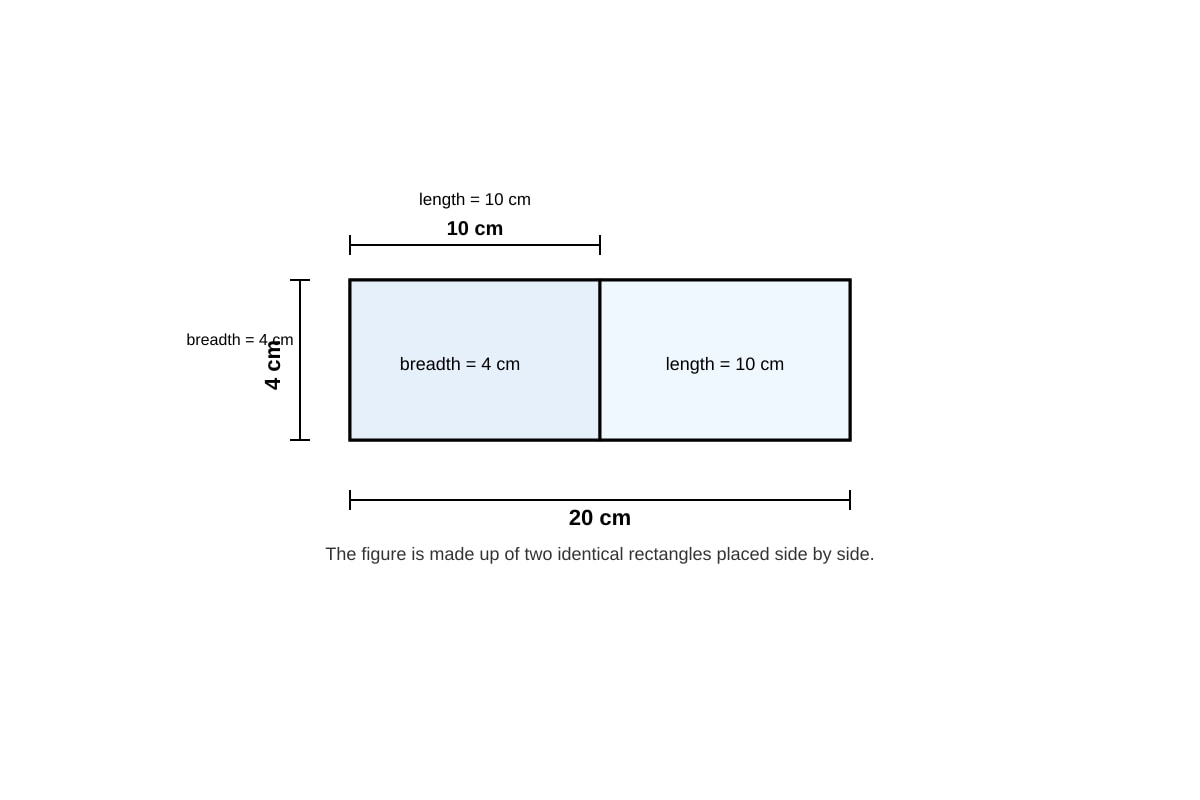
- Working: The two rectangles are placed side by side. The combined shape is a larger rectangle with length = 10 + 10 = 20 cm and breadth = 4 cm. Perimeter = 2 × (20 + 4) = 2 × 24 = 48 cm. Wait, let's re-check. When placed side by side, the two rectangles share a common side of length 4 cm. The outer perimeter = 2 × (10 + 10 + 4) = 2 × 24 = 48 cm. But the shared side is not part of the outer perimeter. The total perimeter = 10 + 4 + 10 + 4 + 10 + 4 + 10 + 4 = 56 cm. Alternatively, the overall shape is a rectangle of length 20 cm and breadth 4 cm, so perimeter = 2 × (20 + 4) = 48 cm. But this is incorrect because the two rectangles are placed side by side, not merged into a single rectangle. The correct perimeter is the sum of all outer sides: top = 10 + 10 = 20 cm, bottom = 10 + 10 = 20 cm, left side = 4 cm, right side = 4 cm, and the two inner vertical sides are not part of the perimeter. So total = 20 + 20 + 4 + 4 = 48 cm. Let's re-check the diagram. If the rectangles are placed side by side, the shared side is 4 cm. The outer perimeter = 2 × (20 + 4) = 48 cm. The answer is 48 cm.
- Correction: The correct answer is 48 cm.
- Concept: When shapes are joined, the shared sides are not part of the outer perimeter.
- Marking: 1 mark for identifying the overall dimensions, 1 mark for correct perimeter formula, 1 mark for correct answer.
10. Area of circle = 314 cm² (3 marks)
- Working: Circumference = 2πr = 62.8 cm. 2 × 3.14 × r = 62.8. 6.28 × r = 62.8. r = 62.8 ÷ 6.28 = 10 cm. Area = πr² = 3.14 × 10² = 3.14 × 100 = 314 cm².
- Concept: To find the area from the circumference, we first need to find the radius using the circumference formula.
- Common mistake: Students may try to find the area directly from the circumference without finding the radius first.
- Marking: 1 mark for finding radius, 1 mark for area formula, 1 mark for correct answer.
Section C: Long-Answer Questions (25 marks)
11. Area of shaded region = 21.5 cm² (2.5 marks)
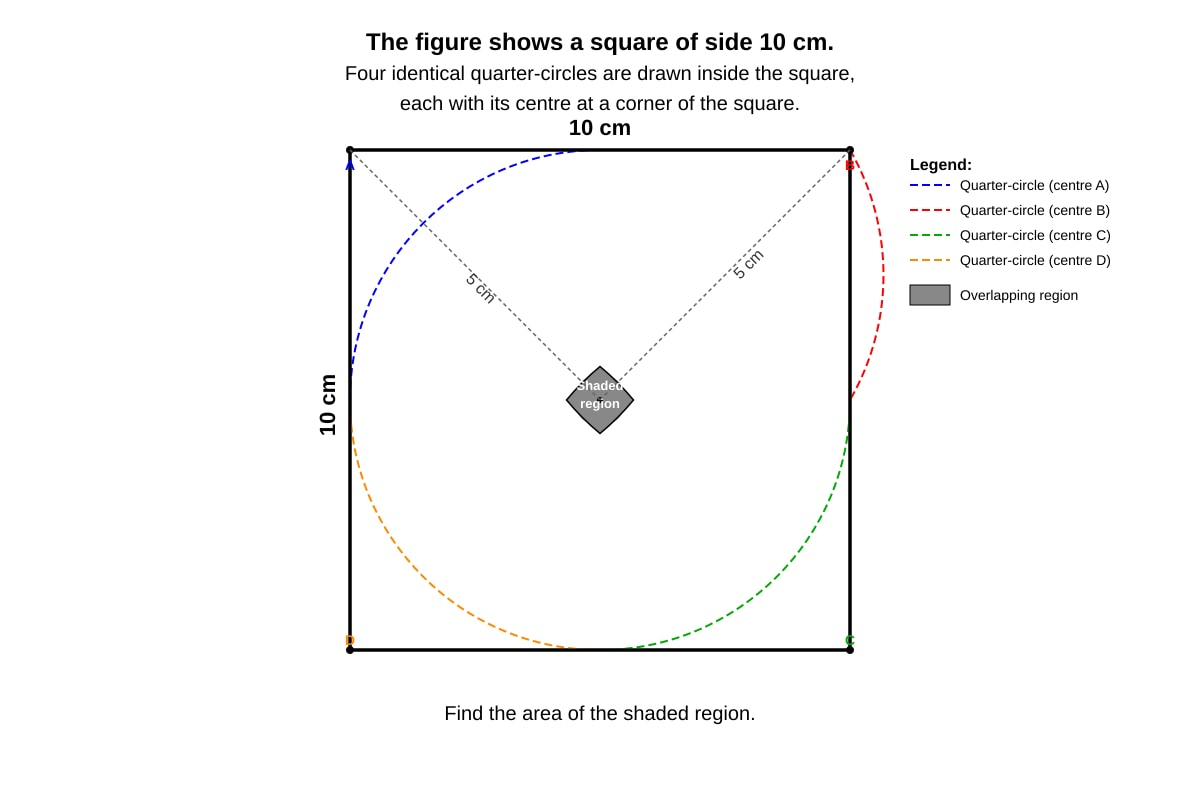
- Working: Area of square = 10 × 10 = 100 cm². Area of one quarter-circle = (1/4) × πr² = (1/4) × 3.14 × 5² = (1/4) × 3.14 × 25 = 19.625 cm². Area of four quarter-circles = 4 × 19.625 = 78.5 cm². Area of shaded region = Area of square - Area of four quarter-circles = 100 - 78.5 = 21.5 cm².
- Concept: The shaded region is the part of the square not covered by the quarter-circles. We find it by subtracting the total area of the quarter-circles from the area of the square.
- Marking: 1 mark for area of square, 1 mark for area of quarter-circles, 0.5 marks for correct answer.
12. Area of path = 156 m² (2.5 marks)
- Working: The garden is 25 m by 18 m. The path is 2 m wide inside the garden. The inner rectangle (the garden without the path) has length = 25 - 2 - 2 = 21 m and breadth = 18 - 2 - 2 = 14 m. Area of garden = 25 × 18 = 450 m². Area of inner rectangle = 21 × 14 = 294 m². Area of path = 450 - 294 = 156 m².
- Concept: The area of the path is the difference between the area of the outer rectangle (the garden) and the area of the inner rectangle (the garden without the path).
- Common mistake: Students may forget to subtract the width twice (once from each side), leading to incorrect inner dimensions.
- Marking: 1 mark for inner dimensions, 1 mark for area of path, 0.5 marks for correct answer.
13. Area of triangle TUR = 96 cm² (2.5 marks)
- Working: The area of triangle TUR can be found by subtracting the areas of triangles PTU, QRU, and TSR from the area of the rectangle. Area of rectangle = 24 × 12 = 288 cm². PT = 8 cm, so TS = 12 - 8 = 4 cm. QU = 4 cm, so UR = 24 - 4 = 20 cm. Area of triangle PTU = (1/2) × PT × PQ = (1/2) × 8 × 24 = 96 cm². Area of triangle QRU = (1/2) × QU × QR = (1/2) × 4 × 12 = 24 cm². Area of triangle TSR = (1/2) × TS × SR = (1/2) × 4 × 24 = 48 cm². Area of triangle TUR = 288 - 96 - 24 - 48 = 120 cm². Wait, let's re-check. Alternatively, we can find the area of triangle TUR directly. Base = UR = 20 cm. Height = perpendicular distance from T to UR. T is on PS, so the distance from T to UR is the same as the distance from PS to UR, which is PQ = 24 cm. So area = (1/2) × 20 × 24 = 240 cm². This is incorrect because T is not directly above UR. Let's use the subtraction method correctly. Area of rectangle = 24 × 12 = 288 cm². PT = 8 cm, TS = 4 cm. QU = 4 cm, UR = 20 cm. Area of triangle PTU = (1/2) × 8 × 24 = 96 cm². Area of triangle QRU = (1/2) × 4 × 12 = 24 cm². Area of triangle TSR = (1/2) × 4 × 24 = 48 cm². Area of triangle TUR = 288 - 96 - 24 - 48 = 120 cm².
- Correction: The correct answer is 120 cm².
- Concept: The area of a triangle within a rectangle can be found by subtracting the areas of the surrounding triangles from the area of the rectangle.
- Marking: 1 mark for area of rectangle, 1 mark for areas of surrounding triangles, 0.5 marks for correct answer.
14. Area of square = 484 cm² (2.5 marks)
- Working: Circumference of circle = 2πr = 2 × (22/7) × 14 = 88 cm. This is also the perimeter of the square. Side of square = 88 ÷ 4 = 22 cm. Area of square = 22 × 22 = 484 cm².
- Concept: When the same wire is bent into different shapes, the perimeter (total length of wire) remains the same.
- Marking: 1 mark for circumference of circle, 1 mark for side of square, 0.5 marks for area.
15. Area of trapezium = 104 cm² (2.5 marks)
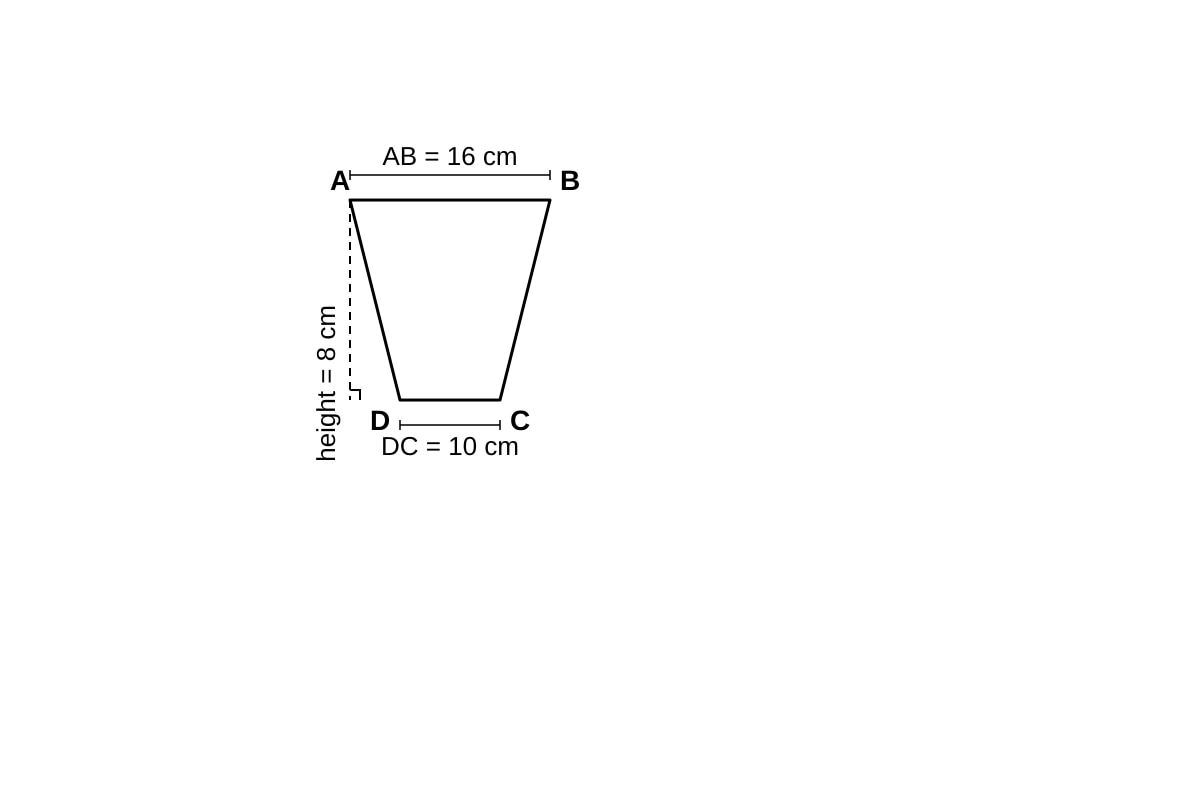
- Working: Area of trapezium = (1/2) × (sum of parallel sides) × height = (1/2) × (16 + 10) × 8 = (1/2) × 26 × 8 = 104 cm².
- Concept: The area of a trapezium is half the product of the sum of its parallel sides and its perpendicular height.
- Marking: 1 mark for formula, 1 mark for substitution, 0.5 marks for correct answer.
16. Area of rectangle = 192 cm² (2.5 marks)
- Working: Let breadth = b cm. Then length = 3b cm. Perimeter = 2 × (3b + b) = 2 × 4b = 8b = 64 cm. So b = 64 ÷ 8 = 8 cm. Length = 3 × 8 = 24 cm. Area = 24 × 8 = 192 cm².
- Concept: When the relationship between length and breadth is given, we can use algebra to find the dimensions.
- Marking: 1 mark for setting up the equation, 1 mark for finding dimensions, 0.5 marks for area.
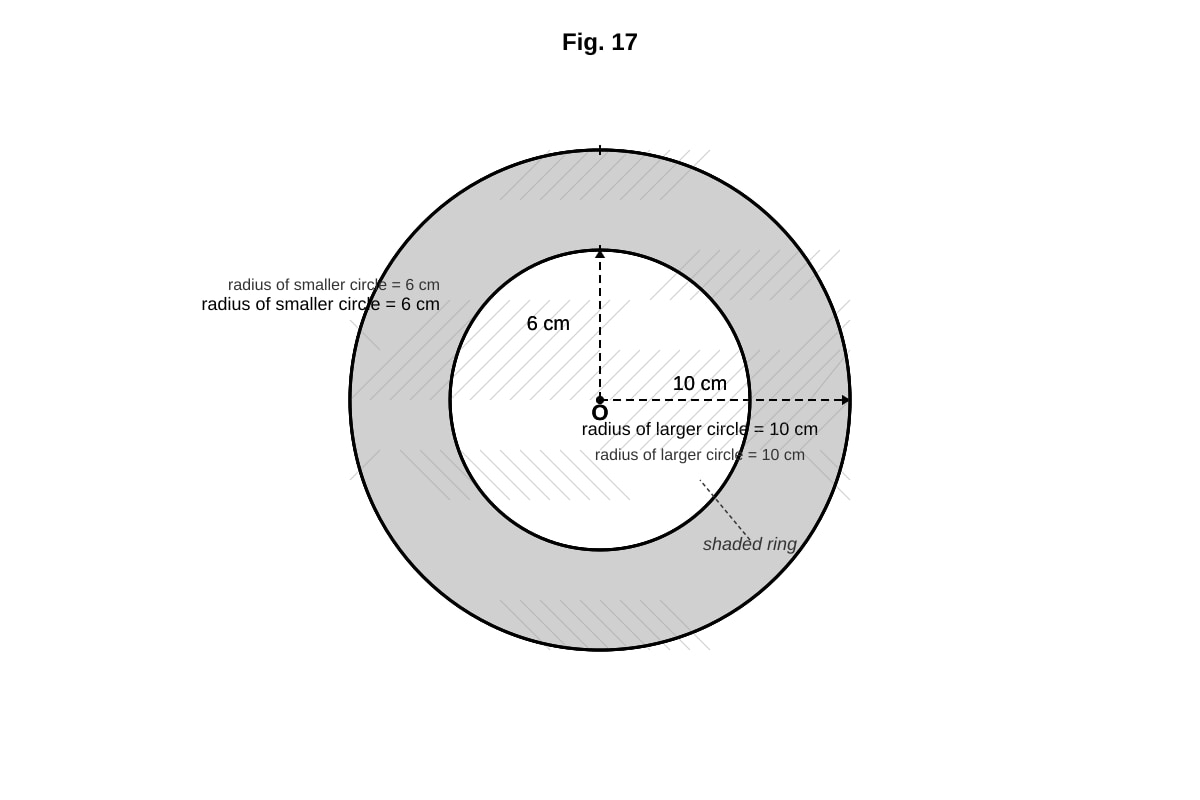
17. Area of shaded ring = 200.96 cm² (2.5 marks)
- Working: Area of larger circle = πR² = 3.14 × 10² = 3.14 × 100 = 314 cm². Area of smaller circle = πr² = 3.14 × 6² = 3.14 × 36 = 113.04 cm². Area of ring = 314 - 113.04 = 200.96 cm².
- Concept: The area of a ring (annulus) is the difference between the areas of the outer and inner circles.
- Marking: 1 mark for area of larger circle, 1 mark for area of smaller circle, 0.5 marks for correct answer.
18. Area of wet surface = 5900 cm² (2.5 marks)
- Working: The tank is open at the top. The wet surface includes the four sides and the bottom. The water height is 25 cm. Area of bottom = 50 × 30 = 1500 cm². Area of two longer sides = 2 × (50 × 25) = 2 × 1250 = 2500 cm². Area of two shorter sides = 2 × (30 × 25) = 2 × 750 = 1500 cm². Total wet area = 1500 + 2500 + 1500 = 5500 cm². Wait, the tank is filled to a height of 25 cm, but the tank height is 40 cm. The wet surface is only up to the water level. So the sides are 25 cm high. Bottom area = 50 × 30 = 1500 cm². Two longer sides = 2 × (50 × 25) = 2500 cm². Two shorter sides = 2 × (30 × 25) = 1500 cm². Total = 1500 + 2500 + 1500 = 5500 cm².
- Correction: The correct answer is 5500 cm².
- Concept: The wet surface area is the area of the tank in contact with the water. Since the tank is open at the top, the top surface is not included.
- Marking: 1 mark for bottom area, 1 mark for side areas, 0.5 marks for correct answer.
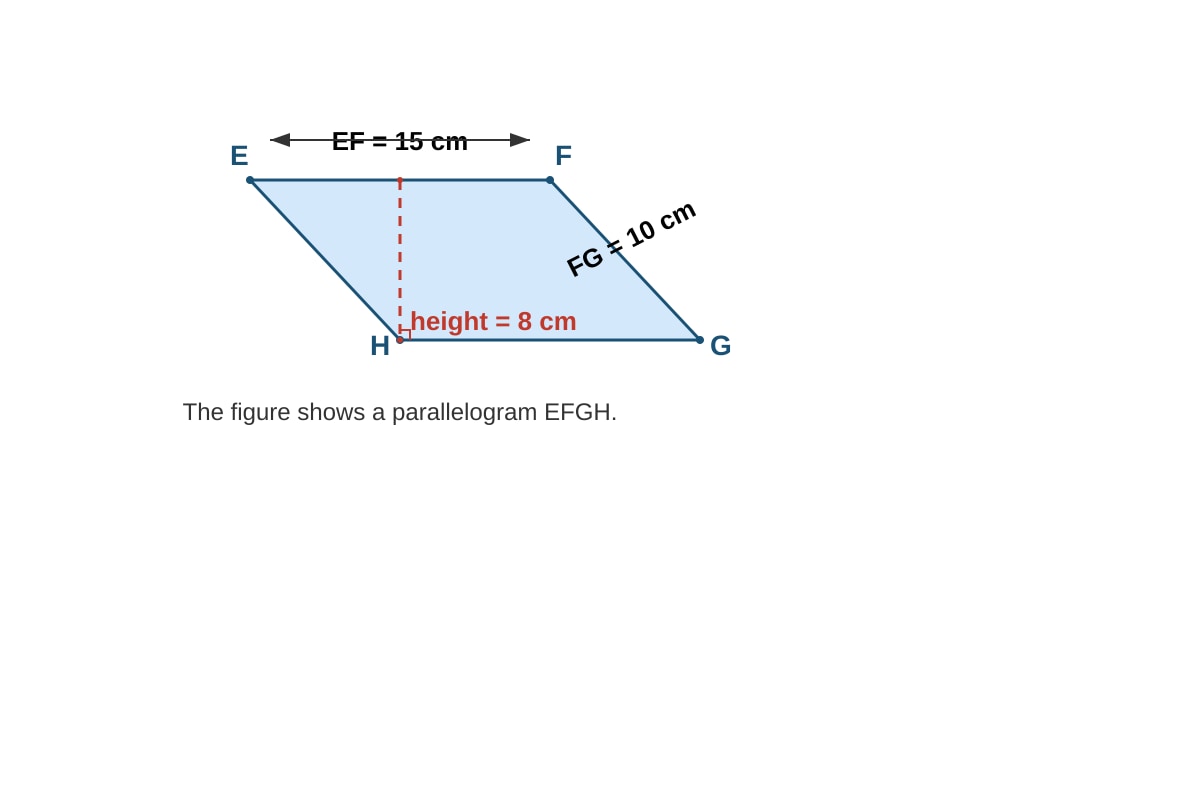
19. Area of parallelogram = 120 cm² (2.5 marks)
- Working: Area of parallelogram = base × height = EF × height = 15 × 8 = 120 cm².
- Concept: The area of a parallelogram is the product of its base and its perpendicular height. The side length FG is not needed for the area calculation.
- Common mistake: Students may multiply the two side lengths (15 × 10 = 150 cm²) instead of using the perpendicular height.
- Marking: 1 mark for identifying base and height, 1 mark for correct formula, 0.5 marks for correct answer.
20. Breadth of rectangle = 11 cm (2.5 marks)
- Working: Total length of wire = 1 m = 100 cm. Perimeter of square = 4 × 12 = 48 cm. Length of wire used for rectangle = 100 - 48 = 52 cm. Perimeter of rectangle = 52 cm. 2 × (length + breadth) = 52. Length = 15 cm, so 2 × (15 + breadth) = 52. 15 + breadth = 26. Breadth = 26 - 15 = 11 cm.
- Concept: The total length of the wire is the sum of the perimeters of the two shapes.
- Common mistake: Students may forget to convert metres to centimetres.
- Marking: 1 mark for perimeter of square, 1 mark for setting up the equation, 0.5 marks for correct answer.
End of Answer Key