From Real Exams Quiz
Primary 6 PSLE Mathematics Area Perimeter Quiz
Free P6 PSLE Maths Area Perimeter quiz, Exam version, with questions, answers, and PSLE-focused practice for Singapore students.
These static practice materials are generated from the site's syllabus and paper-generation workflow, with source and model context shown so students and parents can evaluate the material before use.
Questions
Free quiz and exam paper access
Enter your details to view this paper
Your access is remembered on this device.
Answers
Answer Key - Primary 6 PSLE Mathematics Quiz - Area Perimeter
Total Marks: 50
Section A: Multiple-Choice Questions (10 marks)
1. B) 40 cm
- Marks: 2
- Working: Perimeter of rectangle = 2 × (length + width) = 2 × (12 + 8) = 2 × 20 = 40 cm.
- Explanation: The perimeter is the total distance around the outside of the rectangle. We add the length and width, then multiply by 2 because there are two lengths and two widths.
- Common mistake: Option D (40 cm²) uses area units (cm²) instead of perimeter units (cm). Option C (96 cm²) is the area (12 × 8).
2. B) 8 cm
- Marks: 2
- Working: Area of square = side × side = side². So side = √(area) = √64 = 8 cm.
- Explanation: The area of a square is found by multiplying the side length by itself. To find the side from the area, we take the square root.
- Common mistake: Option A (4 cm) is half of 8. Option C (16 cm) is 2 × 8. Option D (32 cm) is 4 × 8.
3. B) 30 cm²
- Marks: 2
- Working: Area of triangle = ½ × base × height = ½ × 10 × 6 = 30 cm².
- Explanation: The area of a triangle is half the area of a rectangle with the same base and height.
- Common mistake: Option C (60 cm²) forgets to multiply by ½. Option D (30 cm) uses length units instead of area units.
4. B) 49.98 cm
- Marks: 2
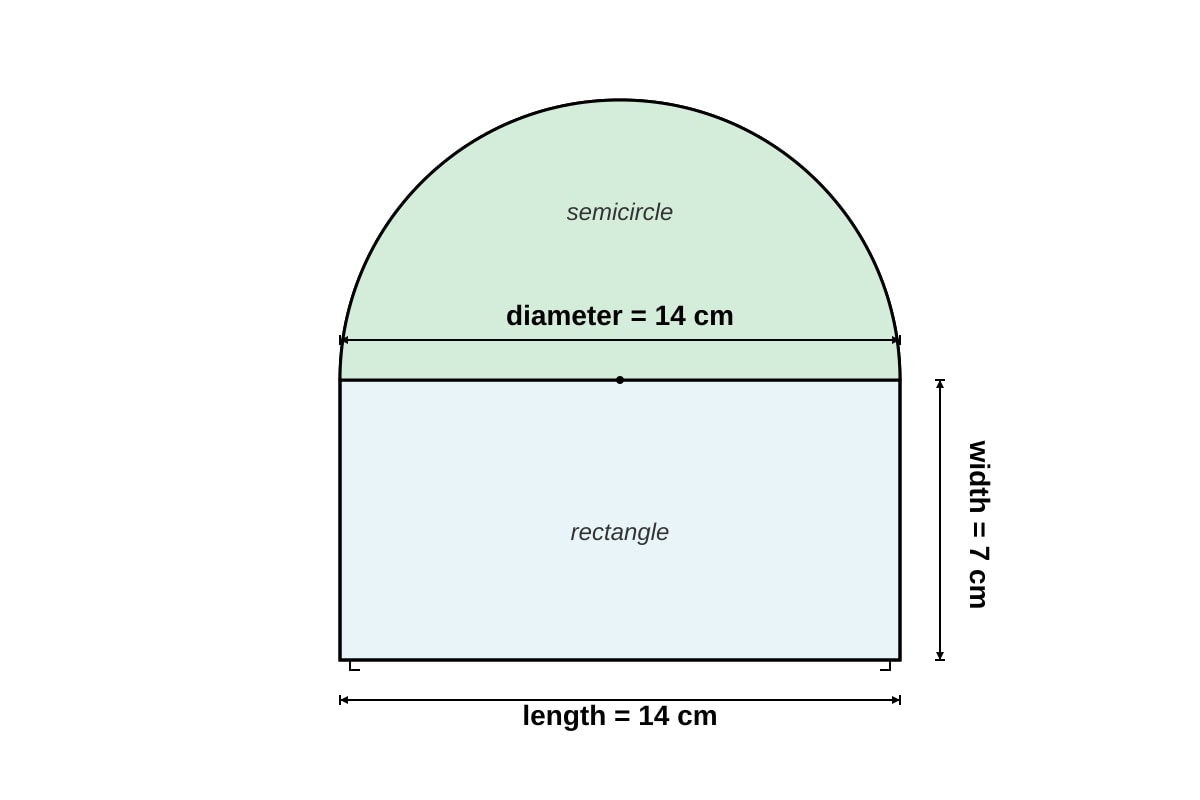
- Working: Perimeter = perimeter of rectangle (excluding the top side) + circumference of semicircle.
- Rectangle: 2 × (14 + 7) = 42 cm. But the top side (14 cm) is replaced by the semicircle, so we subtract it: 42 - 14 = 28 cm.
- Semicircle circumference = ½ × π × d = ½ × 3.14 × 14 = 21.98 cm.
- Total perimeter = 28 + 21.98 = 49.98 cm.
- Explanation: The perimeter of a composite figure is the total distance around its outer boundary. The semicircle replaces the top side of the rectangle, so we don't count that side.
- Common mistake: Option A (35.98 cm) forgets to add the rectangle's sides. Option C (63.98 cm) adds the full circle circumference instead of half.
5. D) 120 cm²
- Marks: 2
- Working: Area of parallelogram = base × height = 15 × 8 = 120 cm².
- Explanation: The area of a parallelogram is found the same way as a rectangle: base times perpendicular height.
- Common mistake: Option C (60 cm²) uses ½ × base × height (triangle formula).
Section B: Short-Answer Questions (20 marks)
6. 450 m²
- Marks: 2
- Working: Area = length × width = 25 × 18 = 450 m².
- Explanation: The area of a rectangle is found by multiplying its length by its width.
- Marking note: Award 1 mark for correct method (25 × 18), 1 mark for correct answer with units.
7. 36 cm
- Marks: 2
- Working: Length of wire = perimeter of square = 4 × side = 4 × 9 = 36 cm.
- Explanation: The wire forms the boundary of the square, so its length equals the perimeter of the square.
- Marking note: Award 1 mark for correct method, 1 mark for correct answer.
8. 10 cm
- Marks: 2
- Working: Area of triangle = ½ × base × height. So height = (2 × area) ÷ base = (2 × 45) ÷ 9 = 90 ÷ 9 = 10 cm.
- Explanation: We rearrange the triangle area formula to find the height. Multiply the area by 2 to get the area of the corresponding rectangle, then divide by the base.
- Marking note: Award 1 mark for correct rearrangement, 1 mark for correct answer.
9. 43.96 cm
- Marks: 2
- Working: Circumference = 2 × π × r = 2 × 3.14 × 7 = 43.96 cm.
- Explanation: The circumference of a circle is the distance around it. The formula is 2πr or πd.
- Marking note: Award 1 mark for correct formula, 1 mark for correct answer.
10. 10 cm
- Marks: 2
- Working: Perimeter = 2 × (length + width). So 48 = 2 × (14 + width). 14 + width = 24. Width = 24 - 14 = 10 cm.
- Explanation: We work backwards from the perimeter formula. First divide the perimeter by 2, then subtract the length to find the width.
- Marking note: Award 1 mark for correct method, 1 mark for correct answer.
11. 76 cm²
- Marks: 2
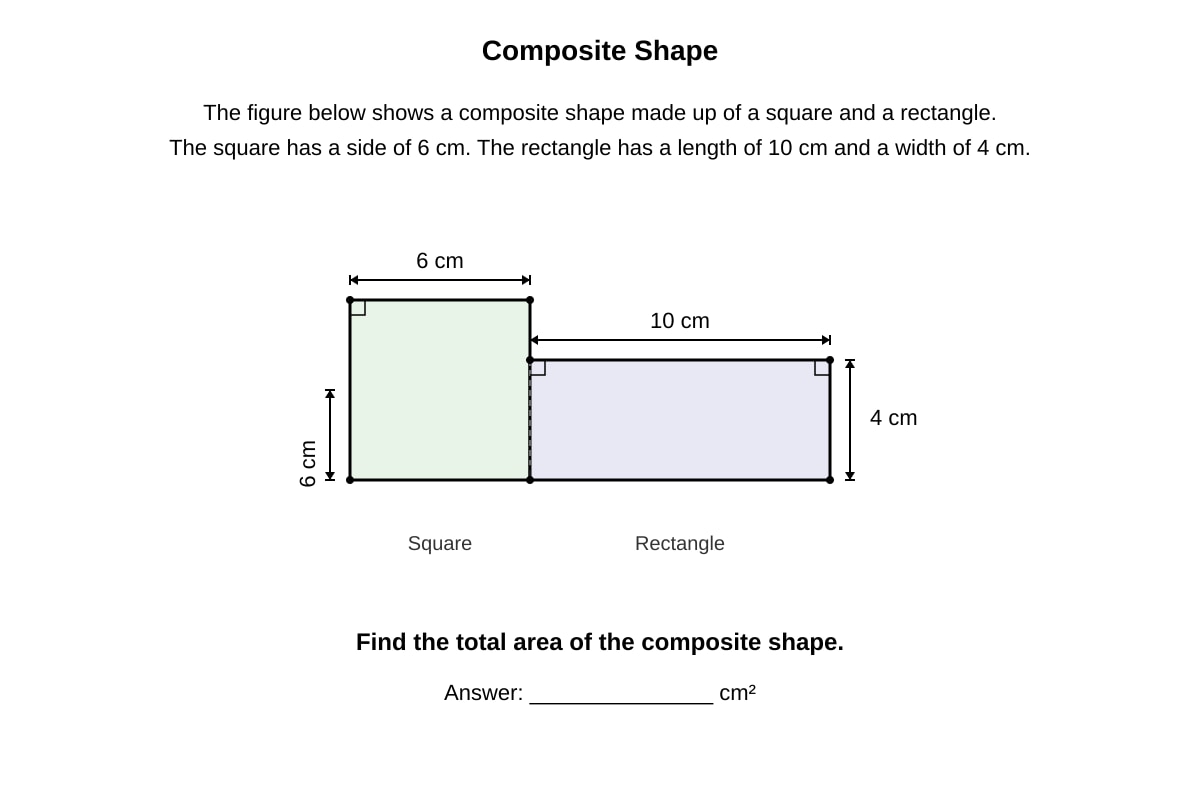
- Working: Area of square = 6 × 6 = 36 cm². Area of rectangle = 10 × 4 = 40 cm². Total area = 36 + 40 = 76 cm².
- Explanation: The total area of a composite shape is the sum of the areas of its parts.
- Marking note: Award 1 mark for finding both areas correctly, 1 mark for correct total.
12. 76.93 cm²
- Marks: 2
- Working: Radius = diameter ÷ 2 = 14 ÷ 2 = 7 cm. Area of semicircle = ½ × π × r² = ½ × 3.14 × 7² = ½ × 3.14 × 49 = 76.93 cm².
- Explanation: A semicircle is half of a circle. First find the radius, then calculate the area of the full circle, then divide by 2.
- Marking note: Award 1 mark for correct radius and formula, 1 mark for correct answer.
13. 536 cm²
- Marks: 2
- Working: Area of paper = 30 × 20 = 600 cm². Area of square cut out = 8 × 8 = 64 cm². Remaining area = 600 - 64 = 536 cm².
- Explanation: When a shape is cut out from another shape, the remaining area is the original area minus the area of the cut-out piece.
- Marking note: Award 1 mark for finding both areas, 1 mark for correct subtraction.
14. 10 cm
- Marks: 2
- Working: Circumference = 2 × π × r. So r = circumference ÷ (2 × π) = 62.8 ÷ (2 × 3.14) = 62.8 ÷ 6.28 = 10 cm.
- Explanation: We rearrange the circumference formula to find the radius. Divide the circumference by 2π.
- Marking note: Award 1 mark for correct rearrangement, 1 mark for correct answer.
15. 50 cm²
- Marks: 2
- Working: Area of trapezium = ½ × (sum of parallel sides) × height = ½ × (8 + 12) × 5 = ½ × 20 × 5 = 50 cm².
- Explanation: The area of a trapezium is found by averaging the lengths of the parallel sides and multiplying by the height.
- Marking note: Award 1 mark for correct formula, 1 mark for correct answer.
Section C: Problem-Solving Questions (20 marks)
16. 384 m²
- Marks: 4
- Working:
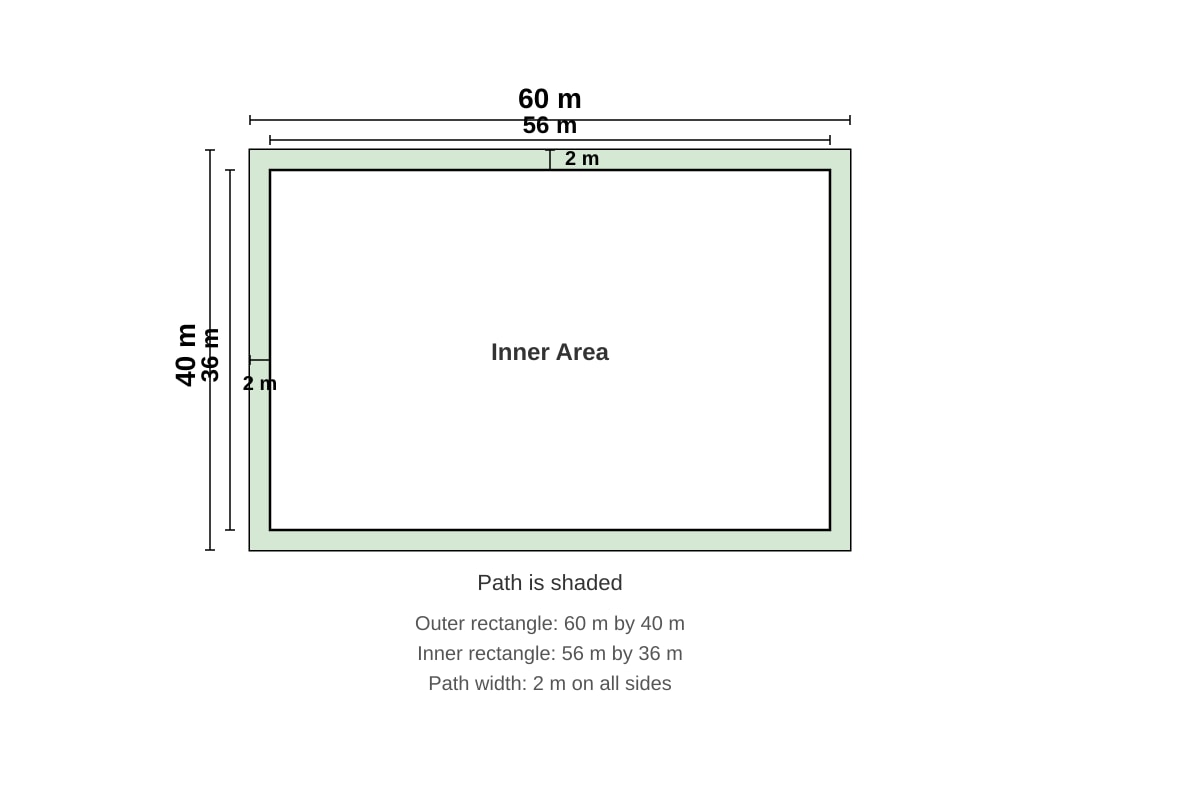
- Area of field = 60 × 40 = 2400 m².
- Inner rectangle length = 60 - 2 - 2 = 56 m.
- Inner rectangle width = 40 - 2 - 2 = 36 m.
- Area of inner rectangle = 56 × 36 = 2016 m².
- Area of path = 2400 - 2016 = 384 m².
- Explanation: The path runs inside the boundary, so we subtract 2 m from each side of the field to find the inner rectangle dimensions. The path area is the difference between the outer and inner areas.
- Marking scheme:
- 1 mark: Correct area of field.
- 1 mark: Correct inner dimensions (56 m and 36 m).
- 1 mark: Correct area of inner rectangle.
- 1 mark: Correct final answer.
- Common mistake: Subtracting 2 m only once from each dimension (giving 58 m and 38 m). Remember the path is on both sides, so subtract 2 m twice.
17. 8 cm
- Marks: 4
- Working:
- Length of wire = perimeter of square = 4 × 12 = 48 cm.
- Perimeter of rectangle = 2 × (length + width) = 48 cm.
- 2 × (16 + width) = 48.
- 16 + width = 24.
- Width = 24 - 16 = 8 cm.
- Explanation: The wire's length doesn't change when it's rebent. So the perimeter of the square equals the perimeter of the rectangle. We then work backwards to find the width.
- Marking scheme:
- 1 mark: Correct perimeter of square.
- 1 mark: Setting up the equation.
- 1 mark: Correct working.
- 1 mark: Correct final answer.
- Common mistake: Forgetting that the perimeter is the total length of wire, not the area.
18. 433.86 cm²
- Marks: 4
- Working:
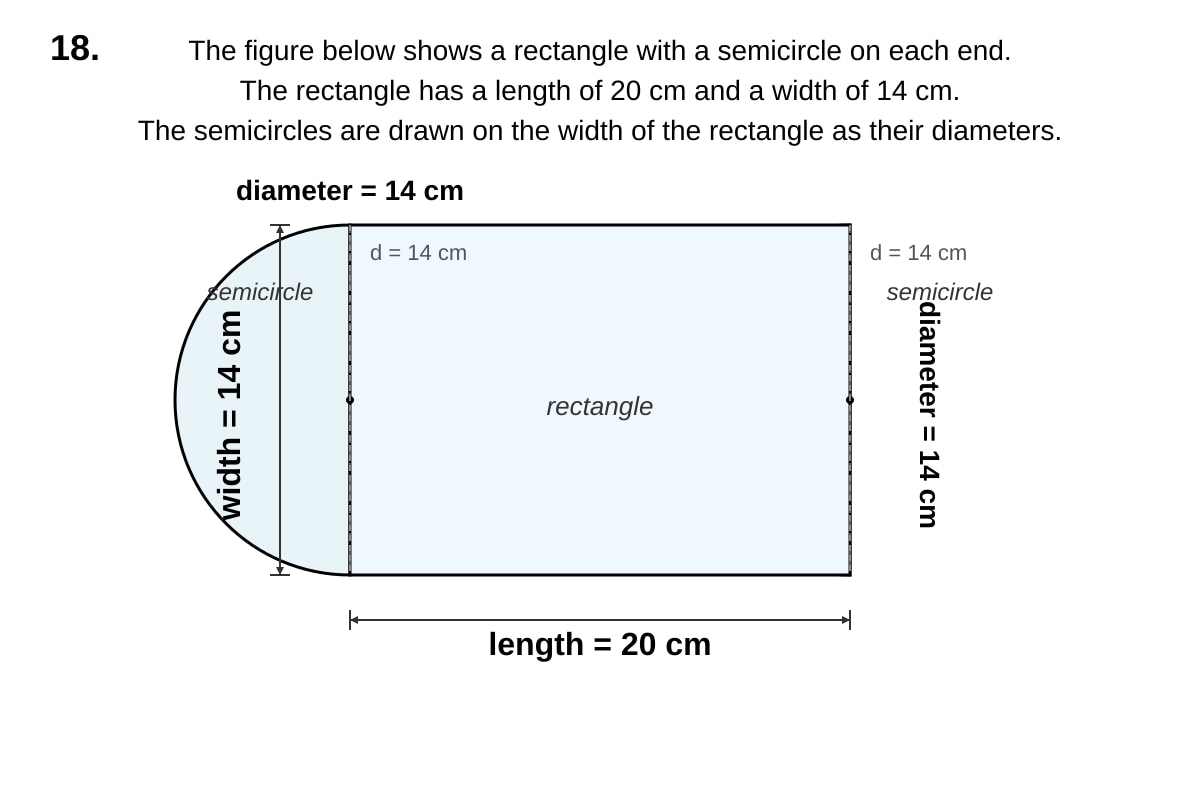
- Area of rectangle = 20 × 14 = 280 cm².
- Radius of each semicircle = 14 ÷ 2 = 7 cm.
- Area of one full circle = π × r² = 3.14 × 7² = 3.14 × 49 = 153.86 cm².
- Area of two semicircles = area of one full circle = 153.86 cm².
- Total area = 280 + 153.86 = 433.86 cm².
- Explanation: Two semicircles with the same diameter make one full circle. So we calculate the area of the rectangle and add the area of one full circle.
- Marking scheme:
- 1 mark: Correct area of rectangle.
- 1 mark: Correct radius.
- 1 mark: Correct area of circle.
- 1 mark: Correct total area.
- Common mistake: Calculating the area of one semicircle and forgetting to double it.
19. 25.67 cm (or 25.7 cm)
- Marks: 4
- Working:
- Volume of water = 50 × 30 × 25 = 37,500 cm³.
- Volume of cube = 10 × 10 × 10 = 1,000 cm³.
- Total volume of water + cube = 37,500 + 1,000 = 38,500 cm³.
- Base area of tank = 50 × 30 = 1,500 cm².
- New height = total volume ÷ base area = 38,500 ÷ 1,500 = 25.67 cm (or 25.7 cm).
- Explanation: When the cube is placed in the water, it displaces its own volume of water. The water level rises because the same amount of water now occupies a smaller space (the tank minus the cube's volume). The new height is found by dividing the total volume (water + cube) by the base area.
- Marking scheme:
- 1 mark: Correct volume of water.
- 1 mark: Correct volume of cube.
- 1 mark: Correct total volume.
- 1 mark: Correct new height.
- Common mistake: Adding the cube's volume to the water's volume but forgetting that the cube also takes up space in the tank.
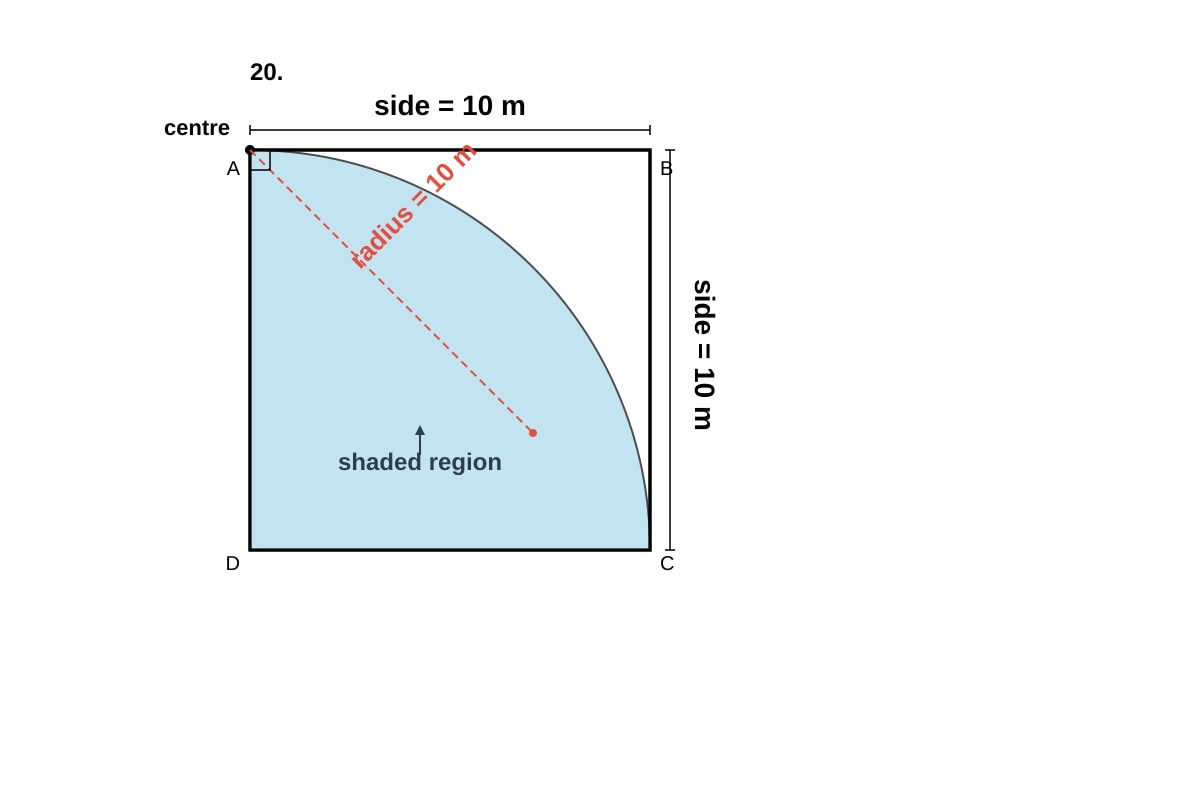
20. 21.5 m²
- Marks: 4
- Working:
- Area of square = 10 × 10 = 100 m².
- Area of quarter circle = ¼ × π × r² = ¼ × 3.14 × 10² = ¼ × 3.14 × 100 = 78.5 m².
- Area of shaded region = 100 - 78.5 = 21.5 m².
- Explanation: The shaded region is the part of the square not covered by the quarter circle. So we subtract the area of the quarter circle from the area of the square.
- Marking scheme:
- 1 mark: Correct area of square.
- 1 mark: Correct formula for quarter circle.
- 1 mark: Correct area of quarter circle.
- 1 mark: Correct final answer.
- Common mistake: Using the formula for a full circle instead of a quarter circle. Remember a quarter circle is ¼ of a full circle.
END OF ANSWER KEY