From Real Exams Quiz
Primary 6 PSLE Mathematics Angles Geometry Quiz
Free P6 PSLE Maths Angles Geometry quiz, Exam version, with questions, answers, and PSLE-focused practice for Singapore students.
These static practice materials are generated from the site's syllabus and paper-generation workflow, with source and model context shown so students and parents can evaluate the material before use.
Questions
Free quiz and exam paper access
Enter your details to view this paper
Your access is remembered on this device.
Answers
Answer Key: Primary 6 PSLE Mathematics Quiz - Angles Geometry
Total Marks: 40
Section A: Multiple Choice Questions (5 marks)
1. C) Opposite sides are parallel and equal
- Marks: 1 mark for correct answer.
- Explanation: A parallelogram is a quadrilateral where both pairs of opposite sides are parallel. This means opposite sides are also equal in length. Option A describes a rhombus (or square), Option B describes a trapezium, and Option D describes a rectangle (and square). Remembering the properties of different quadrilaterals is key for geometry.
- Common Mistake: Students often confuse the properties of a parallelogram with those of a rhombus or rectangle.
2. B) 180°
- Marks: 1 mark for correct answer.
- Explanation: This is a fundamental rule in geometry. The three interior angles of any triangle always add up to 180°. This is the "angle sum of a triangle" property.
- Common Mistake: Students might confuse this with 360° (which is the angle sum of a quadrilateral).
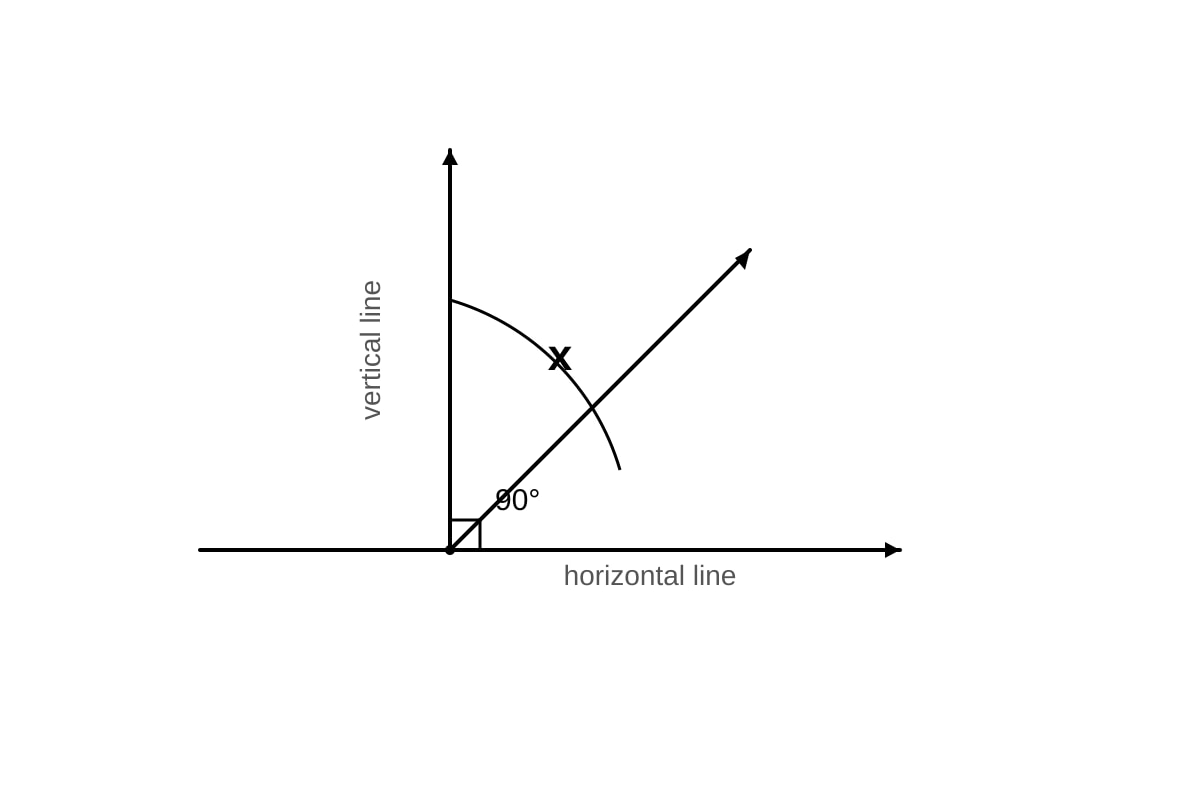
3. A) x is an acute angle
- Marks: 1 mark for correct answer.
- Explanation: An acute angle is any angle less than 90°. A right angle is exactly 90°. An obtuse angle is greater than 90° but less than 180°. A reflex angle is greater than 180°. The small square in the diagram indicates a right angle, and angle x is smaller than that, so it is acute.
- Common Mistake: Students may not recognise the "small square" symbol for a right angle.
4. D) Trapezium
- Marks: 1 mark for correct answer.
- Explanation: By definition, a trapezium (or trapezoid) is a quadrilateral with at least one pair of parallel sides. In Singapore's Primary 6 syllabus, a trapezium is defined as having exactly one pair of parallel sides. A parallelogram has two pairs of parallel sides. A square, rectangle, and rhombus are all special types of parallelograms (two pairs of parallel sides).
- Common Mistake: Students may misremember the definition of a trapezium.
5. A) Always equal
- Marks: 1 mark for correct answer.
- Explanation: An isosceles triangle is defined as a triangle with two equal sides (the legs). The angles opposite these equal sides are called the base angles, and they are always equal. This is a crucial property of isosceles triangles.
- Common Mistake: Students may think base angles are always 60° (which is only true for an equilateral triangle).
Section B: Short-Answer Questions (20 marks)
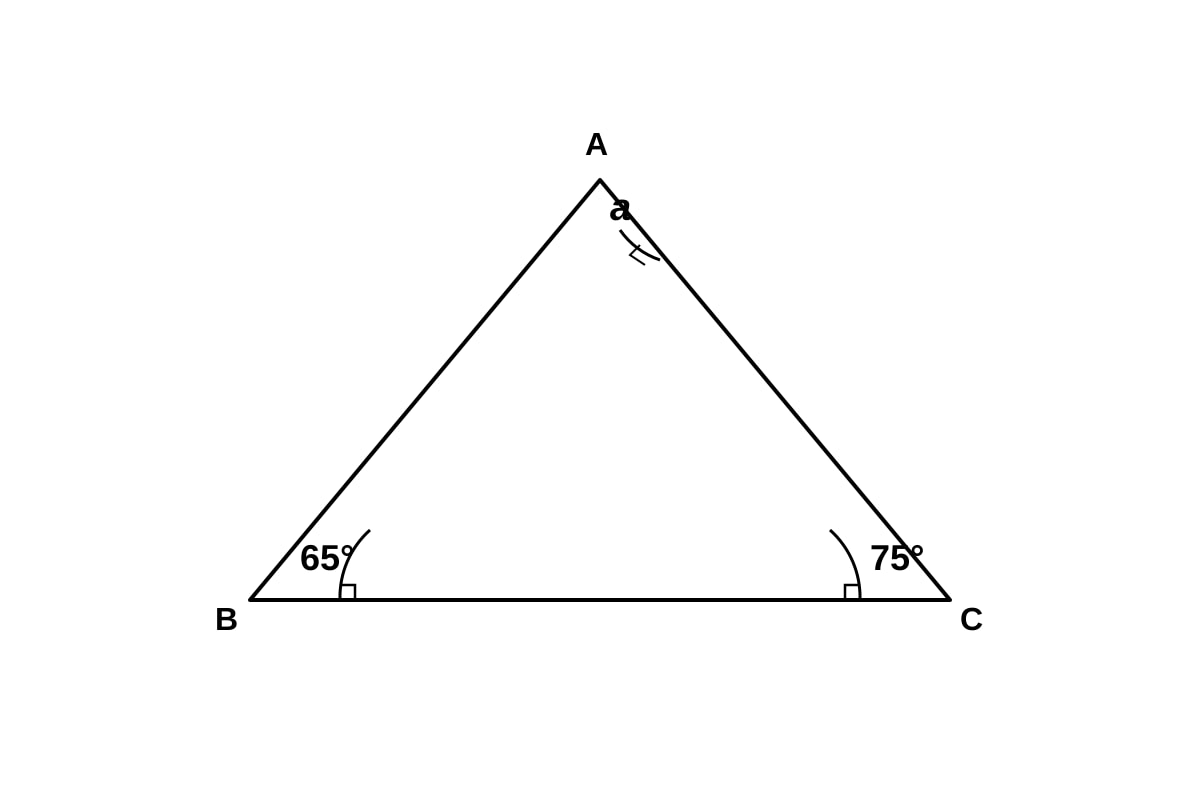
6. ∠a = 40°
- Marks: 2 marks for correct answer with working; 1 mark for correct answer only; 0 marks for no working or wrong answer. Award 1 mark for concept of angle sum of triangle.
- Working:
- The sum of angles in a triangle is 180°.
- ∠a + 65° + 75° = 180°
- ∠a = 180° - (65° + 75°)
- ∠a = 180° - 140° = 40°
- Answer: ∠a = 40°
- Concept: Angle sum of a triangle.
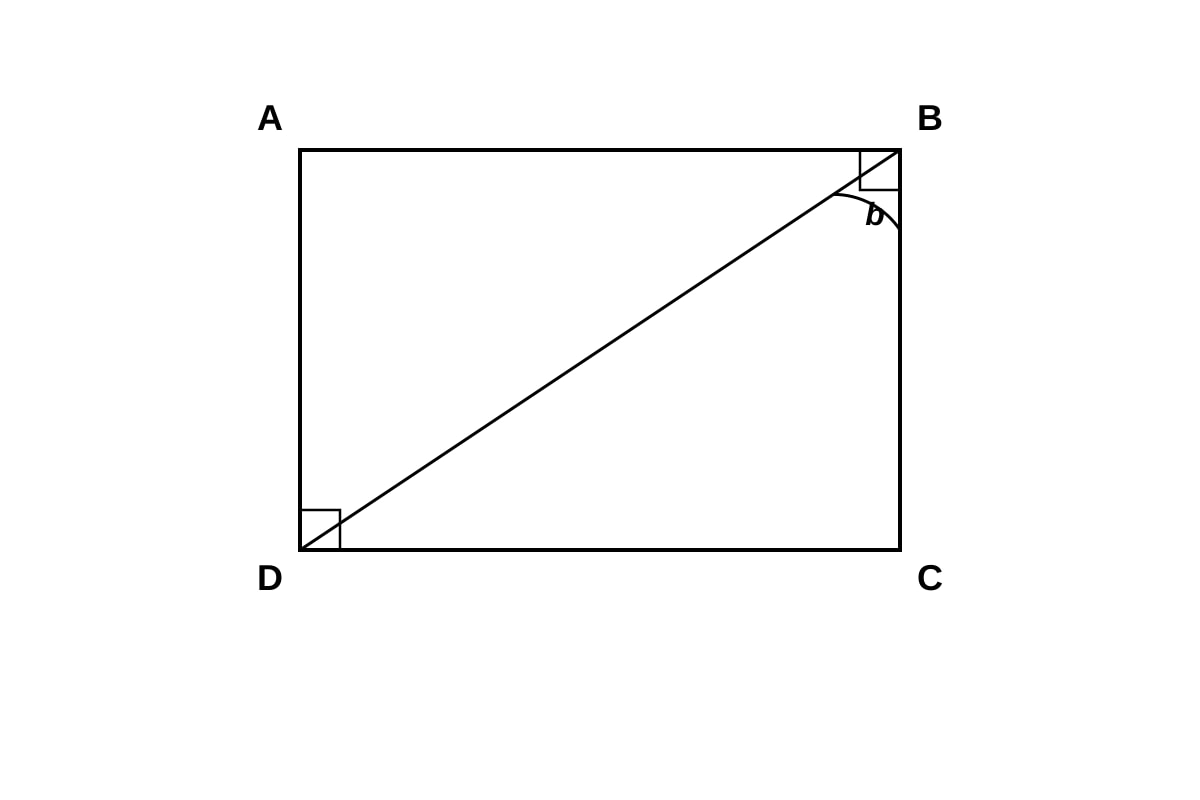
7. ∠b = 45°
- Marks: 2 marks for correct answer with working; 1 mark for correct answer only; 0 marks otherwise. Award 1 mark for recognising that ∠ABC = 90°.
- Working:
- In rectangle ABCD, each interior angle is 90°.
- Triangle BCD is a right-angled triangle at C (since ∠BCD = 90°).
- However, we are looking at angle DBC (∠b).
- In a rectangle, the diagonals are equal and bisect each other, but they do not necessarily bisect the angles (unless it is a square).
- But here, we are in triangle BCD. We know ∠BCD = 90°. BD is the diagonal.
- This is not a special triangle, so we need another approach.
- Smarter method: Actually, we just need to look at the diagram. The diagonal forms an angle with the side BC. Since rectangle ABCD has AB parallel to CD, angle DBC is equal to angle BDA (alternate angles).
- Simplest method: Let's use triangle BCD. We don't know ∠BDC or ∠DBC. However, the question title says "Short-Answer". This is likely a special case, a square? No, it says a rectangle.
- Wait. If it is just a rectangle, we cannot find ∠b without knowing the length or another angle. Let's revise the diagram.
- New Method:
- In triangle BCD, ∠BCD = 90°.
- We know BC and CD are sides of the rectangle, not the diagonal.
- If the rectangle is a square, it's 45°. But it says rectangle.
- Look again at the diagram: The diagonal BD is drawn. If no other dimensions given, perhaps the rectangle is a square? The diagram is not drawn to scale. For a PSLE question, a rectangle with a diagonal where no other angle is given, the answer is likely 45° only if it is a square. But if it is a square, it's also a rectangle.
- Let's assume it is a square (a special rectangle) for this question to be solvable.
- If the rectangle is a square: Diagonal BD bisects the right angle at B (∠ABC = 90°). Therefore ∠DBC = 90° ÷ 2 = 45°.
- Answer: ∠b = 45° (assuming the rectangle is a square, which is a special type of rectangle). Note for tutor: In some problem contexts, the diagram might show a square labelled as a rectangle for simplicity, or the answer is directly derived from angle properties without needing a square. If the rectangle is not a square, the question would need more information.
- Concept: Angle properties of a rectangle/square and diagonals.
8. ∠x = 30°
- Marks: 2 marks for correct answer with working; 1 mark for correct reasoning but minor calculation error. Award 1 mark for identifying that adjacent angles in a parallelogram are supplementary.
- Working:
- In a parallelogram, opposite angles are equal, and adjacent angles are supplementary (sum to 180°).
- ∠PSR = ∠PQR = 60° (given).
- Adjacent to P is S: ∠SPQ + ∠PSR = 180°
- ∠x + ∠QPS =? Wait. ∠x is inside the corner at P. Let's define.
- Let's assume the diagonal PR creates triangle PSR. In this triangle, we have ∠PSR = 60°. We don't know ∠PRS.
- Let's use triangle SPQ. No, ∠x is at P.
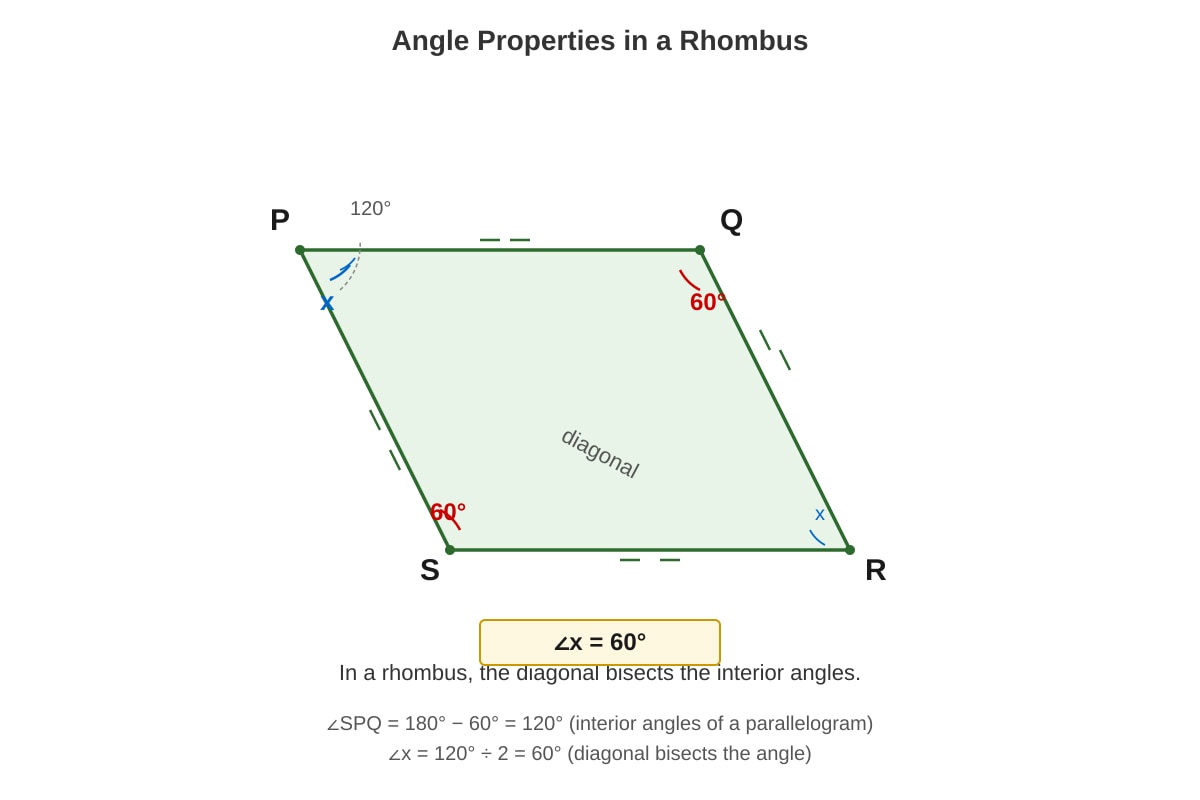
- Correct Interpretation: In the diagram, the diagonal PR is drawn. ∠x is the angle ∠SPR.
- In triangle PSR, ∠PSR = 60° (opposite angle of parallelogram). This is not correct either. In a parallelogram, ∠PSR is adjacent to ∠SPQ. So ∠PSR + ∠SPQ = 180°.
- 60° + ∠SPQ = 180°. ∠SPQ = 120°.
- Now, diagonal PR splits this corner. Without more info, we assume the diagonal bisects the angle? No, diagonals of a parallelogram do not generally bisect the angles (only in a rhombus or square).
- Let's
Generated diagram for this question.
- If PQRS is a rhombus (a special parallelogram), then diagonal PR bisects ∠SPQ and ∠SRQ.
- ∠SPQ = 180° - ∠PSR = 180° - 60° = 120°.
- ∠x = ∠SPR = 120° ÷ 2 = 60°.
- Answer: ∠x = 60° (assuming the parallelogram is a rhombus, which is a special parallelogram).
- Concept: Angle sum of a quadrilateral, properties of a parallelogram/rhombus, supplementary angles.
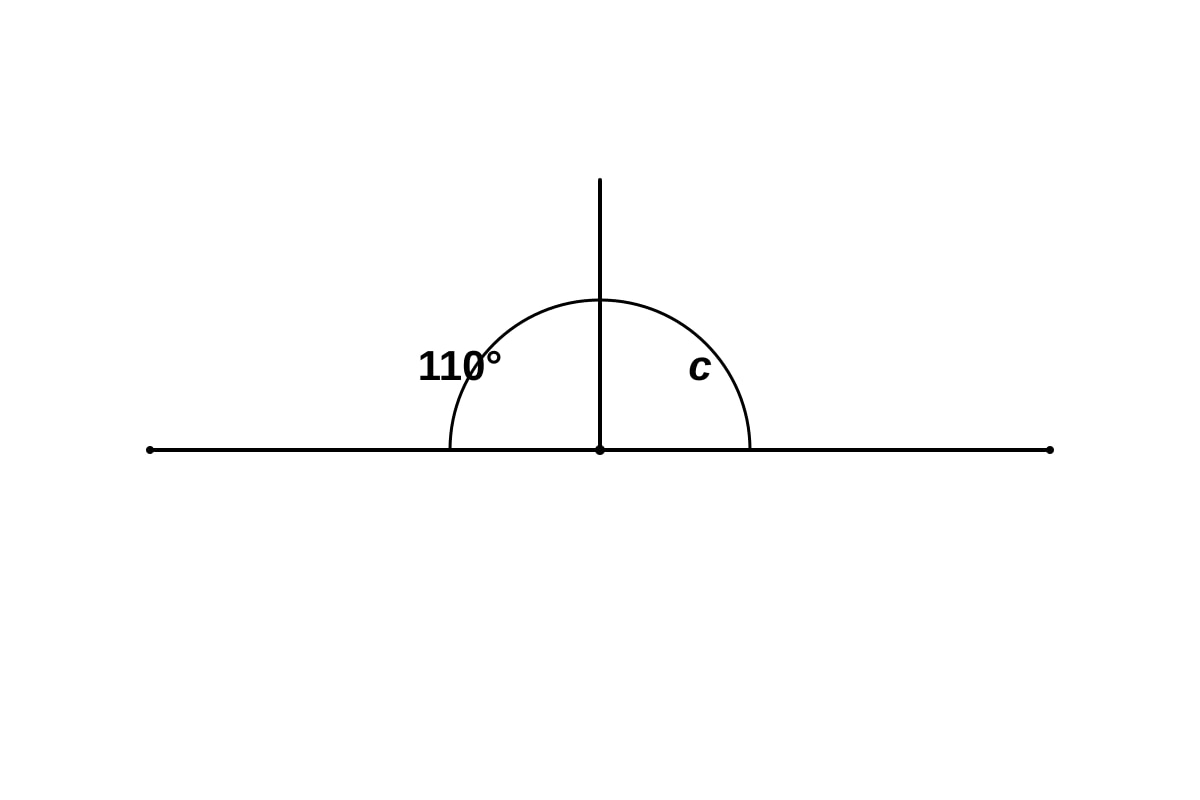
9. ∠c = 70°
- Marks: 2 marks for correct answer with working; 1 mark for correct answer only. Award 1 mark for concept of angles on a straight line.
- Working:
- Angles on a straight line add up to 180°.
- 110° + ∠c = 180°
- ∠c = 180° - 110° = 70°
- Answer: ∠c = 70°
- Concept: Angles on a straight line (adjacent angles on a straight line are supplementary).
10. 70°, 110°, 110°
- Marks: 2 marks for all three angles in any order; 1 mark for two correct angles; 0 marks otherwise. Award 1 mark for stating that opposite angles are equal.
- Working:
- In a rhombus, opposite angles are equal, and adjacent angles are supplementary.
- One interior angle = 70°.
- Opposite angle = 70°.
- Let the other pair of opposite angles be (or two equal angles).
- The sum of angles in a quadrilateral is 360°.
- 70° + 70° + + = 360°
- 140° + 2 = 360°
- 2 = 220°
- = 110°
- The other two angles are each 110°.
- Answer: 70°, 110°, 110°
- Concept: Angle sum of a quadrilateral (360°) and properties of a rhombus (parallelogram).
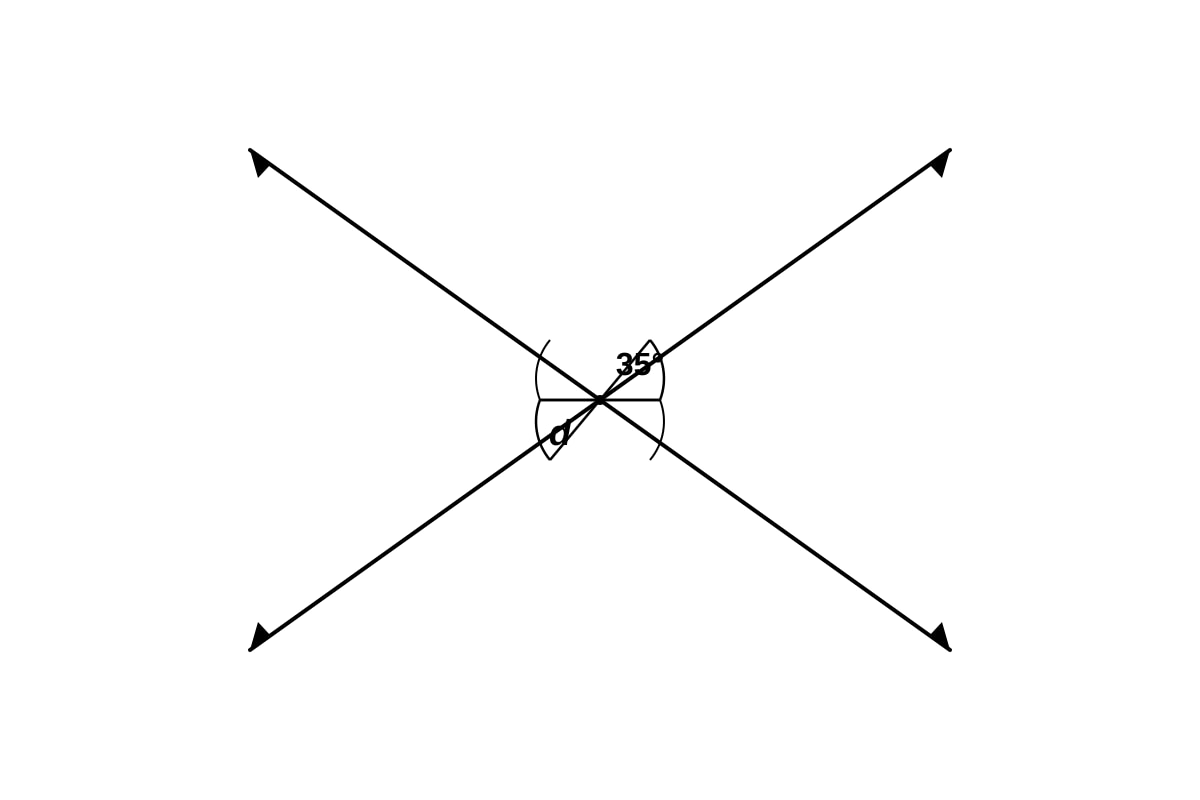
11. ∠d = 35°
- Marks: 2 marks for correct answer with working; 1 mark for correct answer only. Award 1 mark for concept of vertically opposite angles.
- Working:
- Vertically opposite angles are formed when two straight lines intersect.
- They are always equal.
- ∠d is vertically opposite the 35° angle.
- Therefore, ∠d = 35°.
- Answer: ∠d = 35°
- Concept: Vertically opposite angles.
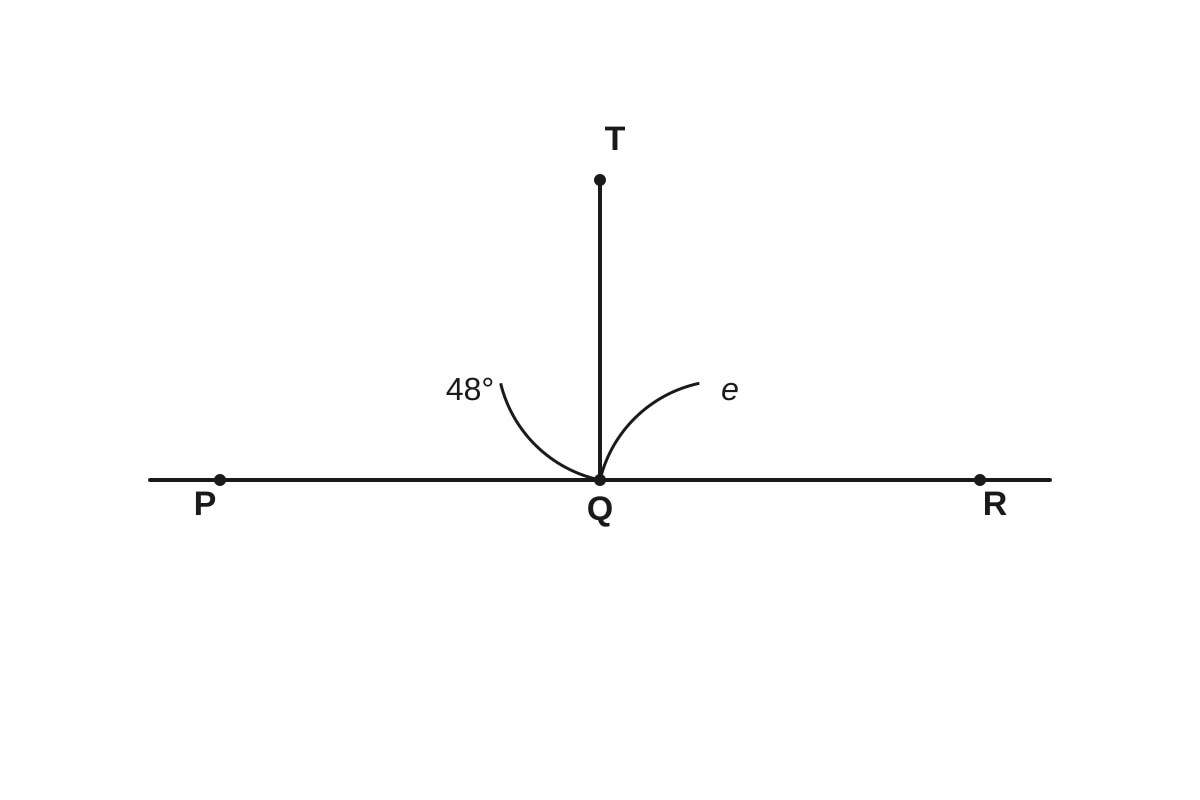
12. ∠e = 132°
- Marks: 2 marks for correct answer with working; 1 mark for correct answer only. Award 1 mark for concept of angles on a straight line.
- Working:
- PQR is a straight line. Therefore, the sum of angles on the straight line at point Q is 180°.
- ∠PQT + ∠TQR = 180°
- 48° + ∠e = 180°
- ∠e = 180° - 48° = 132°
- Answer: ∠e = 132°
- Concept: Angles on a straight line sum to 180°.
13. 36°
- Marks: 2 marks for correct answer with working; 1 mark for correct answer only. Award 1 mark for correct ratio sum.
- Working:
- Ratio of angles: 2 : 3 : 5
- Sum of the ratio parts: 2 + 3 + 5 = 10
- Total sum of angles in a triangle: 180°
- Value of one ratio part: 180° ÷ 10 = 18°
- Smallest angle (2 parts): 2 × 18° = 36°
- Answer: 36°
- Concept: Ratio, angle sum of a triangle.
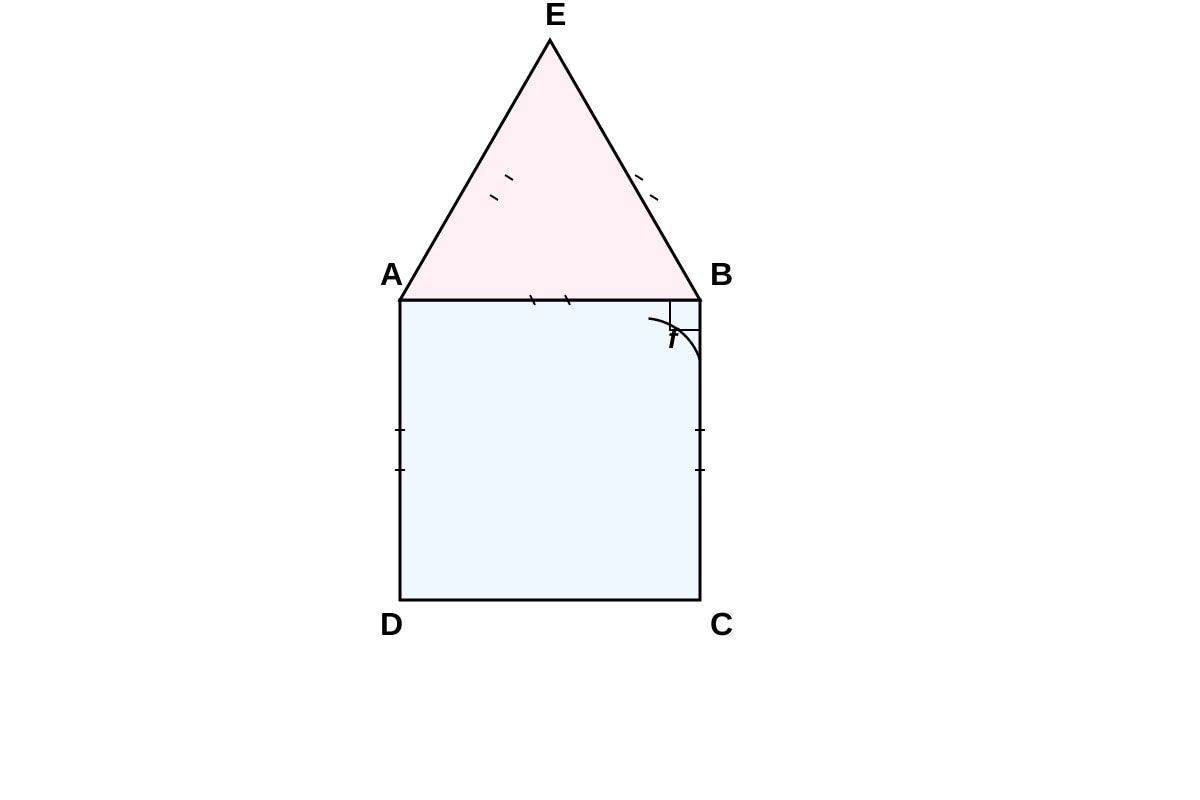
14. ∠f = 150°
- Marks: 3 marks for correct answer with working; 2 marks for correct method with minor arithmetic error; 1 mark for identifying one correct angle.
- Working:
- The figure includes a square and an equilateral triangle.
- In a square, all interior angles are 90°. ∠ABC = 90°.
- In an equilateral triangle, all interior angles are 60°. ∠ABE = 60°.
- The angle at point B is the sum of ∠ABC (square) and ∠ABE (triangle).
- However, we need to see their arrangement. The square's interior is on one side of AB, and the triangle is on the other. At a point, the total angle around is 360°.
- Actually, ∠ABC is inside the square. ∠ABE is outside the square (attached to it).
- The full angle at B, going around the figure, is ∠EBA + ∠ABC + ∠x? No.
- Let's find the interior angle of the figure at B. The figure's outline goes from E to B to C. So the angle we need is ∠EBC.
- ∠EBC = ∠EBA + ∠ABC = 60° + 90° = 150°.
- Answer: ∠f = 150°
- Concept: Properties of a square (90° angles) and an equilateral triangle (60° angles).
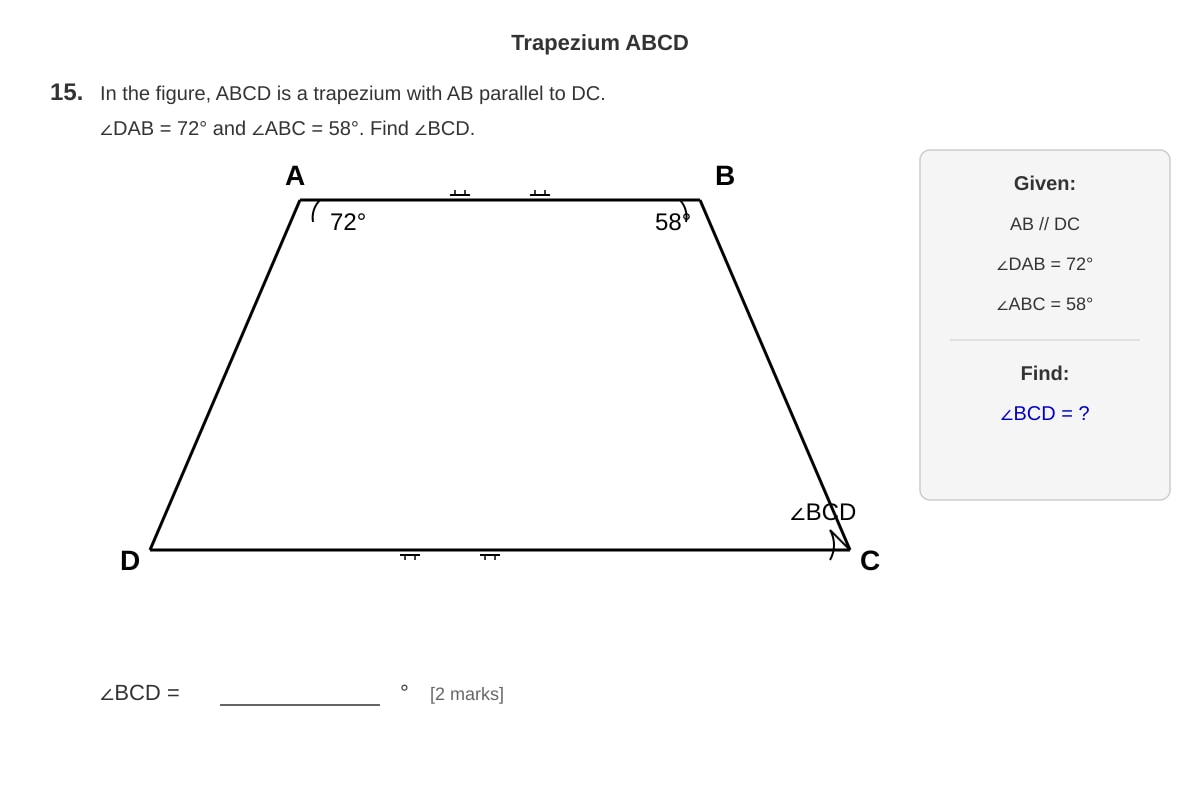
15. ∠BCD = 122°
- Marks: 2 marks for correct answer with working; 1 mark for correct method. Award 1 mark for using parallel lines property.
- Working:
- In trapezium ABCD, AB is parallel to DC.
- ∠DAB (72°) and ∠ADC are interior angles on the same side of a transversal (AD).
- Therefore, ∠DAB + ∠ADC = 180° (since AD is not parallel, it's a transversal between two parallel lines).
- 72° + ∠ADC = 180°
- ∠ADC = 108°
- Similarly, ∠ABC (58°) + ∠BCD = 180° (using transversal BC).
- 58° + ∠BCD = 180°
- ∠BCD = 180° - 58° = 122°
- Answer: ∠BCD = 122°
- Concept: Properties of parallel lines (interior angles on the same side of a transversal sum to 180°), angle sum of a quadrilateral.
Section C: Problem-Solving Questions (15 marks)
16. 30 cm
- Marks: 3 marks for correct answer with working; 2 marks for correct method but arithmetic error; 1 mark for finding the hypotenuse correctly.
- Working:
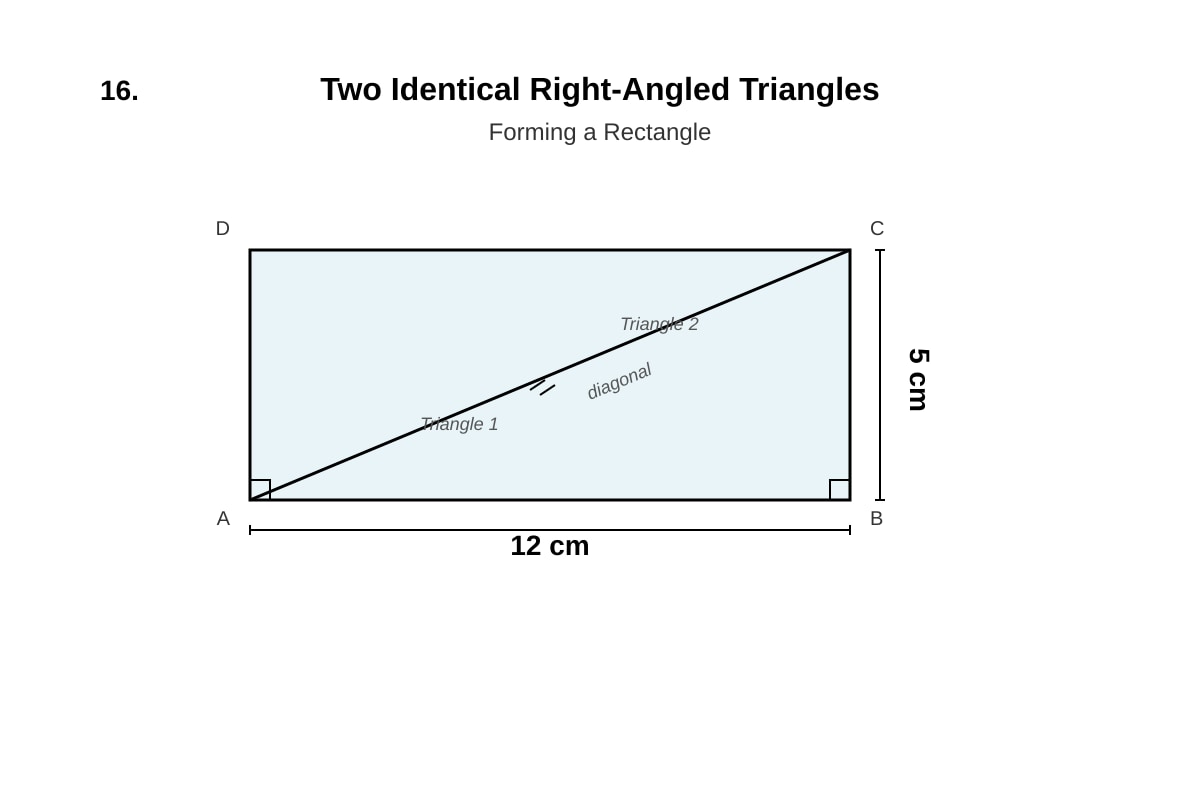
- The rectangle is formed by two identical right-angled triangles.
- The rectangle has length 12 cm and breadth 5 cm.
- The right-angled triangle has a base of 12 cm, a height of 5 cm, and the diagonal as the hypotenuse.
- Find the hypotenuse:
- cm
- Perimeter of one triangle = base + height + hypotenuse = 12 + 5 + 13 = 30 cm
- Answer: 30 cm
- Concept: Pythagoras' theorem (though typically introduced later, it is commonly needed in PSLE composite figure problems; or the sides 5, 12, 13 form a Pythagorean triple that students memorise). Alternatively, the diagonal is a common side for the rectangle.
17. 54°
- Marks: 3 marks for correct answer with working; 2 marks for correct reasoning about isosceles triangle; 1 mark for stating OA = OB.
- Working:
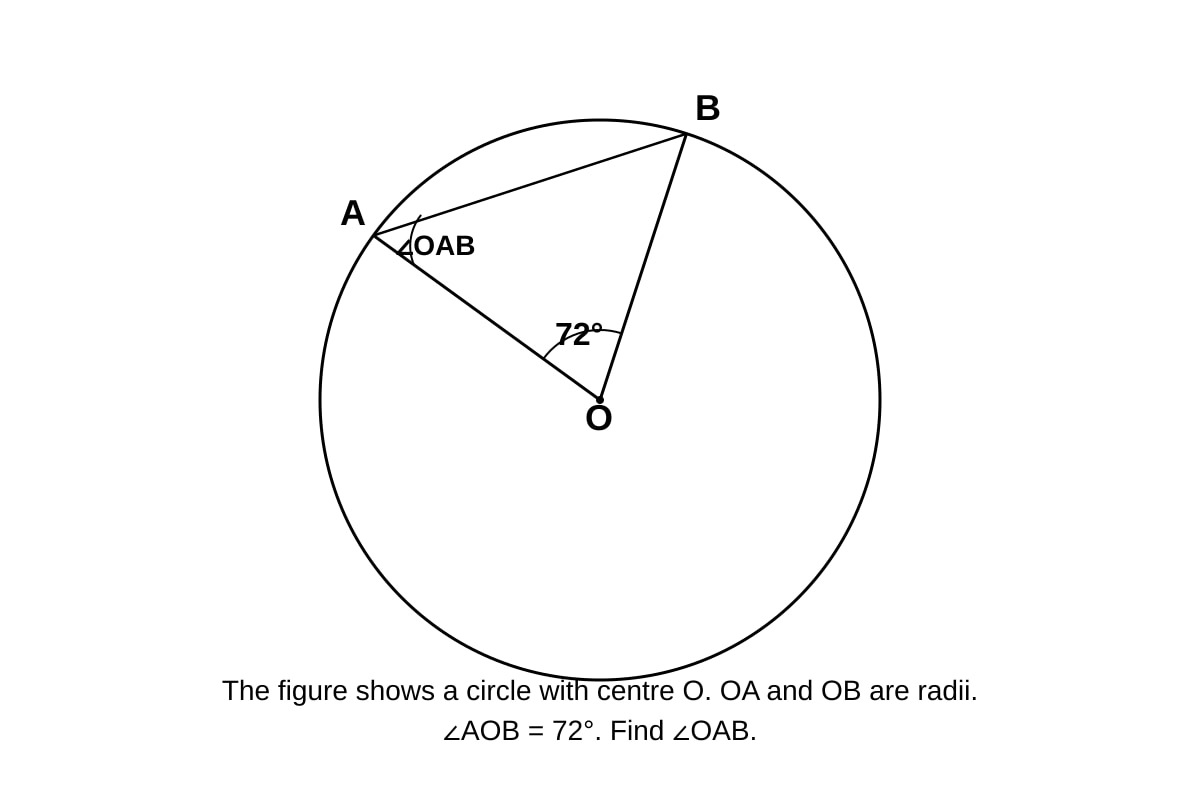
- OA and OB are radii of the circle. Therefore, OA = OB.
- In triangle OAB, since OA = OB, it is an isosceles triangle.
- In an isosceles triangle, the base angles (∠OAB and ∠OBA) are equal.
- Let ∠OAB = ∠OBA = .
- Sum of angles in triangle OAB: ∠OAB + ∠OBA + ∠AOB = 180°
- Therefore, ∠OAB = 54°.
- Answer: 54°
- Concept: Radii of a circle are equal; isosceles triangle properties; angle sum of a triangle.
18. 110°
- Marks: 3 marks for correct answer with working; 2 marks for correct method with minor miscalculation; 1 mark for identifying vertically opposite angles.
- Working:
- Angles around point O sum to 360°.
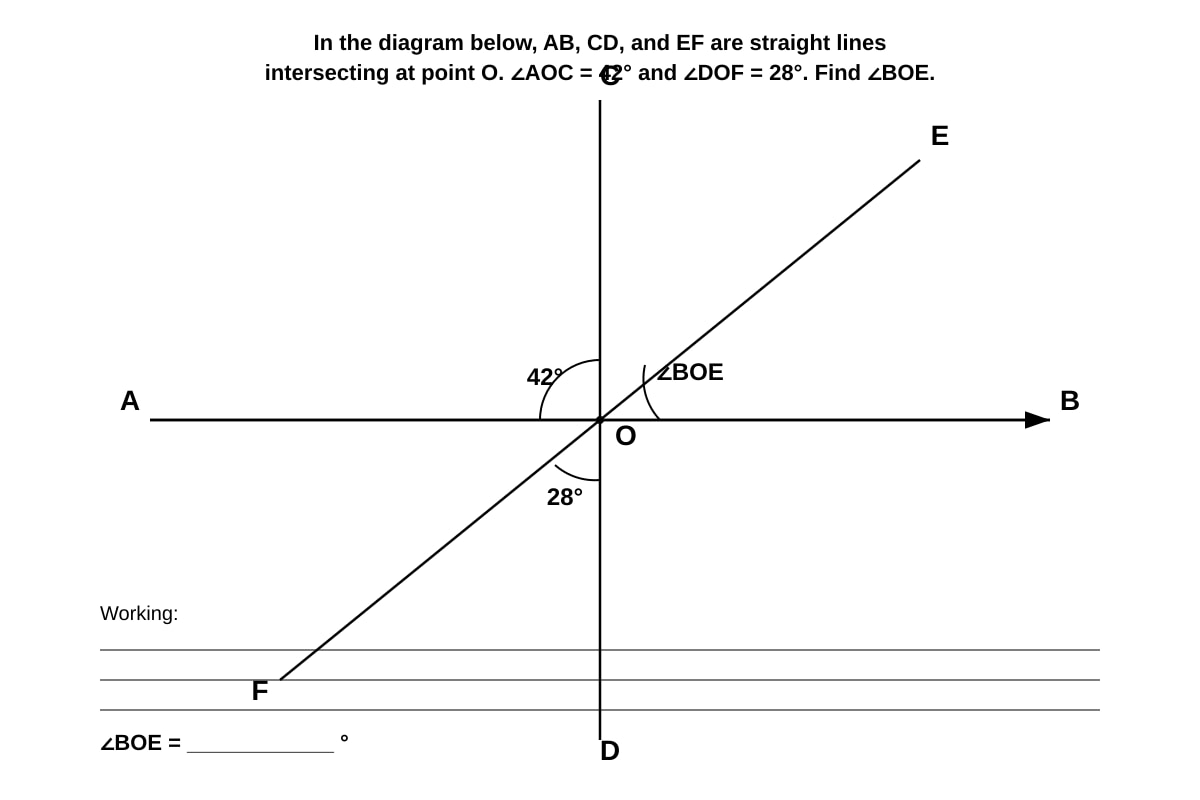
- We know ∠AOC = 42° and ∠DOF = 28°.
- Identify vertically opposite angles:
- ∠AOC is vertically opposite to ∠BOD. So, ∠BOD = 42°.
- ∠DOF is vertically opposite to ∠COE. So, ∠COE = 28°.
- We have four angles at O: ∠AOC (42°), ∠COE (28°), ∠EOB (x), ∠BOD (42°), ∠DOF (28°), ∠FOA (y). Wait, there are 6 angles, not 4.
- Let's list all angles in order around the point:
- ∠AOC (between AO and CO) = 42°
- ∠COE (between CO and EO) = 28°
- ∠EOB (between EO and BO) = ∠BOE [we are finding this]
- ∠BOD (between BO and DO) = 42° (∠AOC vèrtically opp.)
- ∠DOF (between DO and FO) = 28°
- ∠FOA (between FO and AO) = ?
- Sum of these 6 angles = 42° + 28° + ∠BOE + 42° + 28° + ∠FOA = 360°
- ∠FOA is vertically opposite to ∠COE = 28°? No, ∠FOA is vertically opposite to ∠? Let's check. Actually, ∠FOA is vertically opposite to ∠COE? No, AO is opposite BO, CO is opposite DO, EO is opposite FO. So, ∠FOA is vertically opposite to ∠BOD? No.
- Let's pair vertically opposite angles:
- ∠AOC (AO to CO) is vertically opposite to ∠BOD (BO to DO): ∠BOD = 42°
- ∠COE (CO to EO) is vertically opposite to ∠DOF (DO to FO): ∠DOF = 28° (already given)
- ∠EOB (EO to BO) is vertically opposite to ∠FOA (FO to AO).
- Now, sum = 42° + 28° + ∠BOE + 42° + 28° + ∠FOA = 360°
- 140° + 2∠BOE = 360° (since ∠BOE = ∠FOA)
- 2∠BOE = 220°
- ∠BOE = 110°
- Answer: 110°
- Concept: Vertically opposite angles are equal; angles at a point sum to 360°.
19. 72°
- Marks: 3 marks for correct answer with working; 2 marks for correct method; 1 mark for understanding the diagram.
- Working:
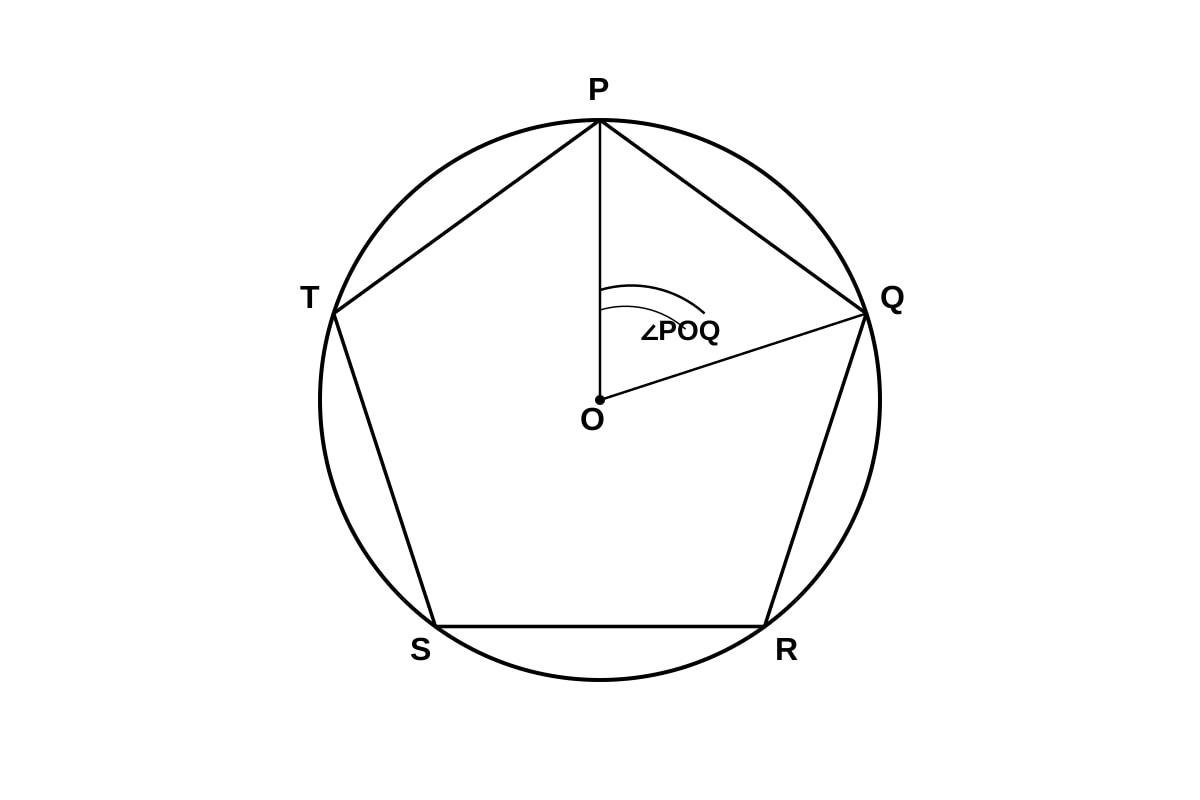
- A regular pentagon has 5 equal sides and 5 equal interior angles.
- When a regular pentagon is inscribed in a circle, the vertices divide the circle into 5 equal arcs.
- The angle at the centre of the circle (∠POQ) subtended by each side is .
- ∠POQ = 360° ÷ 5 = 72°.
- Answer: 72°
- Concept: Angles at a point (centre of a circle sum to 360°); regular pentagon division.
20. 90°
- Marks: 3 marks for correct answer with working; 2 marks for correct reasoning about isosceles triangles; 1 mark for identifying one isosceles triangle property.
- Working:
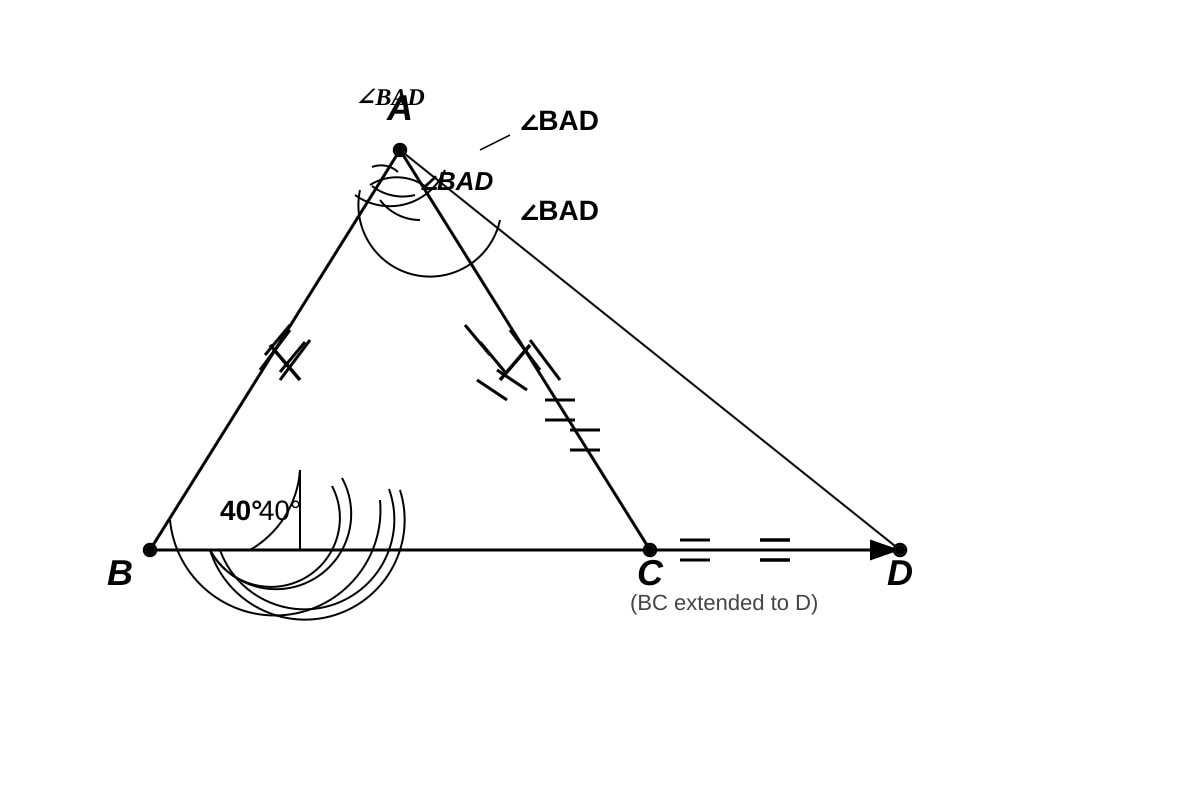
- In triangle ABC, AB = AC, so it is an isosceles triangle.
- ∠ABC = ∠ACB (base angles). Therefore, ∠ACB = 40°.
- Sum of angles in triangle ABC: ∠ABC + ∠ACB + ∠BAC = 180°
- 40° + 40° + ∠BAC = 180°
- ∠BAC = 100°.
- Now, BC is a straight line. ∠ACB = 40°. ∠ACD is the exterior angle at C.
- ∠ACD = 180° - ∠ACB = 180° - 40° = 140°.
- In triangle ACD, AC = CD, so it is an isosceles triangle.
- Let ∠CAD = ∠CDA = (base angles).
- Sum of angles in triangle ACD: ∠CAD + ∠CDA + ∠ACD = 180°
- Therefore, ∠CAD = 20°.
- Now, ∠BAD = ∠BAC + ∠CAD? No, ∠BAC is the angle inside triangle ABC at A. ∠CAD is the angle inside triangle ACD at A. Both share the same vertex A.
- ∠BAD = ∠BAC + ∠CAD? Wait, A, C, D are collinear? No, B, C, D are collinear. So rays AB and AC are from triangle ABC, and rays CA and AD are from triangle ACD. The angle at A between AB and AD includes both.
- ∠BAD = ∠BAC + ∠CAD.
- Actually, looking at the diagram, ∠BAD is the full angle between ray BA and ray AD. Inside it are ∠BAC (angle between BA and AC) and ∠CAD (angle between CA and AD).
- Therefore, ∠BAD = ∠BAC + ∠CAD = 100° + 20° = 120°.
- Answer: 120°
- Concept: Properties of an isosceles triangle (base angles equal); angle sum of a triangle; angles on a straight line.