From Real Exams Quiz
Primary 6 PSLE Mathematics Angles Geometry Quiz
Free P6 PSLE Maths Angles Geometry quiz, Exam version, with questions, answers, and PSLE-focused practice for Singapore students.
These static practice materials are generated from the site's syllabus and paper-generation workflow, with source and model context shown so students and parents can evaluate the material before use.
Questions
Free quiz and exam paper access
Enter your details to view this paper
Your access is remembered on this device.
Answers
Answer Key: Primary 6 PSLE Mathematics Quiz - Angles Geometry
Section A: Multiple Choice (5 marks)
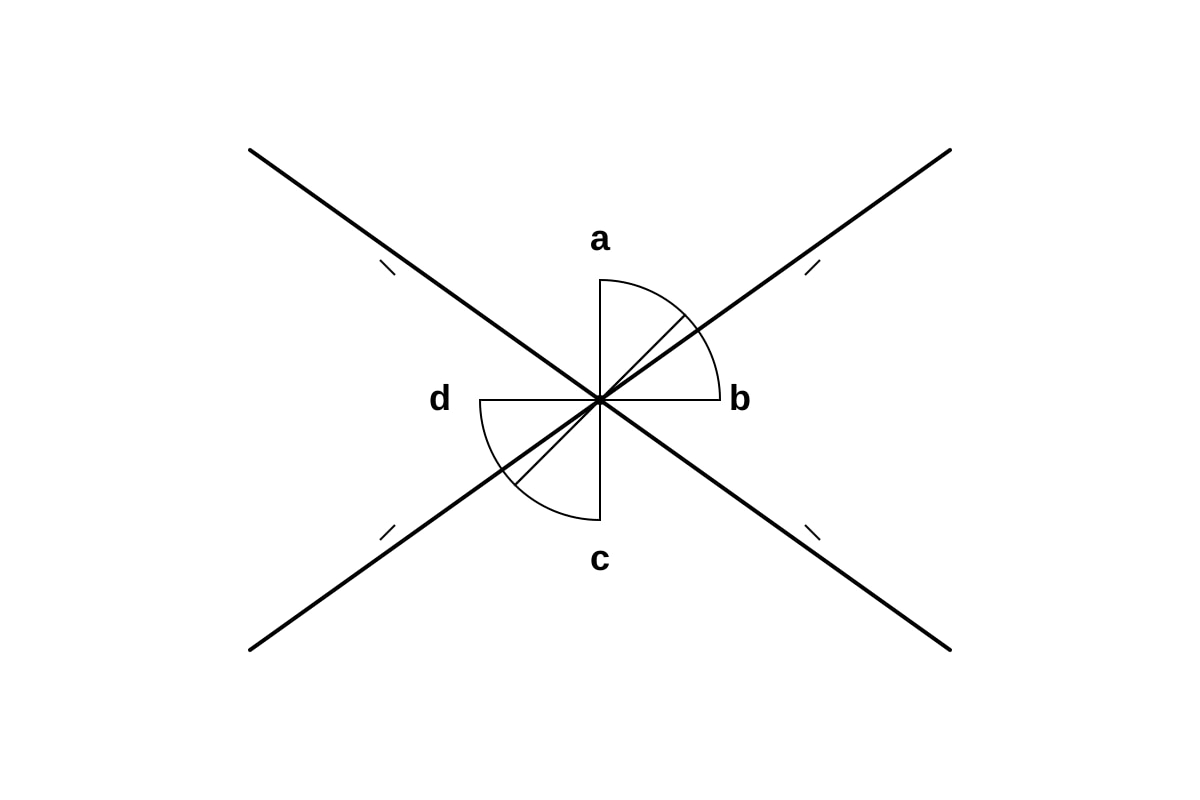
1. B) a and c
- Marks: 1
- Explanation: Vertically opposite angles are the angles opposite each other when two lines intersect. They are always equal. In the diagram, angle a and angle c are vertically opposite. Angle b and angle d are also vertically opposite.
- Common mistake: Students may confuse adjacent angles (a and b) with vertically opposite angles.
2. B) 35°
- Marks: 1
- Explanation: The angle sum of a triangle is 180°. Third angle = 180° - 65° - 80° = 35°.
- Common mistake: Students may forget the angle sum property or make an arithmetic error.
3. A) 60°
- Marks: 1
- Explanation: In a parallelogram, adjacent angles are supplementary (sum to 180°). Adjacent angle = 180° - 120° = 60°.
- Common mistake: Students may think opposite angles are supplementary (they are equal) or that adjacent angles are equal.
4. C) 360°
- Marks: 1
- Explanation: The angle sum of any quadrilateral is 360°. This can be derived by dividing the quadrilateral into two triangles (each 180°).
- Common mistake: Students may confuse this with the angle sum of a triangle (180°).
5. B) 180°
- Marks: 1
- Explanation: A straight line forms an angle of 180°. The line XY and its extension beyond Y form a straight line, so the angle between them is 180°.
- Common mistake: Students may think the angle is 0° or 90°.
Section B: Short-Answer Questions (20 marks)
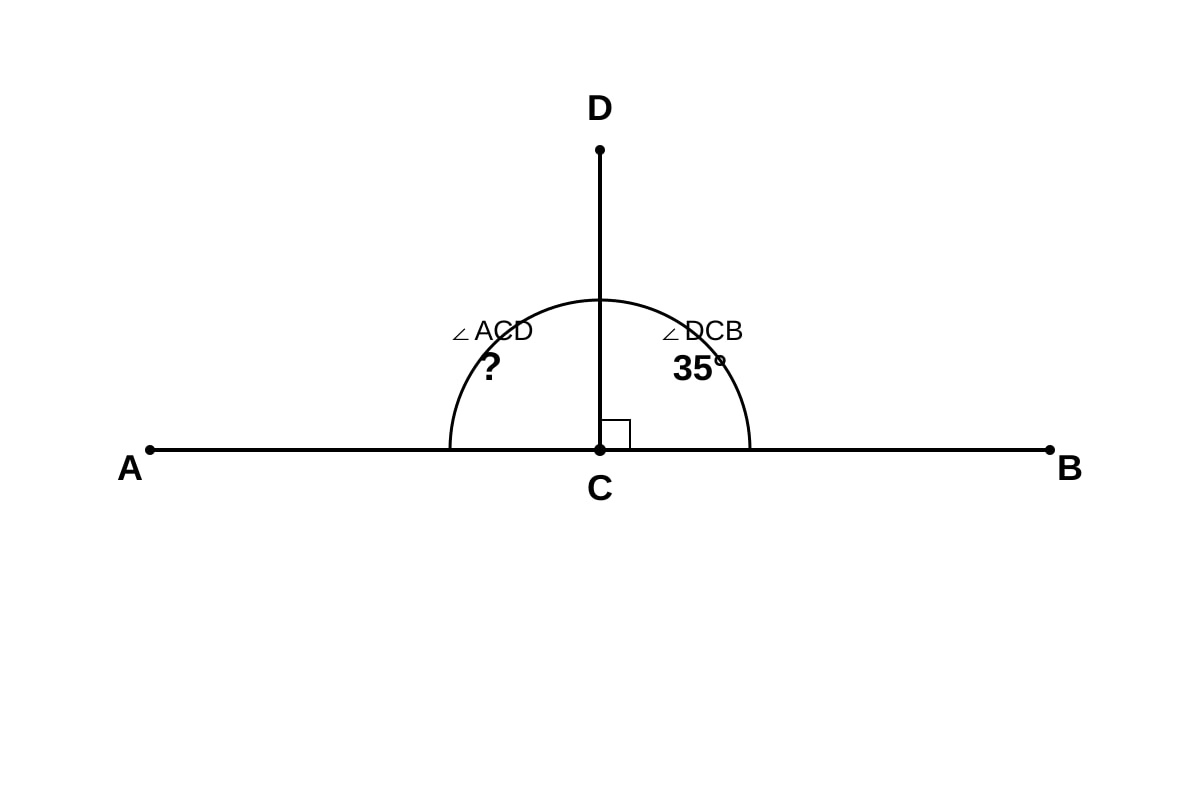
6. ∠ACD = 145°
- Marks: 2 (1 mark for correct method, 1 mark for correct answer)
- Explanation: AB is a straight line, so ∠ACD + ∠DCB = 180° (angles on a straight line). ∠ACD = 180° - 35° = 145°.
- Working: 180° - 35° = 145°
- Common mistake: Students may subtract from 360° or 90° instead of 180°.
7. ∠QPR = 60°
- Marks: 2 (1 mark for correct method, 1 mark for correct answer)
- Explanation: Angle sum of triangle PQR = 180°. ∠QPR = 180° - 55° - 65° = 60°.
- Working: 180° - 55° - 65° = 60°
- Common mistake: Arithmetic error in subtraction.
8. 70°, 110°, 110°
- Marks: 2 (1 mark for identifying opposite angle, 1 mark for adjacent angles)
- Explanation: In a rhombus, opposite angles are equal, and adjacent angles are supplementary. The given angle is 70°, so the opposite angle is also 70°. The other two angles are each 180° - 70° = 110°.
- Working: Opposite angle = 70°. Adjacent angles = 180° - 70° = 110° each.
- Common mistake: Students may think all angles are equal (like a square) or only give two angles.
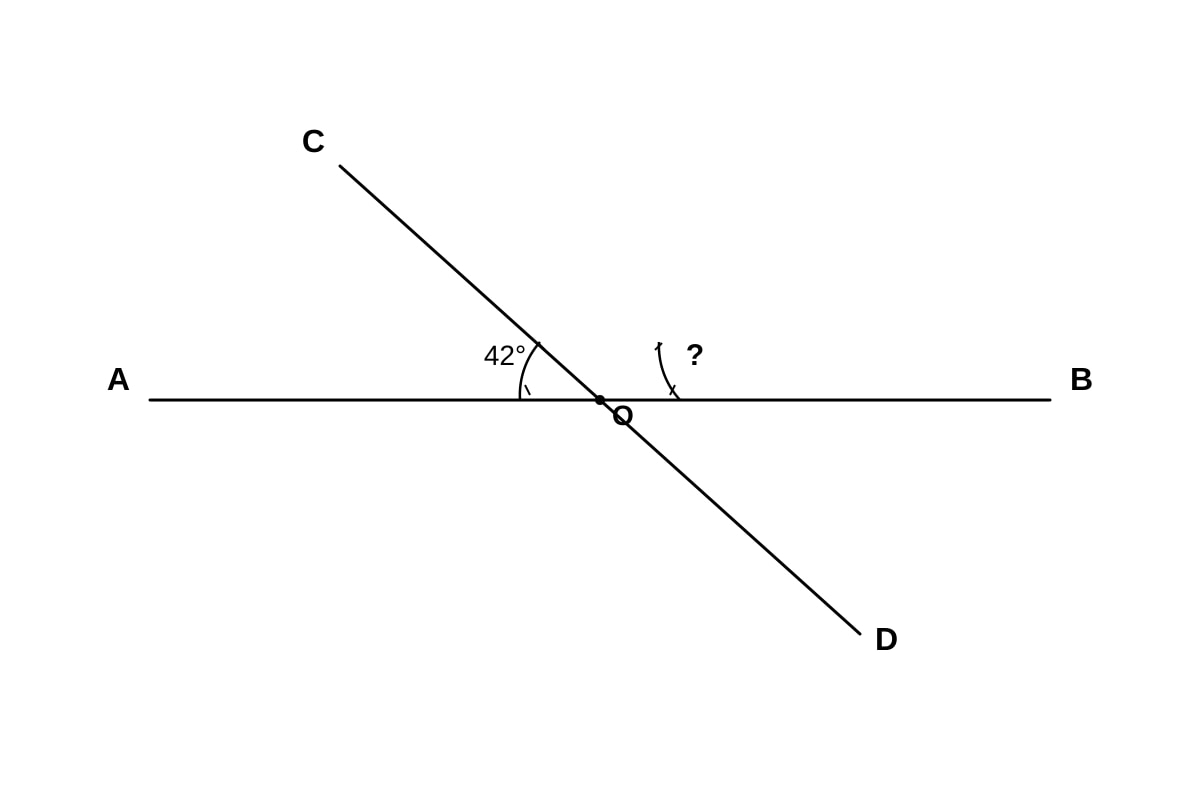
9. ∠BOD = 42°
- Marks: 2 (1 mark for identifying vertically opposite angles, 1 mark for correct answer)
- Explanation: When two lines intersect, vertically opposite angles are equal. ∠AOC and ∠BOD are vertically opposite, so ∠BOD = ∠AOC = 42°.
- Working: ∠BOD = ∠AOC = 42°
- Common mistake: Students may think they are supplementary (sum to 180°).
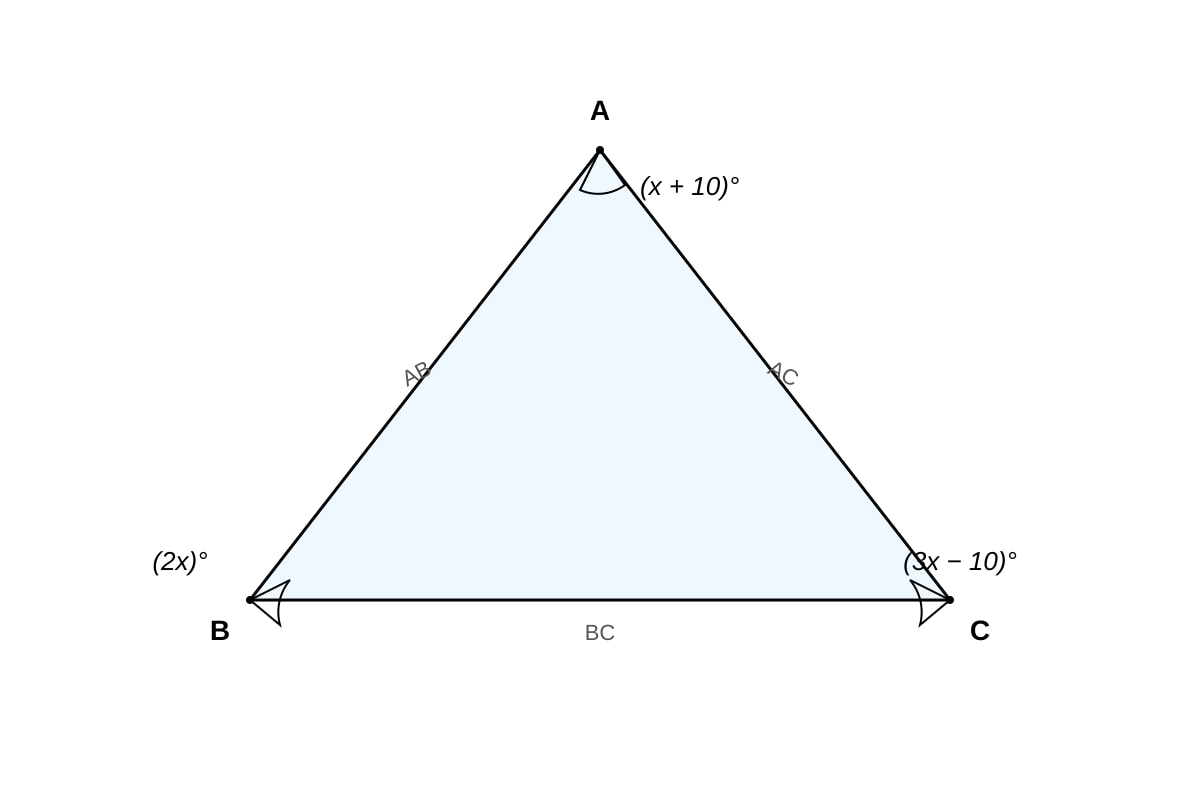
10. x = 30
- Marks: 2 (1 mark for setting up equation, 1 mark for solving correctly)
- Explanation: Angle sum of triangle = 180°. (x + 10) + (2x) + (3x - 10) = 180°. Simplify: 6x = 180°. x = 30.
- Working:
- (x + 10) + (2x) + (3x - 10) = 180°
- 6x = 180°
- x = 30
- Common mistake: Students may forget to include all three angles or make an algebraic error.
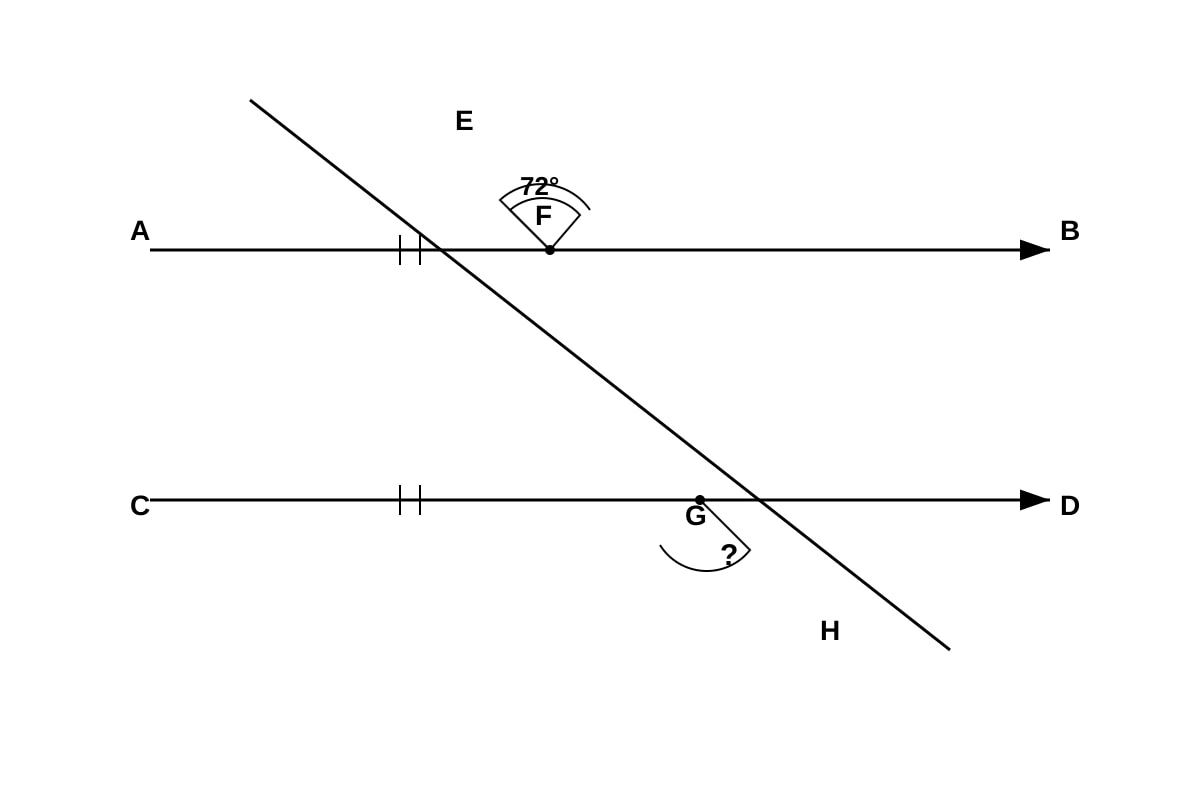
11. ∠FGH = 72°
- Marks: 2 (1 mark for identifying corresponding angles, 1 mark for correct answer)
- Explanation: When a transversal crosses parallel lines, corresponding angles are equal. ∠EFG and ∠FGH are corresponding angles, so ∠FGH = ∠EFG = 72°.
- Working: ∠FGH = ∠EFG = 72° (corresponding angles, AB ∥ CD)
- Common mistake: Students may confuse corresponding angles with alternate or interior angles.
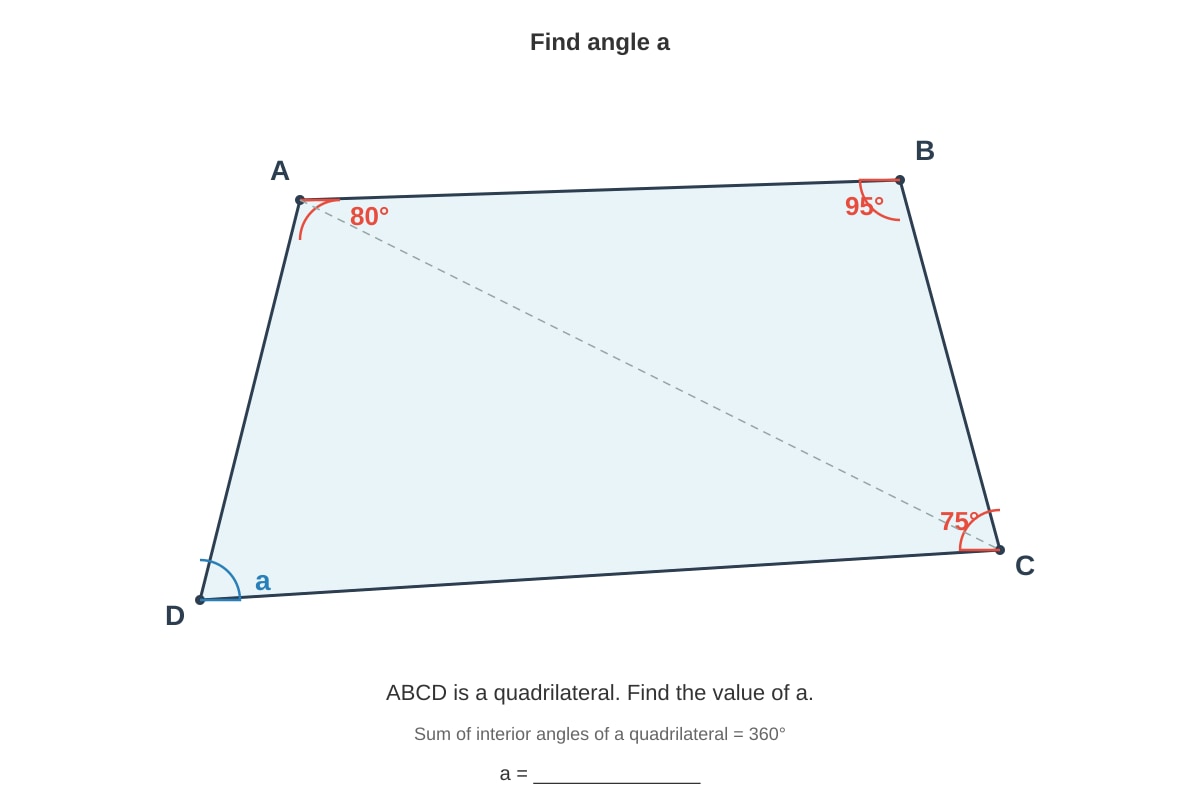
12. a = 110°
- Marks: 2 (1 mark for using angle sum of quadrilateral, 1 mark for correct answer)
- Explanation: Angle sum of quadrilateral = 360°. a = 360° - 80° - 95° - 75° = 110°.
- Working: 360° - 80° - 95° - 75° = 110°
- Common mistake: Arithmetic error or using 180° instead of 360°.
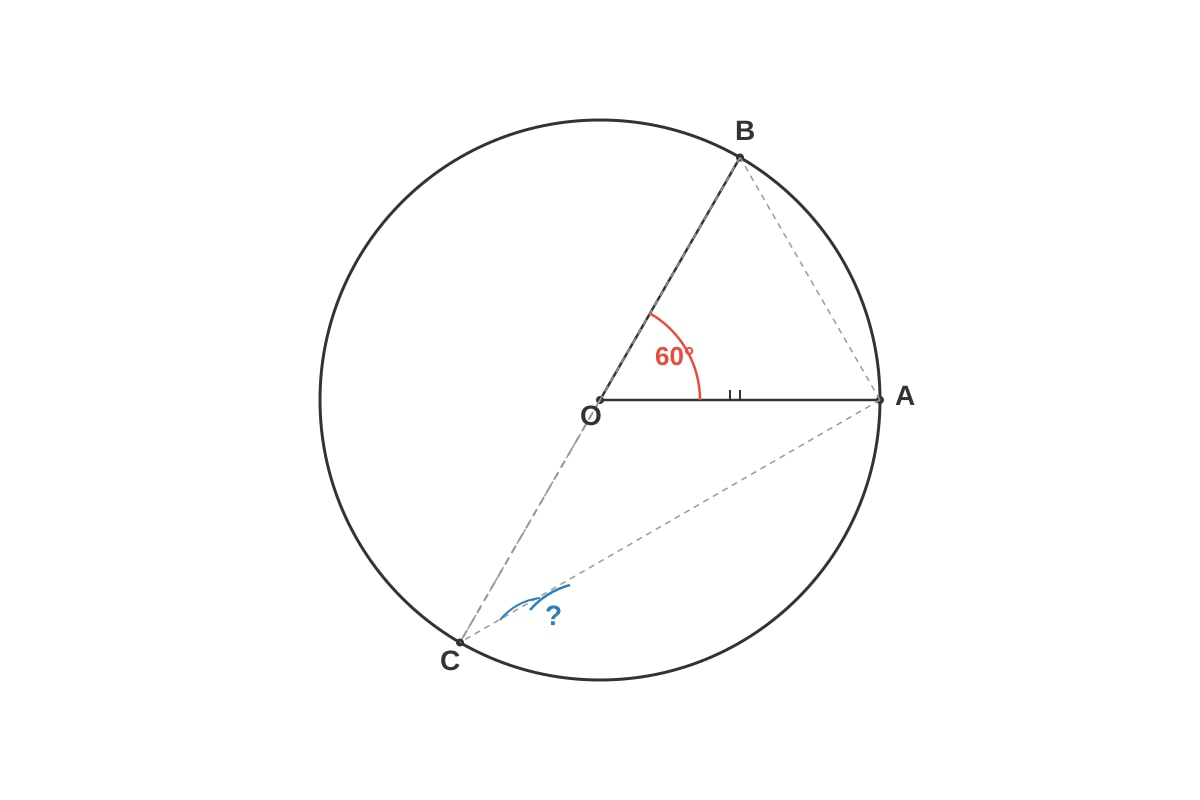
13. ∠ACB = 30°
- Marks: 2 (1 mark for identifying angle at centre theorem, 1 mark for correct answer)
- Explanation: The angle at the centre of a circle is twice the angle at the circumference subtended by the same arc. ∠AOB = 2 × ∠ACB. So ∠ACB = 60° ÷ 2 = 30°.
- Working: ∠ACB = ∠AOB ÷ 2 = 60° ÷ 2 = 30°
- Common mistake: Students may think the angle at the circumference is equal to the angle at the centre.
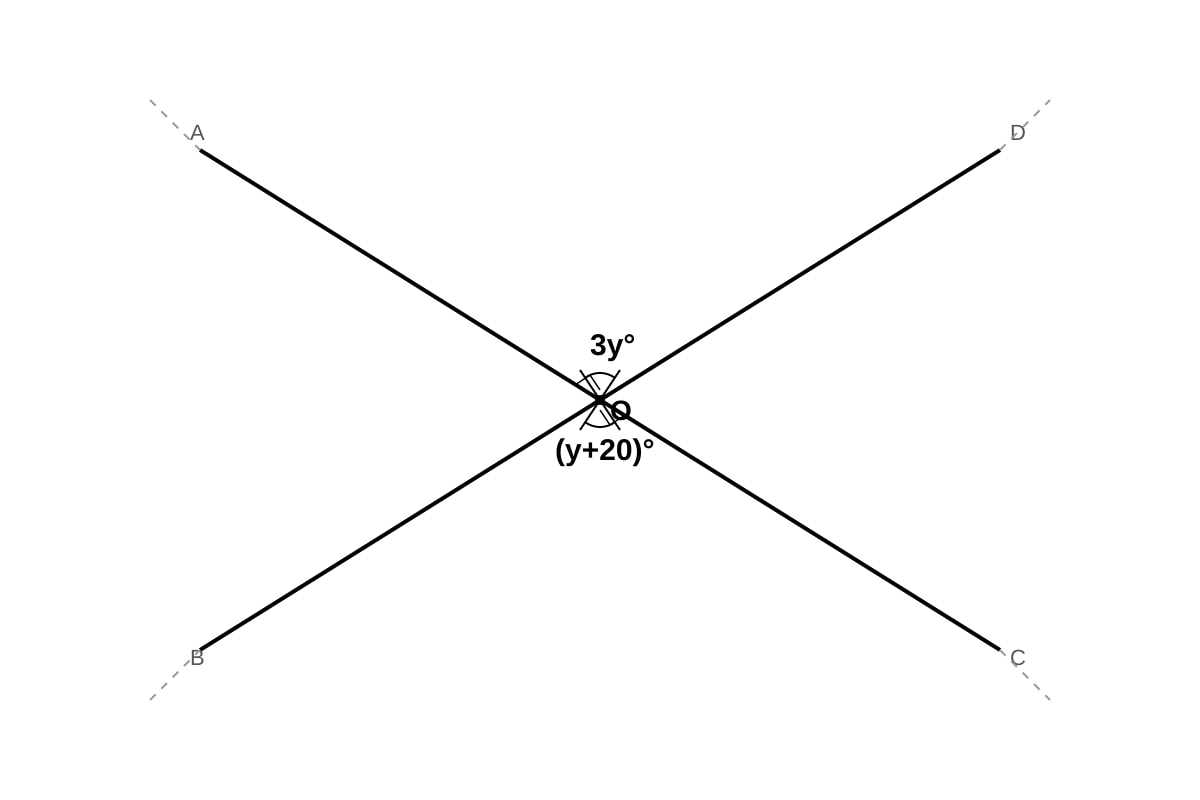
14. y = 10
- Marks: 2 (1 mark for setting up equation, 1 mark for solving correctly)
- Explanation: Vertically opposite angles are equal. 3y = y + 20. 2y = 20. y = 10.
- Working:
- 3y = y + 20
- 2y = 20
- y = 10
- Common mistake: Students may think the angles are supplementary (sum to 180°).
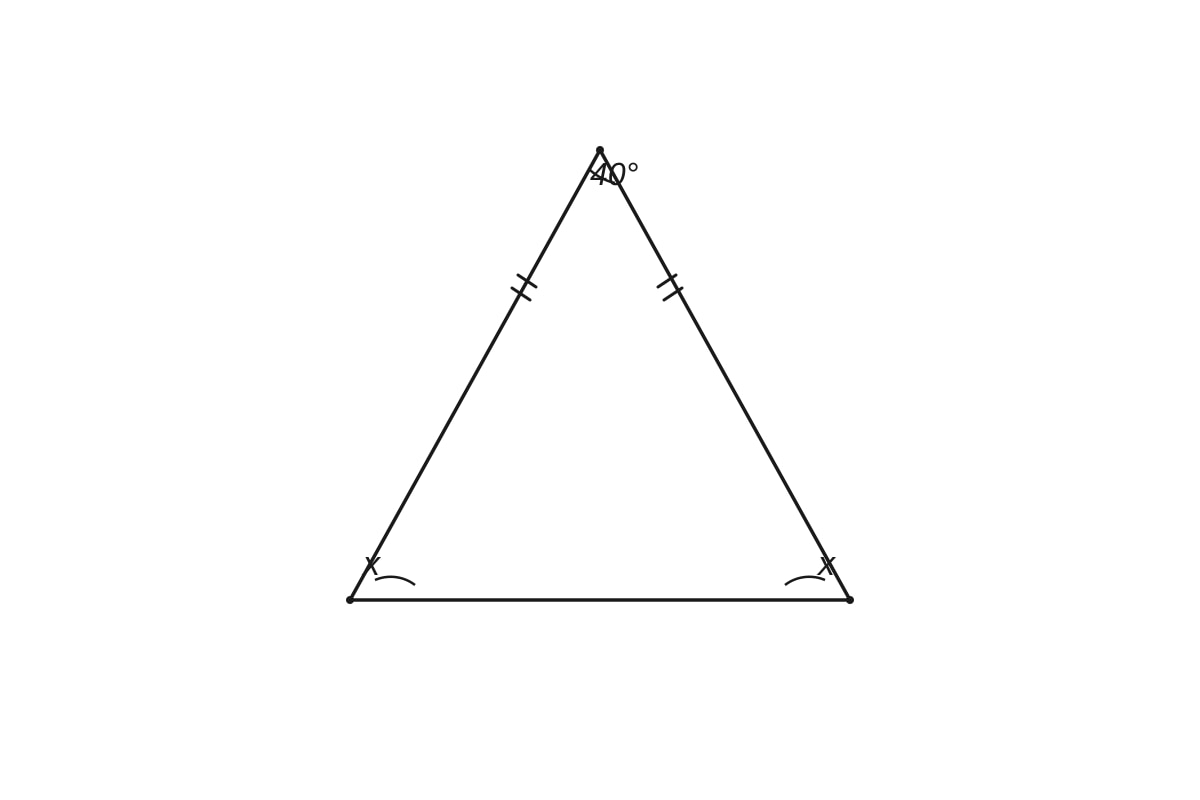
15. x = 70°
- Marks: 2 (1 mark for using isosceles triangle property, 1 mark for correct answer)
- Explanation: In an isosceles triangle, base angles are equal. Angle sum = 180°. 40° + x + x = 180°. 2x = 140°. x = 70°.
- Working:
- 40° + 2x = 180°
- 2x = 140°
- x = 70°
- Common mistake: Students may forget that base angles are equal or make an arithmetic error.
Section C: Problem-Solving Questions (20 marks)
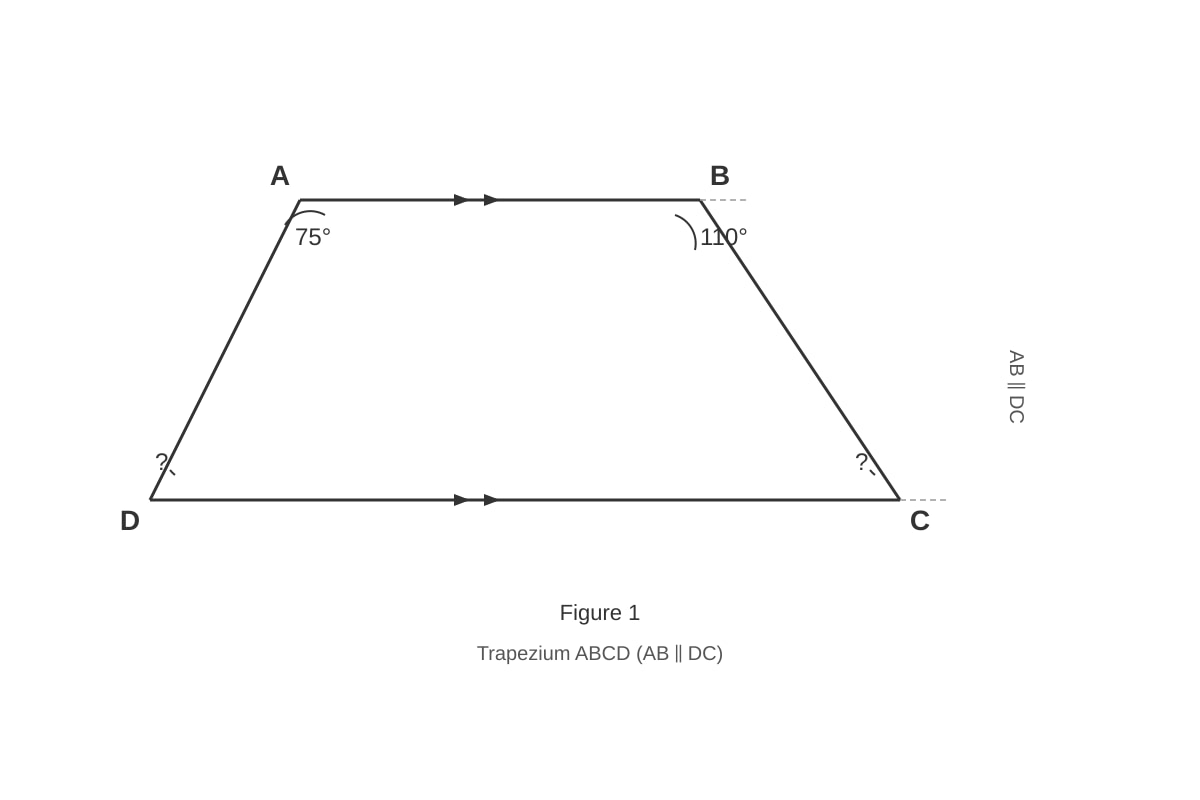
16. ∠BCD = 70°, ∠CDA = 105°
- Marks: 4 (2 marks for each angle: 1 mark for correct method, 1 mark for correct answer)
- Explanation:
- In a trapezium with AB ∥ DC, interior angles on the same side of a transversal are supplementary.
- ∠DAB + ∠CDA = 180° (angles on same side of transversal AD). So ∠CDA = 180° - 75° = 105°.
- ∠ABC + ∠BCD = 180° (angles on same side of transversal BC). So ∠BCD = 180° - 110° = 70°.
- Working:
- ∠CDA = 180° - 75° = 105°
- ∠BCD = 180° - 110° = 70°
- Common mistake: Students may think opposite angles are supplementary (they are not in a trapezium) or confuse which angles are on the same side of the transversal.
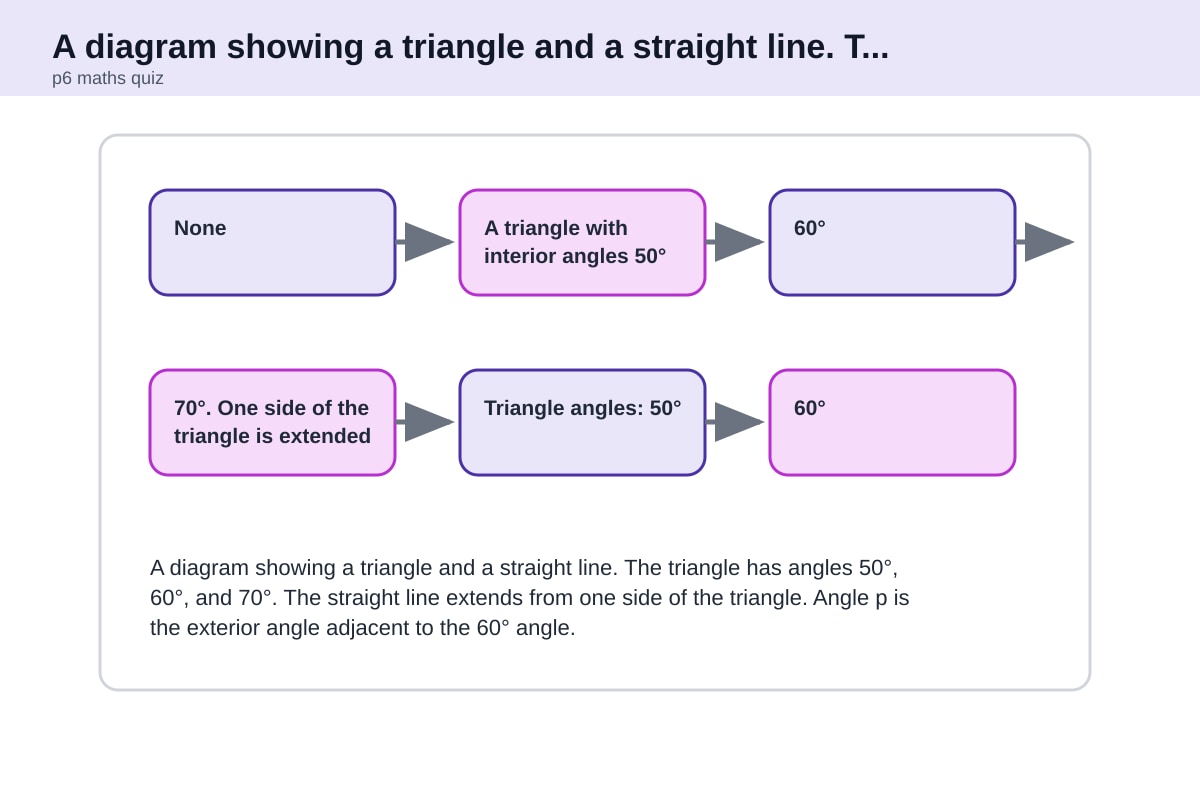
17. p = 120°
- Marks: 4 (2 marks for correct method, 2 marks for correct answer)
- Explanation: The exterior angle of a triangle is equal to the sum of the two opposite interior angles. The exterior angle p is adjacent to the 60° angle, so the two opposite interior angles are 50° and 70°. p = 50° + 70° = 120°.
- Working: p = 50° + 70° = 120°
- Alternative method: Interior angle adjacent to p = 60°. Angles on a straight line: p + 60° = 180°. p = 120°.
- Common mistake: Students may add the adjacent angle (60°) instead of the opposite angles, or think the exterior angle equals one interior angle.
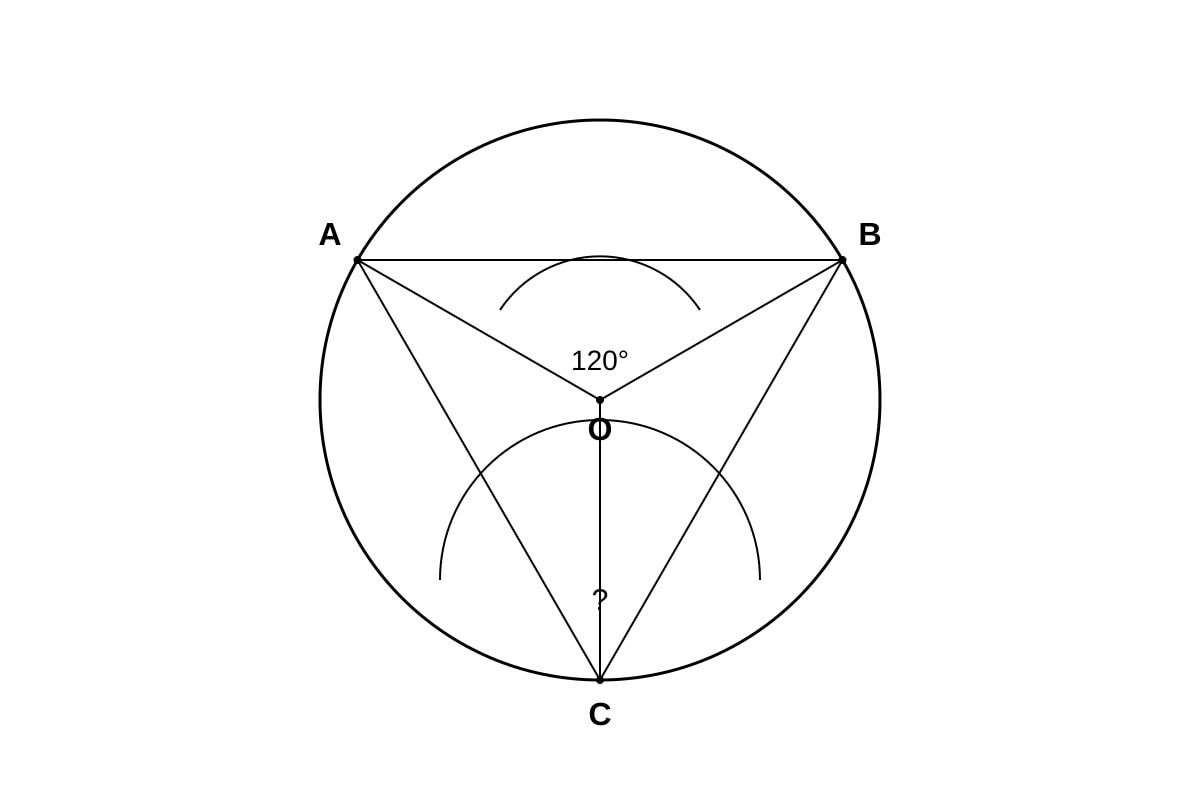
18. ∠ACB = 60°
- Marks: 4 (2 marks for identifying angle at centre theorem, 2 marks for correct answer)
- Explanation: The angle at the centre of a circle is twice the angle at the circumference subtended by the same arc. ∠AOB is the angle at the centre subtended by arc AB. ∠ACB is the angle at the circumference subtended by the same arc AB. So ∠ACB = ∠AOB ÷ 2 = 120° ÷ 2 = 60°.
- Working: ∠ACB = 120° ÷ 2 = 60°
- Common mistake: Students may think ∠ACB = ∠AOB (equal) or use the wrong relationship. Note: The fact that OA = OB = OC is always true for radii and does not affect the calculation.
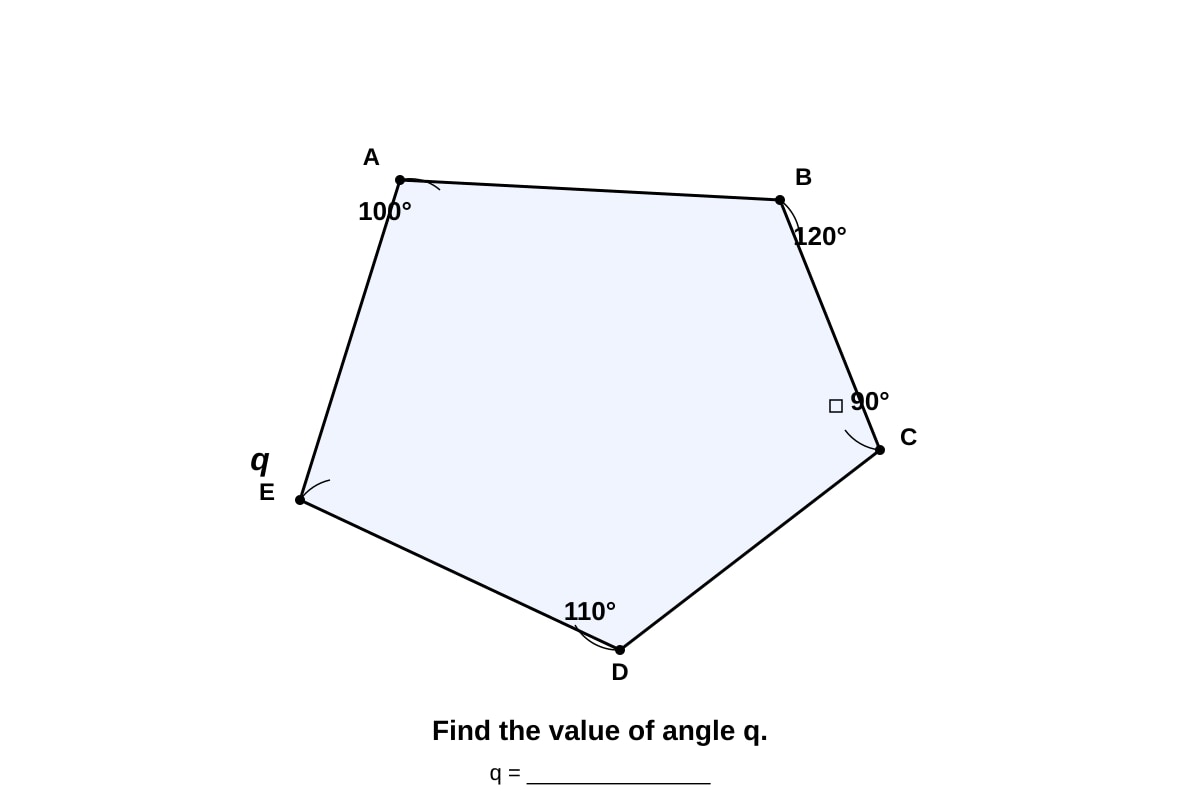
19. q = 120°
- Marks: 4 (2 marks for using angle sum of pentagon, 2 marks for correct answer)
- Explanation: The angle sum of a pentagon (5-sided polygon) is (5 - 2) × 180° = 3 × 180° = 540°. q = 540° - 100° - 120° - 90° - 110° = 120°.
- Working:
- Angle sum of pentagon = (5 - 2) × 180° = 540°
- q = 540° - 100° - 120° - 90° - 110° = 120°
- Common mistake: Students may use the wrong formula (e.g., (n-1) × 180°) or make an arithmetic error.
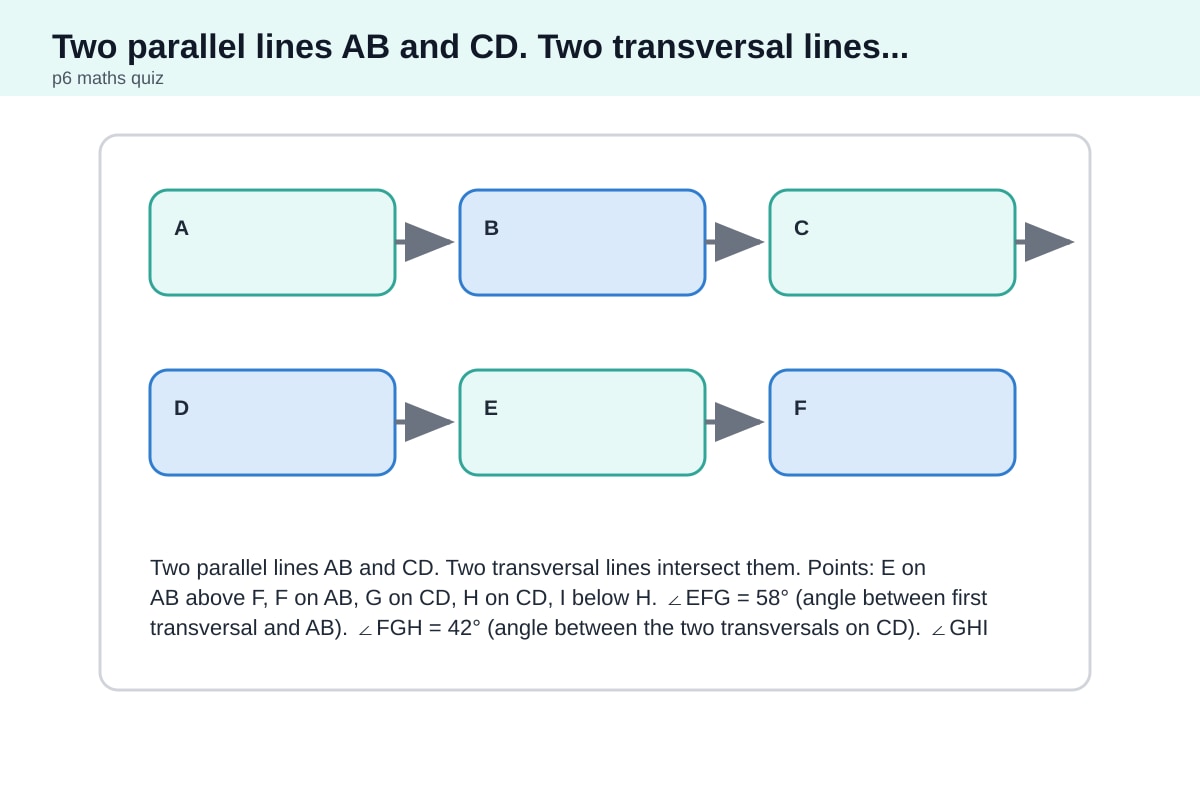
20. ∠GHI = 80°
- Marks: 4 (2 marks for correct method using parallel lines, 2 marks for correct answer)
- Explanation:
- Since AB ∥ CD, ∠EFG and ∠FGH are angles on the same side of the transversal FG. They are not directly related by a simple rule.
- We need to find ∠GHI. Consider the triangle FGH. We know ∠FGH = 42°.
- To find ∠GFH, note that ∠EFG = 58° and AB ∥ CD. ∠GFH is the alternate angle to ∠FGH? No, let's reconsider.
- Actually, ∠EFG and ∠FGH are interior angles on the same side of the transversal FG. Since AB ∥ CD, interior angles on the same side of a transversal are supplementary. So ∠EFG + ∠FGH should be 180°? But 58° + 42° = 100°, not 180°. This means FG is not a transversal between the parallel lines in the usual sense.
- Let's re-examine the diagram. E is on AB above F, F is on AB, G is on CD, H is on CD. So line EG is a transversal crossing AB at F and CD at G. ∠EFG is the angle between the transversal and AB at F. ∠FGH is the angle between the transversal and CD at G.
- Since AB ∥ CD, alternate angles are equal. ∠EFG and ∠FGD are alternate angles, so ∠FGD = 58°.
- Now, ∠FGH = 42°. So ∠HGD = ∠FGD - ∠FGH = 58° - 42° = 16°.
- Now, line HI is another transversal. ∠GHI is the angle between this transversal and CD at H. Since AB ∥ CD, ∠GHI and ∠GFH are corresponding angles? No, let's think differently.
- Actually, we can use the angle sum of triangle FGH. We know ∠FGH = 42°. We need ∠GFH.
- ∠GFH is the angle between line FG and line FH. Since F is on AB and H is on CD, and AB ∥ CD, ∠GFH and ∠FHD are corresponding angles? Not directly.
- Let's use a different approach. Consider the triangle formed by the two transversals and the parallel lines. The angles at F and G are known. The angle at H (∠GHI) is what we need.
- In triangle FGH, ∠FGH = 42°. ∠GFH = ∠EFG = 58° (alternate angles, AB ∥ CD). So ∠GHI = 180° - 42° - 58° = 80°.
- Working:
- ∠GFH = ∠EFG = 58° (alternate angles, AB ∥ CD)
- In triangle FGH: ∠GHI = 180° - ∠FGH - ∠GFH = 180° - 42° - 58° = 80°
- Common mistake: Students may struggle to identify the correct angle relationships or try to use the wrong parallel line rule.