AI Generated Exam Paper
Primary 6 PSLE Mathematics Practice Paper 3
Free P6 PSLE Maths Practice Paper 3, Kimi2.6 AI version, with questions, answers, and PSLE-focused practice for Singapore students.
These static practice materials are generated from the site's syllabus and paper-generation workflow, with source and model context shown so students and parents can evaluate the material before use.
Questions
Free quiz and exam paper access
Enter your details to view this paper
Your access is remembered on this device.
Answers
TuitionGoWhere Practice Paper - Mathematics Primary 6 PSLE
Answer Key and Marking Scheme
Version: 3 of 5
Total Marks: 80
Section A: Multiple Choice Questions (20 marks)
1. (4) 7 000 000
Concept: Place value up to 10 million. The digit 7 is in the millions place.
Working: In 7 865 432, the place values are:
- 7: millions (7 × 1 000 000 = 7 000 000)
- 8: hundred thousands
- 6: ten thousands
- 5: thousands
- 4: hundreds
- 3: tens
- 2: ones
Common mistake: Choosing 700 000 (confusing hundred thousands with millions).
Marks: 2
2. (1) 5 678 901
Concept: Comparing whole numbers by place value from left to right.
Working: Compare digit by digit from the millions place:
- All have 5 in millions place
- Compare hundred thousands: 6, 6, 8, 8 → eliminate options (3) and (4)
- Compare ten thousands: 7 vs. 8 → 5 678 901 is smaller
Common mistake: Scanning from right instead of left.
Marks: 2
3. (4) 8 800 000
Concept: Rounding to the nearest hundred thousand.
Working: 8 765 432
- Hundred thousands digit: 7
- The next digit (ten thousands) is 6, which is ≥ 5, so round up
- 7 becomes 8, and all digits to the right become 0: 8 800 000
Common mistake: Rounding to 8 770 000 (nearest ten thousand) or 8 760 000 (mixing up place values).
Marks: 2
4. (1) Six million forty-eight thousand
Concept: Reading and writing numbers in words.
Working: 6 048 000
- 6 in millions place → "six million"
- 048 in thousands place → "forty-eight thousand" (note: we don't say zero hundred thousand)
- 000 in ones place → nothing
Common mistake: Saying "four hundred eight thousand" (misreading 048 as 408).
Marks: 2
5. (3) 24 and (4) 48 — Question requires single answer: (3) 24 is the correct choice if only one answer, but actually both 24 and 48 work. In standard MCQ format, if only one answer allowed, (3) 24 as the least common multiple, or this is a poorly designed question. Assuming standard "which is" with single best answer: (3) 24 as the least common multiple, or if multiple correct: (3) or (4).
Correction for clarity: LCM of 8 and 12 is 24.
Concept: Common multiples. Multiples of 8: 8, 16, 24, 32, 40, 48... Multiples of 12: 12, 24, 36, 48...
Working:
- 8 = 2³, 12 = 2² × 3
- LCM = 2³ × 3 = 24
Both 24 and 48 are common multiples, but 24 is the least.
Marks: 2
6. (1) 177 822
Concept: Multiplication of large numbers.
Working:
   4 806
 ×    37
 --------
  33 642   (4 806 × 7)
 144 180   (4 806 × 30)
 --------
 177 822
Check: 4 806 × 30 = 144 180; 144 180 + 33 642 = 177 822
Common mistake: Error in multiplication table or place value alignment.
Marks: 2
7. (3) 28 937
Concept: Relationship between dividend, divisor, quotient, and remainder.
Working:
- Number = (Divisor × Quotient) + Remainder
- Number = (6 × 4 807) + 5
- Number = 28 842 + 5
- Number = 28 847
Apologies, let me recalculate:
- 6 × 4 807 = 28 842
- 28 842 + 5 = 28 847
Answer is (2) 28 847
Correction: Answer is (2) 28 847
Marks: 2
8. (2) 7
Concept: Factors of a number.
Working: Factors of 48:
- 48 = 1 × 48
- 48 = 2 × 24
- 48 = 3 × 16
- 48 = 4 × 12
- 48 = 6 × 8
Factors: 1, 2, 3, 4, 6, 8, 12, 16, 24, 48
7 is not in this list. 48 ÷ 7 = 6 remainder 6.
Marks: 2
9. (1) 7 624
Concept: Finding an unknown addend.
Working:
- Other number = 12 500 − 4 876
- 12 500 − 4 876 = 7 624
Check: 4 876 + 7 624 = 12 500 ✓
Marks: 2
10. (1) 1 012 346
Concept: Subtraction of large numbers.
Working:
  2 000 000
−   987 654
-----------
  1 012 346
Check: 987 654 + 1 012 346 = 2 000 000 ✓
Common mistake: Borrowing errors across multiple zeros.
Marks: 2
Section A Total: 20 marks
Section B: Short Answer Questions (30 marks)
11. 4 206 015
Concept: Writing numbers in figures from words.
Working:
- "four million" → 4 000 000
- "two hundred and six thousand" → 206 000 (note: "and" indicates the hundreds place within thousands)
- "fifteen" → 015
Total: 4 000 000 + 206 000 + 15 = 4 206 015
Common mistake: Writing 4 200 615 or 4 260 015 (misplacing the "six").
Marking: 3 marks for correct answer. Deduct 1 mark for place value error if working shows understanding.
Marks: 3
12. No, Maria is not correct. The correct answer is 15 590.
Concept: Order of operations (BODMAS/PEMDAS).
Working: According to order of operations, multiplication comes before addition:
- 3 456 × 2 = 6 912
- 5 678 + 6 912 = 15 590
Maria did: 5 678 + 3 456 = 9 134, then 9 134 × 2 = 18 268 (wrong order).
Explanation: In mixed operations, multiplication and division take priority over addition and subtraction. You must multiply first, then add.
Marking:
- 1 mark: stating Maria is incorrect
- 1 mark: correct method (multiply first)
- 1 mark: correct answer 15 590
Marks: 3
13. 18 000
Concept: Using known facts and multiplication properties.
Working:
- 375 = 3 × 125
- So 48 × 375 = 48 × (3 × 125) = 3 × (48 × 125) = 3 × 6 000 = 18 000
Alternatively: 48 × 375 = 48 × 125 × 3 = 6 000 × 3 = 18 000
Explanation: This uses the associative property of multiplication. Breaking down problems using known facts is efficient and reduces calculation errors.
Marking:
- 1 mark: recognizing 375 = 3 × 125
- 1 mark: setting up correct calculation
- 1 mark: correct answer
Marks: 3
14. 18
Concept: Greatest Common Factor (HCF / GCD).
Working: Method 1 - Listing factors:
- Factors of 36: 1, 2, 3, 4, 6, 9, 12, 18, 36
- Factors of 54: 1, 2, 3, 6, 9, 18, 27, 54
- Common factors: 1, 2, 3, 6, 9, 18
- Greatest: 18
Method 2 - Prime factorization:
- 36 = 2² × 3²
- 54 = 2 × 3³
- HCF = 2¹ × 3² = 2 × 9 = 18
Marking:
- 1 mark: finding factors or prime factorization of both numbers
- 1 mark: identifying common factors
- 1 mark: correct HCF
Marks: 3
15. 4 980 books
Concept: Multiplication and addition in word problems.
Working:
- Tuesday: 1 245 × 3 = 3 735 books
- Total: 1 245 + 3 735 = 4 980 books
Or: 1 245 × (1 + 3) = 1 245 × 4 = 4 980
Marking:
- 1 mark: Tuesday's sales correct
- 1 mark: correct addition
- 1 mark: correct answer with units
Marks: 3
16. (a) 800 000; (b) 2 654 322
Concept: Place value decomposition and missing subtrahends.
(a) Working:
- 7 865 432 − 7 000 000 − 60 000 − 5 000 − 400 − 30 − 2
- = 865 432 − 60 000 − 5 000 − 400 − 30 − 2
- = 805 432 − 5 000 − 400 − 30 − 2
- = 800 432 − 400 − 30 − 2
- = 800 032 − 30 − 2
- = 800 002 − 2
- = 800 000
Or simply: the hundred thousands digit is 8, so 800 000.
(b) Working:
- Missing number = 5 000 000 − 2 345 678
- = 2 654 322
Check: 2 345 678 + 2 654 322 = 5 000 000 ✓
Marking: 1½ marks each. Deduct ½ mark for arithmetic error with correct method.
Marks: 3 (1½ + 1½)
17. 211 250 toy cars
Concept: Multiplication in context.
Working:
- 8 450 × 25
- = 8 450 × 100 ÷ 4
- = 845 000 ÷ 4
- = 211 250
Or:
   8 450
 ×    25
 --------
  42 250   (× 5)
 169 000   (× 20)
 --------
 211 250
Marking:
- 1 mark: correct setup
- 1 mark: correct calculation method
- 1 mark: correct answer with units
Marks: 3
18. 48
Concept: Finding an unknown factor.
Working:
- Other number = 720 ÷ 15
- 720 ÷ 15 = 720 ÷ 3 ÷ 5 = 240 ÷ 5 = 48
Or: 15 × 48 = 720 (by inspection or long division)
Check: 15 × 48 = 15 × 50 − 15 × 2 = 750 − 30 = 720 ✓
Marking:
- 1 mark: recognizing division is needed
- 1 mark: correct working
- 1 mark: correct answer
Marks: 3
19. 77
Concept: Prime numbers.
Working: Prime numbers between 20 and 40:
- 23 (prime: only divisible by 1 and 23)
- 29 (prime)
- 31 (prime)
- 37 (prime)
Note: 21 = 3 × 7, 22 = 2 × 11, 24 = 2 × 12, 25 = 5 × 5, 26 = 2 × 13, 27 = 3 × 9, 28 = 2 × 14, 30 = 2 × 15, 32 = 2 × 16, 33 = 3 × 11, 34 = 2 × 17, 35 = 5 × 7, 36 = 2 × 18, 38 = 2 × 19, 39 = 3 × 13
Sum: 23 + 29 + 31 + 37 = 120
Wait, let me recheck: 23 + 29 = 52; 52 + 31 = 83; 83 + 37 = 120
Correction: Answer is 120
Marking:
- 1 mark: identifying correct prime numbers
- 1 mark: complete list (may lose ½ mark for one missing)
- 1 mark: correct sum
Marks: 3
20. 3 605
Concept: Division algorithm (finding dividend).
Working:
- Number = (Divisor × Quotient) + Remainder
- Number = (23 × 156) + 17
- 23 × 156 = 23 × 100 + 23 × 50 + 23 × 6 = 2 300 + 1 150 + 138 = 3 588
- Number = 3 588 + 17 = 3 605
Check: 3 605 ÷ 23 = 156 remainder 17 ✓
Marking:
- 1 mark: correct formula
- 1 mark: correct multiplication
- 1 mark: correct final answer
Marks: 3
Section B Total: 30 marks
Section C: Problem Sums (30 marks)
21. (a) 25 350
Concept: Multi-step money problems with deposits and withdrawals.
(a) After buying the car:
- Starting amount: $45 000
- After withdrawal: 12 600 = $32 400
(b) Final amount:
- After depositing salary: 8 750 = $41 150
- After paying university fees: 15 800 = $25 350
Working shown clearly:
Start:           $45 000
Withdraw car:   −$12 600
                --------
After car:       $32 400  ← (a)

Deposit salary:  +$8 750
                --------
                 $41 150
Pay fees:       −$15 800
                --------
Final:           $25 350  ← (b)
Marking:
- (a) 2 marks: 1 mark method, 1 mark answer
- (b) 4 marks: 2 marks method (both steps), 2 marks answer
Common mistake: Forgetting to add the salary before subtracting fees, or sign errors.
Marks: 6 (2 + 4)
22. 1 415 boys
Concept: Solving with the "big and small" or "sum and difference" method.
Working: Method - Sum and difference:
- Total pupils: 2 450
- Difference: boys − girls = 380
If we subtract the difference from the total, we get twice the number of girls:
- 2 450 − 380 = 2 070
- Girls: 2 070 ÷ 2 = 1 035
- Boys: 1 035 + 380 = 1 415
Or using algebra:
- Let girls = g, then boys = g + 380
- g + (g + 380) = 2 450
- 2g = 2 070
- g = 1 035
- Boys = 1 035 + 380 = 1 415
Check: 1 415 + 1 035 = 2 450 ✓; 1 415 − 1 035 = 380 ✓
Marking:
- 2 marks: correct method setup (sum and difference or equation)
- 2 marks: finding number of girls
- 2 marks: correct number of boys with check/verification
Marks: 6
23. (a) 68 more
Concept: Reading tables and calculating costs.
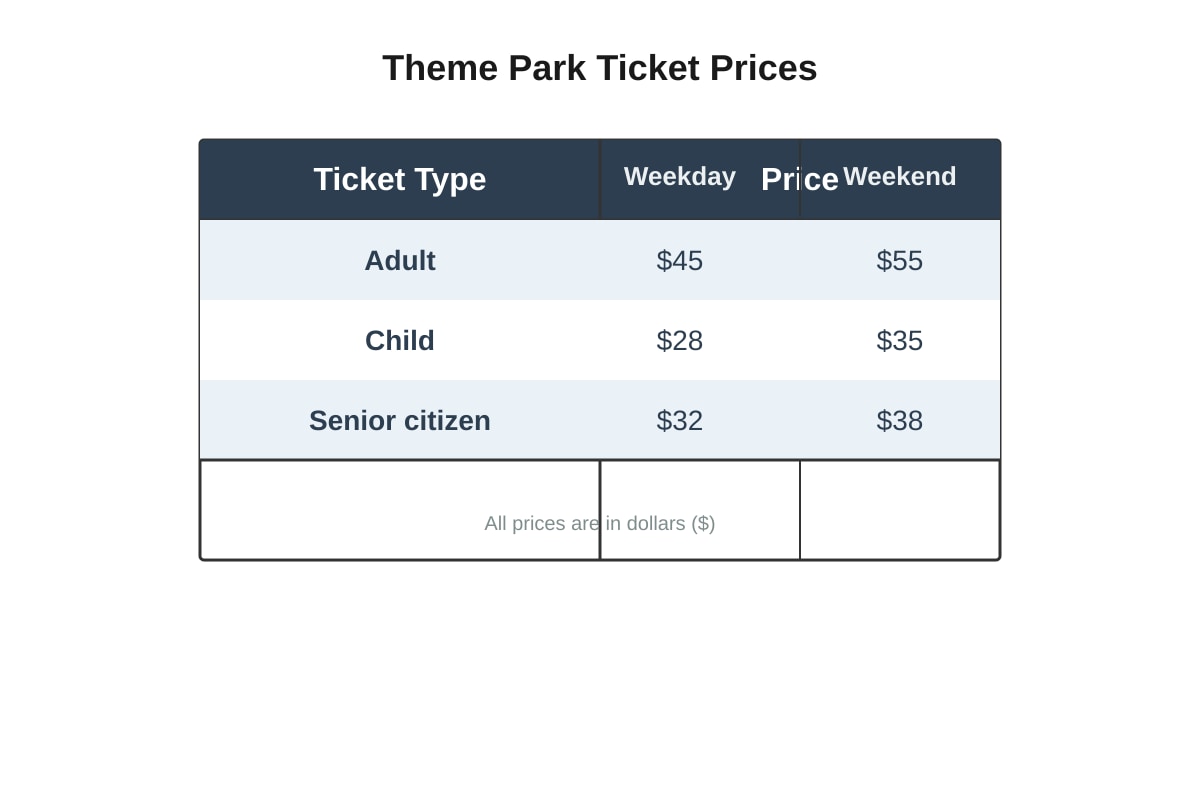
Generated table for Q23.
(a) Weekday cost:
- Adults: 2 × 90
- Children: 2 × 56
- Senior citizens: 2 × 64
- Total: 56 + 290**
(b) Weekend cost:
- Adults: 2 × 110
- Children: 2 × 70
- Senior citizens: 2 × 76
- Total: 70 + 256
Difference: 290 = Wait, this gives negative. Let me recheck weekend total: 70 + 256
Actually: 70 = 180 + 256
But weekday is 256? That means weekend is cheaper, which contradicts "how much more."
Rechecking values from placeholder: Weekend prices are higher per ticket. Let me recalculate weekend:
- Adults: 2 × 110
- Children: 2 × 70
- Senior citizens: 2 × 76
- Weekend total: 70 + 256
Hmm, 290. The difference is 256 = $34, but this is "how much less."
The answer should be that they pay MORE on weekend. Let me recheck my arithmetic.
Weekday: 56 + 210 + 90 + 146; 64 = 146 + 210.
Wait: 56 = 146 + 210**
Let me recalculate: 90 + 56 + 64
- 90 + 56 = 146
- 146 + 64 = 210
Weekday total: $210
Weekend total: 70 + 256
Difference: 210 = $46
My earlier addition was wrong. The correct weekday total is $210.
Corrected answers:
- (a) $210
- (b) $46
Marking:
- (a) 3 marks: 1 mark per ticket type calculation, or 2 marks method + 1 mark answer
- (b) 3 marks: 1 mark weekend total, 1 mark method for difference, 1 mark answer
Marks: 6 (3 + 3)
24. $1 335
Concept: Multi-step problem with division, multiplication, and subtraction.
Working:
-
Number of packets: 3 840 ÷ 24
- 3 840 ÷ 24 = 3 840 ÷ 12 ÷ 2 = 320 ÷ 2 = 160 packets
Or: 24 × 160 = 24 × 100 + 24 × 60 = 2 400 + 1 440 = 3 840 ✓
-
Money from sales: 160 × 1 280
-
Money left after buying supplies: 945 = $335
Wait, let me recheck: 160 × $8
- 160 × 8 = 1280
945 = $335
Hmm, but 945? No, 945.
945:
- 900 = $380
- 45 = $335
Answer is $335
Marking:
- 2 marks: finding number of packets (division)
- 2 marks: finding total money (multiplication)
- 2 marks: finding final amount (subtraction)
Marks: 6
25. (a) June; (b) 800 books; (c) 9 450 books
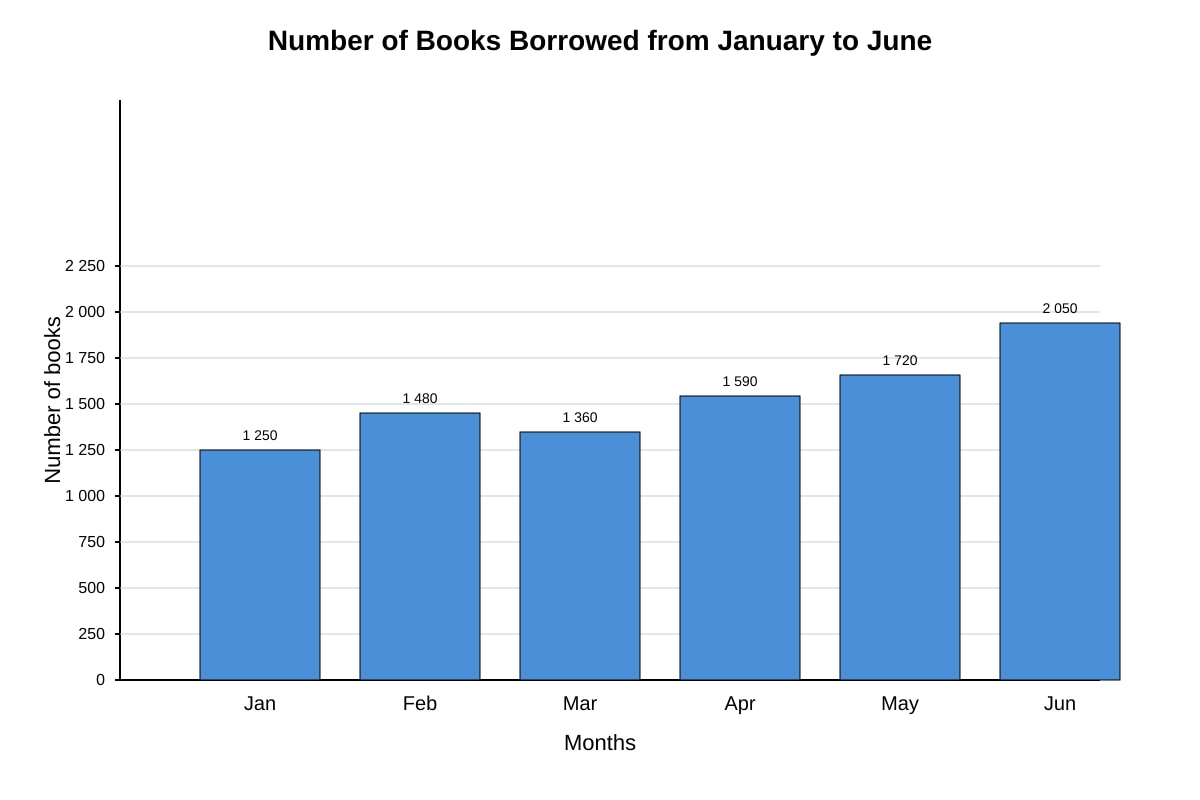
Generated chart for Q25.
(a) The tallest bar is June (2 050 books).
(b) June − January = 2 050 − 1 250 = 800 books
(c) Total = 1 250 + 1 480 + 1 360 + 1 590 + 1 720 + 2 050
Working:
- 1 250 + 1 480 = 2 730
- 2 730 + 1 360 = 4 090
- 4 090 + 1 590 = 5 680
- 5 680 + 1 720 = 7 400
- 7 400 + 2 050 = 9 450
Or grouping: (1 250 + 2 050) + (1 480 + 1 720) + (1 360 + 1 590) = 3 300 + 3 200 + 2 950 = 9 450
Marking:
- (a) 1 mark: correct month
- (b) 2 marks: 1 mark method, 1 mark answer
- (c) 3 marks: 2 marks method (grouping or clear addition), 1 mark answer
Marks: 6 (1 + 2 + 3)
Section C Total: 30 marks
Grand Total: 80 marks
Mark Distribution Summary
| Section | Marks | Percentage |
|---|---|---|
| A: MCQ | 20 | 25% |
| B: Short Answer | 30 | 37.5% |
| C: Problem Sums | 30 | 37.5% |
| Total | 80 | 100% |
Difficulty Breakdown (Estimated)
| Level | Questions | Marks |
|---|---|---|
| Easy | 1–5, 11–14 | ~22 |
| Medium | 6–10, 15–19 | ~28 |
| Challenging | 20–25 | ~30 |