From Real Exams Exam Paper
Primary 6 PSLE Mathematics Semestral Assessment 2 (End of Year) Paper 3
Free P6 PSLE Maths SA2 Paper 3, Kimi2.6 Exam version, with questions, answers, and PSLE-focused practice for Singapore students.
These static practice materials are generated from the site's syllabus and paper-generation workflow, with source and model context shown so students and parents can evaluate the material before use.
Questions
Free quiz and exam paper access
Enter your details to view this paper
Your access is remembered on this device.
Answers
TuitionGoWhere Exam Practice (AI) - Mathematics Primary 6 PSLE
SA2 Practice Paper - Version 3 of 5
ANSWER KEY
SECTION A: Multiple-Choice Questions (10 marks)
| Question | Answer | Explanation / Working |
|---|---|---|
| 1 | (4) | Compare digit by digit from the left: All start with 5. Next digit: 0, 0, 0, 7. Since 7 > 0, 5 708 234 is greatest. Key concept: Place value comparison—compare digits from highest place value first. |
| 2 | (3) | In 3 704 562, digit 7 is in the hundred thousands place: 700 000. Place value: 3 (millions), 7 (hundred thousands), 0 (ten thousands), 4 (thousands), 5 (hundreds), 6 (tens), 2 (ones). |
| 3 | (2) | 4 785 639 → hundred thousands digit is 7. Look at ten thousands digit (8) ≥ 5, so round up: 4 800 000. Common mistake: Rounding to wrong place value (nearest million would give 5 000 000). |
| 4 | (2) | LCM of 8 and 12: Multiples of 8: 8, 16, 24, 32... Multiples of 12: 12, 24, 36... First common multiple is 24. Note: 48 and 96 are also common multiples but 24 is the least (LCM). Question asks for "a" common multiple, not "the least." Both 24, 48, 96 work, but only 24 appears in options 1-2, and 16 is not a multiple of 12. |
| 5 | (1) | Smaller number = 12 034 − 4 568 = 7 466. Key phrase: "difference between two numbers" means subtraction. Larger − smaller = difference. |
| 6 | (3) | 2 453 817: places are 2 (millions), 4 (hundred thousands), 5 (ten thousands), 3 (thousands), 8 (hundreds), 1 (tens), 7 (ones). |
| 7 | (3) | Factors of 72: 1, 2, 3, 4, 6, 8, 9, 12, 18, 24, 36, 72. 16 is not in this list. Check: 72 ÷ 16 = 4.5 (not whole number). |
| 8 | (2) | Sum = 7 + 14 + 21 + 28 + 35 + 42 + 49 + 56 + 63 + 70. Method: This is 7 × (1+2+3+...+10) = 7 × 55 = 385. Or use formula: (\frac{n(a+l)}{2} = \frac{10 \times (7+70)}{2} = \frac{10 \times 77}{2} = 385). |
| 9 | (2) | Number = 6 × 145 + 4 = 870 + 4 = 874. Formula: Dividend = Divisor × Quotient + Remainder. |
| 10 | (2) | 5 000 000 − 3 486 217: Use standard subtraction with regrouping. 5 000 000 = 4 999 999 + 1, so 4 999 999 − 3 486 217 = 1 513 782, then +1 = 1 513 783. Or direct: 5 000 000 − 3 486 217 = 1 513 783. Check: 3 486 217 + 1 513 783 = 5 000 000 ✓ |
Section A Total: 10 marks
SECTION B: Short-Answer Questions (20 marks)
11. 4 568 × 25 [2 marks]
Method 1 (Standard multiplication):
  4 568
×    25
-------
 22 840  (4568 × 5)
91 360   (4568 × 20)
-------
114 200
Method 2 (Efficient method using 25 = 100 ÷ 4): 4 568 × 25 = 4 568 × 100 ÷ 4 = 456 800 ÷ 4 = 114 200
Marking: [1] for correct method shown, [1] for correct answer.
Answer: 114 200
12. 72 000 ÷ 600 [2 marks]
Method: 72 000 ÷ 600 = 72 000 ÷ 100 ÷ 6 = 720 ÷ 6 = 120
Or: 72 000 ÷ 600 = 720 ÷ 6 = 120 (cancel two zeros)
Marking: [1] for correct method, [1] for correct answer.
Answer: 120
13. Common factors of 48 and 60 [2 marks]
Working: Factors of 48: 1, 2, 3, 4, 6, 8, 12, 16, 24, 48 Factors of 60: 1, 2, 3, 4, 5, 6, 10, 12, 15, 20, 30, 60
Common factors: 1, 2, 3, 4, 6, 12
Marking: [1] for showing method of finding factors, [1] for complete correct list. Deduct [½] if one missing.
Answer: 1, 2, 3, 4, 6, 12
14. Smallest 5-digit number using 3, 5, 7, 8, 9 (each once) divisible by 5 [2 marks]
Key concept: Divisible by 5 → last digit must be 0 or 5. From given digits, must end in 5.
To make smallest number: arrange remaining digits (3, 7, 8, 9) in ascending order in front: 3, 7, 8, 9, 5
Answer: 37 895
Marking: [1] for identifying last digit must be 5, [1] for correct arrangement.
Common mistake: Putting 3 first without checking if smaller arrangement exists. 37 895 < 37 985 < 38 795 etc.
15. Sum of prime numbers between 20 and 40 [2 marks]
Working: Numbers to check: 21, 22, 23, 24, 25, 26, 27, 28, 29, 30, 31, 32, 33, 34, 35, 36, 37, 38, 39
Primes: 23, 29, 31, 37 (check: 21=3×7, 22=2×11, 24÷2, 25=5×5, 26=2×13, 27=3×9, 28÷2, 30÷2, 32÷2, 33=3×11, 34÷2, 35=5×7, 36÷2, 38÷2, 39=3×13)
Sum = 23 + 29 + 31 + 37 = 120
Marking: [1] for identifying all four primes correctly, [1] for correct sum.
Answer: 120
16. 8 450 toys/day × 28 days [2 marks]
Working: 8 450 × 28 = 8 450 × 30 − 8 450 × 2 = 253 500 − 16 900 = 236 600
Or standard multiplication:
  8 450
×    28
-------
 67 600  (8450 × 8)
169 000  (8450 × 20)
-------
236 600
Marking: [1] for correct method, [1] for correct answer.
Answer: 236 600 toys
17. Repacking pencils [2 marks]
Concept: Total pencils ÷ pencils per packet = number of packets
Working: Total pencils = 48 × 36 = 1 728 Number of packets = 1 728 ÷ 9 = 192
Or combined: (48 × 36) ÷ 9 = 48 × 4 = 192 (since 36 ÷ 9 = 4)
Marking: [1] for finding total pencils, [1] for correct final answer.
Answer: 192 packets
18. Finding the other number [2 marks]
Working: Other number = 3 024 ÷ 24 = 126
Check: 24 × 126 = 24 × 100 + 24 × 26 = 2 400 + 624 = 3 024 ✓
Marking: [1] for correct division method, [1] for correct answer.
Answer: 126
19. Number between 40 and 60 [2 marks]
Working: Multiples of 7 between 40 and 60: 42, 49, 56
Check "remainder 3 when divided by 5":
- 42 ÷ 5 = 8 R 2 ✗
- 49 ÷ 5 = 9 R 4 ✗
- 56 ÷ 5 = 11 R 3 ✓
Answer: 56
Marking: [1] for identifying correct multiple of 7, [1] for verifying remainder condition.
20. 50 + 48 + 46 + ... + 4 + 2 [2 marks]
Working: This is an arithmetic sequence: first term a = 50, last term l = 2, common difference d = −2 (or +2 going up).
Number of terms: (50 − 2) ÷ 2 + 1 = 24 + 1 = 25 terms
Sum = (\frac{n(a+l)}{2} = \frac{25 \times (50+2)}{2} = \frac{25 \times 52}{2} = 25 \times 26 = 650)
Or pair: (50+2) + (48+4) + ... = 52 × 12 + 26 = 624 + 26 = 650 (middle term alone since odd count)
Marking: [1] for identifying 25 terms or pairing method, [1] for correct sum.
Answer: 650
Section B Total: 20 marks
SECTION C: Long-Answer / Problem-Solving Questions (30 marks)
21. Laptop and printer costs [4 marks]
Given: Total = $3 456, Laptop = 5 × Printer
Model method / Unit method: Let printer = 1 unit, then laptop = 5 units Total = 5 + 1 = 6 units = 3 456 ÷ 6 = $576
(a) Printer = **576 = $2 880 [3 marks]
Detailed marking:
- [1] for setting up units or equation (e.g., 6u = $3456 or 5x + x = 3456)
- [1] for finding 1 unit = $576
- [2] for correct final answer with unit ($2 880)
Algebraic method: Let printer cost 5x. x + 5x = 3 456 6x = 3 456 x = 576 Laptop = 5 × 576 = $2 880
Answer: $2 880
22. Tiles needed for hall floor [4 marks]
Step 1: Convert to consistent units Hall: 24 m × 18 m = 2400 cm × 1800 cm [1 mark for conversion or method]
Step 2: Find how many tiles fit each way Along length: 2 400 ÷ 60 = 40 tiles [1 mark] Along width: 1 800 ÷ 60 = 30 tiles [1 mark]
Step 3: Total tiles Total = 40 × 30 = 1 200 tiles [1 mark]
Alternative (area method): Hall area = 24 × 18 = 432 m² = 4 320 000 cm² Tile area = 60 × 60 = 3 600 cm² Tiles = 4 320 000 ÷ 3 600 = 1 200
Marking: [1] for unit conversion or area calculation, [1] for each dimension division, [1] for final answer.
Answer: 1 200 tiles
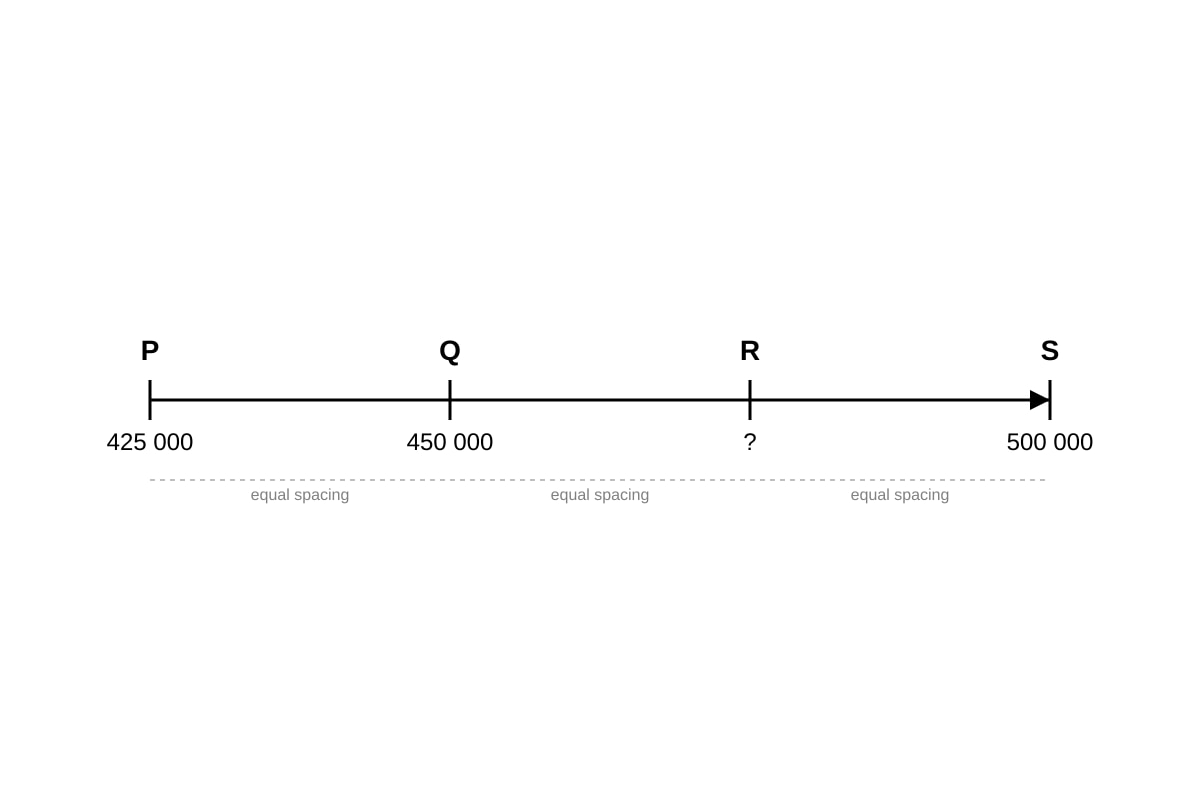
23. Number line problem [4 marks]
Image pending generation: diagram for Q23.
Working: Gap P to Q = 450 000 − 425 000 = 25 000
Since spacing is equal, Q to R = 25 000 and R to S = 25 000
Check: P to S = 500 000 − 425 000 = 75 000, and 75 000 ÷ 3 gaps = 25 000 ✓
R = 450 000 + 25 000 = 475 000 or R = 500 000 − 25 000 = 475 000
Marking:
- [1] for finding gap distance (25 000) or setting up equation
- [1] for recognizing 3 equal gaps total
- [2] for correct answer with working shown
Answer: 475 000
24. Concert attendance problem [6 marks]
Given: Total = 3 800, Men = Women + 420, Children = 3 × Women
(a) Number of women [2 marks]
Let women = W. Then men = W + 420, children = 3W.
Total: W + (W + 420) + 3W = 3 800 5W + 420 = 3 800 5W = 3 380 W = 676
Marking: [1] for correct equation or model, [1] for correct answer.
(b) Number of children [2 marks]
Children = 3 × 676 = 2 028
Marking: [1] for method (3 × women's count), [1] for correct answer.
(c) More children than men [2 marks]
Men = 676 + 420 = 1 096
Difference = 2 028 − 1 096 = 932
Or: Children − Men = 3W − (W + 420) = 2W − 420 = 2(676) − 420 = 1 352 − 420 = 932
Marking: [1] for finding men or setting up difference, [1] for correct answer.
Answers: (a) 676 women, (b) 2 028 children, (c) 932 more children
25. Mrs Goh's stamps [6 marks]
(a) Fraction after giving to brother [2 marks]
Mrs Goh gave (\frac{1}{4}) to brother. Remaining = 1 − (\frac{1}{4}) = (\frac{3}{4})
Marking: [1] for recognizing "remainder," [1] for correct fraction.
(b) Original number of stamps [4 marks]
After brother: (\frac{3}{4}) left Gave (\frac{2}{5}) of remainder to sister: (\frac{2}{5}) × (\frac{3}{4}) = (\frac{6}{20}) = (\frac{3}{10})
Stamps left after sister: (\frac{3}{4}) − (\frac{3}{10}) = (\frac{15}{20}) − (\frac{6}{20}) = (\frac{9}{20})
Or: (\frac{3}{5}) of (\frac{3}{4}) = (\frac{9}{20}) left
Given: (\frac{9}{20}) of total = 90 stamps
Total = 90 ÷ (\frac{9}{20}) = 90 × (\frac{20}{9}) = 10 × 20 = 200 stamps
Unit/Model method verification: Let total = 20 units → Brother: 5 units, left: 15 units → Sister: (\frac{2}{5}) × 15 = 6 units, left: 9 units → 9 units = 90, so 1 unit = 10 → Total = 20 × 10 = 200
Marking:
- [1] for finding fraction after sister (9/20)
- [1] for setting up equation or continuing unit method
- [1] for correct calculation
- [1] for correct final answer
Answers: (a) (\frac{3}{4}), (b) 200 stamps
26. Supermarket sales over three days [6 marks]
Given data:
- Monday: Apples 5 280, Oranges 3 960
- Tuesday: Apples = 2 × Monday, Oranges = Monday − 1 200
- Wednesday: Apples = Tuesday + 1 500, Oranges = (\frac{1}{2}) × Monday
(a) Apples on Wednesday [2 marks]
Tuesday apples = 2 × 5 280 = 10 560 Wednesday apples = 10 560 + 1 500 = 12 060
Marking: [1] for Tuesday apples, [1] for Wednesday answer.
(b) Total fruits over three days [4 marks]
Calculate all values:
| Day | Apples | Oranges | Total |
|---|---|---|---|
| Monday | 5 280 | 3 960 | 9 240 |
| Tuesday | 10 560 | 3 960 − 1 200 = 2 760 | 13 320 |
| Wednesday | 12 060 | 3 960 ÷ 2 = 1 980 | 14 040 |
Grand total = 9 240 + 13 320 + 14 040 = 36 600
Or: Apples total = 5 280 + 10 560 + 12 060 = 27 900 Oranges total = 3 960 + 2 760 + 1 980 = 8 700 Total = 27 900 + 8 700 = 36 600
Marking:
- [1] for all daily values correct
- [2] for method of summing (either by day or by fruit type)
- [1] for correct final answer
Answers: (a) 12 060 apples, (b) 36 600 fruits
Section C Total: 30 marks
GRAND TOTAL: 60 MARKS
Distribution Summary:
- Section A (MCQ): 10 marks (10 × 1 mark)
- Section B (Short Answer): 20 marks (10 × 2 marks)
- Section C (Long Answer): 30 marks (3 × 4 marks + 2 × 6 marks + 1 × 6 marks = 12 + 12 + 6 = 30)
Verified: 10 + 20 + 30 = 60 marks ✓
Time allocation estimate:
- Section A: ~10 minutes (1 min each, some reading)
- Section B: ~20 minutes (2 min each)
- Section C: ~40 minutes (Q21-23: 4 min each; Q24-26: 8-10 min each)
- Review: ~5 minutes
- Total: ~75 minutes ✓