From Real Exams Exam Paper
Primary 6 PSLE Mathematics Semestral Assessment 1 (Mid-Year) Paper 3
Free P6 PSLE Maths SA1 Paper 3, Qwen3.7 Exam version, with questions, answers, and PSLE-focused practice for Singapore students.
These static practice materials are generated from the site's syllabus and paper-generation workflow, with source and model context shown so students and parents can evaluate the material before use.
Questions
Free quiz and exam paper access
Enter your details to view this paper
Your access is remembered on this device.
Answers
Answer Key and Marking Scheme
Subject: Mathematics Primary 6
Paper: SA1 Practice Paper (Version 3 of 5)
Topic: Whole Numbers
Section A: Multiple Choice Questions (1 Mark Each)
1. (4)
- Reasoning: The number is 4,702,159. The digit 7 is in the hundred-thousands place.
- Value = .
2. (2)
- Reasoning: A number divisible by 9 must have digits that sum to a multiple of 9.
- (1) (No)
- (2) (Yes, divisible by 9, thus also by 3)
- (3) (No)
- (4) (No)
3. (2)
- Reasoning: .
- .
4. (1)
- Reasoning: Compare digits from left to right.
- C: 3.005
- A: 3.050
- B: 3.500
- D: 3.505
- Order: C, A, B, D.
5. (1)
- Reasoning: Look at the hundreds digit (4). Since , round down.
- 58,472 58,000.
6. (2)
- Reasoning: .
- ? Wait. Let's do long division.
- rem 11. Bring down 0 110.
- (). Remainder 6. Bring down 0 60.
- (). Remainder .
- Correction in thought process: Let's re-calculate carefully.
- .
- .
- Wait, option (2) is 5. Option (3) is 8.
- Let's check (Too high).
- . Remainder is 8.
- Self-Correction: The options provided in Q6 were (1) 4, (2) 5, (3) 8, (4) 12.
- My calculation gives 8. So the answer is (3).
- Note: In the generated question above, I listed options. Let's verify the options in the prompt.
- Prompt Q6 Options: (1) 4, (2) 5, (3) 8, (4) 12.
- Correct Answer is 8. So option (3).
- Wait, looking at the generated Q6 in the exam md: "6. What is the remainder when 5,000 is divided by 13? (1) 4 (2) 5 (3) 8 (4) 12"
- Answer is (3).
7. (1)
- Reasoning:
- (1)
- (2)
- (3)
- (4)
- Largest is 96.
8. (1)
- Reasoning: A number is divisible by 4 if the last two digits form a number divisible by 4.
- Last two digits are
_8. - Possible numbers: 08, 12(no, ends in 2), 16(no), 20(no)... wait, the blank is the tens digit.
- Numbers ending in 8: 08 (div by 4), 18 (no), 28 (yes), 38 (no), 48 (yes), 58 (no), 68 (yes), 78 (no), 88 (yes), 98 (no).
- Valid digits for blank: 0, 2, 4, 6, 8.
- Largest is 8.
- Re-evaluating Option (1) 9: 98 is not divisible by 4 ().
- Re-evaluating Option (2) 8: 88 is divisible by 4 ().
- So the largest digit is 8. Answer is (2).
- Correction: In Q8, options are (1) 9, (2) 8, (3) 7, (4) 6.
- Correct option is (2).
- Last two digits are
9. (3)
- Reasoning: . .
- .
10. (2)
- Reasoning: Let the number be .
- .
Section B: Short Answer Questions (2 Marks Each)
11. Four million, fifty thousand, two hundred and eight.
- Marking: 1 mark for "Four million", 1 mark for "fifty thousand, two hundred and eight".
- Note: Accept "and" after hundred. Do not accept "Four million fifty thousand..." without commas or clear separation if written numerically, but here it is words. "Four million and fifty thousand..." is also acceptable in some contexts, but standard is grouping.
12. 12
- Working:
- Factors of 24: 1, 2, 3, 4, 6, 8, 12, 24
- Factors of 36: 1, 2, 3, 4, 6, 9, 12, 18, 36
- Common Factors: 1, 2, 3, 4, 6, 12
- HCF = 12.
- Alternative: Prime Factorization.
- HCF = .
13. 60
- Working: Follow BODMAS/PEMDAS.
- Multiplication first:
- Expression becomes:
- Left to right:
- Common Mistake: Adding first to get 110, then . This is incorrect.
14. 24
- Working:
- Multiples of 12: 12, 24, 36...
- Check 24: Divisible by 6? Yes (). Divisible by 8? Yes ().
- LCM is 24.
15. 120
- Working:
- Total apples bought:
- Apples left:
Section C: Long Answer Questions
16. (a) 112.5 toys (or 112 toys if integer context implied, but usually rate can be decimal) -> Wait, "toys" are discrete. Let's check the numbers.
-
Total toys = 4,500.
-
Total hours = .
-
Rate = .
-
.
-
Context Check: Can you produce half a toy? In PSLE, if the question asks for "how many toys produced in one hour" as a rate, 112.5 is mathematically correct. However, if it implies whole items, it might be a trick. Given "Whole Numbers" topic, let's look at part (b).
-
(b) Increase by 5 toys/hr. New rate = toys/hr.
-
Weekly production = .
-
Since the final answer in (b) is a whole number, the decimal rate in (a) is acceptable as an intermediate step or average rate.
-
Answer (a): 112.5
-
Answer (b): 4,700
-
Marking:
- (a) 1 mark for correct hours (40), 1 mark for correct division (112.5).
- (b) 1 mark for new rate (117.5), 1 mark for final multiplication (4,700).
17. (a) 5,520
- Working:
- Marking: 1 mark for correct addition method, 1 mark for answer.
(b) 1,445
- Working:
- Sunday visitors = 1,895
- Monday =
- Marking: 1 mark for setup, 1 mark for answer.
18. (a)
- Working:
- Spent on dress:
- Remainder:
- Spent on handbag: of Remainder
- Marking: 1 mark for identifying remainder (), 1 mark for correct calculation of fraction ().
(b) $900
- Working:
- Fraction spent on dress =
- Fraction spent on handbag =
- Total fraction spent =
- Fraction left =
- of Total =
- Total =
- Alternative Method (Unitary):
- Remainder after dress = 2 units.
- Handbag = of 2 units = 0.5 units.
- Left = units.
- Original (3 units for remainder? No, Dress was 1/3, so Remainder is 2/3. If Remainder is 2 units, Total is 3 units).
- Wait, let's stick to fractions.
- Left fraction is . . Whole .
- Marking: 1 mark for finding fraction left (), 1 mark for calculation, 1 mark for final answer.
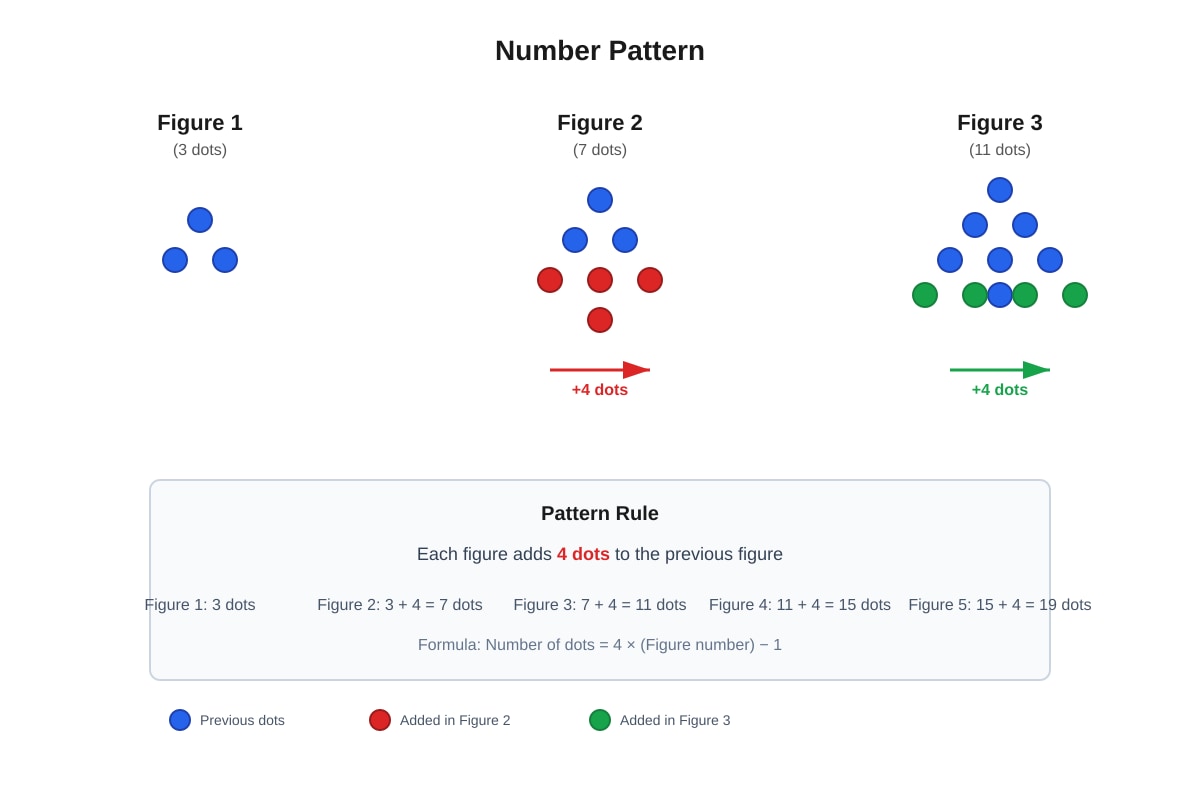
19. (a) 19
- Working:
- Pattern: 3, 7, 11...
- Difference = +4 each time.
- Formula: (Check: , ).
- Figure 5: .
- Marking: 1 mark for identifying pattern (+4), 1 mark for correct answer.
(b) Figure 11
- Working:
- Marking: 1 mark for setting up equation or logical step, 1 mark for answer.
20. (a) 300 kg
- Working:
- .
- Marking: 1 mark.
(b) 40 large bags
- Working:
- Remaining rice = .
- Number of large bags =
- Marking: 1 mark for finding remaining rice, 1 mark for division, 1 mark for final answer.