AI Generated Quiz
Primary 6 PSLE Malay Writing Quiz
Free P6 PSLE Malay Writing quiz, AI version, with questions, answers, and PSLE-focused practice for Singapore students.
These static practice materials are generated from the site's syllabus and paper-generation workflow, with source and model context shown so students and parents can evaluate the material before use.
Questions
Free quiz and exam paper access
Enter your details to view this paper
Your access is remembered on this device.
Answers
Primary 6 PSLE Malay Quiz - Writing (Answer Key)
Total Marks: 40
Note to markers: Accept any reasonable answer that is grammatically correct, uses bahasa baku, and fits the context. For open-ended questions, the answers below are suggested responses.
Section A: Ejaan dan Tanda Baca (Spelling and Punctuation) [5 marks]
Question 1 (1 mark)
- Corrected sentence: Saya dan Ali pergi ke perpustakaan pada hari Sabtu.
- Explanation: "Saya" at the start of a sentence must begin with a capital letter. "Ali" is a proper noun so it must be capitalised. "Sabtu" is a day of the week and must be capitalised. A full stop is needed at the end.
- Common mistake: Students often forget to capitalise proper nouns and the first word of a sentence.
Question 2 (1 mark)
- Corrected sentence: Ibu membeli buku cerita, pensel warna, dan pemadam di kedai alat tulis.
- Explanation: Commas are needed to separate items in a list (buku cerita, pensel warna, dan pemadam). "Ibu" at the start of the sentence must be capitalised. A full stop is needed at the end.
- Teaching note: In Malay, when listing three or more items, use commas between items and "dan" before the last item.
Question 3 (1 mark)
- Corrected sentence: Cikgu Siti berkata, "Belajarlah bersungguh-sungguh untuk mencapai cita-cita."
- Explanation: "Cikgu Siti" is a title and name, so both words must be capitalised. A comma is needed before the quotation. The first word inside the quotation marks must be capitalised. A full stop inside the quotation marks ends the sentence.
- Common mistake: Students often forget the comma before the quotation and the capital letter inside the quotation.
Question 4 (1 mark)
- Corrected sentence: "Adakah kamu sudah menyiapkan kerja sekolah?" tanya kakak.
- Explanation: Direct speech requires quotation marks. The question mark replaces the full stop inside the quotation marks because it is a question. "Adakah" must be capitalised as it is the first word of the quoted speech. "Kakak" is not capitalised here because it is a common noun, not a proper name.
- Teaching note: In Malay, question words like "adakah" signal a question, so use a question mark.
Question 5 (1 mark)
- Corrected sentence: Encik Ahmad bin Hassan ialah Guru Besar Sekolah Kebangsaan Utama.
- Explanation: "Encik" is a title and must be capitalised. "Ahmad bin Hassan" is a full name, so each part is capitalised. "Guru Besar" is a specific job title in this context and should be capitalised. "Sekolah Kebangsaan Utama" is the full name of a school and must be capitalised. A full stop is needed at the end.
- Common mistake: Students often forget to capitalise "bin" (it is capitalised as part of a name) and official titles.
Section B: Membina Ayat (Sentence Construction) [10 marks]
Question 6 (2 marks)
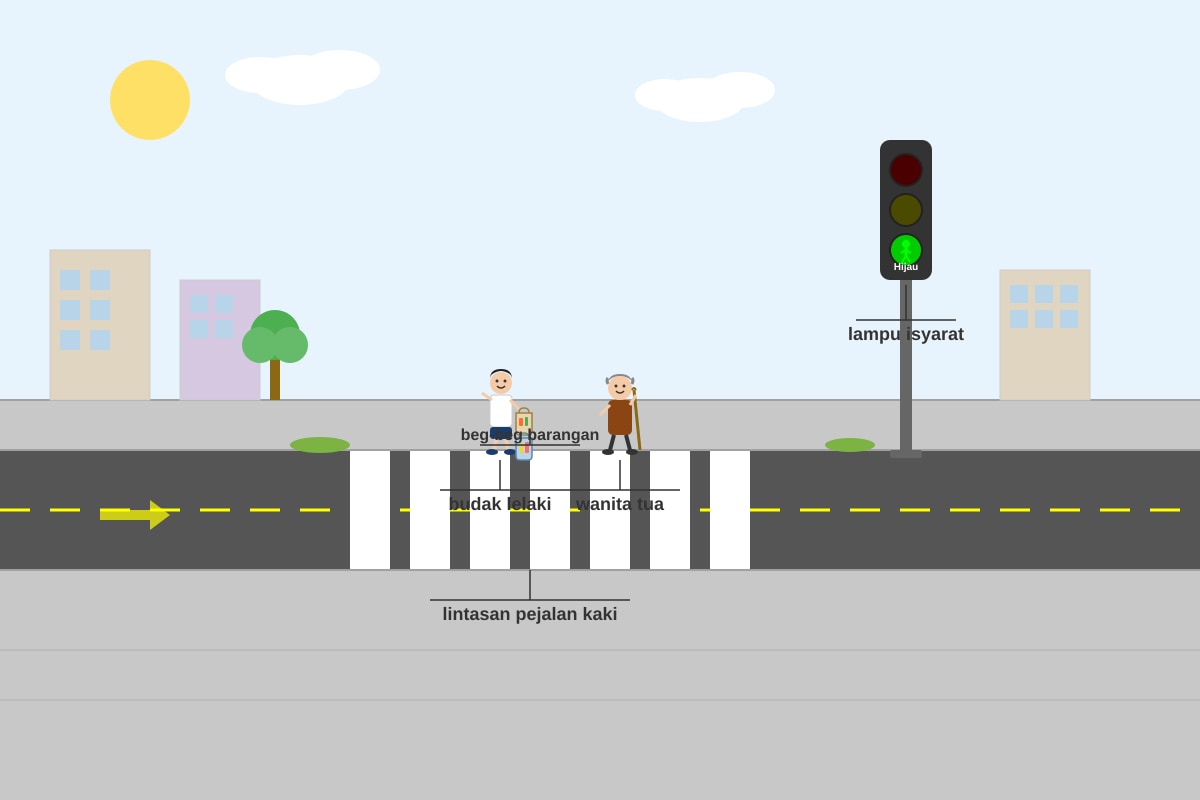
- Suggested answer: Seorang budak lelaki sedang menolong seorang wanita tua membawa beg-beg barangan runcitnya melintas jalan di kawasan pejalan kaki.
- Marking scheme:
- 2 marks: Complete, grammatically correct sentence that accurately describes the picture.
- 1 mark: Partially correct sentence with minor errors in grammar or vocabulary.
- 0 marks: No attempt or completely incorrect sentence.
- Explanation: The sentence should describe the action (helping), the people (boy, elderly woman), the objects (grocery bags), and the location (pedestrian crossing). Use present continuous tense ("sedang menolong") to describe the action in the picture.
Question 7 (2 marks)
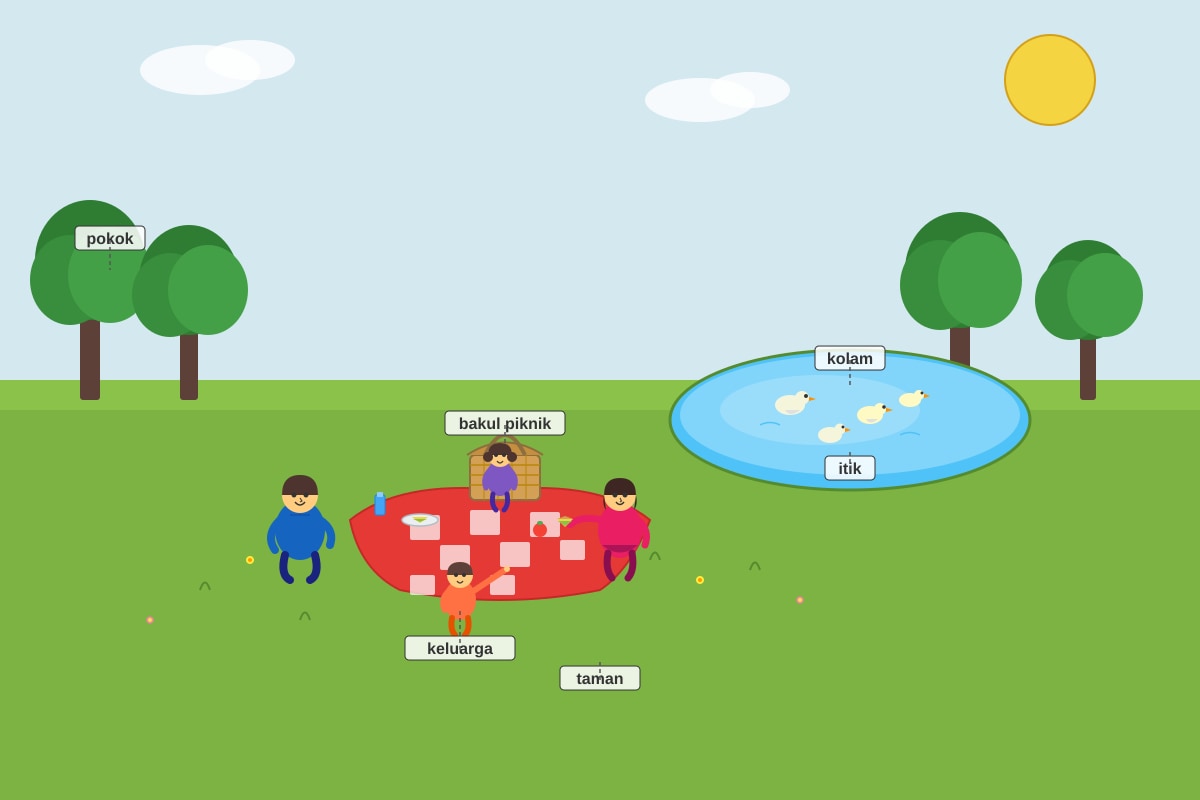
- Suggested answer: Sebuah keluarga sedang berkelah di taman sambil menikmati pemandangan tasik yang indah.
- Explanation: The sentence should describe the family activity (picnic), the location (park), and the scene (pond, ducks). "Sedang berkelah" indicates the ongoing action.
Question 8 (2 marks)
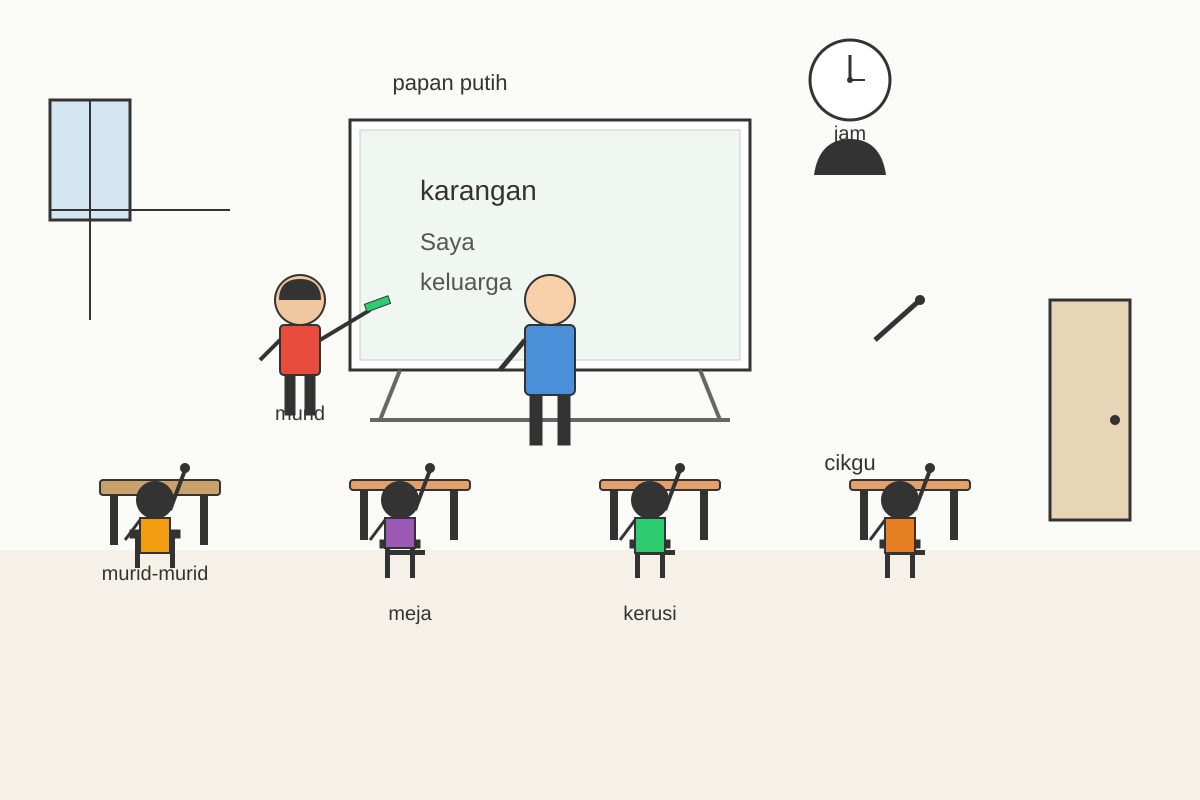
- Suggested answer: Murid-murid di dalam kelas itu sedang mengangkat tangan untuk menjawab soalan yang diberikan oleh guru.
- Explanation: The sentence should describe the classroom setting, the teacher at the whiteboard, and the students raising their hands. "Sedang mengangkat tangan" shows the action.
Question 9 (2 marks)
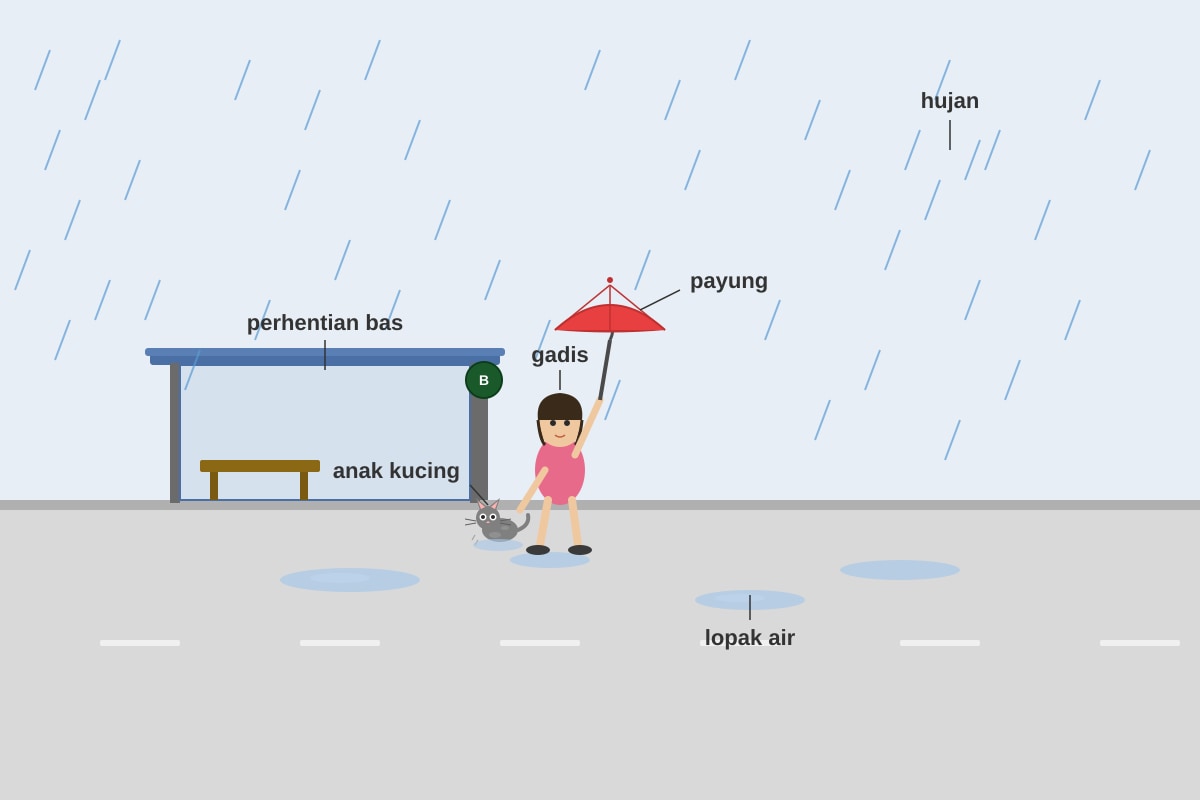
- Suggested answer: Seorang gadis sedang melindungi seekor anak kucing yang basah kuyup daripada hujan dengan menggunakan payungnya.
- Explanation: The sentence should describe the girl helping the kitten, the rain, and the umbrella. "Sedang melindungi" shows the helping action.
Question 10 (2 marks)
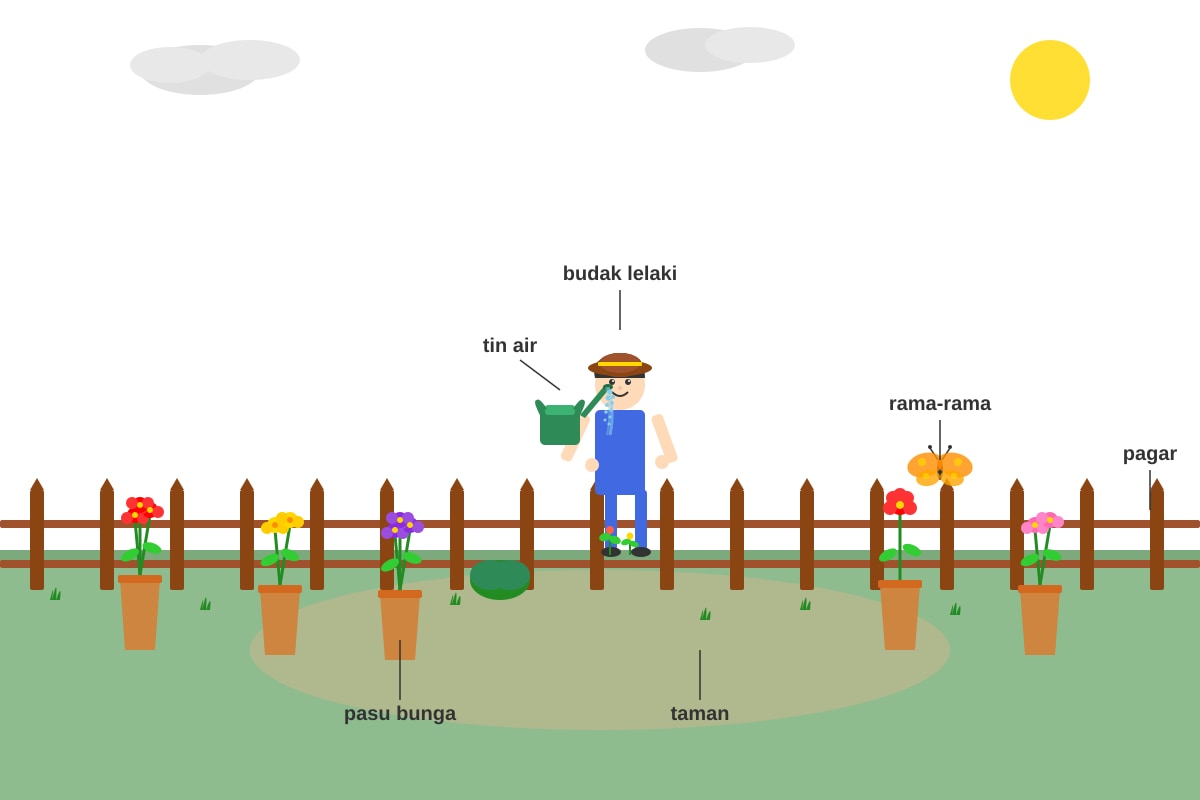
- Suggested answer: Seorang budak lelaki sedang menyiram pokok-pokok bunga di taman dengan menggunakan sebuah tin air.
- Explanation: The sentence should describe the boy watering plants, the watering can, and the garden setting. "Sedang menyiram" shows the action.
Section C: Karangan Naratif (Narrative Essay) [15 marks]
Question 11 (15 marks)
Suggested answer:
Pengalaman Bercuti di Kampung
Pada cuti sekolah yang lalu, saya pulang ke kampung datuk dan nenek di Johor. Saya sangat teruja kerana sudah lama tidak berjumpa dengan mereka.
Setibanya di kampung, datuk mengajak saya memancing di sungai. Pada mulanya, saya tidak sabar-sabar untuk menangkap ikan. Namun, selepas sejam, saya masih belum mendapat seekor ikan pun. Saya mula berasa bosan. Datuk tersenyum dan berkata, "Bersabarlah, cucuku. Memancing memerlukan kesabaran." Akhirnya, saya berjaya menangkap seekor ikan yang besar. Saya berasa sangat gembira!
Pada waktu petang, nenek memasak ikan tersebut untuk makan malam. Rasanya sungguh lazat! Saya membantu nenek menyediakan meja makan. Kami makan bersama-sama sambil bercerita.
Pengalaman ini tidak dapat saya lupakan. Saya belajar bahawa kesabaran akan membuahkan hasil. Saya juga lebih menghargai masa bersama keluarga.
Marking scheme (15 marks):
| Criteria | Excellent (5 marks) | Good (3-4 marks) | Satisfactory (2 marks) | Weak (0-1 mark) |
|---|---|---|---|---|
| Isi (Content) | Relevant, interesting, well-developed story with clear beginning, middle, and end | Relevant story with some development | Basic story with limited development | Irrelevant or no clear story |
| Bahasa (Language) | Excellent grammar, vocabulary, and sentence structure; minimal errors | Good grammar with few errors | Adequate grammar with some errors | Poor grammar with many errors |
| Organisasi (Organisation) | Clear structure (pendahuluan, isi, penutup); logical flow | Good structure with minor issues | Basic structure present | No clear structure |
Total for Isi + Bahasa + Organisasi = 15 marks
- Pendahuluan (Introduction): Should introduce the setting (when, where, who).
- Isi (Body): Should describe the main event(s) with details (what happened, feelings, dialogue).
- Penutup (Conclusion): Should include the lesson learned or feelings about the experience.
Common mistakes:
- Writing too short (less than 80 words) or too long (more than 120 words).
- Using bahasa pasar (colloquial Malay) instead of bahasa baku.
- Not having a clear moral or lesson at the end.
Section D: Menulis Mesej dan Ucapan (Writing Messages and Speeches) [10 marks]
Question 12 (2 marks)
- Suggested answer: Assalamualaikum Cikgu Rahim. Saya ingin memaklumkan bahawa saya tidak dapat hadir ke kelas tambahan pada hari Sabtu ini kerana saya demam. Saya mohon maaf. Terima kasih.
- Marking scheme:
- 2 marks: Clear, polite message with correct format and grammar.
- 1 mark: Message is understandable but has minor errors.
- 0 marks: No attempt or completely incorrect.
- Explanation: A message should include a greeting, the reason for absence, an apology, and a closing. Use polite language.
Question 13 (2 marks)
- Suggested answer: Hai Ahmad, awak ada masa lapang pada hujung minggu ini? Saya nak ajak awak menonton wayang. Filem apa yang awak nak tonton? Beritahu saya ya.
- Marking scheme:
- 2 marks: Clear, friendly message with correct format and grammar.
- 1 mark: Message is understandable but has minor errors.
- 0 marks: No attempt or completely incorrect.
- Explanation: A message to a close friend can be less formal but still grammatically correct. Include the invitation and a question to encourage a reply.
Question 14 (3 marks)
- Suggested answer: Selamat petang dan salam sejahtera. Saya ucapkan selamat datang kepada semua ahli baharu Kelab Bola Sepak kita. Saya berharap kamu semua akan belajar kemahiran bola sepak dengan bersungguh-sungguh. Ingatlah, disiplin dan kerjasama amat penting dalam sukan ini. Mari kita jadikan kelab ini yang terbaik! Terima kasih.
- Marking scheme:
- 3 marks: Complete speech with greeting, welcome message, encouragement, and closing; at least 30 words; correct grammar.
- 2 marks: Speech is complete but has minor errors or is slightly short.
- 1 mark: Speech is incomplete or has major errors.
- 0 marks: No attempt.
- Explanation: A speech should have a greeting, a clear message, and a closing. Use formal but friendly language. Include encouragement for new members.
Question 15 (3 marks)
-
Suggested answer:
Kepada Cikgu Fatimah yang dikasihi,
Selamat Hari Guru! Terima kasih cikgu kerana mendidik kami dengan sabar dan dedikasi. Jasa cikgu akan saya kenang selama-lamanya. Semoga cikgu sentiasa sihat dan bahagia.
Yang ikhlas, [Nama Murid]
-
Marking scheme:
- 3 marks: Complete card with recipient, greeting, message of appreciation, closing, and sender's name; correct grammar.
- 2 marks: Card is complete but has minor errors.
- 1 mark: Card is incomplete or has major errors.
- 0 marks: No attempt.
-
Explanation: A greeting card should include the recipient's name, a greeting, a message of appreciation, a closing, and the sender's name. Use warm and respectful language.
Section E: Mengedit Teks (Editing Text) [5 marks]
Questions 16-20 (1 mark each)
| Baris | Kesalahan | Pembetulan |
|---|---|---|
| 16. | "pada" — huruf kecil pada permulaan ayat | Pada |
| 17. | "ali" — nama khas tidak menggunakan huruf besar | Ali |
| 18. | "sandwic air minuman" — tiada koma antara perkataan dalam senarai | sandwic, air minuman, |
| 19. | "jangan" — petikan langsung tidak menggunakan huruf besar | "Jangan |
| 20. | "encik ramli" — gelaran dan nama khas tidak menggunakan huruf besar | Encik Ramli |
Corrected passage:
Pada suatu petang yang cerah, Ali dan kawan-kawannya pergi ke pantai. Mereka membawa bekal seperti sandwic, air minuman, dan buah-buahan. Setibanya di sana, mereka bermain bola tampar dan berenang. "Jangan berenang terlalu jauh," pesan Encik Ramli, bapa Ali. Mereka berseronok sehingga ke petang. "Kita mesti pulang sekarang," kata Ali. Mereka pun pulang dengan gembira.
Explanation of each correction:
- "pada" → "Pada": The first word of a sentence must always begin with a capital letter.
- "ali" → "Ali": Names of people are proper nouns and must be capitalised.
- "sandwic air minuman" → "sandwic, air minuman,": When listing items, commas are needed between each item. "Dan" is used before the last item.
- "jangan" → "Jangan": In direct speech (quotation), the first word inside the quotation marks must be capitalised.
- "encik ramli" → "Encik Ramli": "Encik" is a title and "Ramli" is a name; both must be capitalised.
Marking scheme:
- 1 mark for each correctly identified and corrected error (5 errors total).
- Accept if the student either circles/underlines the error in the passage AND writes the correction in the table, OR writes the correction in the table only.
- Do not penalise if the student identifies more than 5 errors; only the first 5 correct identifications count.
Common mistakes:
- Students may identify correct items as errors (false positives). Only the 5 listed errors should be marked correct.
- Students may miss the comma error in the list.