From Real Exams Quiz
Primary 6 PSLE Higher Chinese Comprehension Quiz
Free P6 PSLE HCL Comprehension quiz, Exam version, with questions, answers, and PSLE-focused practice for Singapore students.
These static practice materials are generated from the site's syllabus and paper-generation workflow, with source and model context shown so students and parents can evaluate the material before use.
Questions
Free quiz and exam paper access
Enter your details to view this paper
Your access is remembered on this device.
Answers
Primary 6 PSLE Higher Chinese Quiz - Comprehension - Answer Key
Total Marks: 60
Section A: Comprehension of Modern Chinese Text (Questions 1-10)
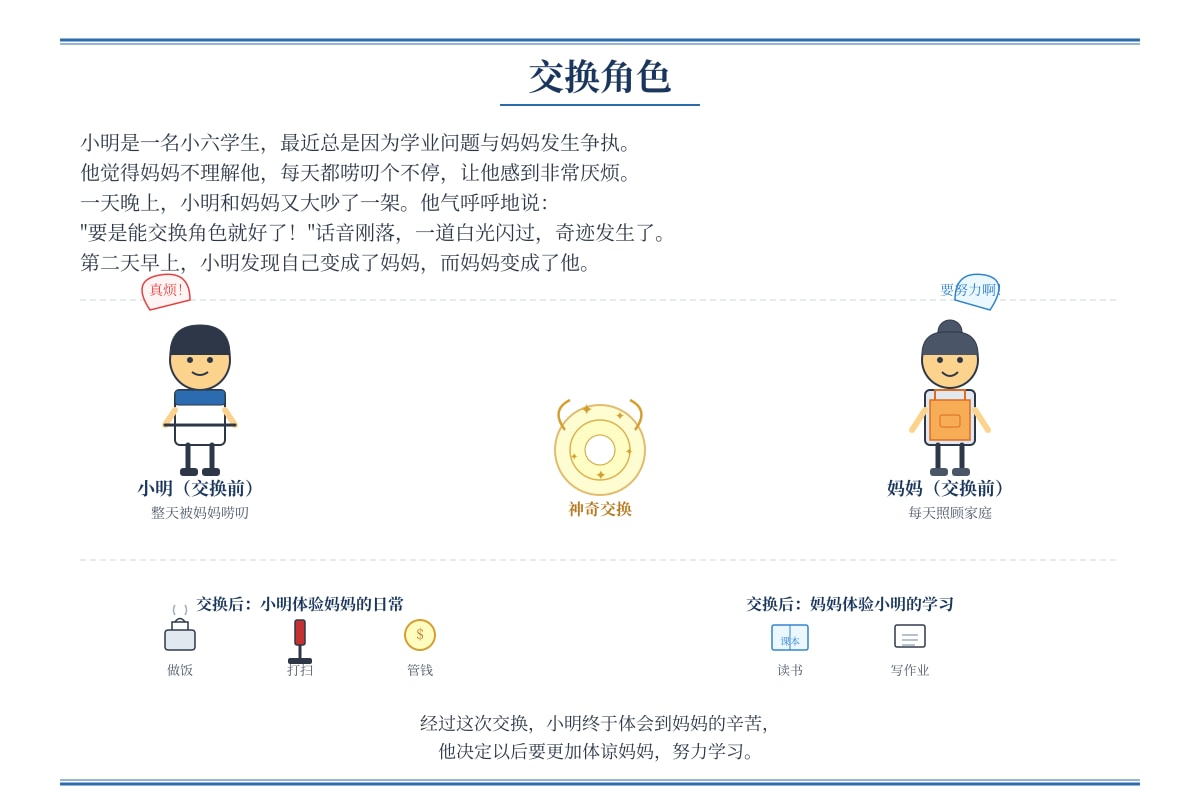
Passage: 交换角色 (Role Swap)
Question 1 (2 marks)
Answer: 这篇文章主要讲述了小明和妈妈交换角色后,他亲身体验了妈妈的辛苦,从而理解并感激妈妈的故事。
Marking Notes:
- Award 1 mark for mentioning the "role swap" event.
- Award 1 mark for mentioning Xiao Ming's change in understanding/appreciation.
- A complete answer must refer to the cause (exchange of roles) and the effect (change in understanding).
Teaching Explanation: This is a summary question. You need to identify the main events (beginning, middle, end) and the central message. The story starts with a conflict, moves to the magical role swap, and ends with resolution and understanding. A good summary captures this arc.
Question 2 (2 marks)
Answer: 不耐烦 / 气呼呼 / 厌烦 (any two)
Marking Notes:
- Award 1 mark for each correct word, up to 2 marks.
- Accept: 气呼呼, 厌烦, 不耐烦
- Do not accept words not from the passage.
Teaching Explanation: This is a direct lookup question. The passage clearly states Xiao Ming was "厌烦" (annoyed) and "气呼呼" (fuming). You need to find adjectives or descriptive phrases that show his attitude. Always look for character's feelings described by the narrator.
Question 3 (3 marks)
Answer: Any three of the following: (1) 天还没亮就要起来准备早餐 (2) 吃完早餐后还要赶着去上班 (3) 下班后还要去巴刹买菜 (4) 回家做饭、打扫房间 (5) 检查孩子的功课
Marking Notes:
- Award 1 mark for each correct task listed, up to 3 marks.
- Accept paraphrased answers as long as the meaning is clear.
Teaching Explanation: This is a listing question. Scan the passage for actions Xiao Ming performed after the swap. The passage lists them in sequence: preparing breakfast → going to work → buying groceries → cooking/cleaning → checking homework. Any of these are correct.
Question 4 (1 mark)
Answer: 非常疲劳/一点力气都没有了/累坏了
Marking Notes:
- Award 1 mark for a correct explanation.
- Accept: 非常累, 精疲力尽, 没有力气
Teaching Explanation: "筋疲力尽" is a chengyu (idiom) that describes extreme exhaustion. Breaking it down: 筋 (tendons/muscles) + 疲 (tired) + 力 (strength) + 尽 (exhausted). So it means muscles and strength are completely used up.
Question 5 (1 mark)
Answer: 工作的压力
Marking Notes:
- Award 1 mark for this answer.
- Accept: 工作上的压力, 应付工作的压力
Teaching Explanation: The passage says: "妈妈不仅要照顾家庭,还要应付工作的压力。" So in addition to family responsibilities, the mother also faces work pressure. This is a fact-retrieval question.
Question 6 (2 marks)
Answer: 因为当时小明只从自己的角度考虑问题,他只考虑到自己的感受,不理解妈妈每天的辛苦,所以觉得妈妈的唠叨很厌烦。
Marking Notes:
- Award 1 mark for referencing Xiao Ming's one-sided perspective.
- Award 1 mark for mentioning his lack of understanding of his mother's struggles.
Teaching Explanation: This question asks for analysis of a character's emotion. The word "厌烦" is stated in the passage, but you need to explain why he felt that way. At the start, Xiao Ming only saw his own unhappiness and didn't understand his mother's love and hard work.
Question 7 (1 mark)
Answer: 体现了小明当时非常生气/愤怒的心情。
Marking Notes:
- Award 1 mark for a correct explanation.
- Accept: 很生气, 怒气冲冲, 愤怒
Teaching Explanation: "气呼呼" is a reduplicated word (AABB structure) that vividly describes someone breathing heavily from anger. It shows Xiao Ming was very upset during the argument with his mother.
Question 8 (3 marks)
Answer: 交换角色后,小明认识到妈妈每天非常辛苦,不仅要照顾家庭,还要应付工作的压力。他明白妈妈的唠叨不是啰嗦,而是对他的关心和爱。他从厌烦妈妈转变为理解、感激和爱妈妈。
Marking Notes:
- Award 1 mark for mentioning the realization of mother's hard work.
- Award 1 mark for mentioning the understanding that nagging = care/love.
- Award 1 mark for mentioning the overall change in attitude (from annoyance to appreciation).
Teaching Explanation: This is a character development question. Compare Xiao Ming's attitude BEFORE vs AFTER the swap. Before: 厌烦, 气呼呼. After: 明白, 感动, 抱住妈妈. The role swap changes his perspective.
Question 9 (2 marks)
Answer: 妈妈感动是因为小明终于理解了她的辛苦,并且主动向她道歉,还承诺会好好读书,不让妈妈操心。看到孩子懂事了、长大了,妈妈因此感动落泪。
Marking Notes:
- Award 1 mark for referencing Xiao Ming's apology and understanding.
- Award 1 mark for referencing his promise to study hard and the mother seeing his growth.
Teaching Explanation: The passage ends with Xiao Ming hugging his mother, apologizing, and promising to work hard. The mother's tears come from a mixture of relief, love, and pride — her child has finally understood her sacrifices.
Question 10 (4 marks)
Answer: 这篇文章告诉我们,要学会换位思考,理解他人的辛苦。(2分)在生活中,我们常常只看到自己的付出,忽视了父母、老师或朋友对我们的关心和爱。(1分)只有当我们真正站在别人的角度去体会时,才能懂得感恩和珍惜。(1分)学生应结合自己的生活经验阐述。
Marking Scheme (Level-based):
| Level | Marks | Description |
|---|---|---|
| Excellent | 4 | Insightful answer with clear moral and personal example |
| Good | 3 | Clear moral with some personal application |
| Adequate | 2 | Basic moral identified, limited personal connection |
| Weak | 1 | Vague or incomplete answer |
Sample Exemplar Answer: 这篇文章告诉我们要学会换位思考,理解别人的不易。(2分)比如,我以前也常常觉得妈妈太严格,总是逼我做功课。但后来我看到妈妈下班后还要做家务到很晚,才明白她的用心良苦。(2分)
Teaching Explanation: This is an open-ended evaluative question. Start with the moral of the story, then connect to real life. Using "比如" (for example) to introduce a personal experience makes the answer more convincing.
Section B: Comprehension of Classical Chinese Text (Questions 11-15)
Text: 孟母三迁 (Mencius's Mother Moves Three Times)
Question 11 (2 marks)
Answer: "孟子幼时,其舍近墓。" (When Mencius was young, their home was near a cemetery.)
Marking Notes:
- Award 2 marks for the correct original sentence.
- Do not award marks for modern Chinese paraphrase only.
- 1 mark deduction if answer is incomplete.
Teaching Explanation: This requires selecting the exact original text. Look at the first sentence. 舍 means home, 近 means near, 墓 means cemetery. So the answer is literally the first sentence.
Question 12 (2 marks)
Answer: 因为孟子模仿出殡和埋葬的游戏,孟母认为这样的环境不适合教育孩子,所以搬家。(2分)
Marking Notes:
- Award 1 mark for mentioning the games (墓间之事/出殡埋葬).
- Award 1 mark for explaining that the mother thought the environment was unsuitable.
Teaching Explanation: "嬉游为墓间之事,踊跃筑埋" — the son was playing funeral games. The mother's reaction was "此非所以居子也" (This is not a suitable place to raise a child). She moved for a better environment.
Question 13 (3 marks)
Answer: (1) 舍:房子/家/住处 (1 mark) (2) 去:离开 (1 mark) (3) 遂:于是/就 (1 mark)
Marking Notes:
- Award 1 mark for each correct modern Chinese equivalent.
- For (3) "遂", do not accept "最终" (finally) — it means "then/so".
Teaching Explanation: Classical Chinese words often have different meanings from modern Chinese:
- 舍 in classical = 房屋 (house/home). Compare modern: 宿舍 (dormitory).
- 去 in classical = 离开 (leave). Compare modern: 去 (to go to).
- 遂 in classical = 于是/就 (then/thereupon). Compare modern: 遂 (rarely used, means "fulfill").
Question 14 (3 marks)
Answer: 第二次搬家后,他们住在学宫/学校附近。(1分)孟子在那里玩摆设俎豆、学习礼仪和进退礼节(或"设俎豆揖让进退之事")的游戏。(2分)
Marking Notes:
- Award 1 mark for mentioning the school/academy location.
- Award 2 marks for describing the ritual/etiquette games.
- Accept description in own words.
Teaching Explanation: "徙居学宫之旁" — moved next to the school. "乃嬉游为设俎豆揖让进退之事" — then played at setting up sacrificial vessels and practicing ritual bowing and courteous behavior. The environment directly influenced the child's play.
Question 15 (4 marks)
Answer: 孟母是一个重视教育、有远见、懂得为孩子创造良好成长环境的母亲。(2分)
这个故事的启发是:环境对一个人的成长非常重要。我们应选择良好的环境,也要努力为自己创造好的学习氛围。同时,长辈的良苦用心值得我们感恩。(2分)
Marking Scheme (Level-based):
| Level | Marks | Description |
|---|---|---|
| Excellent | 4 | Detailed character analysis + insightful lesson with personal connection |
| Good | 3 | Clear analysis + reasonable lesson |
| Adequate | 2 | Basic description + simple lesson |
| Weak | 1 | Incomplete or vague answer |
Teaching Explanation: The story is called "孟母三迁" — note the mother moved three times (the text shows two moves, but the third was final). This shows she was persistent and committed. The lesson is about environmental influence: "近朱者赤,近墨者黑" (near vermilion gets stained red, near ink gets stained black).
Section C: Comparative Literary Analysis (Questions 16-20)
Question 16 (2 marks)
Answer: 原本是好朋友关系,形影不离。(1分)后来因为阿华成绩超越阿强,阿强产生嫉妒,开始疏远阿华,甚至说他的坏话。(1分)
Marking Notes:
- Award 1 mark for describing the original friendship.
- Award 1 mark for describing the change and its cause.
Teaching Explanation: Look for contrasts in the passage. Before: "形影不离" (inseparable). After: "疏远" (distant), "说阿华的坏话" (spoke ill of A Hua). The trigger was "阿华在一次考试中超越了阿强".
Question 17 (2 marks)
Answer: "君子之交淡如水"意思是真正的君子之间的友谊就像水一样清澈纯朴、不掺杂功利。(1分)它强调友谊应该建立在相互理解和信任的基础上,而不是表面的亲密或利益关系。(1分)
Marking Notes:
- Award 1 mark for explaining the literal meaning.
- Award 1 mark for explaining the deeper meaning.
Teaching Explanation: Breaking down the idiom: 君子 (gentleman/virtuous person) + 之交 (their relationship) + 淡如水 (as plain as water). It doesn't mean boring — it means pure, genuine, without selfish motives. "淡" here means "不浓烈但持久" (not intense but lasting).
Question 18 (3 marks)
Answer: 甲文是记叙文/叙事文,通过一个编造的故事来反映现实生活中的问题,语言较为生动形象。(1.5分)乙文是议论文,先提出观点,再用历史典故来支持论点,语言较为简洁有力、说理性强。(1.5分)
Marking Notes:
- Award 1.5 marks for correctly identifying and explaining Passage A.
- Award 1.5 marks for correctly identifying and explaining Passage B.
Teaching Explanation:
- 甲文: Telling a story (记叙). Features: characters (阿强, 阿华), plot (conflict), narrative structure.
- 乙文: Arguing a point (议论). Features: thesis (君子之交淡如水), evidence (蔺相如和廉颇的故事), conclusion.
- Key difference: one shows through a story, the other argues with reasoning and examples.
Question 19 (4 marks)
Answer: 蔺相如和廉颇的故事说明了真正的友谊/同僚之情需要相互尊重和包容。(1分)廉颇开始也不服气蔺相如,但后来能认识到错误、主动道歉,这种"负荆请罪"的精神很可贵。(1分)
这与甲文的联系是:甲文中的阿强也像廉颇一样产生了嫉妒心理(1分),但阿强选择疏远和说坏话,而不是像廉颇那样最终认识到错误并改正。两篇文章都反映了面对他人成功时的心态问题。(1分)
Marking Notes:
- Award 2 marks for explaining the 廉颇蔺相如 story's moral.
- Award 2 marks for connecting to Passage A.
Teaching Explanation: The key is comparison. Both stories deal with jealousy (嫉妒) in relationships. 蔺相如: 廉颇不顺 → 负荆请罪 → 和好. 阿强: 阿华超越 → 疏远/说坏话 → (故事未说明结局). The contrast shows a right way and a wrong way to handle jealousy.
Question 20 (5 marks)
Answer: 如果我是阿华,我会怎么做:
- 保持冷静,不因阿强的嫉妒而生气或报复。(1分)
- 主动找阿强沟通,了解他疏远我的原因,并表示友谊的重要性。(1分)
- 鼓励阿强,帮助他一起进步,让友谊变成互相促进的力量。(1分)
- 从乙文的观点出发,真正的友谊应该像"君子之交淡如水"一样经得起考验。我不会因为阿强暂时的误解就放弃这段友谊。(1分)
- 同时,我会继续努力学习,用正面的行动影响阿强。(1分)
Marking Scheme (Level-based):
| Level | Marks | Description |
|---|---|---|
| Excellent | 5 | Comprehensive, empathetic, and well-reasoned response with strong connection to Passage B |
| Good | 3-4 | Clear response with several good ideas and some connection to Passage B |
| Adequate | 2 | Basic suggestions without deep reasoning |
| Weak | 0-1 | Vague or inappropriate response |
Teaching Explanation: This is a synthesis and application question. You need to:
- Put yourself in A Hua's position (empathy).
- Solve the problem constructively.
- Use ideas from Passage B to support your approach.
- Show mature thinking — not taking offense, but seeking reconciliation.
Key vocabulary to use: 沟通 (communicate), 包容 (be tolerant), 谅解 (understand), 互相促进 (mutually improve).
Common Mistakes to Avoid:
- Being revengeful: "他不理我,我也不理他" — loses marks
- Being passive: "算了,不理他" — loses marks for lack of proactive thinking
- Only describing feelings without action plan
— End of Answer Key —