From Real Exams Exam Paper
Primary 6 PSLE Higher Chinese Semestral Assessment 2 (End of Year) Paper 1
Free P6 PSLE HCL SA2 Paper 1, Nemo3 Exam version, with questions, answers, and PSLE-focused practice for Singapore students.
These static practice materials are generated from the site's syllabus and paper-generation workflow, with source and model context shown so students and parents can evaluate the material before use.
Questions
Free quiz and exam paper access
Enter your details to view this paper
Your access is remembered on this device.
Answers
TuitionGoWhere Practice Paper - Higher Chinese Primary 6 PSLE SA2 (Version 1) - Answer Key
Total Marks: 80
Section A: Language Use [20 marks]
Part 1: Vocabulary and Word Choice [10 marks]
1. (A) 献身于 [2 marks]
Explanation: "献身于" means "to devote oneself to", collocates with "学术研究" (academic research) and carries a positive connotation matching "令人敬佩" (admirable).
- (B) 沉湎于 = indulge in (negative, usually for bad habits)
- (C) 专注于 = focus on (neutral, lacks the sense of lifelong dedication)
- (D) 执着于 = persist in (can be neutral/positive but less idiomatic for "devoting one's life")
2. (D) 坚韧不拔 [2 marks]
Explanation: The context "面对突如其来的困难……没有退缩,而是……寻找解决办法" describes persistent perseverance in adversity. "坚韧不拔" (unyielding despite setbacks) fits best.
- (A) 从容不迫 = calm and unhurried (describes manner, not perseverance)
- (B) 临危不惧 = fearless in danger (focuses on courage, not sustained effort)
- (C) 井井有条 = orderly (describes method, not attitude toward difficulty)
3. (A) 蕴含 [2 marks]
Explanation: "蕴含" means "contain implicitly / embody (deep meaning)", often used for abstract qualities like "历史文化底蕴" (historical and cultural depth). "读来令人回味无穷" suggests layered meaning.
- (B) 包含 = contain (general, neutral)
- (C) 充满 = full of (collocates poorly with abstract "底蕴")
- (D) 渗透 = permeate (usually for influence spreading into something)
4. (A) 宁静致远 [2 marks]
Explanation: This is the second half of the famous couplet from Zhuge Liang's 《诫子书》: "非淡泊无以明志,非宁静无以致远" (Without tranquility, one cannot achieve far-reaching goals). The question stem gives the meaning directly.
5. (C) 细致入微……唤起 [2 marks]
Explanation: "细致入微" (meticulous down to the tiniest detail) fits a documentary showing "普通人的生活百态" (myriad facets of ordinary lives). "唤起……共鸣" (evoke resonance) is a standard collocation.
- (A) 淋漓尽致 = thoroughly/vividly (usually for expression/performance, not observation)
- (B) 入木三分 = penetrating deeply (usually for analysis/insight/calligraphy)
- (D) 栩栩如生 = lifelike (usually for artistic depiction, not documentary footage)
Part 2: Sentence Transformation and Correction [10 marks]
6. 尽管天气恶劣,救援队员仍然坚持搜救工作。 [2 marks]
Marking: 1 mark for "尽管", 1 mark for "仍然" (or "也") in correct positions.
Note: "虽然……但……" → "尽管……也/仍……" is a direct concession structure transformation.
7. 这首古诗不但意境深远,而且读者读后久久不能忘怀。 [2 marks]
Marking: 1 mark for "不但", 1 mark for "而且" in correct positions.
Note: The original is a cause-effect/compound sentence; "不但……而且……" links two predicates about the poem/its effect.
8. 除非努力学习,否则不能掌握知识。 [2 marks]
Marking: 1 mark for "除非" at start, 1 mark for "否则" in second clause.
Logic: "只有A才B" ≡ "除非A,否则不B" (Unless A, not B).
9. 他的感人事迹深深打动了大家。 [2 marks]
Marking: 1 mark for correct subject "他的感人事迹", 1 mark for active verb "打动了" and object "大家".
Passive → Active: "大家都被……打动了" → "……打动了大家".
10. 无论从思想深度还是艺术美感来看,这位作家的作品都令人赞叹。 (Accept reasonable variations using "无论……都……") [2 marks]
Marking: 1 mark for "无论……都……" structure, 1 mark for preserving meaning (both depth and beauty).
Example answer: 无论是在思想深度上,还是在艺术美感上,这位作家的作品都达到了很高的水平。
Section B: Reading Comprehension [35 marks]
Passage 1: Classical Chinese Text [15 marks]
11. Vocabulary Explanation [4 marks, 1 each]
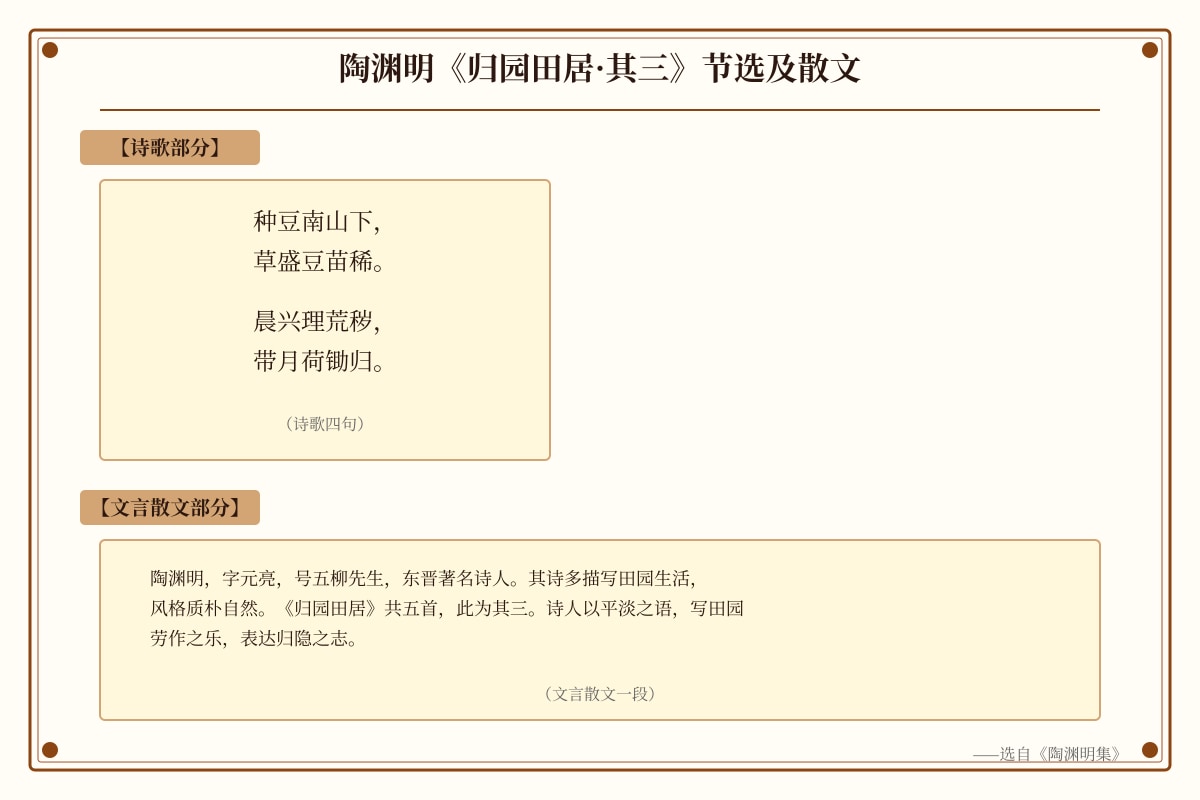
(a) 理 = 整治,管理 / treat, manage (the wasteland)
(b) 会 = 领悟,理解 / comprehend, grasp (the essence)
(c) 恒 = 常,经常 / constantly, regularly
(d) 吝 = 吝惜,介意 / begrudge, mind (leaving or staying)
Teaching Note: Classical function words (虚词) often have different meanings from modern usage. "会" here is not "meeting" but "understanding". "吝" is not just "stingy" but "reluctant to part with / mind".
12. Translation [4 marks, 2 each]
(a) 晨兴理荒秽,带月荷锄归。
Translation: 清晨起来整理荒地,傍晚带着月光挑着锄头回家。
Marking: 1 mark for "晨兴" (early morning rise), "理荒秽" (clear wasteland); 1 mark for "带月" (under moonlight), "荷锄归" (carry hoe home).
(b) 造饮辄尽,期于必醉。
Translation: 每次喝酒就喝个尽兴,以求必醉为目的。
Marking: 1 mark for "造饮辄尽" (every time drink, finish all); 1 mark for "期于必醉" (aim to get drunk).
Teaching Note: "辄" = 就,便 (then/immediately); "期于" = 以……为期望 (take ... as goal).
13. Summary of Pastoral Scene [3 marks]
Answer: 陶渊明描写了自己清晨起来锄草除秽,直到月亮升起才挑着锄头回家的辛勤耕作场景,展现了田园生活的朴实与劳作的艰辛,也流露出闲适自在的心境。
Marking: 1 mark for "晨兴理荒秽" (morning weeding), 1 mark for "带月荷锄归" (returning at moonlight), 1 mark for capturing the mood (辛勤/闲适).
14. Evidence of "超然物外" Attitude [4 marks, 2 each]
Sentence 1: “箪瓢屡空,晏如也。”
Reason: 即使饭篮和水瓢经常空空如也(生活贫困),他依然安之若素、心情平静,不为贫穷所动,体现超脱物质追求。
Sentence 2: “世人皆贵奔竞,而潜独超然物外。” (or "造饮辄尽,期于必醉。既醉便退,曾不吝情去留。")
Reason: 直接点明世人追逐名利,而他独自超脱于世俗之外;或:喝酒痛快淋漓,醉了就走,不介意去留,体现洒脱不羁、不受世俗礼法拘束。
Marking: 1 mark for accurate quote, 1 mark for valid explanation linking to "超然物外/不慕名利".
Passage 2: Modern Literary Text [20 marks]
15. Fill in the Blanks [2 marks]
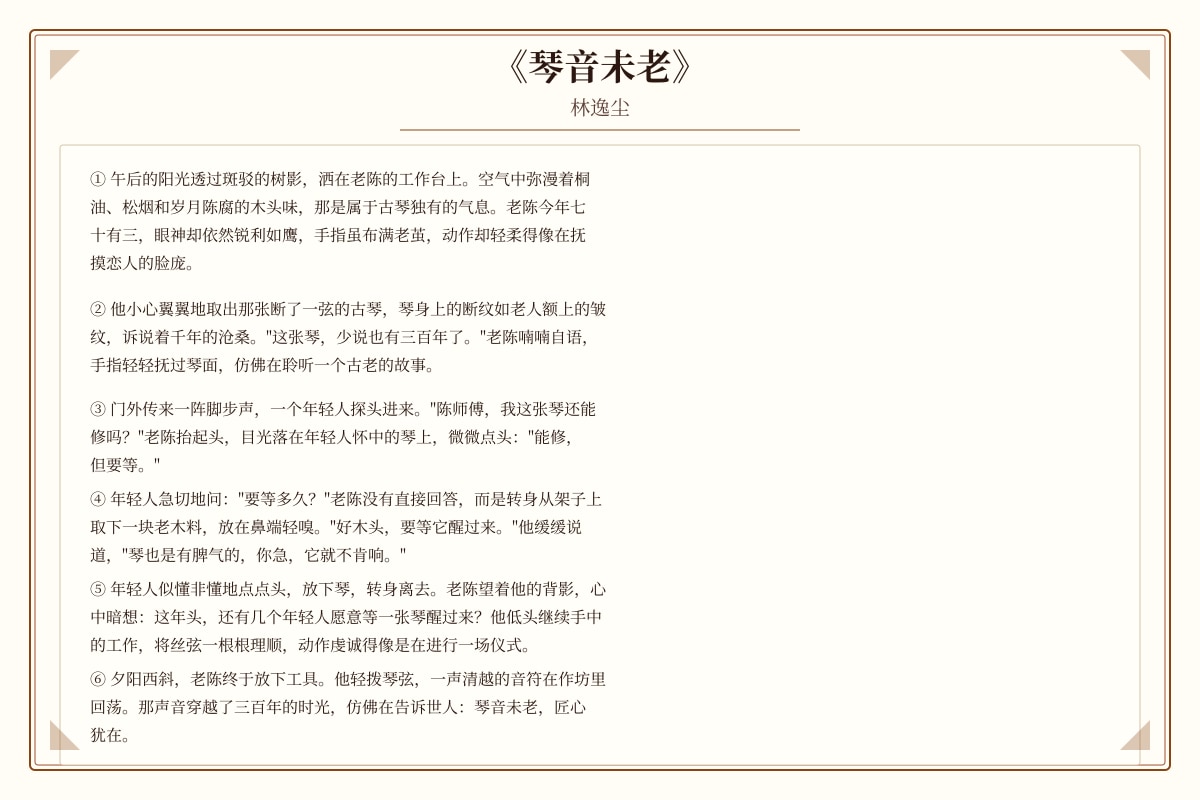
Answer: 桐油、松烟、岁月陈腐的木头味 (any order)
Marking: 1 mark for any two correct, 2 marks for all three. Must use original text words.
16. Meaning of "音魂" [3 marks]
Answer: “音魂”指古琴内在的音韵灵魂、艺术生命。老陈认为修琴不仅是修复木质结构、调整音准等物理层面,更是唤醒和传承古琴承载的文化意蕴、演奏者的情感寄托以及琴本身的“性格”与“韵味”,让琴声重焕生机与神韵。
Marking: 1 mark for "内在音韵/艺术生命/文化意蕴"; 1 mark for contrasting with "修木头" (physical repair); 1 mark for "唤醒/传承/重焕生机" (restoring vitality).
17. Contrast of Psychological States [4 marks]
小林:
- 动作/语言:“声音里带着焦急” / “师父……这琴……真能赶上吗?” (急切询问)
- 心理:担心完不成任务,对师父身体担忧,缺乏定力。
老陈:
- 动作/语言:“放下锉刀,抬头看了眼墙上挂满的琴” / “急什么?琴性如人性,急不得。” (从容自若)
- 心理:胸有成竹,遵循琴的规律,心态平和,专注于艺术本身而非外在压力。
Marking: 1 mark each for correct quote/action for 小林 and 老陈; 1 mark each for accurate psychological inference. Must show contrast (焦急 vs 从容).
18. Function of "Red Paper Strips" Detail [3 marks]
Answer:
- 侧面描写老陈修琴经验丰富、数量巨大,确立“资深琴师”形象。
- 体现老陈工作严谨细致、一丝不苟,每张琴都有详细档案记录。
- 铺垫后文老陈对“流泉”琴音准问题的精准判断,强化其专业权威。
Marking: 1 mark per valid point (max 3). Accept: 侧面烘托、人物性格、铺垫伏笔.
19. Double Meaning of "乐者,乐也" [4 marks]
Answer:
双关含义:
- 字面义:“乐”(音乐)的作用是让人“乐”(快乐/愉悦)。
- 深层义:“修琴”这一过程本身就是修心养性、获得内心安宁与快乐的过程。
结合经历的深层意义: 老陈修琴四十年,经历枯燥、孤独、身体劳累,但他不视为“累”,而视为“乐”。因为他在修琴中磨砺心性、寄托情感、实现自我超越,达到了“琴人合一”的境界。这句话点明了“技以载道、艺以养心”的核心主旨。
Marking: 1 mark for identifying double meaning (music/joy), 1 mark for explaining "修琴即修心", 2 marks for linking to 老陈's 40-year experience and "非累是乐" insight.
20. Understanding of Title "琴音未老" [4 marks]
Answer:
- 字面层面: 古琴“流泉”虽历经岁月、音色曾沙哑,但经老陈精心修复,音色重归圆润,琴声依然动听,不显衰老。
- 人物层面: 老陈虽年过七十、双手布满老茧,但初心不改、技艺精湛、精神矍铄,内心对古琴艺术的热爱与追求“未老”。
- 传承层面: 通过徒弟小林的学习与成长,古琴修复技艺与“琴以养性”的精神得以传承,中华传统琴文化薪火相传,生生不息。
- 主题升华: 标题点出“琴音未老,人心亦然” —— 真正的艺术与匠心不朽,超越时光流转。
Marking: 1 mark per layer (literal, person, inheritance, theme), max 4. Requires textual evidence integration.
Section C: Writing [25 marks]
Marking Guidelines (Generic for both topics):
| Criteria | Marks | Descriptors |
|---|---|---|
| Content & Perspective (立意与内容) | 8 | - Topic 1: Concrete examples, analysis of challenges/opportunities, youth role, insightful view.<br>- Topic 2: Clear stance, dialogue with opposing views, logical reasoning, cultural depth. |
| Structure & Logic (结构与逻辑) | 6 | Clear intro-body-conclusion; coherent paragraphs; smooth transitions; argument progresses logically. |
| Language & Expression (语言表达) | 6 | Elegant, precise vocabulary; varied sentence structures; appropriate rhetorical devices; few/no grammatical errors. |
| Depth & Originality (深度与创见) | 5 | Goes beyond clichés; shows critical thinking; personal voice; connects to broader cultural/social context. |
Total: 25 marks
Topic 1: 〈中华传统技艺的当代传承〉 - Key Content Points for Marking
Expected coverage:
- 具体例子: e.g., 古琴制作(如文中老陈)、苏绣“双面绣”创新、景泰蓝非遗传承人进校园、京剧脸谱文创产品。
- 挑战: 市场萎缩、传承周期长/收益低、年轻人缺乏耐心、机械化冲击、原材料稀缺。
- 机遇: 国家政策扶持、非遗进校园/社区、文创产品/直播带货新渠道、跨界合作(时尚/游戏/文旅)、数字化存档。
- 年轻一代角色: 学徒制学习、设计赋能、新媒体传播、学术研究、创新应用(如古琴电子化教学)。
- 观点: “活化而非复古”、“技艺核心不变、形式与时俱进”、“传承人+设计师+运营者”协作模式。
Topic 2: 〈“读万卷书,不如行万里路”──你怎么看?〉 - Key Content Points for Marking
Possible stances:
- 赞同: 实践出真知、书本知识需实践检验、行万里路拓宽眼界增厚阅历(如王安石、顾炎武)。
- 反对/辩证: 读书是行路的地图/基础、无书本理论指导行路盲目(如“纸上谈兵”需书本铺垫)、读万卷书本身是精神之旅(朱熹“半亩方塘”)。
- 辩证融合: “读万卷书”是内在积淀,“行万里路”是外在验证,二者辩证统一、相辅相成(董其昌“读万卷书,行万里路”)。
- 对话他人观点: 回应“读书无用论”/“实践至上论”,引用古今中外例证(孔子周游列国、徐霞客、现代留学/社会实践)。
- 文化修养体现: 引用经典、联系时事、逻辑严密、语言典雅。
End of Answer Key