AI Generated Exam Paper
Primary 6 PSLE Higher Tamil Practice Paper 3
Free P6 PSLE Higher Tamil Practice Paper 3, Kimi2.6 AI version, with questions, answers, and PSLE-focused practice for Singapore students.
These static practice materials are generated from the site's syllabus and paper-generation workflow, with source and model context shown so students and parents can evaluate the material before use.
Questions
Free quiz and exam paper access
Enter your details to view this paper
Your access is remembered on this device.
Answers
TuitionGoWhere Practice Paper - Higher Tamil Primary 6 PSLE
Answer Key and Marking Scheme
Version: 3 of 5 Total Marks: 60
Section A: Vocabulary in Context [Questions 1-8] / 16 marks
Question 1 [2 marks]
Answer: (b) வெற்றி
Explanation: The sentence describes someone achieving something through hard work. "வெற்றி" (victory/success) is the logical outcome of "கடின உழைப்பு" (hard work). The other options — "தோல்வி" (failure), "சோர்வு" (tiredness), and "கவலை" (worry) — are negative outcomes that contradict the positive context of hard work. In Tamil reading comprehension, students must identify semantic consistency between cause (hard work) and effect (success).
Common mistake: Choosing (a) through misreading the positive context; some students associate hard work with struggle rather than outcome.
Question 2 [2 marks]
Answer: (a) திட்டமிடப்பட்ட
Explanation: The sentence structure indicates a cause-effect relationship: rain caused a previously arranged event to stop. "திட்டமிடப்பட்ட" (planned/scheduled) describes an event that was organized in advance. The other options describe timing (b, c) or manner (d) but don't establish the necessary semantic relationship with cancellation due to weather. The collocation "திட்டமிடப்பட்ட விளையாட்டு" (scheduled game) is standard in formal Tamil.
Common mistake: Choosing (c) நேற்று — students confuse when the rain fell with when the game was planned.
Question 3 [2 marks]
Answer: (c) பல நூற்றாண்டுகளுக்கு முன்பு
Explanation: The keywords are "பழமையான கோவில்" (ancient temple) and "வரலாற்றாளர்கள்" (historians). Ancient temples are by definition very old, measured in centuries. The phrase "பல நூற்றாண்டுகளுக்கு முன்பு" (many centuries ago) matches this temporal depth. Options (a) and (b) are too recent for "பழமையான"; (d) "நாளை" (tomorrow) is future tense and logically impossible.
Common mistake: Choosing (b) through underestimating what "பழமையான" implies about time depth.
Question 4 [2 marks]
Answer: (a) பழைய
Explanation: The sentence describes helping a friend, which implies an existing relationship. "பழைய நண்பன்" (old friend — long-standing friend) is the natural collocation in Tamil. While (b) "புதிய" is possible grammatically, the context of helping suggests established trust. Options (c) and (d) don't fit the semantic field of friendship in this context.
Common mistake: Choosing (b) assuming "new friend" shows kindness; however, "பழைய" better fits the implicit trust in helping behavior.
Question 5 [2 marks]
Answer: (b) உற்சாகமாக
Explanation: Children playing in a park is typically an energetic, joyful scene. "உற்சாகமாக" (enthusiastically/joyfully) captures this affective quality. While (d) "விரைவாக" (quickly) describes speed, it misses the emotional dimension. Options (a) "அமைதியாக" (quietly) and (c) "மெதுவாக" (slowly) contradict the expected behavior of children at play.
Common mistake: Choosing (d) focusing on physical movement rather than emotional state; Tamil adverbs often prioritize manner over speed in descriptive contexts.
Question 6 [2 marks]
Answer: (b) உயரமான
Explanation: The key phrase is "மலை உச்சியில்" (mountain peak). Snow at mountain peaks relates to altitude — "உயரமான" (high/tall) correctly describes this. "பனிப் பொழிவது அரிதானது" (rare to snow) further confirms tropical high-altitude context typical of Singapore's geography understanding. Other options: (a) "குறைந்த" (low/decreased) contradicts peak; (c) "சமனான" (level/equal) doesn't describe mountains; (d) "ஆழமான" (deep) applies to depth, not height.
Common mistake: Confusing "ஆழமான" (deep) with height; these are dimensional opposites in Tamil spatial vocabulary.
Question 7 [2 marks]
Answer: (b) முக்கியமான
Explanation: Government consultation with the public emphasizes significance. "முக்கியமான கருத்துக்கள்" (important opinions/views) reflects civic discourse where input matters. Options (a), (c), and (d) are either diminutive or irrelevant to the governmental context of seeking meaningful feedback.
Common mistake: Choosing (c) "தனிப்பட்ட" (personal) — confusing privacy with the public nature of policy consultation.
Question 8 [2 marks]
Answer: (b) ஆழமான
Explanation: Problem analysis requires depth of thinking. "ஆழமான சிந்தனை" (deep thinking) is a standard collocation in Tamil intellectual discourse. The contrast is with (a) "மேல்போக்கு" (superficial) which would produce ineffective analysis. Options (c) and (d) describe speed, not cognitive quality.
Common mistake: Confusing this with Q6's dimensional use; here "ஆழமான" is metaphorical (intellectual depth), not literal.
Section B: Grammar and Sentence Structure [Questions 9-14] / 12 marks
Question 9 [2 marks]
Answer: (a) எழுதிய
Explanation: This tests relative participle (இடப்பெயரெச்சம்) formation. The sentence requires a past participle because the books were already written before being given to the publisher. "எழுதிய" is the past relative participle of "எழுது" (to write). The structure: Subject + [verb root + past tense marker + ய்/வ்] + Object
- (b) "எழுதுகிற" = present habitual participle (used for ongoing/regular action)
- (c) "எழுதும்" = future participle or habitual (not completed)
- (d) "எழுத" = verbal noun/infinitive base form
Step-by-step reasoning:
- Identify tense requirement: action completed before main verb "கொடுத்தனர்" (gave)
- Apply past participle rule: எழுது → எழுத் + இ + ய் → எழுதிய
- Verify subject-verb agreement: plural subject "மாணவர்கள்" matches plural verb
Common mistake: Choosing (c) assuming future relevance; but for giving completed books, past participle is required.
Question 10 [2 marks]
Answer:
- தவறான சொல்: பாட்டம்
- சரியான சொல்: பாடல்
Explanation: This tests homophone confusion and semantic correctness. "பாட்டம்" (pāṭṭam) means "bet/wager" in Tamil, not "song." The correct word for song is "பாடல்" (pāṭal). The student intended "பாடினாள்" (sang), which requires the object "பாடல்" (song).
Grammar note: In Tamil, பாடு (verb, to sing) → பாடல் (noun, song). The suffix "-ல்" forms the verbal noun. "பாட்டம்" derives from different root or is a malapropism.
Marking: [1] for identifying error; [1] for correction.
Question 11 [2 marks]
Answer: (b) எப்போது
Explanation: The sentence asks about completion time of a course: "When did this course end?" The answer requires a temporal interrogative. "எப்போது" (when) is the time interrogative.
- (a) "எங்கு" = where (location)
- (c) "எப்படி" = how (manner/method)
- (d) "யார்" = who (person)
Interrogative classification in Tamil:
| Interrogative | Category | Answer type |
|---|---|---|
| எப்போது | Time | Temporal phrase |
| எங்கு | Place | Location |
| எப்படி | Manner | Description of process |
| யார் | Person | Name/identity |
Common mistake: Choosing (c) confusing process completion with time of completion.
Question 12 [2 marks]
Answer: ரவி அந்தப் போட்டியில் கலந்து கொள்ளவில்லை. / ரவி அந்தப் போட்டியில் கலந்து கொள்ளலில்லை.
Explanation: Tamil negative formation uses the negative suffix. For past tense:
Affirmative: கலந்து கொண்டான் (participated — past tense, masculine) Negative: கலந்து கொள்ளவில்லை (did not participate — neutral past negative)
Alternative formal negative: கலந்து கொள்ளலில்லை (literary/formal negative)
Step-by-step transformation:
- Identify verb: கலந்து கொள் (participate — compound verb)
- Remove past tense marker and subject agreement: கலந்து கொண்ட் + ஆன் → base
- Add negative suffix: கலந்து கொள் + வில்லை → கலந்து கொள்ளவில்லை
Marking: [1] for correct negative structure; [1] for correct verb form preserving compound structure.
Question 13 [2 marks]
Answer: (a) சாரியைக்குப் பின்
Explanation: This tests Tamil phonological rule: வல்லினம் மிகல் (hard consonant strengthening). The rule states that when a word ending in a "சாரியை" (ending letter that is not a vowel or valid liaison point) meets certain conditions, the initial consonant of the next word strengthens.
The contexts for வல்லினம் மிகல் include:
- After சாரியை endings (ஐ, ஔ endings)
- After specific grammatical particles
- In compound formations
"உயிரெழுத்துக்குப் பின்" (after vowel) is incorrect because vowels cause softening, not hardening. "மெய்யெழுத்துக்குப் பின்" is too vague — specific consonants trigger this, not all consonants.
Common mistake: Confusing with ஆய்த எழுத்து or other sandhi rules.
Question 14 [2 marks]
Answer: The original sentence contains a பொருந்தாச் சொற்றொடர் (inappropriate collocation). "மழை பெய்தபோது" is grammatically acceptable but stylistically awkward. Better revision:
சரியான வாக்கியம்: "மழை பெய்யும்போது, அவன் குடையுடன் சென்றான்." / "மழை பெய்த காரணத்தால், அவன் குடை எடுத்துச் சென்றான்."
Or, correcting the particular issue: "மழை பெய்தபோது" implies simultaneity, but "எடுத்துச் சென்றான்" implies preparation before departure.
Revised for logic: "மழை பெய்யும் என்று அறிந்து, அவன் குடையை எடுத்துச் சென்றான்."
Acceptable answer: Identifying that "எடுத்துச் சென்றான்" should be "எடுத்துக் கொண்டு சென்றான்" for clearer carrying-meaning, or any valid grammatical correction of the student's identified error.
Marking: [1] for identifying the discrepancy (temporal logic or collocation); [1] for providing corrected version.
Section C: Reading Comprehension [Questions 15-20] / 32 marks
Question 15 [4 marks]
Answer:
Main idea [2 marks]: The primary message is that environmental protection is everyone's responsibility, beginning with individual small actions at the local level.
Evidence from passage [2 marks — 1 mark each]:
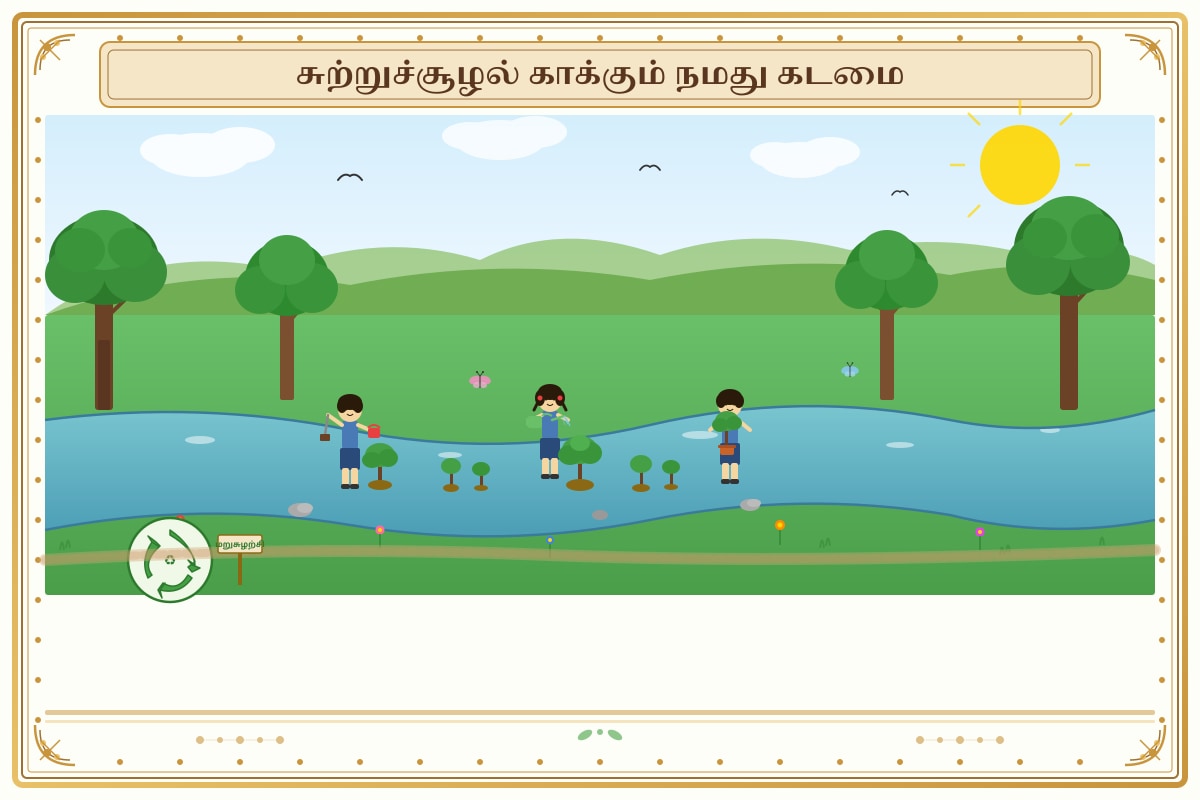
- Evidence 1: Paragraph 2 states that the Singapore government implements "சுத்தமான நகரம், பசுமையான நகரம்" (Clean City, Green City) policy, showing institutional commitment.
- Evidence 2: Paragraph 4 quotes Anitha describing how her class participated in river cleanup and tree planting, demonstrating student-level action.
- Evidence 3: Paragraph 5 emphasizes "நம் தலைமுறையின் கடமை" (our generation's duty) to act.
Marking descriptor:
| Marks | Standard |
|---|---|
| 4 | Clear main idea stated + two precise textual evidence with location identifiers |
| 3 | Main idea clear + two evidence but less precise location |
| 2 | Main idea vague or implied only + at least one evidence |
| 1 | Main idea missing or incorrect |
| 0 | No relevant response |
Question 16 [4 marks]
Answer:
Three actions under Singapore's "Clean City, Green City" policy [any three, ~1 mark each with slight explanation]:
- மரங்கள் நடுதல் (Tree planting) — mentioned explicitly in paragraph 2; increases green cover and absorbs CO₂
- நீர் மறுசுழற்சி (Water recycling) — NEWater programme context; reduces water wastage
- கழிவு மேலாண்மை (Waste management) — systematic garbage collection and processing
- தொடர்புப் பாடநெறி (interdisciplinary curriculum in schools) — environmental awareness education
From text: மரங்கள் நடுதல், நீர் மறுசுழற்சி, கழிவு மேலாண்மை ஆகியவை இதில் அடங்கும்.
Marking: Approximately 1 mark for each correctly identified action with brief functional explanation; accept reasonable inferences from Singapore context if supported by text.
Question 17 [6 marks]
Answer:
Anitha's actions described [2 marks]:
- Participated in Kishan waterway project with classmates (கிஷான் நீர்வழித் திட்டம்)
- Removed garbage from riverbank (நதிக்கரையில் உள்ள குப்பைகளை அகற்றி)
- Planted tree saplings at the site (மரக்கன்றுகளை நட்டோம்)
Importance of these actions [2 marks]:
- Direct environmental improvement: cleaning prevents water pollution and protects aquatic ecosystems
- Tree planting provides long-term benefits: shade, oxygen production, habitat restoration
- Community building: group participation creates shared responsibility and multiplies impact
Personal opinion required [2 marks]:
- Student should connect to own experience or values
- Example: "I have participated in school recycling drives" or "I believe individual effort inspires others"
- Must show reflection beyond text, not mere repetition
Marking descriptor:
| Component | Marks |
|---|---|
| Accurate summary of Anitha's actions | 2 |
| Analysis of environmental/community significance | 2 |
| Personal connection/reflection | 2 |
Question 18 [6 marks]
Answer:
Literal meaning [2 marks]: Environmental problems are not distant or abstract issues affecting only faraway places. They begin right where we live — at our doorstep. The metaphor "வீட்டு வாசலில்" (at the house entrance) emphasizes immediate proximity and personal relevance.
Extended interpretation [2 marks]: The author uses spatial metaphor to challenge the psychological distancing that prevents action. By collapsing the distance between "global problem" and "local reality," the text demands personal accountability. The progression from distant (தொலைவில்) to immediate (வாசலில்) mirrors the reader's journey from passive awareness to active responsibility.
Personal experience connection [2 marks]:
- Student should provide concrete example of local environmental issue
- Examples: litter in neighborhood park, water waste at home, plastic use in school canteen
- Must explicitly link to "not distant" theme — showing how global issues manifest locally
Sample response structure: "This means climate change isn't just about polar bears. In my estate, blocked drains during rain cause flooding because people litter. This local problem connects to global water management issues. I started carrying reusable bags after seeing plastic clog our drain."
Marking descriptor:
| Marks | Quality |
|---|---|
| 5-6 | Full interpretation + metaphor analysis + specific personal example with explicit thematic link |
| 3-4 | Meaning explained + some personal connection but lacking depth or explicit linkage |
| 1-2 | Superficial meaning only or personal example without text connection |
| 0 | Misunderstanding or no response |
Question 19 [6 marks]
Answer:
Two small actions from text [1 mark for identification each]:
- பிளாஸ்டிக் பைகளைக் குறைப்பது (reducing plastic bags)
- தண்ணீரைச் சிக்கனமாகப் பயன்படுத்துவது (using water carefully/saving water)
- மின்சாரத்தைச் சேமிப்பது (saving electricity)
Explanation for each [2 marks each — 1 mark for why important, 1 mark for elaboration]:
Example 1 — Plastic reduction:
- Plastic pollution harms marine life and accumulates in ecosystems; takes hundreds of years to decompose
- Singapore, as island nation, has limited landfill space (Semakau Landfill); reducing plastic extends landfill lifespan
- Personal action: bringing reusable bags, refusing unnecessary packaging
Example 2 — Water conservation:
- Singapore relies on imported water and desalination; energy-intensive water production increases carbon footprint
- Daily habits (shorter showers, fixing leaks) compound across population to significant savings
- Connects to "Four National Taps" strategy students learn in Social Studies
Example 3 — Electricity saving:
- Reduces fossil fuel consumption at power plants
- Lowers household costs while benefiting environment
Marking descriptor:
| Component | Marks |
|---|---|
| Two clear actions identified from text | 2 |
| First action: importance explained with reasoning | 2 |
| Second action: importance explained with reasoning | 2 |
Question 20 [6 marks]
Answer:
Author's purpose [2 marks]: To persuade and motivate Primary-level readers (and general public) to recognize environmental degradation as an urgent local issue and to take concrete conservation actions. The purpose combines informing (about government efforts, student projects) with exhorting (to personal responsibility).
How purpose is achieved — rhetorical/literary techniques [4 marks]:
-
Structural progression [1 mark]:
- Problem (paragraph 1): global crisis establishes urgency
- Solution examples (paragraphs 2-4): institutional and individual models
- Call to action (paragraph 5): direct address to reader's generation
-
Specific exemplification through Anitha's narrative [1 mark]:
- Student's first-person account creates relatability for P6 readers
- Concrete details (Kishan waterway, removing garbage, planting saplings) make abstract "environmentalism" tangible
- Emotional payoff "மிகுந்த திருப்தியை அளித்தது" models positive reinforcement for helping
-
Inclusivity in action spectrum [1 mark]:
- List of simple actions (plastic, water, electricity) removes intimidation barrier
- Rhetorical message: sophistication unnecessary, consistency matters
-
Patriotic framing [1 mark]:
- "சிங்கப்பூர் நம் தாய்நாடு" (Singapore our motherland) invokes national identity
- "நம் பாக்கியம்" (our fortune/blessing) reframes obligation as privilege
- Connects environmental duty to citizenship values
Alternative literary techniques accepted: contrast (ancient beauty vs. current destruction), direct address ("நமக்கு ஒரு முக்கிய பாடத்தைக் கற்பிக்கின்றன"), metaphor (duty at doorstep not in distance).
Marking descriptor:
| Marks | Quality |
|---|---|
| 5-6 | Clear purpose stated + 3-4 techniques identified with textual evidence and explanation of effect |
| 3-4 | Purpose stated + 2 techniques with some evidence |
| 1-2 | Purpose vague or techniques listed without explanation |
| 0 | No relevant literary analysis |
Total Marks Verification:
| Section | Marks |
|---|---|
| A (Q1-8) | 16 |
| B (Q9-14) | 12 |
| C (Q15-20) | 32 |
| Total | 60 |
Duration: 1 hour 15 minutes (75 minutes)
- Section A: ~2 minutes/question = 16 minutes
- Section B: ~3 minutes/question = 18 minutes
- Section C: ~7 minutes/question reading+writing = 42 minutes
- Review buffer: approximately -1 minutes (tight but manageable; advise students to plan time carefully)