AI Generated Quiz
Primary 6 PSLE Higher Malay Speaking Quiz
Free P6 PSLE Higher Malay Speaking quiz, Nemo3 AI version, with questions, answers, and PSLE-focused practice for Singapore students.
These static practice materials are generated from the site's syllabus and paper-generation workflow, with source and model context shown so students and parents can evaluate the material before use.
Questions
Free quiz and exam paper access
Enter your details to view this paper
Your access is remembered on this device.
Answers
Primary 6 PSLE Higher Malay Quiz - Speaking (Answer Key)
Total Marks: 40
Section A: Reading Aloud (10 marks)
Assessment Criteria: Pronunciation (4 marks), Fluency & Phrasing (3 marks), Expressiveness (3 marks)
| Question | Expected Performance | Marks |
|---|---|---|
| 1 | Clear pronunciation of "berjalan" (ber-ja-lan, not ber-jan), "sebelah" (se-be-lah). Smooth phrasing: "Setiap pagi / Encik Rahman berjalan / ke taman di sebelah rumahnya." | 2 |
| 2 | Clear pronunciation of "menikmati" (me-nik-ma-ti), "keheningan" (ke-he-ni-ngan), "chirping" (chir-ping). Expressiveness: calm, peaceful tone to reflect "keheningan pagi". | 2 |
| 3 | Clear pronunciation of "bertemu" (ber-te-mu), "kawan lamanya" (ka-wan la-ma-nya). Natural phrasing with slight pause after "Kadang-kadang,". | 2 |
| 4 | Clear pronunciation of "bercakap-cakap" (ber-ca-kap-ca-kap), "tanaman-tanaman" (ta-na-man-ta-na-man), "komuniti" (ko-mu-ni-ti). Fluent delivery of the longer sentence. | 2 |
| 5 | Clear pronunciation of "merasa" (me-ra-sa), "berkongsi" (ber-kong-si), "berkebun" (ber-ke-bun). Expressiveness: warm, happy tone to convey "gembira". | 2 |
Section A Total: 10 marks
Marking Notes:
- Deduct 0.5 marks per mispronounced word (e.g., "berjalan" → "berjan", "komuniti" → "komuniti" with wrong stress).
- Deduct 1 mark for monotonous reading (lack of expressiveness).
- Deduct 1 mark for hesitations/self-corrections that disrupt fluency.
- Award full marks for accurate, fluent, and expressive reading.
Section B: Video Stimulus / Picture Discussion (15 marks)
Assessment Criteria: Content & Relevance (6 marks), Language & Vocabulary (5 marks), Interaction & Elaboration (4 marks)
Question 6 (3 marks)
Sample Answer:
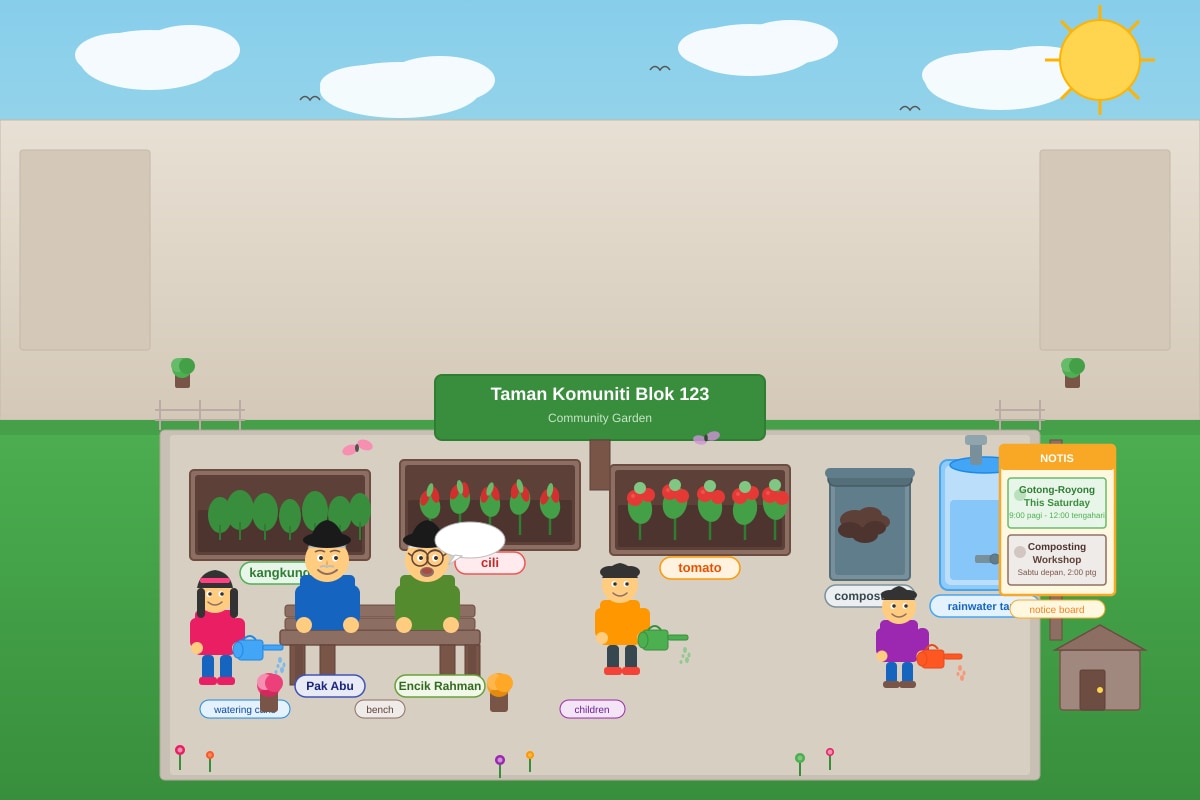
"Saya melihat sebuah taman komuniti di kawasan HDB. Terdapat bed-bed tanaman yang ditanam kangkung, cili, dan tomato. Ada dua orang lelaki tua duduk di bangku bercakap-cakap. Beberapa kanak-kanak sedang menyiram tumbuhan dengan timba air. Di papan notis, ada poster tentang gotong-royong dan bengkel kompos."
Mark Breakdown:
- 1 mark: Identifies setting (community garden in HDB estate)
- 1 mark: Mentions ≥4 distinct details (e.g., vegetables, elderly men, children watering, notice board, compost bin, rainwater tank, signboard)
- 1 mark: Uses complete sentences with appropriate vocabulary (taman komuniti, bed tanaman, bangku, timba air, papan notis)
Common Mistake: Listing items without sentence structure or missing the setting.
Question 7 (2 marks)
Sample Answer:
"Mereka mungkin Encik Rahman dan Pak Abu seperti dalam bacaan tadi. Mereka bercakap tentang tanaman yang mereka tanam atau merancang aktiviti gotong-royong pada hari Sabtu."
Mark Breakdown:
- 1 mark: Reasonable identification (e.g., residents, gardeners, friends, or link to passage characters)
- 1 mark: Plausible topic of conversation (gardening, community events, plants, health)
Marking Note: Accept any logical inference supported by the picture.
Question 8 (2 marks)
Sample Answer:
"Kanak-kanak itu sedang menyiram tumbuhan dengan timba air. Aktiviti ini baik kerana mengajar mereka tanggungjawab, mencintai alam, dan bekerjasama."
Mark Breakdown:
- 1 mark: Correct action (watering plants)
- 1 mark: Valid benefit (responsibility, love for nature, teamwork, learning about plants, outdoor activity)
Question 9 (3 marks)
Sample Answer:
"Dua acara yang diiklan adalah 'Gotong-Royong This Saturday' dan 'Composting Workshop'. Saya akan menyertai bengkel kompos kerana saya ingin belajar cara membuat baja sendiri dari sisa makanan dan daun kering."
Mark Breakdown:
- 1 mark: Identifies both events correctly
- 1 mark: Chooses one event
- 1 mark: Gives a personal, relevant reason (learning, helping, interest, family bonding)
Question 10 (2 marks)
Sample Answer:
"Tong kompos digunakan untuk menjadikan sisa organik seperti sisa sayur dan daun kering menjadi baja alami. Tangki air hujan mengumpulkan air hujan untuk menyiram tumbuhan, menghemat air paip."
Mark Breakdown:
- 1 mark: Correct function of compost bin (recycle organic waste → natural fertiliser)
- 1 mark: Correct function of rainwater tank (collect rainwater → water plants, save water)
Question 11 (3 marks)
Sample Answer:
Ali: "Eh, lihat cili ini sudah merah! Boleh kita petik nanti?"
Siti: "Boleh! Tapi kita mesti tanya Pak Abu dulu, dia yang paling tahu."
Ali: "Baik, nanti kita tanya dia bila dia selesai bercakap dengan Encik Rahman."
Mark Breakdown:
- 1 mark: Natural dialogue format (speaker names, colon)
- 1 mark: Two exchanges (4 lines total)
- 1 mark: Contextually appropriate (refers to picture elements: chilli, Pak Abu, Encik Rahman)
Marking Note: Accept any plausible, polite, child-like dialogue related to the scene.
Question 12 (2 marks)
Sample Answer:
"Taman ini mengumpulkan orang-orang: pertama, orang tua seperti Encik Rahman dan Pak Abu berkumpul di bangku sambil berkebun. Kedua, kanak-kanak dan orang dewasa bekerjasama menyiram dan menjaga tanaman bersama-sama."
Mark Breakdown:
- 1 mark: Example 1 (elderly bonding)
- 1 mark: Example 2 (intergenerational / collaborative gardening)
Question 13 (2 marks)
Sample Answer:
"Saya cadangkan 'Hari Panen Bersama' di mana warga memetik hasil tanaman dan masak bersama. Ini menarik lebih ramai warga kerana ada makanan dan kegembiraan berkongsi hasil."
Mark Breakdown:
- 1 mark: Creative, feasible activity (harvest festival, cooking demo, seed swap, eco-craft, storytelling)
- 1 mark: Reason links to attracting residents (food, fun, sharing, learning, family time)
Question 14 (2 marks)
Sample Answer:
"Nama dan nombor blok memudahkan warga mencari lokasi taman, terutama warga baru. Ia juga memberi rasa pemilikan dan identiti kepada taman komuniti itu."
Mark Breakdown:
- 1 mark: Practical reason (wayfinding, location identity)
- 1 mark: Social reason (sense of belonging, ownership, pride)
Question 15 (3 marks)
Sample Answer:
"Jiran, awak mesti datang ke Taman Komuniti Blok 123! Di sini ada tanaman segar, udara sejuk, dan warga mesra. Kita boleh belajar berkebun, join gotong-royong Sabtu ini, dan kenal jiran baru. Jangan lepaskan peluang ini!"
Mark Breakdown:
- 1 mark: Persuasive tone (inviting, enthusiastic)
- 1 mark: Mentions ≥2 specific attractions from picture (fresh plants, cool air, friendly residents, gardening, gotong-royong, new friends)
- 1 mark: 3–4 sentences, natural spoken Malay
Common Mistake: Too formal (like writing), fewer than 3 sentences, generic reasons not tied to picture.
Section C: Conversation (15 marks)
Assessment Criteria: Content & Ideas (5 marks), Language & Vocabulary (5 marks), Fluency & Interaction (5 marks)
Question 16 (3 marks)
Sample Answer:
"Saya paling gemari gotong-rooyong membersihkan taman permainan. Saya suka kerana boleh bermain setelah bersih, dan rasa bangga melihat taman bersih untuk semua kanak-kanak main."
Mark Breakdown:
- 1 mark: Names a specific community activity
- 1 mark: Gives a personal reason (enjoyment, pride, friends, helping)
- 1 mark: Elaborates with detail (not just "seronok" — explains why)
Marking Note: Accept any activity (cleaning, gardening, recycling, food distribution, tuition, sports). Must show personal connection.
Question 17 (3 marks)
Sample Answer:
"Tahun lepas, saya join gotong-royong di sekolah untuk membersihkan hutan kecil di belakang sekolah. Kami mengumpul sampah, menebang rumput liar, dan menanam pokok. Saya rasa penat tapi gembira kerana sekolah jadi lebih cantik."
Mark Breakdown:
- 1 mark: Specific experience (school / housing estate, what activity)
- 1 mark: Describes actions (clean, plant, paint, sort recycling, etc.)
- 1 mark: Personal reflection (feelings, learning, outcome)
Common Mistake: Vague ("saya buat gotong-royong"), no detail, no feeling.
Question 18 (3 marks)
Sample Answer:
"Faedah utama gotong-royong adalah membina semangat muhibbah dan kerjasama di antara jiran. Apabila kita kerja bersama, kita kenal satu sama lain, saling tolong, dan kawasan jadi lebih selamat dan harmonis."
Mark Breakdown:
- 1 mark: Identifies a core benefit (unity, cooperation, cleanliness, safety, belonging)
- 1 mark: Explains how it happens (interaction, shared effort, trust)
- 1 mark: Links to community outcome (harmony, safety, support network)
Question 19 (3 marks)
Sample Answer:
"Saya cadangkan 'Kem Kecil Kanak-Kanak: Penjaga Alam' selama 2 hari di taman komuniti. Aktiviti: jalan jungle mudah, bina hotel serangga, belajar kompos, dan cerita malam di bawah pokok. Saya akan minta bantuan guru dan ibu bapa sebagai sukarelawan, dan guna bajet JKKK untuk bahan-bahan."
Mark Breakdown:
- 1 mark: Creative, child-friendly activity name & concept
- 1 mark: Lists 2–3 concrete activities
- 1 mark: Practical implementation plan (volunteers, venue, budget, permission, promotion)
Question 20 (3 marks)
Sample Answer:
"Jangan malu! Mulakan dengan aktiviti kecil seperti menyiram tanaman atau mengumpul sampah bersama kawan. Semua orang mula dari sifar. Yang penting hadir dan cuba. Nanti anda akan rasa percaya diri dan gembira dapat kawan baru."
Mark Breakdown:
- 1 mark: Empathetic, encouraging tone
- 1 mark: Practical advice (start small, bring a friend, low-pressure tasks)
- 1 mark: Positive outlook (growth, friendship, confidence builds with action)
Marking Note: Accept any supportive, actionable advice. Not just "jangan malu" — must suggest how.
Overall Marking Guidance for Teachers
| Band | Description | Marks Range |
|---|---|---|
| Excellent | Confident, fluent, rich vocabulary, elaborate ideas, natural interaction, accurate pronunciation | 36–40 |
| Good | Fluent, good vocabulary, clear ideas, minor hesitations, mostly accurate pronunciation | 28–35 |
| Satisfactory | Understandable, simple vocabulary, basic ideas, some hesitation, occasional pronunciation errors | 20–27 |
| Needs Improvement | Limited responses, frequent pauses, restricted vocabulary, pronunciation impedes meaning | <20 |
Note: This is a practice quiz. Actual PSLE Higher Malay Oral Examination follows MOE/SEAB format with examiner-interlocutor interaction. Use this to build confidence and identify areas for growth.
End of Answer Key