AI Generated Quiz
Primary 6 PSLE English Oral Quiz
Free P6 PSLE English Oral quiz, AI version, with questions, answers, and PSLE-focused practice for Singapore students.
These static practice materials are generated from the site's syllabus and paper-generation workflow, with source and model context shown so students and parents can evaluate the material before use.
Questions
Free quiz and exam paper access
Enter your details to view this paper
Your access is remembered on this device.
Answers
Primary 6 PSLE English Quiz - Oral: ANSWER KEY
Total Marks: 20
Section A: Reading Aloud (Questions 1 - 5)
1. Answer: C) promise Marks: 1 Explanation: The word "promise" is the key to understanding the lighthouse keeper's role and his feeling of safety. He feels safe because he is fulfilling his duty. Emphasising "promise" highlights his commitment and the security he finds in his purpose. The other words describe actions or feelings, but "promise" is the core of his motivation. Common Mistake: Choosing "afraid" because it is a strong emotion word. However, the passage says he was not afraid, so emphasising "afraid" would contradict the meaning.
2. Answer: C) deep and ongoing Marks: 1 Explanation: The phrase uses the adjectives "low" (deep in pitch) and "continuous" (ongoing, without stopping). The word "roar" suggests a powerful, rumbling sound. Therefore, the reading should reflect a sound that is deep in tone and does not stop, creating a sense of a persistent, powerful force. Common Mistake: Choosing "loud and sudden" (B). While a roar can be loud, the word "continuous" tells us it is not sudden or brief.
3. Answer: B) after "stairs" Marks: 1 Explanation: The first sentence is: "The old lighthouse keeper climbed the winding stairs, his lantern casting a warm, dancing glow on the stone walls." A natural pause occurs after the main clause ("The old lighthouse keeper climbed the winding stairs") and before the participial phrase ("his lantern casting..."). The comma after "stairs" indicates this pause. This break helps the listener process the action before the description of the lantern. Common Mistake: Pausing after "walls" (D) would be at the very end of the sentence, which is a full stop, not a pause within the sentence.
4. Answer: B) calm and confident Marks: 1 Explanation: The sentence "He was not afraid" directly states the character's emotional state. The preceding sentences describe a "sense of calm" and the lighthouse as his "home." Therefore, the tone should match this feeling of security and certainty. A calm and confident tone conveys that the character is in control and unafraid. Common Mistake: Choosing "fearful and trembling" (A) would completely contradict the meaning of the sentence.
5. Answer: C) with a steady, rhythmic emphasis Marks: 1 Explanation: A metaphor compares two things without using "like" or "as." Here, the rhythm of the stairs is compared to a "heartbeat." A heartbeat is a steady, repeating rhythm. To help the listener understand this comparison, the word "heartbeat" should be read with a steady, rhythmic emphasis, perhaps by slightly slowing down and stressing each syllable. Common Mistake: Reading it quickly (A) would not convey the steady, rhythmic nature of a heartbeat.
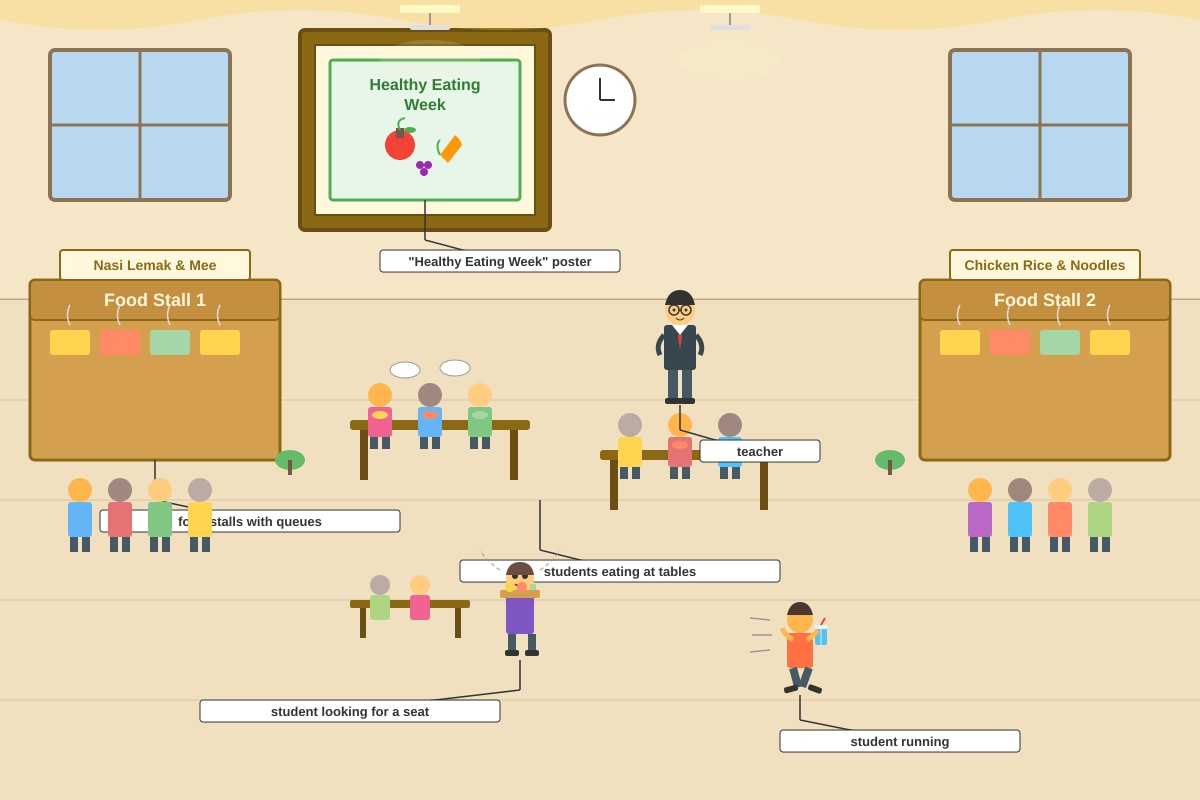
Section B: Stimulus-Based Conversation - Picture Discussion (Questions 6 - 10)
6. Answer: (Accept any reasonable observation from the picture, e.g., "There are long queues at the food stalls," or "Many students are crowded around the tables.") Marks: 1 Explanation: The question asks for a description of one thing that shows the canteen is busy. The student must identify a visual cue from the image, such as queues, crowded tables, or many people moving around. The answer should be a single, clear observation. Marking Note: Award 1 mark for a clear, relevant observation. Do not award marks for general statements like "It looks busy" without a specific detail.
7. Answer: (Accept reasonable inferences. Example: "The student might be running because he is late for class or wants to get back to his friends quickly. He could trip and fall, spilling his drink and hurting himself.") Marks: 2 (1 mark for a plausible reason, 1 mark for a logical consequence) Explanation: This question tests inference (reading between the lines). The student must use the visual clue (a student running with a drink) to infer a reason for the action and a potential negative outcome.
- Reason (1 mark): The student is in a hurry (e.g., late, wants to play, wants to join friends).
- Consequence (1 mark): An accident (e.g., tripping, spilling, bumping into someone). Marking Note: Award full marks for any logical and well-explained reason and consequence.
8. Answer: (Accept any example of healthy food, e.g., "They might be selling fruit like apples or oranges," or "They could have a salad stall.") Marks: 1 Explanation: This is a direct application of the concept of "healthy eating." The student must connect the poster's theme to a specific type of food that would be considered healthy. Marking Note: Award 1 mark for any specific, healthy food item or meal. Do not award marks for vague answers like "good food."
9. Answer: (Accept any reasonable and polite solution. Example: "I would look for a table where there are only one or two people and ask politely if I could join them.") Marks: 2 (1 mark for a clear action, 1 mark for explaining the manner in which it is done) Explanation: This question assesses problem-solving and social skills. The student needs to propose a practical solution to the problem shown in the picture (no seat) and demonstrate good social etiquette.
- Action (1 mark): A clear step (e.g., ask to share, wait for a table, find a less crowded spot).
- Manner (1 mark): The action should be polite and considerate (e.g., "ask politely," "wait patiently"). Marking Note: Award 1 mark for a reasonable action. Award the second mark if the student explains how they would do it politely.
10. Answer: (Accept a clear opinion with a supporting reason. Example: "Yes, I think it is a good idea because it teaches students about making healthy choices. Many students eat unhealthy food, and this week can help them try new, healthy foods.") Marks: 3 (1 mark for a clear opinion, 2 marks for a well-developed reason) Explanation: This is an evaluative question requiring the student to form and justify an opinion. A strong answer will state a clear position ("Yes" or "No") and provide a detailed, logical reason.
- Opinion (1 mark): Clearly states "Yes" or "No."
- Reason 1 (1 mark): A relevant reason (e.g., promotes health, educates students).
- Elaboration (1 mark): Explains why that reason is important or gives a specific example. Marking Note: A simple "Yes, it's good" without a reason gets only 1 mark. A "Yes" with one reason gets 2 marks. A "Yes" with a reason and a clear explanation of its importance gets 3 marks.
Section C: Stimulus-Based Conversation - Personal Response (Questions 11 - 15)
11. Answer: (Accept a clear preference with one reason. Example: "I prefer eating at the canteen because there is more variety of food to choose from.") Marks: 1 Explanation: This is a simple personal preference question. The student must state their choice and provide one clear, relevant reason. Marking Note: Award 1 mark for a clear choice and a reason. A choice without a reason gets 0 marks.
12. Answer: (Accept a personal anecdote with a description of a feeling. Example: "I had to wait in a long queue at the supermarket with my mother. I felt very impatient and bored because it took a long time.") Marks: 2 (1 mark for a clear description of the event, 1 mark for describing the feeling) Explanation: This question tests the ability to narrate a personal experience and express emotions clearly.
- Event (1 mark): A specific, clear description of a time they waited in a queue.
- Feeling (1 mark): An appropriate emotion (e.g., impatient, bored, frustrated, excited). Marking Note: Award 1 mark for a clear description of the event. Award the second mark for a clear and appropriate feeling.
13. Answer: (Accept a clear opinion with a supporting reason. Example: "I agree that recess is too short. By the time I finish eating, I only have a few minutes to play with my friends.") Marks: 2 (1 mark for a clear opinion, 1 mark for a relevant reason) Explanation: This question requires the student to take a position on a common school issue and defend it.
- Opinion (1 mark): Clearly states "Agree" or "Disagree."
- Reason (1 mark): A relevant and logical reason to support their opinion. Marking Note: Award 1 mark for a clear opinion. Award the second mark for a reason that logically supports that opinion.
14. Answer: (Accept a reasonable rule with a clear explanation. Example: "One rule should be that students must clean up their own tables after eating. This is important because it keeps the canteen clean and hygienic for everyone.") Marks: 2 (1 mark for a clear rule, 1 mark for explaining its importance) Explanation: This question tests the ability to propose a solution and justify it.
- Rule (1 mark): A specific, clear rule (e.g., no running, clean up after yourself, queue up).
- Importance (1 mark): A clear explanation of why that rule is necessary. Marking Note: Award 1 mark for a clear rule. Award the second mark for a well-explained reason for the rule.
15. Answer: (Accept a reasonable and appropriate statement from a teacher's perspective. Example: "I would say, 'Please stop running. It is dangerous and you might fall and hurt yourself or someone else. Walk slowly to your seat.'") Marks: 2 (1 mark for addressing the action, 1 mark for explaining the reason or giving a polite instruction) Explanation: This question requires the student to adopt a role (the teacher) and respond appropriately to a situation. The response should be firm but fair.
- Address the action (1 mark): Clearly tells the student to stop running.
- Reason/Instruction (1 mark): Explains why it is wrong (danger) or gives a clear alternative (walk). Marking Note: Award 1 mark for a clear instruction to stop. Award the second mark for a polite tone and a clear reason or alternative.
Section D: Reading and Discussion (Questions 16 - 20)
16. Answer: The writer's opinion changed because they found the experience was not boring and they learned new things (how to grow food and why the environment is important). Marks: 1 Explanation: The text explicitly states, "At first, I thought it would be boring, but I was wrong." The reason for the change is given in the next sentences: "I have learned how to grow my own food and why it is important to take care of our environment." The student must identify this contrast and the reason for the change. Marking Note: Award 1 mark for identifying that the writer learned something or found it interesting, directly referencing the text.
17. Answer: The writer means that volunteering made them feel good and gave them a sense of satisfaction or achievement. Marks: 1 Explanation: The word "rewarding" means providing satisfaction or a sense of accomplishment. The student must explain this in their own words, connecting it to the context of volunteering. The text provides evidence: learning new skills and seeing the elderly residents happy. Marking Note: Award 1 mark for a clear explanation of the meaning of "rewarding" in this context (e.g., "it made him feel happy and useful").
18. Answer: (Accept a clear opinion with one reason. Example: "Yes, I think it is important because it helps young people learn to be responsible and care for others.") Marks: 2 (1 mark for a clear opinion, 1 mark for a relevant reason) Explanation: This is an opinion question based on the theme of the text. The student must take a position and support it.
- Opinion (1 mark): Clearly states "Yes" or "No."
- Reason (1 mark): A relevant and logical reason (e.g., builds character, helps the community, teaches new skills). Marking Note: Award 1 mark for a clear opinion. Award the second mark for a well-explained reason.
19. Answer: (Accept a creative and well-explained idea. Example: "I would start a reading buddy programme where older students read to younger students. This would help the younger students improve their reading and build friendships.") Marks: 2 (1 mark for a clear activity, 1 mark for explaining why) Explanation: This question tests creativity and the ability to justify a choice.
- Activity (1 mark): A specific, clear volunteer activity (e.g., a recycling club, a tutoring group, a visit to an old folks' home).
- Reason (1 mark): A clear explanation of the benefit of that activity. Marking Note: Award 1 mark for a clear activity. Award the second mark for a well-explained reason for choosing it.
20. Answer: This tells me the writer is a kind, caring, and empathetic person who finds joy in helping others and making them happy. Marks: 2 (1 mark for identifying a positive character trait, 1 mark for explaining the connection to the text) Explanation: This is an inference question about character. The student must look at what the writer values (the elderly residents' happiness) and infer what this says about their personality.
- Trait (1 mark): A positive character trait (e.g., kind, caring, compassionate, selfless, generous).
- Explanation (1 mark): Connects the trait to the specific action in the text (sharing vegetables and seeing their smiles). Marking Note: Award 1 mark for a relevant character trait. Award the second mark for explaining how the text supports this trait.