AI Generated Quiz
Primary 6 PSLE English Oral Quiz
Free P6 PSLE English Oral quiz, AI version, with questions, answers, and PSLE-focused practice for Singapore students.
These static practice materials are generated from the site's syllabus and paper-generation workflow, with source and model context shown so students and parents can evaluate the material before use.
Questions
Free quiz and exam paper access
Enter your details to view this paper
Your access is remembered on this device.
Answers
Primary 6 PSLE English Quiz - Oral: Answer Key
Total Marks: 40
Section A: Reading Aloud Techniques (Questions 1 - 5)
(5 marks)
1. (1 mark)
- Answer: Pausing at a comma helps to group related words together, making the sentence easier for the listener to understand. It also creates a natural rhythm and prevents the reading from sounding rushed.
- Marking Notes: Accept any answer that conveys the idea of grouping words, improving clarity, or creating natural phrasing. A simple answer like "to make the sentence clearer" is acceptable for 1 mark.
2. (1 mark)
- Answer: The student should emphasise the word "enormous" or "ancient" or "silently". Any of these is acceptable as they are the key descriptive words that create the image.
- Marking Notes: Accept "enormous", "ancient", or "silently". The key is that the student identifies a descriptive adjective or adverb that paints a picture. Do not accept "tree" or "clearing" as they are nouns and less impactful for emphasis.
3. (1 mark)
- Answer: Changing your tone for different characters helps the listener to distinguish who is speaking. It also brings the dialogue to life, making the reading more engaging and expressive, and it helps to convey the emotions and personality of each character.
- Marking Notes: Accept any answer that mentions distinguishing characters, adding expression, or making the reading more interesting. A simple answer like "to show who is talking" is acceptable for 1 mark.
4. (1 mark)
- Answer: The question mark (?) tells you to make your voice rise at the end.
- Marking Notes: Must identify the question mark. Do not accept "the sentence" or "the words".
5. (1 mark)
- Answer: I would advise the student to use a more expressive and varied tone. They should emphasise words like "crashed", "thunderous", and "roar" to convey the power of the waves. They could also slow down their pace to build suspense and make the description more dramatic.
- Marking Notes: Accept any advice that suggests varying tone, pace, or volume, or emphasising descriptive words. The key is that the advice addresses the problem of a flat, monotone delivery.
Section B: Stimulus-Based Conversation (Questions 6 - 15)
(20 marks)
6. (2 marks)
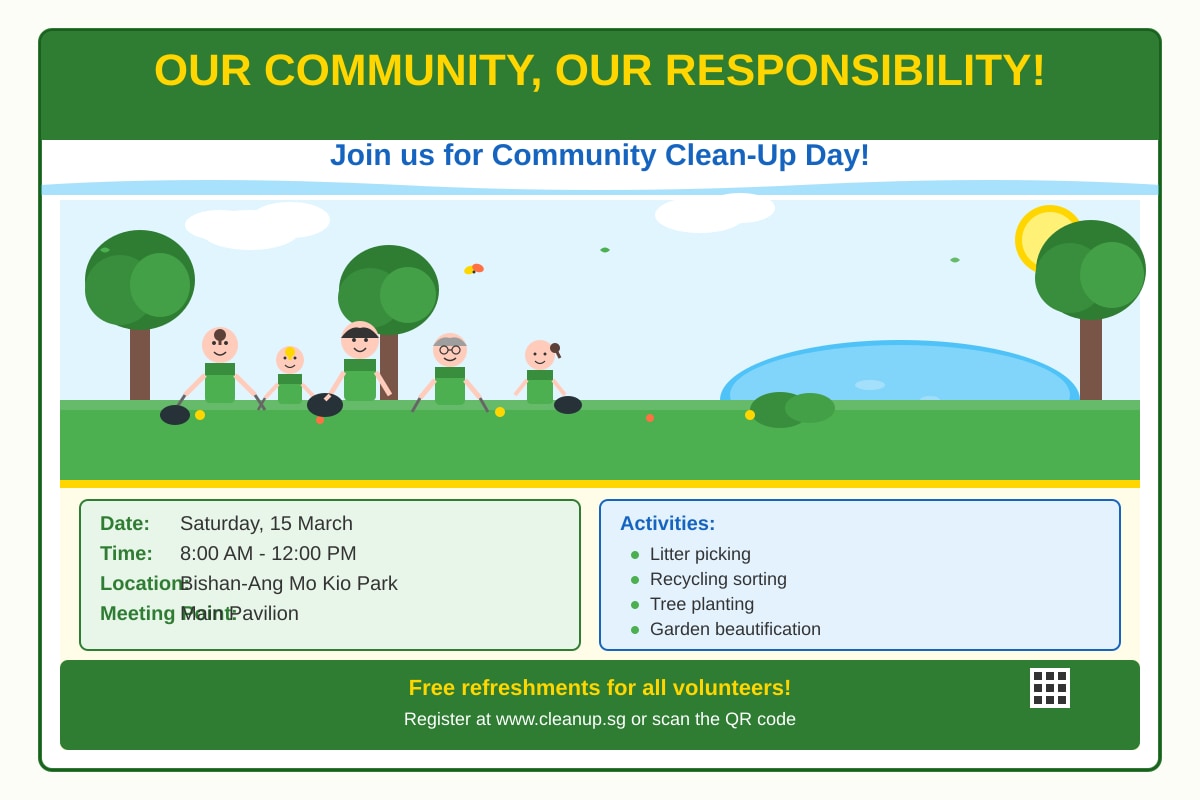
- Answer: The main purpose of this event is to bring the community together to clean up and beautify Bishan-Ang Mo Kio Park. It aims to encourage people to take responsibility for their environment by participating in activities like litter picking, recycling, and tree planting.
- Marking Notes:
- 2 marks: Clearly identifies the purpose (community clean-up/environmental responsibility) and mentions at least one specific activity from the poster.
- 1 mark: Mentions the general idea of a clean-up but lacks specific detail.
- 0 marks: Vague or incorrect answer.
7. (2 marks)
- Answer: The organisers included this information to encourage more people to volunteer. Offering free refreshments is an incentive that makes the event more appealing and rewarding. It shows appreciation for the volunteers' time and effort, and it might persuade people who are unsure about joining.
- Marking Notes:
- 2 marks: Explains the persuasive/incentive purpose clearly.
- 1 mark: Mentions that it's a reward or a way to attract people, but the explanation is brief.
- 0 marks: Simply restates the information without explanation.
8. (2 marks)
- Answer: (Sample answer) Yes, I would be interested. I think it is important to take care of our environment, and this event seems like a fun and meaningful way to spend a Saturday. I would enjoy working with other people from my community and doing activities like tree planting. Also, the free refreshments are a nice bonus!
- Marking Notes:
- 2 marks: Gives a clear opinion (yes/no) and provides at least one well-explained reason.
- 1 mark: Gives an opinion but the reason is weak or unclear.
- 0 marks: No opinion given or no reason provided.
9. (2 marks)
- Answer: It is important for people of all ages to take part because caring for the environment is everyone's responsibility. When different generations work together, they can learn from each other. Children can learn good habits from adults, and older people can be inspired by the energy of the young. It also strengthens the sense of community.
- Marking Notes:
- 2 marks: Explains the value of intergenerational participation (e.g., shared responsibility, learning from each other, community bonding).
- 1 mark: Mentions only one simple idea, such as "everyone should help".
- 0 marks: Irrelevant answer.
10. (2 marks)
- Answer: Students can help by starting a recycling programme at their school. They can set up separate bins for paper, plastic, and cans, and educate their classmates about what can be recycled. They could also organise a "no-waste lunch" day where everyone tries to bring food in reusable containers.
- Marking Notes:
- 2 marks: Suggests a specific, practical idea and explains how it helps.
- 1 mark: Suggests a general idea (e.g., "recycle more") without specific detail.
- 0 marks: Irrelevant or impractical suggestion.
11. (2 marks)
- Answer: (Sample answer) I would say, "I understand that you want to relax on a Saturday, but think about it this way: we all use the park, so we all have a part to play in keeping it nice. It's not just a job for someone else. Besides, it can actually be fun! You'll be with your friends, you'll be outside, and at the end, you'll feel proud that you made a real difference. Plus, there are free refreshments!"
- Marking Notes:
- 2 marks: Response is persuasive, addresses the friend's objection, and offers positive reasons to join.
- 1 mark: Response is a simple statement like "you should help" without addressing the objection.
- 0 marks: Agrees with the friend or gives an irrelevant response.
12. (2 marks)
- Answer: Sorting recyclables correctly is important because if the wrong items are put in the recycling bin, they can contaminate the whole batch. This means the entire load might have to be thrown away instead of being recycled. Correct sorting ensures that materials can be properly processed and turned into new products, which saves resources and reduces waste.
- Marking Notes:
- 2 marks: Explains the concept of contamination and the importance of proper processing.
- 1 mark: Mentions a simple idea like "so it can be recycled properly".
- 0 marks: Incorrect or irrelevant answer.
13. (2 marks)
- Answer: (Sample answer) Yes, I think it is effective. When people see others in their community working together, they are more likely to join in. It makes environmental action feel like a shared goal rather than a chore. Events like this also raise awareness and teach people practical skills, like how to sort recycling. The positive, social atmosphere can change people's attitudes.
- Marking Notes:
- 2 marks: Gives a clear opinion and supports it with logical reasoning about community action, awareness, or attitude change.
- 1 mark: Gives an opinion but the reasoning is simple or unclear.
- 0 marks: No opinion or irrelevant reasoning.
14. (2 marks)
- Answer: To attract more young people, I would add a social media element to the poster. For example, I could include a hashtag like "#CleanUpChallenge" and a mention of a prize for the best photo or video taken during the event. Young people are often motivated by things they can share online with their friends.
- Marking Notes:
- 2 marks: Suggests a specific, creative change that would appeal to young people (e.g., social media, music, games, prizes).
- 1 mark: Suggests a generic change (e.g., "make it more colourful").
- 0 marks: Suggestion is not relevant to attracting young people.
15. (2 marks)
- Answer: (Sample answer) Last year, my class noticed that our school garden was full of weeds and litter. We decided to adopt it as our class project. Every week, we spent 15 minutes after school weeding, picking up trash, and watering the plants. By the end of the term, the garden looked beautiful, and we even grew some vegetables. It felt good to see the difference we made.
- Marking Notes:
- 2 marks: Describes a specific, personal experience with clear details about the action and its positive outcome.
- 1 mark: Describes a general or vague experience.
- 0 marks: Does not describe a real or relevant experience.
Section C: Expressing and Justifying Opinions (Questions 16 - 20)
(15 marks)
16. (3 marks)
- Sample Answer: I agree that community service should be part of the school curriculum. Firstly, it teaches students important values like responsibility and empathy. When students help others, they learn to appreciate what they have and understand the challenges faced by different people. Secondly, it provides practical experience that cannot be learned from a textbook. For example, cleaning a beach teaches you about pollution in a way that a lesson cannot. Finally, it strengthens the community. When young people contribute, it creates a stronger bond between the school and the neighbourhood.
- Marking Notes:
- 3 marks: Gives a clear opinion and provides at least two well-developed reasons with examples or elaboration.
- 2 marks: Gives a clear opinion and provides one well-developed reason with some elaboration.
- 1 mark: Gives an opinion but the reason is simple or lacks development.
- 0 marks: No opinion or irrelevant response.
17. (3 marks)
- Sample Answer: I think a "No Single-Use Plastics" campaign is an excellent idea. Single-use plastics like straws and plastic bags are a major source of pollution. To make the campaign successful, I would suggest a few things. First, the school should provide alternatives, like selling reusable water bottles and lunch boxes at a discount. Second, they could have a competition between classes to see which class can reduce their plastic waste the most. Finally, they should educate students about why this is important through assembly talks and posters, so everyone understands the reason for the change.
- Marking Notes:
- 3 marks: Gives a clear opinion on the campaign and provides at least two specific, practical suggestions for success.
- 2 marks: Gives a clear opinion and provides one specific suggestion with some explanation.
- 1 mark: Gives an opinion but the suggestion is vague or not well-explained.
- 0 marks: No opinion or irrelevant suggestions.
18. (3 marks)
- Sample Answer: I believe both ideas are important, but if I had to choose one, I would say reducing the number of cars is more effective in the long run. While planting trees helps to absorb carbon dioxide, it does not stop the pollution from being created in the first place. Cars produce exhaust fumes that are harmful to our health. If we reduce the number of cars by improving public transport and encouraging cycling, we directly reduce the amount of pollution in the air. However, I think the best solution is to do both: reduce car use and plant more trees.
- Marking Notes:
- 3 marks: Gives a clear opinion, explains the reasoning with a comparison between the two options, and shows an understanding of the issue.
- 2 marks: Gives a clear opinion and provides one good reason, but the comparison is weak.
- 1 mark: Gives an opinion but the reasoning is simple or unclear.
- 0 marks: No opinion or irrelevant reasoning.
19. (3 marks)
- Sample Answer: I disagree with this statement. One person can make a big difference. For example, if one person decides to stop using plastic bags, they might inspire their family to do the same. That family might then tell their friends, and the idea can spread. Also, many big changes start with one person's action. A single student who starts a recycling programme at school can change the habits of hundreds of people. Every small action adds up, and if everyone thought their actions didn't matter, nothing would ever change.
- Marking Notes:
- 3 marks: Clearly disagrees, explains why individual actions matter, and provides a specific, relevant example.
- 2 marks: Disagrees and provides a general explanation, but the example is weak or missing.
- 1 mark: Disagrees but the explanation is very simple or the example is irrelevant.
- 0 marks: Agrees with the statement or gives an irrelevant response.
20. (3 marks)
- Sample Answer: In my opinion, the most important environmental issue facing Singapore is the problem of waste, especially since we have limited space for landfills. We produce a lot of waste, and our only landfill, Semakau, is expected to be full by 2035. One thing individuals can do is to practice the "3Rs": Reduce, Reuse, and Recycle. For example, we can reduce waste by saying no to single-use items, reuse containers and bags, and recycle paper, plastic, and metal correctly. If everyone does this, we can significantly reduce the amount of waste we send to the landfill.
- Marking Notes:
- 3 marks: Identifies a specific, relevant environmental issue for Singapore, explains why it is important, and suggests a clear, practical individual action.
- 2 marks: Identifies an issue and provides a suggestion, but the explanation of why it is important is weak.
- 1 mark: Identifies a general issue (e.g., "pollution") but the explanation and suggestion are vague.
- 0 marks: No clear issue identified or irrelevant response.
- End of Answer Key -