From Real Exams Quiz
Primary 6 PSLE English Oral Quiz
Free P6 PSLE English Oral quiz, Nemo3 Exam version, with questions, answers, and PSLE-focused practice for Singapore students.
These static practice materials are generated from the site's syllabus and paper-generation workflow, with source and model context shown so students and parents can evaluate the material before use.
Questions
Free quiz and exam paper access
Enter your details to view this paper
Your access is remembered on this device.
Answers
Primary 6 PSLE English Quiz - Oral (Answer Key)
Total Marks: 20
Section A: Reading Aloud (Questions 1-5) [5 marks]
1. Answer: (A) TRAN-kwil [1 mark]
Explanation: The word "tranquil" is pronounced /ˈtræŋkwɪl/ (TRANG-kwil). The first syllable "tran" rhymes with "ran", and the "qu" makes a /kw/ sound. The stress is on the first syllable. Option (A) shows the correct stress pattern and vowel sounds.
Common mistake: Some students pronounce it as "tran-KEEL" or "TRAN-kweel" — the ending is "-quil" (/kwɪl/), not "-keel" or "-kweel".
2. Answer: (C) never [1 mark]
Explanation: In the sentence "Despite his busy schedule, he never neglects this routine", the word "never" carries the contrastive stress. The sentence contrasts the expectation (that a busy person might skip the routine) with the reality (he never neglects it). Stressing "never" highlights this contrast.
Teaching note: Contrastive stress is used to correct an assumption or emphasise a surprising fact. Try reading the sentence aloud stressing "busy" vs "never" — only "never" makes the contrast clear.
3. Answer: (B) /z/ as in "dogs" [1 mark]
Explanation: The plural ending "-s" in "ripples" is pronounced /z/ because the base word "ripple" ends in a voiced consonant sound /l/. In English, the plural -s is pronounced:
- /s/ after voiceless sounds (p, t, k, f, θ) → cats, books
- /z/ after voiced sounds (b, d, g, v, ð, m, n, ŋ, l, r, vowels) → dogs, pens, ripples
- /ɪz/ after sibilants (s, z, ʃ, ʒ, tʃ, dʒ) → watches, boxes
Since /l/ is voiced, "ripples" takes /z/.
4. Answer: (B) Slow and measured to reflect the peaceful mood [1 mark]
Explanation: The passage describes a peaceful, reflective morning routine. Words like "tranquil", "pauses", "ripples", "serene", "reflect", "peace", and "clarity" create a calm mood. Reading slowly and measuredly matches this mood and allows the listener to visualise the scene. Fast reading (A) would sound rushed; monotonous (C) would lose the descriptive beauty; random variation (D) would sound unnatural.
5. Answer: (C) After "atmosphere" [1 mark]
Explanation: The sentence "The serene atmosphere helps him reflect on the day ahead" has a natural phrase boundary after the subject noun phrase "The serene atmosphere". Pausing here (The serene atmosphere | helps him reflect on the day ahead) groups the subject together before the verb phrase.
- (A) After "The" — breaks the determiner from its noun
- (B) After "serene" — separates adjective from noun
- (D) After "helps" — separates verb from object
Teaching tip: Pause at grammatical boundaries (between subject and predicate, between clauses, after introductory phrases) for meaningful phrasing.
Section B: Stimulus-Based Conversation (Questions 6-15) [10 marks]
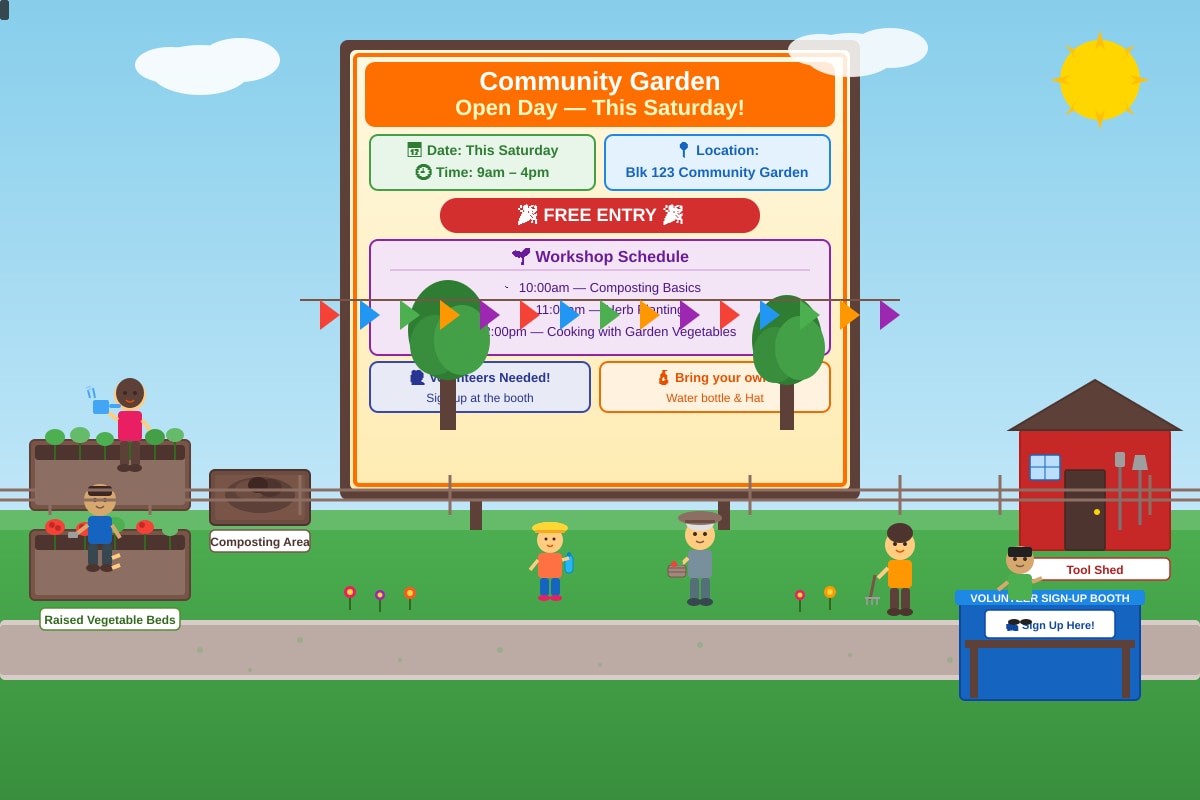
6. Answer: (A) "Hey, there is a Community Garden Open Day this Saturday. Do you want to go?" [1 mark]
Explanation: This is a natural, friendly invitation. It gives the key information (event, day) and asks an open question to invite a response.
- (B) is too commanding ("I command you") — not conversational.
- (C) is a statement, not an invitation — no question to engage the friend.
- (D) is too abrupt and unnatural — lacks politeness and clarity.
7. Answer: (B) "There are free workshops on composting, herb planting, and cooking with garden vegetables, plus you can volunteer." [1 mark]
Explanation: This response accurately uses details from the poster (three specific workshops with topics, free entry, volunteer opportunity). It shows the candidate has read and understood the stimulus.
- (A) is too vague — misses the workshops and volunteering.
- (C) and (D) show poor engagement and lack of detail.
8. Answer: (B) "Community gardens are important because they bring people together, teach us about nature, and provide fresh food. My grandmother grows tomatoes in one and she loves meeting her neighbours there." [1 mark]
Explanation: This response gives three clear reasons (social, educational, practical) and includes a personal example (grandmother). This structure — Opinion + Reasons + Personal Experience — is ideal for PSLE Oral.
- (A) just references the poster, not own thinking.
- (C) is too brief — no reasoning.
- (D) shows no opinion or knowledge.
9. Answer: (B) "Oh, that's a pity. But the event goes on until 4pm, so you could join after your tuition. The cooking workshop is at 2pm!" [1 mark]
Explanation: This shows active listening ("Oh, that's a pity"), problem-solving (suggests a time alternative), and specific knowledge from the poster (event ends 4pm, cooking workshop at 2pm). It keeps the conversation going positively.
- (A) dismisses the friend.
- (C) judges the friend's priorities.
- (D) asks an irrelevant question.
10. Answer: (B) "I would add a 'Seed Swap' corner where gardeners can exchange seeds and share tips, because it encourages sharing and helps people try new plants without buying them." [1 mark]
Explanation: This is creative (Seed Swap), relevant to a garden event, and well-justified (encourages sharing, low-cost way to try new plants). It shows the candidate can think beyond the given stimulus.
- (A) "Lucky draw" is generic — not specific to gardening.
- (C) and (D) lack creativity and reasoning.
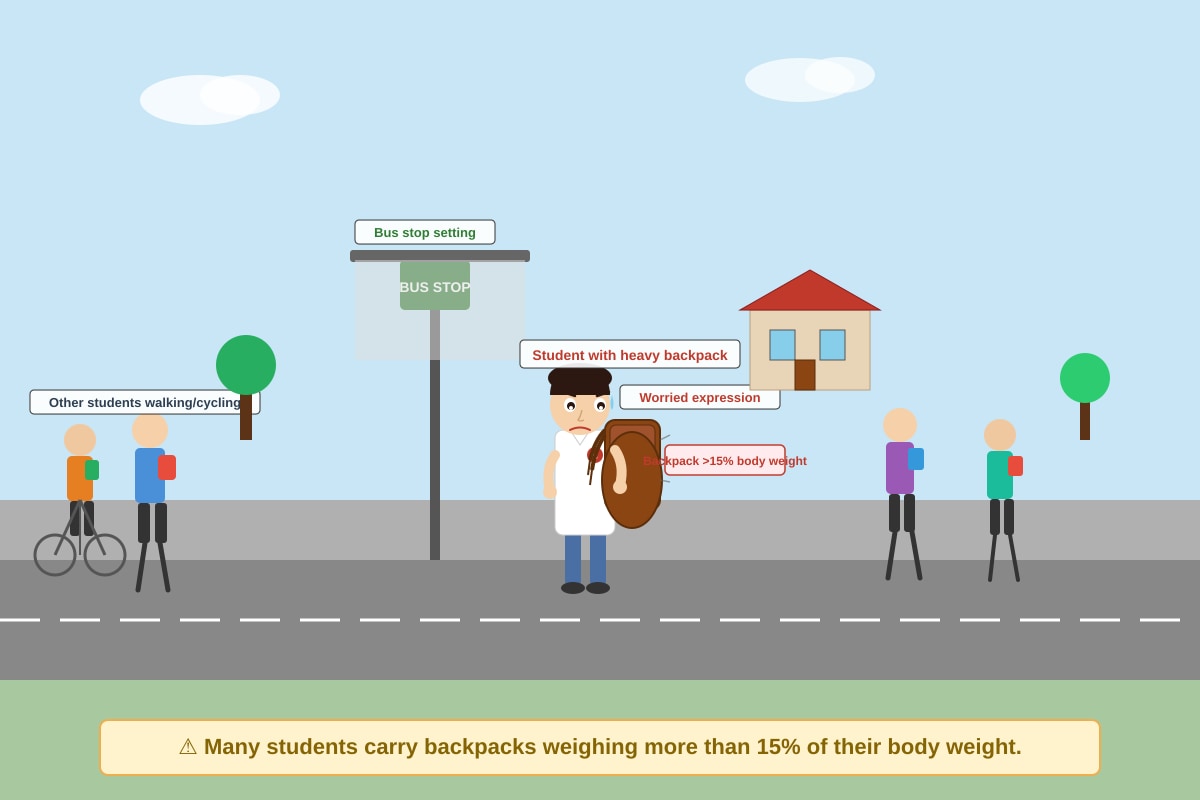
11. Answer: (B) "A primary school student looking worried while carrying a very heavy backpack at a bus stop. Other students are walking or cycling. The caption says many students carry bags over 15% of their body weight." [1 mark]
Explanation: This response describes the main subject (student, expression, backpack), setting (bus stop), other details (other students), and reads the caption. It shows thorough observation.
- (A), (C), (D) are too brief and miss key details.
12. Answer: (B) "He looks worried and strained because his backpack is very heavy. He might be tired or in pain, and perhaps worried about his health or being late." [1 mark]
Explanation: This shows empathy (recognises worry/strain), inference (links heavy bag to tiredness/pain), and speculation (health concerns, punctuality). It goes beyond "tired" to consider multiple feelings.
- (A) gives only one word.
- (C) contradicts the visual evidence.
- (D) avoids the question.
13. Answer: (B) "Heavy bags can cause back pain, poor posture, shoulder strain, and fatigue. Long-term, they might affect spinal development. Students may also struggle to walk far or climb stairs." [1 mark]
Explanation: This gives multiple specific problems (back pain, posture, shoulder strain, fatigue, spinal development, mobility issues) covering immediate and long-term effects. It shows good knowledge and ability to elaborate.
- (A) gives only one point.
- (C) and (D) are not substantive answers.
14. Answer: (B) "Schools can provide lockers, use digital textbooks, coordinate homework across subjects so students don't bring all books daily, and encourage using both backpack straps." [1 mark]
Explanation: This offers four practical, varied solutions: infrastructure (lockers), technology (digital textbooks), policy (homework coordination), and habit (wearing straps correctly). It shows systems thinking.
- (A) is one-sided and not fully practical.
- (C) is dismissive.
- (D) gives up.
15. Answer: (B) "Students should carry their own bags to build responsibility and independence, but parents can help on days when the load is exceptionally heavy, like when bringing project materials. It's about balance." [1 mark]
Explanation: This presents a balanced view with justification for both sides: student responsibility (independence) + parental support (exceptional circumstances). The phrase "It's about balance" shows mature thinking.
- (A) and (C) are extreme positions.
- (D) avoids taking a stance.
Section C: Language Use & Pronunciation (Questions 16-20) [5 marks]
16. Answer: (C) HAPpy [1 mark]
Explanation: Stress patterns:
- (A) reLAX — stress on 2nd syllable
- (B) enJOY — stress on 2nd syllable
- (C) HAPpy — stress on 1st syllable ✓
- (D) deCIDE — stress on 2nd syllable
"Happy" is a two-syllable noun/adjective with first-syllable stress (like "STUdent", "TAble"). The others are verbs with second-syllable stress.
17. Answer: (B) rarely [1 mark]
Explanation: In "She rarely eats fast food", the adverb "rarely" (a negative frequency adverb) carries the focus stress because it conveys the key meaning — the unusualness of the action. The sentence emphasises how often (rarely), not who (she), what action (eats), or what food (fast food).
Teaching note: In English, new or important information typically receives sentence stress. Negative words (rarely, never, seldom) often attract stress.
18. Answer: (A) "Could you please pass the salt?" (rising intonation at the end) [1 mark]
Explanation: Polite requests (especially with "could you", "would you") typically use rising intonation to sound courteous and tentative. Falling intonation (B) sounds like a command or statement. Flat (C) sounds bored or rude. Sharp falling (D) sounds impatient or angry.
19. Answer: (A) thin / this [1 mark]
Explanation: The underlined "th" represents two different sounds:
- thin → /θ/ (voiceless dental fricative)
- this → /ð/ (voiced dental fricative)
The other pairs: - (B) cat / kite — both /k/ (same sound, different spelling)
- (C) pen / ben — /p/ vs /b/ (different initial consonants, not the same letter)
- (D) sit / zip — /s/ vs /z/ (different initial consonants)
Only (A) has the same spelling "th" but different pronunciation.
20. Answer: (B) Change your voice (pitch, tone, pace) for each character [1 mark]
Explanation: When reading dialogue aloud, vocal variety (pitch, tone, pace, volume) helps the listener distinguish characters and understand their emotions. This is a key skill assessed in PSLE Reading Aloud.
- (A) Reading fast makes it harder to follow.
- (C) Whispering loses clarity and expression.
- (D) Skipping dialogue tags ("said John", "asked Mary") removes important context about who is speaking.
Marking Summary:
- Section A: 5 marks (Q1-5, 1 mark each)
- Section B: 10 marks (Q6-15, 1 mark each)
- Section C: 5 marks (Q16-20, 1 mark each)
- Total: 20 marks
Grading Guide:
- 18-20: Excellent — Ready for PSLE Oral
- 15-17: Good — Minor areas to refine
- 12-14: Satisfactory — Needs practice on elaboration/pronunciation
- Below 12: Needs improvement — Focus on conversation structure and reading fluency