From Real Exams Quiz
Primary 6 PSLE English Oral Quiz
Free P6 PSLE English Oral quiz, Kimi2.6 Exam version, with questions, answers, and PSLE-focused practice for Singapore students.
These static practice materials are generated from the site's syllabus and paper-generation workflow, with source and model context shown so students and parents can evaluate the material before use.
Questions
Free quiz and exam paper access
Enter your details to view this paper
Your access is remembered on this device.
Answers
Primary 6 PSLE English Quiz - Oral: Answer Key
Total Marks: 20
Section A: Reading Aloud Preparation
1. [1 mark]
Answer: "precious" (accept: "most precious," "world's," or "Southeast Asia" with valid explanation)
Teaching note: In reading aloud, stress falls on words that carry the main meaning or emotional weight. "Precious" is an evaluative adjective that conveys the rainforest's value, so stressing it establishes the passage's appreciative tone from the opening. Alternatively, "world's" could be stressed to emphasise global significance, or "most" to highlight the superlative degree. The key is choosing a content word (not a function word like "is" or "the") that carries semantic weight.
Common mistake: Students may stress "the" or "a" — these are function words and should generally be unstressed in fluent reading.
2. [1 mark]
Answer: "hidden" (silent 'd') and "beneath" (consonant cluster /nθ/ at the end, or tricky /ð/ sound)
Teaching note: "Hidden" contains a silent consonant 'd' — the word is pronounced /ˈhɪdn/ with the 'd' barely audible or completely silent in rapid speech. "Beneath" ends with the difficult dental cluster /nθ/, requiring the tongue to move quickly from alveolar /n/ to dental /θ/. The silent letter in "hidden" is the more straightforward answer for P6 level; "beneath" tests awareness of consonant clusters.
3. [1 mark]
Answer: After "years" marks the end of a dependent clause ("that have remained largely unchanged for millions of years") that modifies "conditions." The pause allows listeners to process this descriptive detail before hearing the main action of the sentence ("Yet this remarkable habitat faces...").
Teaching note: In oral reading, pauses typically occur at grammatical boundaries: between clauses, after introductory phrases, and before contrasting conjunctions. Here, "yet" signals a contrast (old stability vs. new threat), so the preceding clause needs closure. This is an end-weighted structure where the long post-modification demands breath and processing time.
4. [1 mark]
Answer: Voice should rise or increase in intensity ("unprecedented" higher pitch, "threats" falling or level with tension); the phrase signals danger and requires emotional colouring to engage listeners.
Teaching note: The combination of negative evaluation ("unprecedented" = never before seen, alarming) and negative noun ("threats") typically triggers warning intonation. A falling contour on "threats" creates gravitas; a slight rise on "unprecedented" draws attention to the severity. Monotone reading would flatten the semantic urgency.
Common mistake: Falling on "unprecedented" would wrongly suggest closure rather than building tension toward "threats."
5. [1 mark]
Answer: Conservationists warn / that without immediate intervention, / we may lose irreplaceable biodiversity within our own lifetimes.
(Any two slashes correctly placed at clause boundaries. Alternative: after "warn" and after "intervention.")
Teaching note: The main clause is "Conservationists warn [that-clause]." Within the that-clause, we have a conditional "without immediate intervention" (prepositional phrase functioning as reduced conditional) and the main result "we may lose..." Pausing after the reporting verb ("warn") separates attribution from content; pausing after the condition separates hypothesis from consequence. This chunking aids listener comprehension of complex syntax.
6. [1 mark]
Answer: "true" and "value" (or "understands" and "value"); any content words read more softly to create intimacy or reflection.
Teaching note: The final sentence shifts from external action to internal realisation ("who understands"). Softer volume on "true value" creates a confidential, meaningful tone that invites personal reflection. This is a common technique in oral reading: diminish volume for abstract, evaluative conclusions after presenting concrete facts more energetically.
7. [1 mark]
Answer: ir-RE-place-a-ble or ir-re-PLACE-a-ble (accept either stress pattern with correct syllable division); four dashes showing five syllables required.
Teaching note: Primary stress typically falls on "RE" (second syllable) in educated Singapore English: /ˌɪrɪˈpleɪsəbl/. Some speakers may stress "PLACE" — this is non-standard but intelligible. For P6, either pattern is accepted if consistent. The prefix "ir-" is unstressed; "-able" is always unstressed in this word class.
8. [1 mark]
Answer: Any one valid technique: vary pitch (avoid mid-level monotone), vary pace (slow down for emphasis, speed up for action), adjust volume (louder for important points, softer for reflection), use meaningful pauses, or convey emotion appropriate to content.
Teaching note: PSAffective oral reading requires prosodic variation. Primary students often default to "teacher voice" — flat, loud, fast. Explicit awareness of vocal variety (pitch, pace, pause, power, pronunciation precision) helps break this habit. The rainforest passage offers natural opportunities: faster for "thousands of species thrive" (energy), slower for "irreplaceable biodiversity" (weight).
Section B: Stimulus-Based Conversation Preparation
9. [2 marks]
Answer: (Any two from)
- Planting vegetables (reduces carbon footprint from food transport, organic growing)
- Using/watering plants in community garden (maintaining green space)
- Sorting waste into recycling bins (proper waste disposal)
- Participating in intergenerational knowledge sharing (spreading environmental awareness)
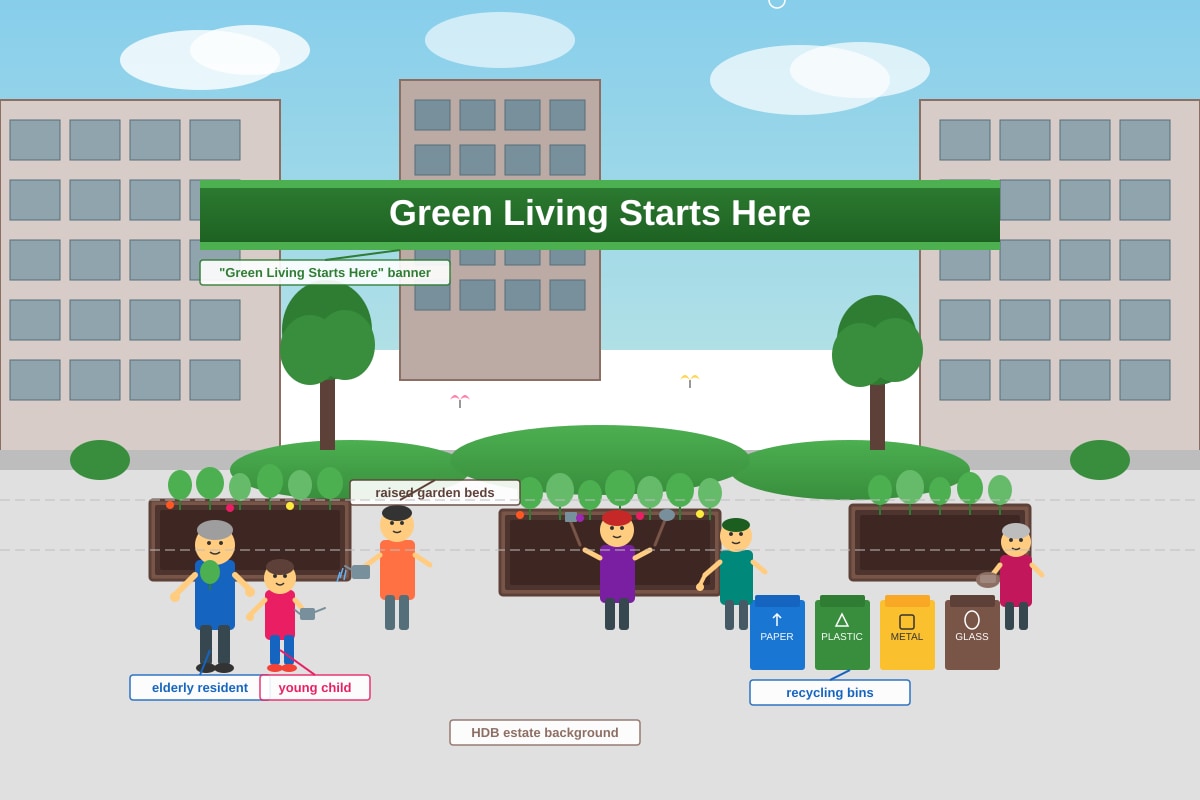
Teaching note: [1 mark each] The stimulus explicitly shows gardening and recycling. For full marks, answers must connect the visible action to environmental care — simply "planting" without environmental purpose is incomplete. The mark scheme rewards observation (what) plus environmental interpretation (why it matters).
10. [1 mark]
Answer: HDB estates have higher population density / more residents who can participate / government community facilities are typically built in public housing / greater need for communal spaces in high-rise living / accessibility for elderly without private transport.
Teaching note: This tests inference about Singapore's built environment. The correct reasoning recognises that HDB estates (housing ~80% of population) are designed with community infrastructure, and that community bonding is an explicit policy goal. Private estates have gardens already; HDB residents lack private green space, making communal solutions necessary.
11. [2 marks]
Answer: "Starts" implies: [1] this location is a beginning point / entry into environmental awareness; [1] green living is a journey that begins with small, local actions and can expand; OR "Starts" suggests personal agency — the individual begins here, taking first steps; OR creates urgency — don't wait, start now.
Teaching note: Word-level analysis of persuasive language. "Starts" functions as a dynamic verb suggesting initiation, accessibility, and forward momentum. It democratises environmentalism (anyone can begin) and lowers barriers (no expertise needed). Contrast with "continues" or "happens" — these lack the same invitation to action.
12. [2 marks]
Answer: (Any two, with development)
- Understanding plant life cycles and biology through direct experience
- Learning respect for nature and where food comes from
- Developing patience and responsibility through regular care
- Interacting with elderly mentors, learning traditional knowledge
- Understanding sustainability and reducing waste
[1 mark each] Must specify what is learned and how the garden enables it.
Teaching note: This connects concrete experience to abstract learning. PSLE oral rewards specific, personal responses over generic answers. "They learn about nature" is too vague; "they observe how seeds germinate and connect this to science topics" demonstrates tangible learning.
13. [2 marks]
Answer: Any two appropriate persuasive sentences, e.g.:
- "Our community garden is so much fun — we grow our own vegetables and the aunties and uncles teach us things you can't learn from books!"
- "If you start a garden in your estate, you'll make new friends and get to eat food you grew yourself."
Teaching note: [1 mark each for appropriate register and content] The voice must be child-appropriate (enthusiastic, simple vocabulary, direct address) while including specific benefits (social, educational, practical). Examiners assess: Does the response sound natural? Does it include personal experience? Is there a clear invitation or encouragement?
14. [2 marks]
Challenge: [1] Any valid challenge: volunteer fatigue / lack of ongoing funding / vandalism or theft of plants / inconsistent participation / pest problems / weather damage / lack of gardening expertise.
Solution: [1] Matching, feasible solution: rotation system for volunteers; apply for CDC or grassroots funding; install simple fencing or CCTV; scheduled gardening days with community leader reminders; organic pest controls; raised beds with protective covering; invite NParks workshops.
Teaching note: The solution must realistically address the stated challenge. Weak responses propose solutions mismatched to problems (e.g., funding for vandalism). Best responses show awareness of Singapore's community structures: RCs, CCs, grassroots organisations, government agency support.
15. [2 marks]
Answer: (Any two developed points)
- [1] Intergenerational bonding: elderly transfer knowledge (gardening skills, life experience) while children provide companionship and energy; reduces social isolation for seniors
- [1] Community cohesion: shared activity builds neighbourly relationships across age groups; creates collective ownership of public space
- [1] Skill transmission: traditional/organic gardening methods preserved; practical life skills learned outside classroom
- [1] Mutual benefit: elderly gain purpose and activity; children gain mentors and supervised outdoor time
Teaching note: "How does X benefit Y?" requires explicit beneficiary identification and mechanism explanation. Simply stating "they learn from each other" is insufficient — specify who learns what, and how this strengthens community fabric.
16. [1 mark]
Answer: The proximity reinforces the connection between growing food (garden) and responsible waste disposal (recycling) — both are aspects of sustainable living; OR visible recycling bins serve as constant reminder of environmental habits during gardening; OR convenient location encourages habitual use.
Teaching note: Spatial design communicates meaning. Placing recycling near the garden creates thematic coherence: waste→compost→growth cycle. This tests whether students can interpret environmental messaging through physical layout, not just explicit text.
Section C: Oral Response Techniques
17. [2 marks]
Points for preferred choice: [1] Any two developed points, e.g., food bank → immediate hunger relief, measurable impact, structured volunteer roles; OR community garden → long-term sustainability, physical outdoor health benefits, skill acquisition.
Point for other option: [1] Acknowledge one valid merit of unchosen option, e.g., "However, food banks address urgent needs that gardens cannot meet" or "Gardens take longer to show results than food distribution."
Teaching note: Balanced responses demonstrate critical thinking — not blind advocacy. The examiner assesses: Can the student see multiple perspectives? Do they evaluate rather than merely choose? The "other option" point is crucial; students who dismiss alternatives entirely lose marks for lack of nuance.
18. [2 marks]
Answer: (Any two specific Singapore examples)
- Chek Jawa wetlands and intertidal conservation on Pulau Ubin
- Bukit Timah Nature Reserve (primary rainforest within city)
- Mandai Wildlife Reserve and rewilding efforts
- Singapore Botanic Gardens (UNESCO World Heritage Site)
- Sungei Buloh Wetland Reserve (migratory bird conservation)
- Park Connector Network and Nature Park Network
- Pulau Semakau (landfill designed as eco-friendly ecosystem)
- Tree planting and "City in a Garden" initiatives
[1 mark each] Must be specific Singapore location/examples.
Teaching note: Generic "we have parks" earns no marks. PSLE rewards place-based knowledge. Each example demonstrates that meaningful conservation occurs in small, highly managed spaces through intensive human intervention — precisely the Singapore model that disproves "too small."
19. [2 marks]
Answer: (Any two)
- [1] Relate to personal experience: "I haven't thought about this before, but it reminds me of when I..."
- [1] Explore hypothetically: "If I were in that situation, I might..."
- [1] Ask clarifying question then respond: "Do you mean...? In that case, I think..."
- [1] Agree to think aloud: "I'm not certain, but one possibility could be..."
- [1] Connect to something you do know: "This seems similar to... which makes me think..."
Teaching note: Oral examiners value curiosity and intellectual honesty over bluffing. These strategies show metacognitive awareness — students who can navigate uncertainty maturely. The key is maintaining engagement: silence or "don't know" ends the interaction; these techniques extend it productively.
20. [2 marks]
Sample PEEL response:
| Component | Content |
|---|---|
| Point | Schools should integrate environmental projects into daily routines rather than treating them as special events. |
| Evidence/Example | For instance, daily rostered composting duties for each class, or a term-long challenge to reduce plastic waste measured weekly. |
| Explanation | Regular participation builds habits more effectively than one-off campaigns because students experience accountability and see cumulative results. |
| Link | Therefore, embedding environmental care into school structures ensures lasting student commitment beyond brief enthusiasm. |
[1 mark for complete PEEL structure with all four components; 1 mark for content quality and specificity]
Teaching note: PEEL provides response architecture. Examiner prompts often require "how" answers — methods, mechanisms, processes. PEEL prevents the common P6 error of listing ideas without development. The Link is frequently omitted; it must explicitly connect back to the question ("how can schools encourage" → "therefore, this encourages...").
Common mistake: Providing four separate ideas without the PEEL progression; or having Evidence without specific example ("for example, doing things").
END OF ANSWER KEY