From Real Exams Quiz
Primary 6 PSLE English Oral Quiz
Free P6 PSLE English Oral quiz, Exam version, with questions, answers, and PSLE-focused practice for Singapore students.
These static practice materials are generated from the site's syllabus and paper-generation workflow, with source and model context shown so students and parents can evaluate the material before use.
Questions
Free quiz and exam paper access
Enter your details to view this paper
Your access is remembered on this device.
Answers
Primary 6 PSLE English Quiz - Oral: Answer Key
Name: _________________________ Class: _________________________ Date: _________________________
Section A: Reading Aloud (5 marks)
1. Read the passage aloud. (5 marks)
Marking Notes:
- Pronunciation (1 mark): All words pronounced clearly and correctly. Pay attention to words like "winding" (as in winding stairs - /ˈwaɪndɪŋ/), "churning" (/ˈtʃɜːnɪŋ/), and "beacon" (/ˈbiːkən/).
- Fluency (2 marks): Reads smoothly without unnecessary pauses or hesitations. Groups words into meaningful phrases. Does not read word-by-word.
- Expression (2 marks): Uses appropriate tone and pace to convey the mood of the passage. The passage is nostalgic and slightly sad, so the reader should sound reflective. Pauses at commas and full stops. Varies pitch to keep the listener engaged.
Teaching Notes:
- Before reading aloud, scan the passage for difficult words and practice pronouncing them.
- Pay attention to punctuation. A comma means a short pause; a full stop means a longer pause.
- Think about the mood of the passage. This passage is about an old lighthouse keeper saying goodbye, so it should be read with a gentle, reflective tone.
Common Mistakes:
- Reading too quickly, which causes words to be slurred.
- Not pausing at punctuation marks.
- Using a flat, monotone voice.
Section B: Stimulus-Based Conversation (5 marks)
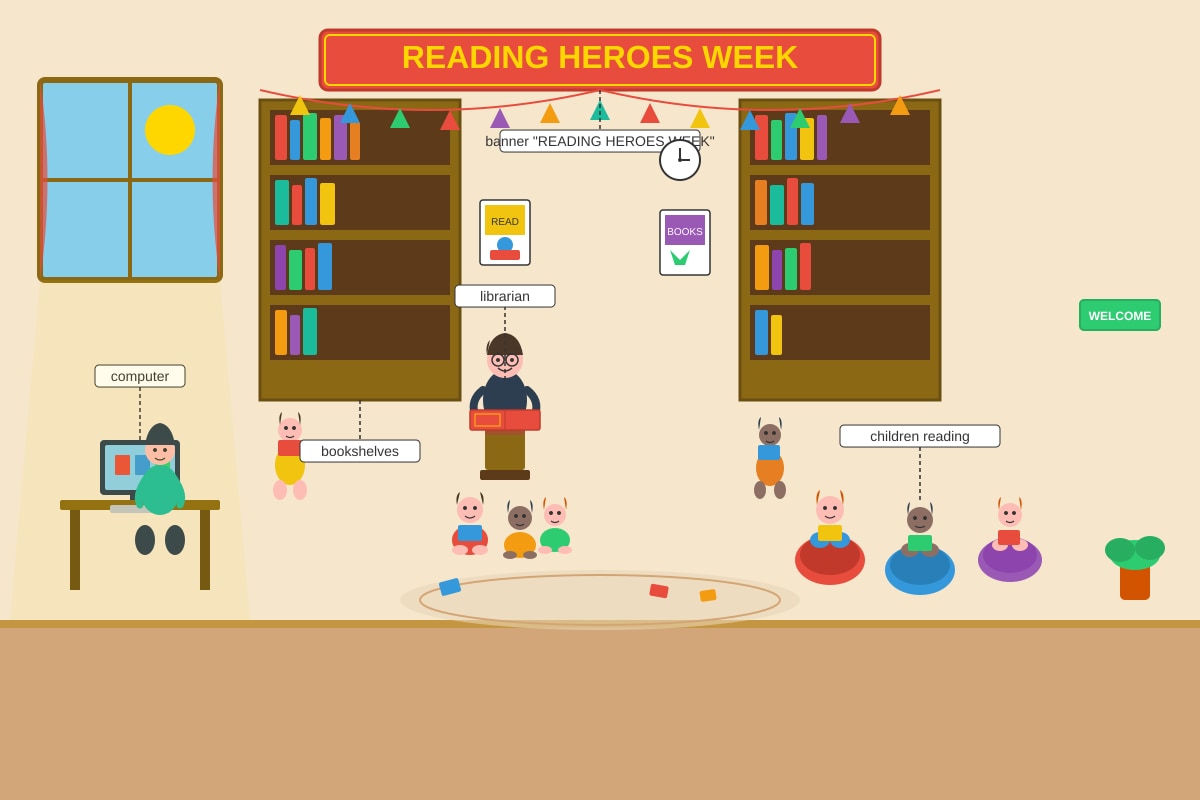
2. Look at the picture. What do you think the children are enjoying about the "Reading Heroes Week" at the library? (2 marks)
Answer: Children are likely enjoying the variety of activities available. They can read books on comfortable bean bags, listen to a librarian tell a story, and even use computers. The special "Reading Heroes Week" makes reading feel like a fun and special event, not just a school task.
Marking Notes:
- 1 mark: Gives a simple, relevant answer (e.g., "They like reading books.").
- 2 marks: Gives a developed answer that refers to specific details in the picture and explains why they are enjoyable (e.g., mentions the bean bags, the story-telling, the computer, and the festive banner).
Teaching Notes:
- When answering questions about a picture, always refer to specific details you can see.
- Use phrases like "I can see..." and "This suggests that..." to structure your response.
- Explain why the details are important. For example, "The colourful bean bags make the library look comfortable and inviting, so children would enjoy sitting there to read."
3. Do you think libraries are still important today when we can find information on the internet? Why or why not? (3 marks)
Answer: Yes, I think libraries are still very important. While the internet is great for finding quick information, libraries offer a quiet and focused space for reading and studying. They also have librarians who can help you find reliable books and resources. Furthermore, libraries provide free access to books and computers for people who may not have them at home, and they host community events like the "Reading Heroes Week" that bring people together.
Marking Notes:
- 1 mark: Gives a simple opinion (e.g., "Yes, they are important.").
- 2 marks: Gives an opinion with one clear reason (e.g., "Yes, because they have many books.").
- 3 marks: Gives a clear opinion with multiple, well-explained reasons. The answer should show an ability to consider different perspectives (e.g., access for everyone, quiet space, community events, expert help).
Teaching Notes:
- Always state your opinion clearly at the start.
- Give at least two or three reasons to support your opinion.
- Use linking words like "Firstly," "In addition," and "For example" to make your response organised.
Common Mistakes:
- Only saying "Yes" or "No" without any explanation.
- Giving only one reason and not developing it.
Section C: Conversation (10 marks)
4. Tell me about a time when you helped someone at school or at home. What did you do, and how did it make you feel? (3 marks)
Answer: (Example response) Last month, my friend Ravi was struggling with his maths homework. He didn't understand how to solve fraction problems. I explained the steps to him slowly and showed him a few examples on paper. After a while, he understood and could do the problems by himself. I felt very happy and proud because I could use what I knew to help a friend. It also made me realise that teaching something is a great way to understand it better myself.
Marking Notes:
- 1 mark: Briefly describes a time they helped someone (e.g., "I helped my friend with his homework.").
- 2 marks: Describes the situation and what they did in some detail.
- 3 marks: Gives a full, detailed account of the situation, their actions, and a thoughtful reflection on their feelings. The response should be fluent and easy to follow.
Teaching Notes:
- Use the STAR method to structure your answer:
- Situation: Set the scene (When and where? Who was involved?).
- Task: What needed to be done?
- Action: What did you specifically do?
- Result: What was the outcome? How did you feel?
- This structure helps you give a complete and organised answer.
5. Some people say that children today spend too much time on their electronic devices. Do you agree? Explain your opinion. (3 marks)
Answer: (Example response) I partly agree with this statement. I think many children do spend a lot of time on their devices, sometimes playing games or watching videos for hours. This can be unhealthy because they might not get enough exercise or sleep. However, I also think devices can be useful for learning. For example, I use my tablet to watch educational videos and to do research for my school projects. So, I believe the problem is not the devices themselves, but how we use them. It is important to have a balance.
Marking Notes:
- 1 mark: States a simple opinion (e.g., "Yes, I agree.").
- 2 marks: Gives an opinion with a reason and a simple example.
- 3 marks: Gives a balanced and nuanced opinion, considering both sides of the argument. The response should be well-organised and use examples to support the points made.
Teaching Notes:
- It is okay to have a nuanced opinion. You don't have to completely agree or disagree.
- Use phrases like "I partly agree..." or "On one hand... but on the other hand..." to show you can see different perspectives.
- Always support your points with examples from your own life or things you have observed.
6. Imagine your school is planning a "No Gadget Day" where everyone must leave their phones and tablets at home. What activities would you suggest for the day, and why? (4 marks)
Answer: (Example response) I would suggest a few different activities. Firstly, we could have a sports carnival with games like captain's ball and relay races. This would get everyone moving and working as a team, which is more fun than playing games on a screen. Secondly, we could organise a board game marathon in the hall, where students can play games like Monopoly or Scrabble. This encourages face-to-face interaction and friendly competition. Finally, I would suggest a "talent showcase" where students can perform magic tricks, sing, or dance. This would allow us to discover hidden talents in our friends and appreciate each other in a new way. These activities are good because they help us connect with each other and have fun without needing any technology.
Marking Notes:
- 1 mark: Suggests one simple activity (e.g., "We could play sports.").
- 2 marks: Suggests one or two activities with a brief reason for each.
- 3 marks: Suggests two or more activities with clear reasons, showing an understanding of the purpose of the day (e.g., to promote interaction, physical activity, and creativity).
- 4 marks: Gives a detailed and thoughtful response with multiple activities and well-explained reasons. The response should be well-organised and easy to follow.
Teaching Notes:
- Brainstorm a few different ideas before you start writing.
- For each activity, explain why it is a good choice for a "No Gadget Day".
- Use linking words like "Firstly," "Secondly," and "Finally" to structure your answer.
Section D: Reading Aloud - Poetry (5 marks)
7. Read the poem aloud. (5 marks)
Marking Notes:
- Pronunciation (1 mark): All words pronounced clearly and correctly.
- Fluency (2 marks): Reads smoothly with a natural rhythm. Does not pause awkwardly between lines. The poem has a gentle, flowing rhythm that should be maintained.
- Expression (2 marks): Uses appropriate tone and pace to convey the calm, peaceful mood of the poem. The reader should sound relaxed and reflective. Pauses slightly at the end of each line to let the imagery sink in.
Teaching Notes:
- Poems often have a rhythm. Practice reading the poem aloud to find its natural beat.
- Pay attention to the mood. This poem describes a peaceful evening, so read it slowly and gently.
- Use your voice to paint a picture. For example, when reading "The sun dips low," let your voice dip slightly.
Common Mistakes:
- Reading the poem too quickly, which ruins its rhythm.
- Pausing in the middle of a line instead of at the end.
- Using a flat, unexpressive voice.
Section E: Stimulus-Based Conversation - Poster (5 marks)
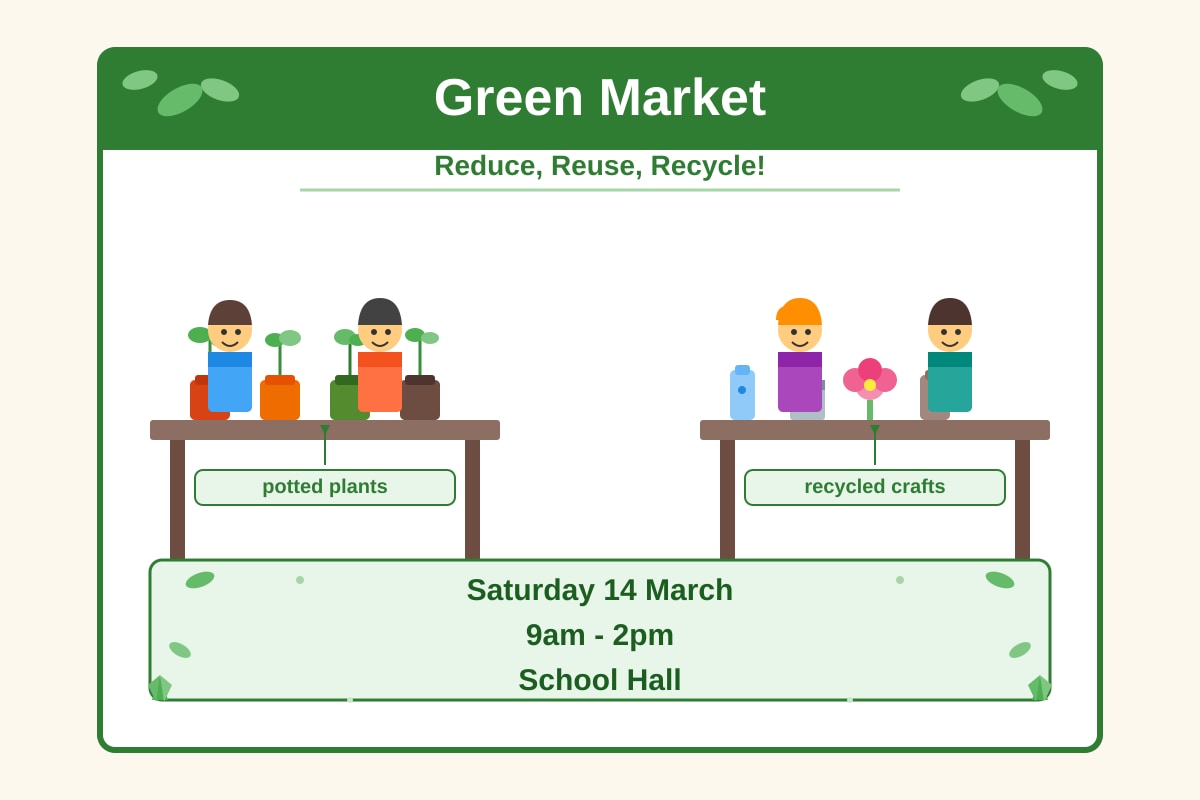
8. Look at the poster. What is the main purpose of the "Green Market" event? (2 marks)
Answer: The main purpose of the "Green Market" event is to promote environmental awareness and encourage people to reduce, reuse, and recycle. The poster shows students selling potted plants and handmade recycled crafts, which suggests the event aims to teach people about sustainability in a fun and practical way.
Marking Notes:
- 1 mark: Gives a simple, relevant answer (e.g., "To sell plants and crafts.").
- 2 marks: Gives a developed answer that explains the deeper purpose (e.g., to promote recycling and environmental awareness) and refers to specific details from the poster (e.g., the tagline "Reduce, Reuse, Recycle!").
Teaching Notes:
- Look at the text on the poster for clues about its purpose.
- Think about what the event is trying to achieve, not just what it is doing.
- Use phrases like "The main purpose is..." and "This is shown by..."
9. Would you like to participate in this event? Why or why not? (3 marks)
Answer: (Example response) Yes, I would like to participate in this event. Firstly, I enjoy making things with my hands, so I would love to create recycled crafts to sell. It would be a fun challenge to turn old materials into something useful and beautiful. Secondly, I think it is important to help the environment, and this event is a great way to spread the message about reducing waste. Finally, it would be exciting to work with my friends to set up a stall and interact with visitors. It sounds like a meaningful and enjoyable day.
Marking Notes:
- 1 mark: States a simple opinion (e.g., "Yes, I would like to participate.").
- 2 marks: Gives an opinion with one clear reason.
- 3 marks: Gives a clear opinion with multiple, well-explained reasons. The response should show personal reflection and an understanding of the event's purpose.
Teaching Notes:
- State your opinion clearly at the start.
- Give at least two or three reasons to support your opinion.
- Use linking words like "Firstly," "In addition," and "Finally" to make your response organised.
Section F: Conversation (5 marks)
10. What is your favourite subject in school? Why do you enjoy it? (2 marks)
Answer: (Example response) My favourite subject is Science. I enjoy it because I love learning about how the world works, like why plants grow and how the human body functions. The experiments are always exciting, and I like discovering new things through hands-on activities.
Marking Notes:
- 1 mark: States a favourite subject with a simple reason (e.g., "I like Maths because it is fun.").
- 2 marks: States a favourite subject with a detailed and personal reason, showing genuine interest or enjoyment.
Teaching Notes:
- Be specific about why you enjoy the subject. Instead of just saying "it's fun," explain what makes it fun for you.
- Use examples from your lessons or experiences to support your answer.
11. Describe a time when you worked with a group to complete a project. What did you learn from the experience? (3 marks)
Answer: (Example response) Last term, my group and I worked on a project about endangered animals. We had to research different animals and create a presentation. I learned that teamwork is very important. At first, we disagreed on which animals to include, but we learned to listen to each other and compromise. I also learned that everyone has different strengths. One friend was good at drawing, so she made the posters, while another friend was good at speaking, so he presented. I learned that by working together, we can create something much better than we could alone.
Marking Notes:
- 1 mark: Briefly describes a group project experience.
- 2 marks: Describes the experience with some detail and mentions one thing they learned.
- 3 marks: Gives a full, detailed account of the experience and reflects thoughtfully on multiple lessons learned (e.g., teamwork, compromise, appreciating different strengths).
Teaching Notes:
- Use the STAR method to structure your answer.
- Focus on what you learned from the experience, not just what happened.
- Think about challenges you faced and how you overcame them.
Section G: Reading Aloud - Prose (5 marks)
12. Read the passage aloud. (5 marks)
Marking Notes:
- Pronunciation (1 mark): All words pronounced clearly and correctly. Pay attention to words like "vendor" (/ˈvendɔː/), "mangoes" (/ˈmæŋɡoʊz/), and "gathered" (/ˈɡæðəd/).
- Fluency (2 marks): Reads smoothly without unnecessary pauses. Groups words into meaningful phrases to create a vivid picture of the market scene.
- Expression (2 marks): Uses appropriate tone and pace to convey the lively, cheerful mood of the passage. The reader should sound engaged and excited. Varies pitch to reflect the different elements described (e.g., the vendor calling out, the musician playing).
Teaching Notes:
- This passage describes a busy, happy scene. Read it with energy and enthusiasm.
- Pay attention to descriptive words like "alive," "bright," "cheerful," and "belong." Use your voice to emphasise these words.
- Imagine you are describing the scene to someone who has never seen it.
Common Mistakes:
- Reading in a monotone voice, which makes the passage sound boring.
- Not pausing at commas and full stops.
- Rushing through the description without letting the listener picture the scene.
Section H: Stimulus-Based Conversation - Photograph (5 marks)
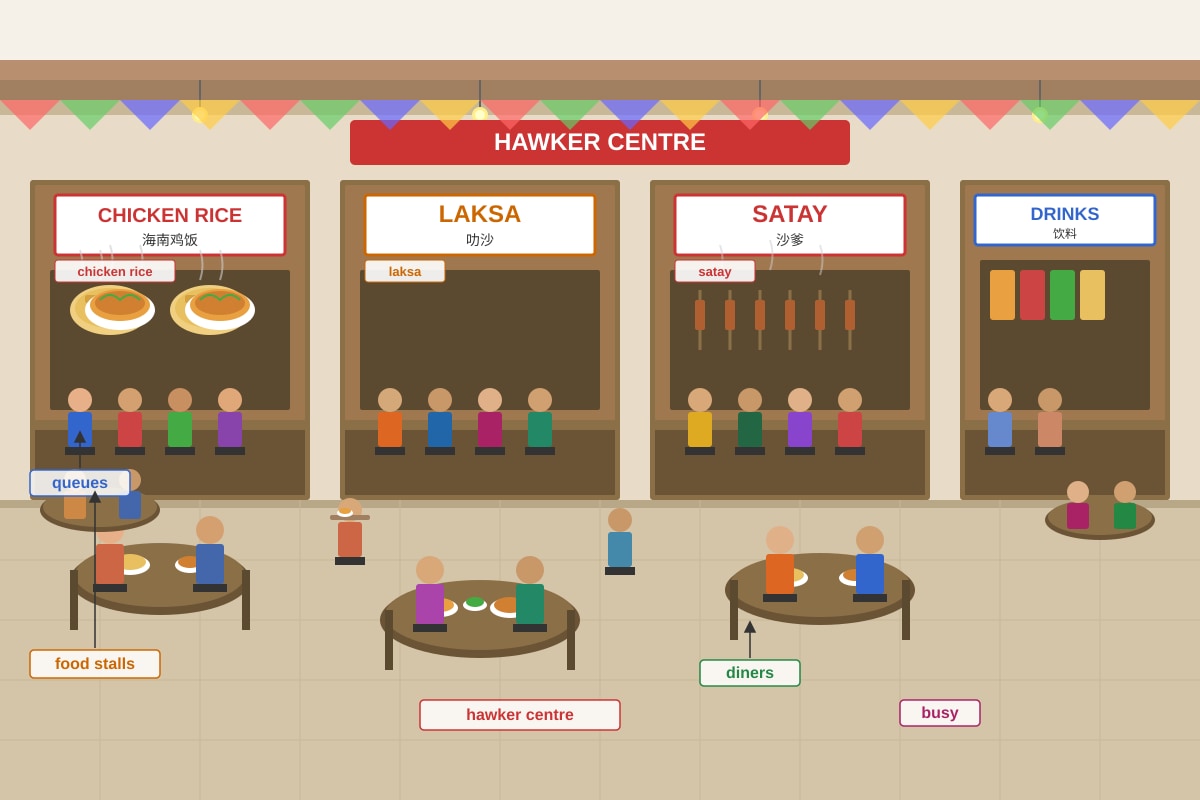
13. Look at the photograph. Why do you think so many people are eating at the hawker centre? (2 marks)
Answer: Many people are eating at the hawker centre because it offers a wide variety of affordable and delicious local food. The photograph shows stalls selling popular dishes like chicken rice, laksa, and satay, which are favourites among Singaporeans. The lively atmosphere also makes it a nice place to eat with family and friends.
Marking Notes:
- 1 mark: Gives a simple, relevant answer (e.g., "Because the food is good.").
- 2 marks: Gives a developed answer that refers to specific details in the photograph (e.g., the variety of food stalls, the busy atmosphere) and explains why these factors attract people.
Teaching Notes:
- Look at the details in the photograph for clues.
- Think about what makes hawker centres popular in Singapore (e.g., affordable, delicious, convenient, social).
- Use phrases like "I can see..." and "This suggests that..." to structure your response.
14. Do you think hawker centres are an important part of Singapore's culture? Explain your answer. (3 marks)
Answer: Yes, I think hawker centres are a very important part of Singapore's culture. They are where people from all walks of life come together to enjoy affordable food. Hawker centres also preserve our local heritage by selling traditional dishes like laksa and satay that have been passed down through generations. Furthermore, they are social hubs where families and friends gather, and where we can experience the unique "kopitiam" culture. Without hawker centres, we would lose a big part of what makes Singapore special.
Marking Notes:
- 1 mark: Gives a simple opinion (e.g., "Yes, they are important.").
- 2 marks: Gives an opinion with one clear reason (e.g., "Yes, because they have traditional food.").
- 3 marks: Gives a clear opinion with multiple, well-explained reasons. The answer should show an understanding of the cultural and social significance of hawker centres.
Teaching Notes:
- Think about what "culture" means. It includes food, traditions, and social habits.
- Give examples to support your points. For example, mention specific dishes or describe a typical scene at a hawker centre.
- Use linking words like "Firstly," "In addition," and "For example" to make your response organised.
Section I: Conversation (5 marks)
15. What is one thing you would like to change about your school? Why? (2 marks)
Answer: (Example response) One thing I would like to change about my school is to have more outdoor play areas. I think it would be great to have a larger field or more playground equipment so that we can have more fun during recess and after school. It would also encourage us to be more active and spend less time sitting in the classroom.
Marking Notes:
- 1 mark: States one thing they would like to change with a simple reason.
- 2 marks: States one thing they would like to change with a detailed and personal reason, showing thoughtful consideration.
Teaching Notes:
- Be realistic and constructive. Suggest a change that would benefit students.
- Explain why this change is important to you and your classmates.
- Use phrases like "I would change..." and "This would help because..."
16. Do you think it is important for children to learn how to cook? Why or why not? (3 marks)
Answer: Yes, I think it is very important for children to learn how to cook. Firstly, cooking is a life skill that will help us take care of ourselves when we are older. Instead of relying on instant food or takeaways, we can prepare healthy meals for ourselves. Secondly, cooking can be a fun and creative activity. It allows us to experiment with different ingredients and flavours. Finally, learning to cook can help us appreciate the effort that goes into preparing food and encourage us to waste less. It is a skill that will benefit us for our whole lives.
Marking Notes:
- 1 mark: States a simple opinion (e.g., "Yes, it is important.").
- 2 marks: Gives an opinion with one clear reason.
- 3 marks: Gives a clear opinion with multiple, well-explained reasons. The answer should show an understanding of the practical and personal benefits of learning to cook.
Teaching Notes:
- Think about the benefits of cooking beyond just making food (e.g., independence, creativity, health, appreciation).
- Use examples from your own experience if you have helped cook at home.
- Use linking words like "Firstly," "In addition," and "Finally" to structure your response.
Section J: Reading Aloud - Dialogue (5 marks)
17. Read the dialogue aloud. (5 marks)
Marking Notes:
- Pronunciation (1 mark): All words pronounced clearly and correctly.
- Fluency (2 marks): Reads smoothly, switching naturally between the two characters' voices. The dialogue should flow like a real conversation.
- Expression (2 marks): Uses different tones for each character to show their personalities. Mei sounds confident and friendly; Ali sounds slightly nervous but determined. The reader should convey the excitement of the race and the sportsmanship in their handshake.
Teaching Notes:
- When reading dialogue, imagine you are the characters. How would they sound?
- Change your voice slightly for each character to make the conversation come alive.
- Pay attention to the punctuation. Question marks and exclamation marks give clues about how to say the lines.
Common Mistakes:
- Reading both characters' lines in the same flat voice.
- Not pausing between the characters' lines, which makes the dialogue confusing.
- Rushing through the dialogue without conveying the emotion.
Section K: Stimulus-Based Conversation - Advertisement (5 marks)
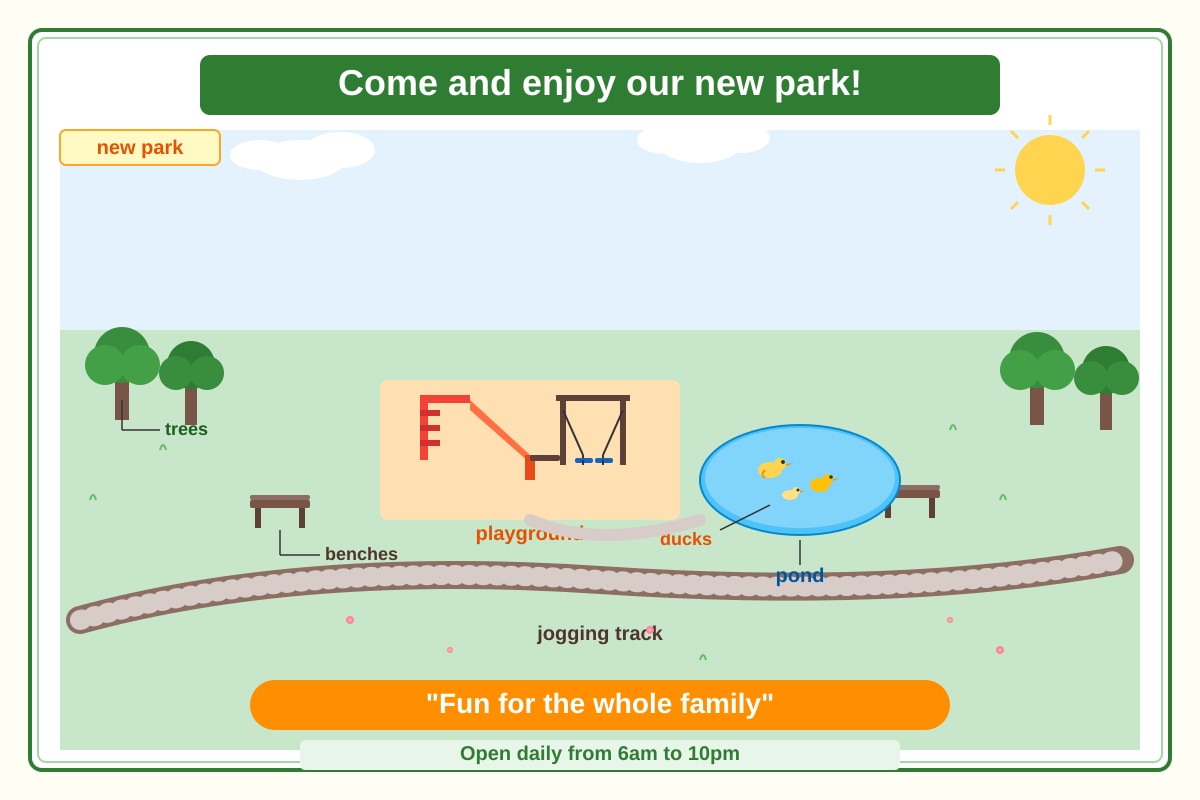
18. Look at the advertisement. What facilities does the new park offer? (2 marks)
Answer: The new park offers several facilities. It has a large playground with slides and swings, a jogging track for runners, a pond with ducks, and many trees and benches for people to sit and relax.
Marking Notes:
- 1 mark: Mentions one or two facilities from the advertisement.
- 2 marks: Mentions at least three facilities from the advertisement accurately.
Teaching Notes:
- Look carefully at the advertisement and list all the facilities you can see.
- Use phrases like "The park has..." or "It offers..." to list the facilities.
- Be specific. Instead of just saying "a playground," say "a large playground with slides and swings."
19. Which facility would you be most excited to use? Why? (3 marks)
Answer: (Example response) I would be most excited to use the jogging track. I enjoy running and exercising outdoors, and a dedicated track would be a safe and pleasant place to do so. The advertisement shows that the track is surrounded by trees, so it would be nice and shady. I could go jogging there with my family on weekends. It would be a great way to stay healthy and spend time together.
Marking Notes:
- 1 mark: States a facility they would use with a simple reason.
- 2 marks: States a facility with a clear reason and a simple example.
- 3 marks: States a facility with a detailed and personal reason, showing genuine interest and imagination. The response should be well-organised and engaging.
Teaching Notes:
- Choose a facility that you can talk about in detail.
- Explain why you are excited about it. Think about how you would use it and who you would use it with.
- Use descriptive language to make your answer interesting.
Section L: Conversation (5 marks)
20. What is the most important lesson you have learned from a friend? Describe the situation and explain why the lesson was important to you. (5 marks)
Answer: (Example response) The most important lesson I have learned from a friend is the value of perseverance. Last year, my best friend, Sarah, and I decided to join the school's choir. I was very excited at first, but after a few weeks, I found the practice sessions tiring and difficult. I wanted to give up. However, Sarah encouraged me to keep trying. She told me that everyone struggles at first, but if I practised every day, I would improve. She even offered to practise with me after school. Because of her encouragement, I stayed in the choir and by the end of the year, I could sing much better than before. This lesson was important to me because it taught me that giving up is easy, but persevering through challenges leads to growth and achievement. Now, whenever I face a difficult task, I remember Sarah's words and keep going. I have also learned to encourage my other friends when they feel like giving up.
Marking Notes:
- 1 mark: Briefly mentions a lesson learned from a friend.
- 2 marks: Describes the situation and the lesson with some detail.
- 3 marks: Gives a detailed account of the situation, the lesson, and why it was important.
- 4 marks: Gives a full, detailed, and reflective account. The response shows a deep understanding of the lesson's impact on the student's life.
- 5 marks: Gives an exceptional response that is fluent, well-organised, and deeply personal. The student demonstrates excellent storytelling skills and a mature understanding of the lesson's significance. The response should be engaging and leave a strong impression.
Teaching Notes:
- Use the STAR method to structure your answer.
- Focus on the lesson you learned and why it was important to you.
- Reflect on how this lesson has changed your behaviour or outlook on life.
- Use descriptive language to make your story come alive.
- This is a longer response, so take your time to develop your ideas fully.
Common Mistakes:
- Simply describing a friend without explaining the lesson.
- Not explaining why the lesson was important.
- Giving a very short, undeveloped answer.
END OF ANSWER KEY