From Real Exams Quiz
Primary 6 PSLE English Oral Quiz
Free P6 PSLE English Oral quiz, Exam version, with questions, answers, and PSLE-focused practice for Singapore students.
These static practice materials are generated from the site's syllabus and paper-generation workflow, with source and model context shown so students and parents can evaluate the material before use.
Questions
Free quiz and exam paper access
Enter your details to view this paper
Your access is remembered on this device.
Answers
Primary 6 PSLE English Quiz - Oral: Answer Key
Total Marks: 40
Section A: Reading Aloud (10 marks)
Question 1 (2 marks)
- Answer: (B) Peaceful
- Explanation: The passage describes a quiet evening, a sense of peace, and a feeling of contentment. Words like "quiet," "deep sense of peace," and the calm tone of the ending all point to a peaceful mood. The other options are not supported: there is no excitement, fear, or humour in the passage.
- Marking: 1 mark for correct choice, 1 mark for a brief explanation (optional in oral context, but accept if given).
Question 2 (2 marks)
- Answer: Accept any phrase that conveys peace, e.g., "deep sense of peace," "quiet of the evening," "would not trade this life for any other."
- Explanation: The question asks for evidence from the text. Students must select a phrase that directly supports the mood identified in Q1. The phrase "deep sense of peace" is the most direct, but other phrases that suggest calmness or contentment are also acceptable.
- Marking: 2 marks for a correctly identified phrase. 1 mark if the phrase is partially correct but not the best choice.
Question 3 (2 marks)
- Answer: (B) Metaphor
- Explanation: A metaphor is a figure of speech that compares two things without using "like" or "as." Here, "each step was a memory" and "each creak a story" directly state that one thing is another. This is not a simile (which would use "like" or "as"), not alliteration (repetition of initial sounds), and not onomatopoeia (words that imitate sounds like "crash" or "buzz").
- Marking: 2 marks for correct answer. 1 mark if the student identifies the device but uses the wrong term (e.g., "comparison" instead of "metaphor").
Question 4 (2 marks)
- Answer: (B) With a strong, forceful tone
- Explanation: The sentence describes waves crashing and sending up spray, which suggests power and energy. Reading it with a strong, forceful tone matches the action and helps the listener imagine the scene. A soft voice would not convey the power, a monotone would be boring, and a slow pace would not match the dynamic action.
- Marking: 2 marks for correct answer.
Question 5 (2 marks)
- Answer: He feels a deep sense of peace because he has spent forty years at the lighthouse, he has done meaningful work (guiding ships to safety), and he is content with his life despite his physical aches.
- Explanation: This is an inference question. The passage tells us the keeper has been at the lighthouse for forty years, remembers a heroic moment, and says he "would not trade this life for any other." The peace comes from a life well-lived and a sense of fulfilment.
- Marking: 2 marks for a complete answer that mentions at least two reasons. 1 mark for a partial answer.
Section B: Stimulus-Based Conversation (20 marks)
Question 6 (2 marks)
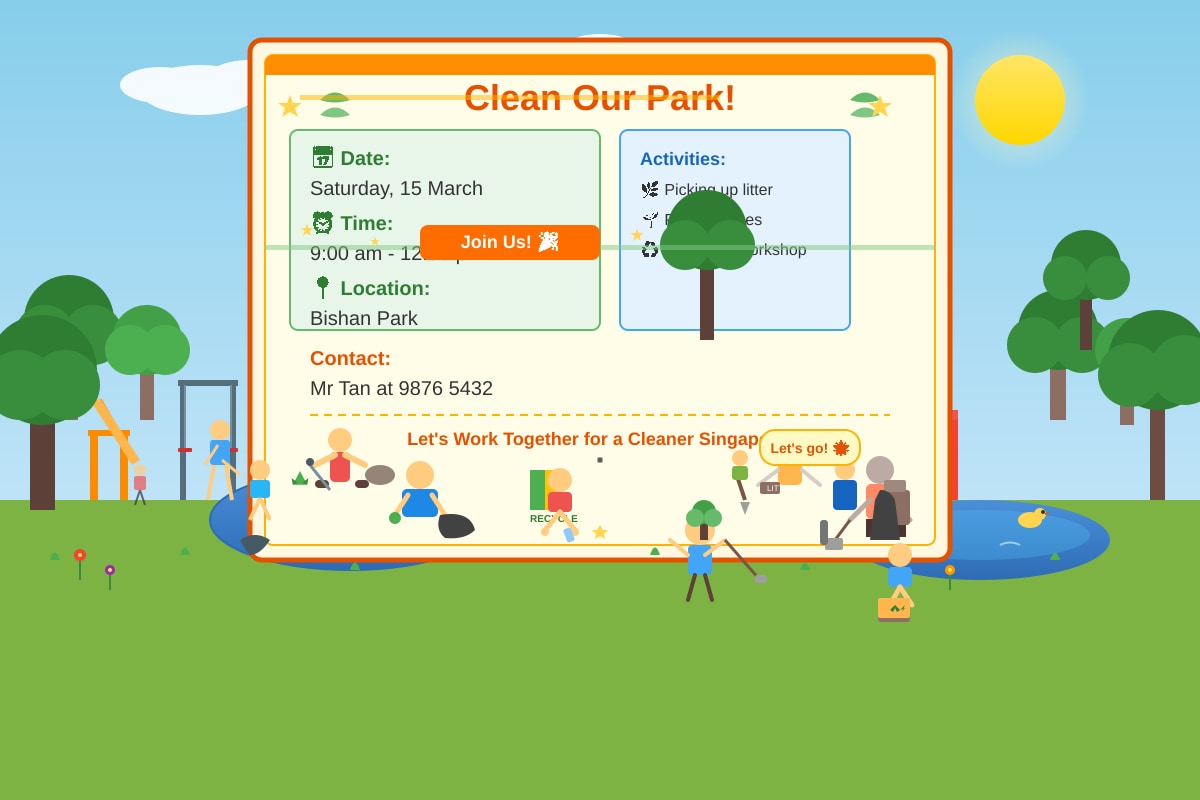
- Answer: The main purpose is to clean up the park and improve the community environment through activities like litter picking, tree planting, and a recycling workshop.
- Explanation: The poster clearly states "Clean Our Park!" and lists activities that all contribute to making the park cleaner and greener. Students should identify the overall goal, not just list activities.
- Marking: 2 marks for identifying the purpose clearly. 1 mark for a vague answer.
Question 7 (3 marks)
- Answer: Accept any reasonable answer, e.g., "I would enjoy tree planting because I love nature and it feels good to help the environment. Trees provide shade and clean air, and planting one is something that lasts for years."
- Explanation: Students must choose one activity from the poster and give a personal reason. The reason should be specific and show personal engagement.
- Marking: 1 mark for choosing an activity, 2 marks for a well-explained reason. Deduct 1 mark if the reason is very general.
Question 8 (4 marks)
- Answer: Accept any well-reasoned opinion, e.g., "Yes, it is very important because community clean-ups help keep our environment clean and safe. They also bring people together and teach us to take responsibility for our shared spaces. When everyone helps, the community becomes a better place to live."
- Explanation: This is an opinion question. Students should state their position clearly and give at least two supporting reasons. Higher marks go to answers that show depth of thought.
- Marking: 1 mark for clear opinion, 3 marks for well-developed reasons. Deduct marks for one-word answers or lack of explanation.
Question 9 (4 marks)
- Answer: Accept creative ideas, e.g., "I would offer a small reward like a free drink or snack for volunteers. I would also make it fun by adding a scavenger hunt where participants find and collect specific types of litter. Posting on social media and asking popular students to help promote it would also attract more young people."
- Explanation: Students should think like an organiser and suggest practical, appealing strategies for young people. Creativity and practicality are both valued.
- Marking: 2 marks for each good idea (up to 4 marks). 1 mark for a weak or impractical idea.
Question 10 (3 marks)
- Answer: Learning about recycling is important because it helps reduce waste, conserves natural resources, and protects the environment. When we recycle, we use less energy and create less pollution. It also teaches us to be responsible consumers.
- Explanation: Students should explain the environmental benefits of recycling. The answer should show understanding of why recycling matters, not just state that it is "good."
- Marking: 1 mark for each valid point (up to 3 marks).
Question 11 (2 marks)
- Answer: Accept polite and persuasive responses, e.g., "Excuse me, I noticed you dropped some litter. There is a bin just over there. It would really help keep our park clean if you could put it in the bin."
- Explanation: The response should be polite, not confrontational. The goal is to encourage the person to change their behaviour without being rude.
- Marking: 2 marks for a polite and effective response. 1 mark if the response is correct but could be more polite.
Question 12 (2 marks)
- Answer: Accept creative ideas, e.g., "I would add a 'Trash Art' competition where participants create art from recycled materials. This would make cleaning up more fun and show that waste can be turned into something beautiful."
- Explanation: The activity should be related to the clean-up theme and should add value to the event. Creativity is encouraged.
- Marking: 1 mark for a reasonable activity, 1 mark for a good explanation.
Section C: Oral Practice Questions (10 marks)
Question 13 (2 marks)
- Answer: Accept any reasonable description, e.g., "My favourite place to relax is the library. It is quiet and full of books. I love reading there because I can escape into different worlds. The soft chairs and warm lighting make it very comfortable."
- Explanation: Students should describe the place and explain why it is special. Personal connection is important.
- Marking: 1 mark for description, 1 mark for personal reason.
Question 14 (2 marks)
- Answer: Accept any real or imagined challenge, e.g., "I struggled with mathematics in Primary 5. I could not understand fractions. I overcame it by asking my teacher for extra help and practising every day. Now I am much better at it."
- Explanation: The answer should show a clear problem and a solution. The student should demonstrate resilience.
- Marking: 1 mark for describing the challenge, 1 mark for explaining how it was overcome.
Question 15 (2 marks)
- Answer: Accept any well-reasoned opinion, e.g., "I think it depends on the task. For creative projects, working in a group is better because you get more ideas. But for focused work like studying, I prefer working alone because I can concentrate better."
- Explanation: Students should give reasons, not just state a preference. A balanced answer that acknowledges both sides is strong.
- Marking: 1 mark for clear opinion, 1 mark for good reasoning.
Question 16 (2 marks)
- Answer: Accept any country with a reason, e.g., "I would go to Japan because I love Japanese culture. I want to see the cherry blossoms, visit ancient temples, and try authentic ramen. It would be an amazing experience."
- Explanation: The reason should be specific and personal. General answers like "it is nice" get lower marks.
- Marking: 1 mark for country choice, 1 mark for a specific reason.
Question 17 (2 marks)
- Answer: Accept any reasonable suggestion, e.g., "I would add more outdoor seating areas so students can eat and study outside. Fresh air helps us think better, and it would be nice to have a choice of where to spend our break time."
- Explanation: The idea should be practical and clearly explained. The student should show why it would improve the school.
- Marking: 1 mark for a clear idea, 1 mark for explanation.
Question 18 (2 marks)
- Answer: Accept any thoughtful response, e.g., "Honesty is important because it builds trust. If people cannot trust you, they will not believe what you say. Even when it is hard, telling the truth shows that you have integrity and respect for others."
- Explanation: Students should explain the value of honesty, not just say "it is good." The answer should show understanding of consequences.
- Marking: 2 marks for a well-explained answer. 1 mark for a simple but correct answer.
Question 19 (2 marks)
- Answer: Accept any real or imagined example, e.g., "I helped my younger brother with his homework. He was struggling with spelling, so I made a fun game to help him learn. It made me feel happy and proud because I could see him improving."
- Explanation: The answer should include a specific example and describe the feeling. Personal reflection is valued.
- Marking: 1 mark for the example, 1 mark for the feeling.
Question 20 (2 marks)
- Answer: Accept any reasonable definition and example, e.g., "Perseverance means not giving up even when things are difficult. For example, I showed perseverance when I was learning to ride a bicycle. I fell many times, but I kept trying until I could ride without falling."
- Explanation: Students should define the word and give a concrete example. The example should clearly show persistence.
- Marking: 1 mark for definition, 1 mark for example.
End of Answer Key