From Real Exams Quiz
Primary 6 PSLE English Comprehension Quiz
Free P6 PSLE English Comprehension quiz, Kimi2.6 Exam version, with questions, answers, and PSLE-focused practice for Singapore students.
These static practice materials are generated from the site's syllabus and paper-generation workflow, with source and model context shown so students and parents can evaluate the material before use.
Questions
Free quiz and exam paper access
Enter your details to view this paper
Your access is remembered on this device.
Answers
Primary 6 PSLE English Quiz - Comprehension: Answer Key
Total Marks: 40 marks
Section A: Visual Text Comprehension (Questions 1–5)
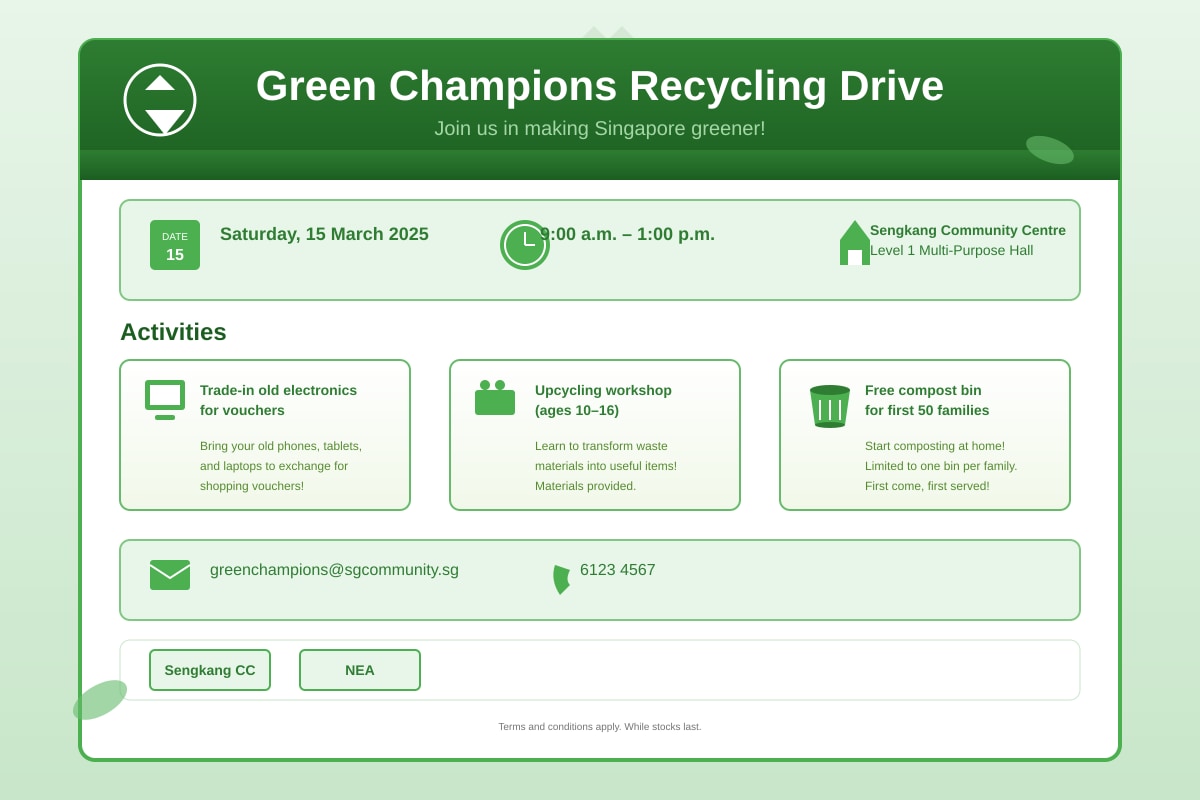
1. According to the poster, name two activities that families can participate in during the recycling drive. [2 marks]
Answer:
Any two from:
• Trading in old electronics for vouchers [1]
• Attending the upcycling workshop (for qualifying ages) [1]
• Receiving a free compost bin (for the first 50 families) [1]
Marking note: Accept clear paraphrasing. Both activities must be distinct; "getting vouchers" and "trading electronics" are the same activity.
2. The poster states that the upcycling workshop is for "ages 10–16." Explain why this age restriction might have been included. [2 marks]
Answer:
• The tools or materials used may require physical dexterity or safety awareness that younger children lack [1]
• The workshop may involve techniques (e.g., using cutters, glue guns, sewing) suited to older children's developed motor skills and concentration span [1]
• The content may be designed to appeal to pre-teens and teenagers' interests and cognitive level [1]
Any two valid, distinct reasons accepted. Must show reasoning beyond restating the restriction.
3. The phrase "While stocks last" appears in small print at the bottom of the poster. What does this suggest about the compost bins? [1 mark]
Answer:
The compost bins are available in limited quantities / there is a finite number / they may run out before everyone who wants one can receive one.
Marking note: Must capture scarcity or limited availability, not just "free" or "for first 50 families."
4. Identify one persuasive technique used in the poster to encourage people to attend. Explain how it works. [2 marks]
Answer:
Technique (any one):
• Incentive/reward: Offering vouchers, free compost bins, or workshop participation creates tangible benefit [1]
• Urgency/scarcity: "First 50 families" and "While stocks last" prompt immediate action [1]
• Authority/credibility: NEA logo suggests government backing and trustworthiness [1]
• Direct appeal to values: "Green Champions" frames participation as heroic/environmentally responsible [1]
Explanation [1]:
Must explain how the identified technique influences behaviour—e.g., "The free compost bin appeals to families' desire to save money while gardening, making the event feel valuable" or "The NEA logo reassures attendees that the event is well-organised and legitimate."
5. Mdm Tan wants to bring her 8-year-old son and 14-year-old daughter to the event, and hopes to get a compost bin. She can only arrive at 11:00 a.m. Do you think she will achieve all her aims? Explain your reasoning using evidence from the poster. [3 marks]
Answer:
| Aim | Achievable? | Evidence |
|---|---|---|
| Bring 14-year-old daughter | Yes | Daughter is 14, within 10–16 range for upcycling workshop |
| Bring 8-year-old son | Uncertain/Partially | Son is below 10; workshop not open to him, but other activities (electronics trade-in) may include him |
| Get compost bin | Uncertain/Unlikely | Only first 50 families receive one; arriving at 11:00 a.m. (2 hours after start) means bins may already be given out |
Conclusion [1]: Mdm Tan will likely not achieve all her aims. She can attend with both children and participate in some activities, but her son cannot join the workshop and the compost bin is uncertain due to late arrival and limited supply.
Marking: 1 mark for each aim evaluated with evidence; 1 mark for supported overall conclusion. Accept nuanced answers that note partial achievement.
Section B: Narrative Comprehension (Questions 6–12)
6. In your own words, explain what is unusual about the door Maya discovers in the clock tower. [2 marks]
Answer:
• The door appears where the clock face should be, in a location that has never been documented or described before [1]
• It has no handle and opens only by a palm-shaped indentation that seems to respond specifically to Maya, suggesting magical or supernatural properties [1]
Marking note: "In your own words" requires transformation of "a small wooden door where the clock face should have been—a door that had never existed in any photograph or story" and "no handle, only a circular indentation the size of a child's palm... the wood warmed beneath her touch." Direct copying capped at 1 mark.
7. The passage states that Maya "understood it less now, with her palm flat against impossible wood." What does "impossible wood" suggest about Maya's state of mind at this moment? [2 marks]
Answer:
• Maya recognises the door defies physical reality—wood should not warm to touch, doors should not appear without handles in familiar places [1]
• Her understanding lessens because her empirical, logical framework is disrupted; she is experiencing cognitive dissonance between what she knows and what she perceives [1]
• The phrase suggests awe mixed with confusion—she cannot rationalise what is happening, yet she continues to engage with it [1]
Any two points accepted. Must address both the literal impossibility and her psychological response.
8. "The tower keeps what is given, not what is taken." Explain what you think this whispered message means, using evidence from the rest of the passage to support your interpretation. [3 marks]
Answer:
Interpretation [1]:
The tower preserves things offered willingly, freely, with love or intention—not things acquired through force, greed, or entitlement.
Evidence and development [2]:
• The locket is "given" by Grandmother with emotional weight ("eyes bright with some emotion") and becomes the key to entry [1]
• Maya "gives" her trust and presence, pressing her palm willingly; she does not force the door or steal entry [1]
• Maya later "gives" her service to others, becoming "the woman who could mend what was broken in people"—she offers healing, extending the cycle of giving [1]
• Grandmother appears in the garden "young and unburdened by the locket she had yet to give"—the giving is what connects them across time [1]
Marking: Needs clear interpretation plus two distinct evidence points. Stronger answers trace the theme through beginning, middle, and end of the narrative arc.
9. Compare the garden Maya finds with her mother's garden. What does this contrast reveal about the two different kinds of spaces? [2 marks]
Answer:
| Mother's Garden | Maya's Magical Garden |
|---|---|
| "Trimmed hedges and labelled rows"—human-controlled, ordered, domesticated [1] | "Wild and deliberate... arranged themselves according to rules older than human tending"—self-organising, ancient, natural intelligence beyond human design [1] |
What the contrast reveals:
The mother's garden represents human ambition to dominate nature through pattern and classification; Maya's garden represents coexistence with natural forces that possess their own wisdom and purpose [1]. The contrast suggests that spaces of true meaning may require surrendering control rather than imposing it [1].
Marking: 1 mark for comparison point; 1 mark for thematic inference about the spaces.
10. When Maya turns after entering the garden, she finds "only the tree's trunk, smooth and unbroken." Why do you think the author describes the trunk in this particular way? [2 marks]
Answer:
• "Smooth and unbroken" emphasises the impossibility of return—the door has vanished without seam or trace, making Maya's entry irreversible [1]
• The description mirrors the door's own lack of handle: where there was once an opening, there is now only continuous surface, suggesting the garden exists in a different dimension or reality [1]
• The tree as replacement for the door symbolises organic growth replacing human-made structures; Maya must adapt to natural, not mechanical, rhythms [1]
Any two points. Stronger answers connect to broader themes of transformation and irreversibility.
11. "Maya would be waiting in the garden, ready with pressed flowers and a story." What does the ending suggest about Maya's understanding of her experience? [2 marks]
Answer:
• Maya has accepted her role as guardian and guide—she "waits" rather than searches, showing patience and purpose [1]
• The "pressed flowers" echo her grandmother's gift, showing she understands the cycle of giving and has become the giver herself [1]
• The "story" indicates she recognises her experience as meaningful narrative to be shared, not trauma to be hidden or理性 to be explained away [1]
• Her waiting for a child who "finds nothing but cold stone" suggests she understands the garden's selective, mysterious nature—its inaccessibility to most is part of its meaning, not a problem to solve [1]
Any two developed points. Must move beyond plot summary to interpret Maya's philosophical acceptance.
12. The passage explores the theme of passing things down through generations. Identify one other theme and explain how it is developed in the story. [1 mark]
Answer:
Any valid theme with brief explanation:
| Theme | How Developed |
|---|---|
| The passage of time / aging | Grandmother appears young; Maya grows gray-haired; the garden exists outside normal chronology |
| Acceptance vs. control | Maya stops searching and learns; mother's garden vs. wild garden |
| The hidden world beneath ordinary reality | Clock tower contains impossible door; ordinary village conceals magic |
| Gift and sacrifice | Locket must be given to open door; Maya gives her life to helping others |
| Identity and belonging | Maya finds her true place not in village but garden; becomes "the woman who could mend" |
Marking: 1 mark for accurate identification with any plausible explanation of development. No mark for theme stated without development.
Section C: Non-Fiction Comprehension (Questions 13–20)
13. According to the passage, how many Olympic-sized swimming pools could be filled with Singapore's annual food waste in 2019? [1 mark]
Answer:
400 (Olympic-sized swimming pools)
Marking note: Must include number. "Approximately 400" accepted. No mark for "200,000 tonnes" alone.
14. What does Dr. Lim mean when she says "the psychological side effect is that food feels unlimited, interchangeable, disposable"? [2 marks]
Answer:
• "Unlimited": Because Singapore imports over 90% from diversified sources, food supply seems inexhaustible; scarcity is never personally experienced [1]
• "Interchangeable": Any shortage in one source can be compensated by another, making individual food items seem replaceable rather than valuable [1]
• "Disposable": When food feels abundant and replaceable, throwing it away carries no emotional or practical weight; waste becomes habitual [1]
Any two components explained. Must show understanding of cause (import dependency/diversification) and effect (careless attitudes).
15. Explain why rice tops Dr. Lim's list of foods with the highest embodied emissions, despite individual grains seeming insignificant. [2 marks]
Answer:
• Rice is wasted not occasionally but habitually and ubiquitously—leftover home meals, food court portions, buffet scrapings—making the cumulative volume enormous [1]
• Individual grains seem small, but multiplied across millions of daily servings, the total embodied emissions (water, transport, refrigeration) become the largest category [1]
Or: The "embodied emissions" methodology calculates lifecycle impact, so rice's high ranking reflects frequency of waste rather than per-grain intensity [1], combined with its staple status in Singaporean cuisine [1].
16. The author describes Singapore's food infrastructure as making waste "almost frictionless." Identify two features of this infrastructure mentioned in the passage. [2 marks]
Answer:
Any two from:
• Hawker centres provide ample portions at low cost [1]
• Takeaway containers are free and abundant [1]
• HDB refrigerators are typically oversized for actual needs, encouraging stockpiling that leads to spoilage [1]
Marking note: Must be features of infrastructure, not attitudes or behaviours. "Frictionless" means the system does not resist or penalise waste.
17. "Numbers have a power that guilt does not." Explain what Dr. Lim means by this statement, and why measurement might be more effective than emotional appeal in reducing food waste. [3 marks]
Answer:
Meaning of statement [1]:
Guilt is diffuse, temporary, and easily dismissed ("I already feel bad enough"); specific quantities (2.3 kg weekly) create concrete, actionable awareness.
Why measurement is more effective [2]:
• Makes invisible visible: People do not perceive cumulative waste; scales reveal the aggregate that individual discards create [1]
• Enables planning: Once quantified, families can set targets, adjust purchasing, and track progress—guilt offers no such structural support [1]
• Avoids defensiveness: Guilt triggers justification; measurement invites problem-solving without moral judgment [1]
• Shows immediate feedback: The 35% reduction within one month demonstrates rapid, motivating results that guilt's slow erosion of willpower cannot match [1]
Marking: 1 mark for interpretation; 2 marks for any two well-developed reasons with evidence from passage.
18. Dr. Lim suggests that "we are not just consumers at the end of a long chain. We are the reason the chain exists at all." Explain this statement using evidence from the passage. [2 marks]
Answer:
• Singapore imports over 90% of its food, so every consumption choice here drives production, transport, and refrigeration decisions in supplying countries [1]
• "Every efficiency we create here is magnified by our import dependency"—because the chain is so long and complex, any reduction in Singaporean waste cascades back through multiple stages of the supply chain [1]
• Our demand creates the infrastructure; without Singapore's purchasing power, the ships, cold storage, and international contracts would not exist [1]
Any two points. Must connect consumption to causal responsibility, not just describe the import system.
19. The passage presents both practical solutions and deeper challenges in addressing food waste. Evaluate which approach you think is more important, supporting your answer with evidence from the passage. [2 marks]
Answer:
Position (either accepted with support):
| Practical solutions more urgent | Deeper challenges more fundamental |
|---|---|
| NEA programme reached 1,200 premises; smaller portions, own-container discounts, composting have immediate measurable impact [1] | Dr. Lim says these "address symptoms"; psychology of abundance is "the harder and slower work" but changes lasting behaviour [1] |
| Pilot schemes can be scaled quickly; 35% reduction from measurement shows practical tools work fast [1] | Without perception change, new habits relapse; infrastructure may adapt but attitudes determine sustained action [1] |
Evaluation criterion [1]:
Must explicitly weigh importance—e.g., "While practical solutions create immediate gains, the passage's emphasis on relapse risk and Dr. Lim's caution suggest deeper change is more important for lasting impact."
Marking: 1 mark for clear position with evidence; 1 mark for evaluative reasoning that weighs alternatives.
20. Based on the passage, propose one additional measure that could reduce food waste in Singapore schools, and explain how it would work. [2 marks]
Answer:
Measure (any plausible, syllabus-aligned proposal) [1]:
• Food waste tracking system with digital scales and class-level competitions
• "Take what you need" buffet lines with smaller serving utensils
• Student-led food rescue teams to redistribute uneaten food
• Curriculum integration: students calculate embodied emissions of their own lunch waste
• Partnership with technology: app to pre-order exact meal portions
Explanation of how it works [1]:
Must connect to passage evidence—e.g., "Following Dr. Lim's finding that measurement reduces waste by 35%, digital scales in school canteens would make students aware of their collective impact, creating the concrete feedback that 'guilt does not' provide."
Marking note: Measure must be original (not already in passage) and explanation must cite passage principles. Vague proposals ("tell students not to waste") without mechanism score 0.
END OF ANSWER KEY