From Real Exams Quiz
Primary 6 PSLE English Composition Quiz
Free P6 PSLE English Composition quiz, Nemo3 Exam version, with questions, answers, and PSLE-focused practice for Singapore students.
These static practice materials are generated from the site's syllabus and paper-generation workflow, with source and model context shown so students and parents can evaluate the material before use.
Questions
Free quiz and exam paper access
Enter your details to view this paper
Your access is remembered on this device.
Answers
Primary 6 PSLE English Quiz - Composition (Answer Key)
Total Marks: 40
Section A: Multiple Choice Questions (10 marks)
1. Answer: (B)
Marks: 1
Explanation: Option (B) uses an engaging hook ("The clock ticked loudly..."), sensory details ("silent room", "two letters"), and implies high stakes ("a future I could not have simultaneously") without stating the theme explicitly. This is the "Show, Don't Tell" technique expected at PSLE level. Options (A), (C), and (D) are generic, "telling" openings that lack tension and voice.
2. Answer: (B)
Marks: 1
Explanation: The narrative arc consists of Exposition (Introduction), Rising Action, Climax, Falling Action, and Resolution. The Rising Action specifically comprises the series of events that build tension, complicate the conflict, and propel the protagonist toward the Climax. (A) describes Exposition; (C) describes Falling Action/Resolution; (D) is thematic, not structural.
3. Answer: (C)
Marks: 1
Explanation: The phrase "like blind eyes" uses the comparative word "like" to compare the windows to eyes. A Simile compares two unlike things using "like" or "as". A Metaphor (A) would state it directly ("The windows were blind eyes"). Personification (B) gives human traits to non-human things (the house watching is personification, but the specific bolded comparison is a simile). Hyperbole (D) is exaggeration.
4. Answer: (B)
Marks: 1
Explanation: "Show, Don't Tell" requires describing physical manifestations of emotion. Option (B) provides visceral sensory details: "heart pounding against his ribs like a trapped bird" (simile + internal sensation), "palms slick with sweat" (touch), "pen slip from his fingers" (motor control loss). Options (A), (C), (D) merely label the emotion ("nervous") without evidence.
5. Answer: (B)
Marks: 1
Explanation: Internal conflict (Character vs. Self) is the struggle within a character's mind. Option (B) features the protagonist blaming the cat (external action) but suffering guilt (internal struggle) while watching the innocent cat get scolded. This moral dilemma drives the confession. (A) is external conflict (hiding vs. getting caught). (C) focuses on problem-solving (external). (D) is a mystery (external investigation).
6. Answer: (B)
Marks: 1
Explanation: A flashback shifts the narrative to an earlier time. "Years later, looking back..." explicitly signals a temporal shift to the past from a future vantage point. (A) and (C) signal sudden immediate action (present tense narrative). (D) signals cause and effect within the current timeline.
7. Answer: (C)
Marks: 1
Explanation: Narrative voice is the personality of the narrator. It requires consistency in perspective (1st/3rd person), tone (humorous, serious, reflective), and vocabulary (suited to the narrator's age/background). (A) leads to "purple prose" (overwriting). (B) creates monotony and readability issues. (D) removes a key tool for characterisation and pacing.
8. Answer: (C)
Marks: 1
Explanation: PSLE marking rubrics for Continuous Writing (Content & Language) reward reflection and maturity. A strong conclusion moves beyond plot summary to answer "So what?" — showing growth, a changed perspective, or a lesson internalised. (A) and (D) are narrative tricks unsuited for a closed composition exam. (B) is repetitive and low-level.
9. Answer: (A)
Marks: 1
Explanation: A dangling modifier occurs when the introductory phrase does not logically modify the subject of the main clause. In (A), "Running down the corridor" implies the subject is running, but the subject is "the bell" (bells cannot run). In (B), (C), (D), the subject "I" is the one running; the modifier attaches correctly.
10. Answer: (B)
Marks: 1
Explanation: PSLE Picture-Based compositions require a cohesive narrative linking the chosen pictures. Option (B) creates a logical cause-and-effect chain: Training (worn shoes) → Injury/Setback (first-aid kit) → Recovery/Success (trophy). This embodies the title "Perseverance". (A) is a list of unrelated events. (C) is illogical (treating shoes). (D) is a static description, not a story.
Section B: Short Answer Questions (10 marks)
11. Sentence Variety (2 marks)
Suggested Answer:
As the rain poured heavily, the match continued, leaving the players soaked within minutes.
OR
Although the rain poured heavily, the match continued, so the players were soaked within minutes.
Marking Notes:
- 1 mark: Correctly combines three clauses into one complex sentence using appropriate subordinating conjunctions (e.g., As, Although, While, Since) or a participle phrase (Pouring heavily, the rain...).
- 1 mark: Maintains original meaning and logical cause-effect relationship (Rain → Match continues → Players soaked).
- Common Error: Creating a run-on sentence with only commas or "and"; changing meaning (e.g., "The match continued because the rain poured heavily").
12. Sensory Details - Show, Don't Tell (2 marks)
Suggested Answer:
A cacophony of clattering plates and shouted orders assaulted my ears the moment I stepped into the hawker centre. The air was thick with the savoury aroma of frying garlic and chilli, mingling with the humid stickiness of sweat. I squeezed past tables packed shoulder-to-shoulder, the vinyl seats sticky against my arms.
Marking Notes:
- 1 mark: Includes details appealing to at least 3 senses (e.g., Sound: cacophony/clattering; Smell: savoury aroma/garlic; Touch: humid stickiness/vinyl sticky; Sight: packed shoulder-to-shoulder).
- 1 mark: Uses precise vocabulary ("cacophony", "assaulted", "savoury", "mingled", "squeezed") and varied sentence structure. No usage of the words "noisy" or "crowded".
13. Characterisation through Action (2 marks)
Suggested Answers:
Action showing strictness: Mrs Tan rapped her ruler sharply on the desk the moment a whisper rose above the silence, her eyes scanning the row until the culprit shrank into their seat.
Action showing care: During recess, Mrs Tan knelt beside the boy staring at his empty lunchbox, quietly sliding her own bento box towards him with a warm smile.
Marking Notes:
- 1 mark per action.
- Strictness: Must show enforcement of rules/high standards without the word "strict" (e.g., immediate correction, high expectations, firm tone).
- Care: Must show empathy/kindness without the word "caring" (e.g., noticing need, self-sacrifice, gentle gesture).
- Teaching Point: "Show, Don't Tell" applies to character traits too. Actions > Adjectives.
14. Dialogue Punctuation & Tags (2 marks)
Suggested Answer:
"Why are you late again?" the teacher demanded.
"I missed the bus," the boy mumbled.
Marking Notes:
- 0.5 marks per line for correct punctuation: Capital letter start, question mark/comma inside quotation marks, closing quotation marks, reporting clause with lowercase start (unless proper noun), full stop at end.
- 0.5 marks per line for descriptive speaking verb replacing "said" (e.g., demanded, snapped, barked, questioned / mumbled, whispered, muttered, admitted, confessed).
- Common Error: "Why are you late again?" The teacher demanded. (Capital T after ?); "I missed the bus." the boy replied. (Full stop instead of comma before tag).
15. Planning - Problem & Solution (2 marks)
Suggested Answer:
(a) Internal Conflict: The protagonist (e.g., a pianist) freezes during a crucial audition due to crippling stage fright/imposter syndrome, despite being technically prepared. The conflict is the battle between their desire to succeed and the paralysing fear of failure/judgement.
(b) Turning Point (Climax): The protagonist's hands hover over the keys, unable to start. They see a younger student in the audience mimicking their finger movements with admiration. The protagonist realises they are letting fear rob not just themselves, but others of inspiration. They close their eyes, breathe, and play — but the time limit expires / the moment passes, resulting in a lost opportunity (or they play beautifully but the slot is over).
Marking Notes:
- 1 mark (a): Specific, relatable internal conflict (fear, pride, indecision, jealousy) — not just "a problem".
- 1 mark (b): A clear, dramatic climax moment where the conflict peaks and the opportunity is lost/realised. Must link to the title "A Lost Opportunity".
Section C: Open-Ended / Application Questions (20 marks)
16. Picture Stimulus Analysis & Planning (3 marks)
Marking Notes: Award marks for a coherent, logical plan linking at least two pictures to the title "A Wake-Up Call".
Suggested Plan:
Introduction: Establish protagonist (e.g., Jayden) as talented but complacent/lazy (e.g., natural athlete who skips training). Hook: "Talent without effort is a sleeping giant."
Rising Action (Pic 1 & 2): Jayden fails a crucial trial/selection (Pic 1: Crumpled 'F' paper / Rejection letter). Parent signs it with disappointment, not anger (Pic 2: Stern signature). The silence in the car ride home is heavier than any lecture.
Climax (Pic 3/Internal): Cleaning room, Jayden finds old trophy (Pic 3: Dusty). Realises past glory ≠ present effort. The dust represents neglected potential. The "Wake-Up Call" is the visual contrast between the shiny past and dusty present.
Resolution: Jayden wakes up early next morning (literal/figurative wake-up). Starts training. Reflection: A wake-up call isn't a sound; it's the moment you stop hitting snooze on your potential.
Mark Breakdown:
- 1 mark: Clear Introduction (Setting, Character, Hook).
- 1 mark: Rising Action uses Pic 1 & 2 logically to develop conflict.
- 1 mark: Climax uses Pic 3/internal realisation; Resolution shows change + Reflection links to Title.
17. Editing for Impact (3 marks)
Suggested Rewritten Version:
Darkness swallowed the room whole as I stepped inside, the stale air choking my lungs. Fear, cold and sharp, spiked in my chest. A skitter — claws on concrete — shattered the silence. A rat. Instinct screamed. I bolted, but the threshold betrayed me; my toe caught the raised step. The floor rushed up. Agony exploded through my knee, hot and wet. A sob tore from my throat, trapped in the dark.
Marking Notes (Holistic - 3 marks):
- Vocabulary Precision (1 mark): Replaces basic words (walked→stepped/bolted, dark→darkness swallowed, scared→fear cold/sharp, noise→skitter/shattered, ran→bolted, fell→floor rushed up, hurt→agony exploded, cried→sob tore).
- Sentence Variety (1 mark): Mix of simple ("A rat."), compound, complex, and fragment for effect ("Instinct screamed."). Use of participle phrases ("claws on concrete", "hot and wet").
- Emotional Impact / Show Don't Tell (1 mark): Sensory details (stale air, choking, skitter, hot/wet knee). Internal sensation (spiked, instinct screamed). Pacing controls tension.
- Deduct 0.5 if core events changed (e.g., didn't trip, didn't cry).
18. Internal Monologue (3 marks)
Suggested Answer:
*Gone. The file — gone. My finger hovered over the empty folder, the cursor blinking a mocking rhythm. How? Why didn't I save? Why didn't I check? The hum of the CPU sounded like a death rattle. Outside, their footsteps paced. They trusted me. We stayed up all night. My throat closed, tasting copper. Tell them. Run. Delete yourself. The mouse trembled in a grip slick with ice. Three minutes. Three minutes to undo a lifetime of trust.
Marking Notes (3 marks):
- Rhetorical Questions (1 mark): At least 2 used effectively (How? Why...?).
- Short Sentences for Effect (1 mark): e.g., "Gone.", "A rat.", "Tell them. Run.", "Three minutes."
- Sensory Details + Emotion (1 mark): Sound (hum, footsteps, blinking rhythm), Touch (mouse trembled, slick with ice, throat closed), Taste (copper), Internal (mocking rhythm, death rattle).
- Word Count: ~75 words (within 60-80 range).
- Teaching Point: Internal monologue reveals character depth; "Show" the panic physically.
19. Cohesion & Paragraphing (3 marks)
Correct Order & Paragraphing:
Paragraph 1 (Introduction):
C. Months of early mornings and sore muscles had led to this single moment.
A. The silence in the hall was deafening as I waited for my name to be called.
Paragraph 2 (Body/Climax):
F. The starting gun cracked, and the world blurred into a rhythm of breath and motion.
D. When the announcer finally boomed my name, my legs moved on their own.
Paragraph 3 (Conclusion):
E. As I stood on the podium, the gold medal heavy around my neck, I looked at my coach's proud smile.
B. Finally, I realised that winning wasn't about the medal, but the journey I had undertaken.
Marking Notes:
- 1 mark: Correct chronological/logical sequence (Pre-race reflection → Wait → Race → Win → Reflection).
- 1 mark: Appropriate paragraph breaks (Intro: Pre-race mental state; Body: The Race Event; Conclusion: Aftermath & Theme).
- 1 mark: Effective transitions added (e.g., Para 1: "Months... led to this moment. Consequently/As a result, the silence..."; Para 2: "The gun cracked... Moments later, when the announcer..."; Para 3: "As I stood... Ultimately/In the end, I realised...").
- Note: Transition words must fit logical relationship (Time, Cause/Effect, Contrast).
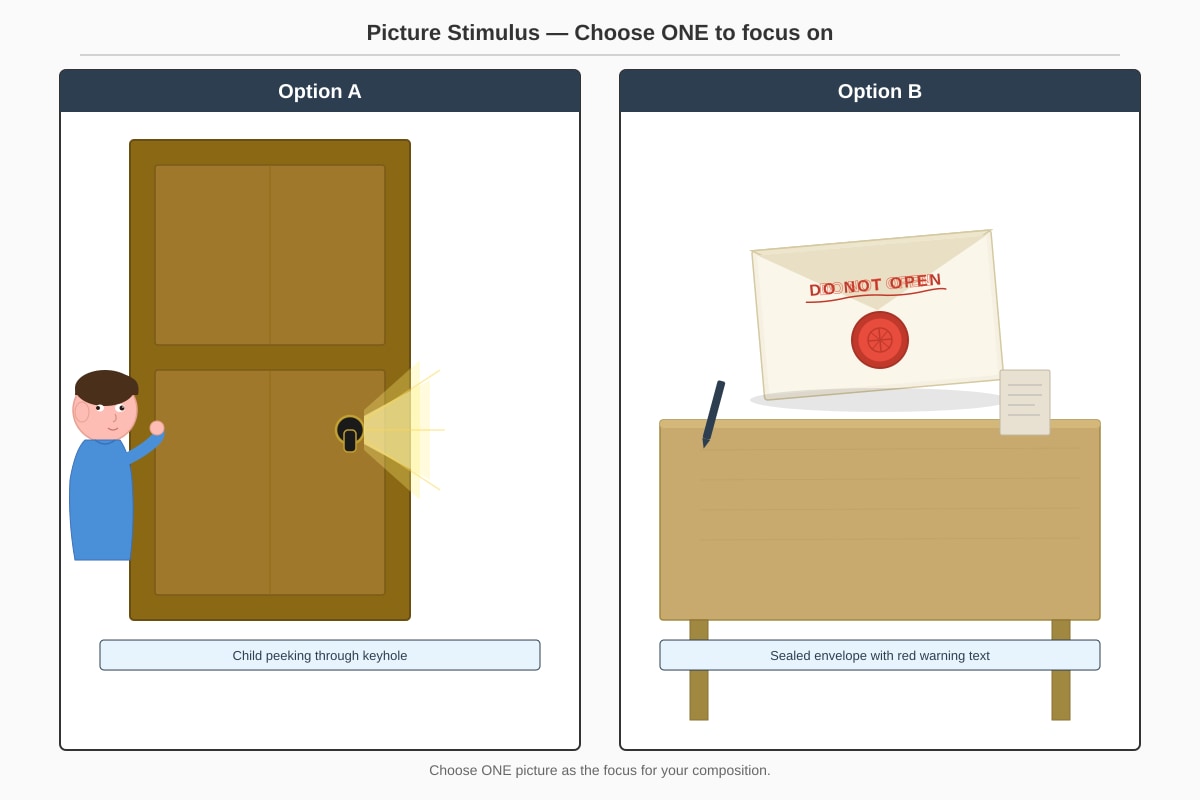
20. Mini Composition - "The Secret" (3 marks)
Marking Notes (Holistic - 3 marks):
Assess based on PSLE Continuous Writing Rubric (scaled): Content (Relevance, Development) & Language (Vocab, Structure, Grammar).
Sample Strong Response (Option A - Keyhole):
The brass keyhole was cold against my eye. Inside, the room glowed with a warmth that had nothing to do with the fireplace. My father sat at his desk, not grading papers, but cradling a tiny, misshapen clay pot — my first Primary One art project. He traced a crack with his thumb, a smile softer than moonlight on his weathered face. That’s where the missing cookie money went. That’s why he never scolded me for breaking the vase. The secret wasn't a scandal; it was a vault of silent forgiveness. I turned the handle, the click loud as a gunshot. "Papa?" His head snapped up, the pot vanishing into a drawer. "Ah, my inspector. Come inspect the dinner." I stepped in, the secret safe between us, heavier than gold. (~130 words)
Mark Breakdown:
- Content (1 mark): Clear focus on one picture (Keyhole). Problem (Curiosity/Secret discovered) → Resolution (Mutual understanding/Secret kept). Emotional core (Father's hidden sentiment).
- Language - Show Don't Tell & Literary Device (1 mark): "smile softer than moonlight" (Simile). "click loud as a gunshot" (Simile). "vault of silent forgiveness" (Metaphor). Shows curiosity/fear/love via actions (cold keyhole, traced crack, head snapped up).
- Language - Sentence Variety & Grammar (1 mark): Varied openings (Prepositional "Inside...", Subject "My father...", Fragment "That's where...", Dialogue). Accurate punctuation, tense control (Past).
- Deduct if <120 or >150 words significantly, or if picture not used, or pure telling.
--- END OF ANSWER KEY ---