AI Generated Exam Paper
Primary 6 PSLE English Practice Paper 1
Free P6 PSLE English Practice Paper 1, Nemo3 AI version, with questions, answers, and PSLE-focused practice for Singapore students.
These static practice materials are generated from the site's syllabus and paper-generation workflow, with source and model context shown so students and parents can evaluate the material before use.
Questions
Free quiz and exam paper access
Enter your details to view this paper
Your access is remembered on this device.
Answers
TuitionGoWhere Practice Paper - English Primary 6 PSLE (Answer Key)
Subject: English
Level: Primary 6 PSLE
Paper: Practice Paper 1 (Version 1)
Total Marks: 55
SECTION A: GRAMMAR (10 marks)
1. Answer: (3) was
Explanation: When "neither...nor" connects two subjects, the verb agrees with the subject closer to it (proximity rule). Here, "the teacher" is singular, so the singular verb "was" is correct.
Mark: 1
2. Answer: (3) had been attending to
Explanation: The phrase "By the time..." indicates past perfect continuous tense for an action that started before another past action and continued up to that point. "Had been attending to" shows the paramedics were in the process of attending to the hiker for twenty minutes before the ambulance arrived.
Mark: 1
3. Answer: (1) Despite
Explanation: "Despite" is a preposition followed by a noun phrase ("the heavy downpour"). "Although" and "even though" are conjunctions requiring a clause (subject + verb). "In spite" requires "of" to function as a preposition.
Mark: 1
4. Answer: (1) leave
Explanation: After verbs of insistence, demand, recommendation, etc. (subjunctive mood), the base form of the verb is used regardless of the subject. "Insisted that... leave" is the correct subjunctive construction.
Mark: 1
5. Answer: (2) did she win
Explanation: "Not only" at the beginning of a sentence triggers subject-auxiliary inversion. The past tense "did" is needed to match "broke" in the second clause. Structure: "Not only + auxiliary + subject + verb".
Mark: 1
6. Answer: (1) which
Explanation: The clause ", which was published last year," is a non-defining relative clause (set off by commas). "Which" is used for non-defining clauses referring to things. "That" cannot be used in non-defining clauses.
Mark: 1
7. Answer: (2) would have taken
Explanation: This is a third conditional (unreal past) structure: "Had I known..." (past perfect) → "...I would have taken" (would have + past participle). It expresses a hypothetical past result.
Mark: 1
8. Answer: (3) was
Explanation: The subject is "The committee members" (plural), but "together with the chairperson" is a prepositional phrase that does not change the subject number. However, collective nouns like "committee" often take singular verbs in formal English when acting as a unit. Here, "The committee members... was" follows the principle that the main subject "committee" (implied collective) takes singular agreement. Note: In modern usage, "were" is also accepted, but formal grammar tests often prefer singular for collective nouns.
Mark: 1
9. Answer: (3) Had it not been
Explanation: This is an inverted third conditional structure. "Had it not been for his quick thinking" = "If it had not been for his quick thinking". The inversion "Had it not been" is formal and correct. "But", "Except", and "If not" cannot introduce this structure grammatically.
Mark: 1
10. Answer: (1) rewrite
Explanation: After causative verbs like "make", "let", "have" (in causative sense), the bare infinitive (base form without "to") is used. Structure: "make + object + bare infinitive".
Mark: 1
SECTION B: VOCABULARY (10 marks)
11. Answer: (1) extracted
Explanation: "Extracted" implies careful removal, especially from something that holds it firmly (like an excavation site). "Withdrew", "removed", and "pulled" are less precise for archaeological contexts.
Mark: 1
12. Answer: (1) persuasive
Explanation: "Persuasive" means effective at convincing someone through reasoning or argument. The context "even his opponents found themselves agreeing" shows the speech changed minds through persuasion, not force, volume, or length.
Mark: 1
13. Answer: (1) mutual
Explanation: "Mutual agreement" is a fixed collocation meaning an agreement shared by both parties. "Common", "shared", and "joint" are possible but "mutual" is the most precise and idiomatic for agreements/benefits between two parties.
Mark: 1
14. Answer: (1) eerie
Explanation: "Eerie" means strange and frightening in a mysterious way, perfectly capturing an atmosphere that makes visitors "feel uneasy". "Scary" is too general, "dark" and "quiet" don't necessarily cause unease.
Mark: 1
15. Answer: (1) revolutionised
Explanation: "Revolutionised" means completely and fundamentally changed, which fits "groundbreaking discovery" and "the way we understand". "Changed", "altered", "modified" are weaker and don't convey the magnitude.
Mark: 1
16. Answer: (1) frail
Explanation: "Frail" means physically weak and delicate, typically due to age. It contrasts directly with "remarkable strength". "Thin", "weak", "small" don't specifically convey the age-related delicacy that makes the strength remarkable.
Mark: 1
17. Answer: (1) distributed
Explanation: "Distributed" is the formal, precise term for an organisation giving out supplies systematically to many recipients. "Gave", "handed", "passed" are too informal and lack the organisational connotation.
Mark: 1
18. Answer: (1) tactless
Explanation: "Tactless" means lacking sensitivity in dealing with others, which specifically explains why remarks "offended several colleagues". "Rude", "blunt", "honest" are related but "tactless" is the most precise for unintentional offence through insensitivity.
Mark: 1
19. Answer: (1) accelerated
Explanation: "Accelerated" means increased speed, the precise term for a runner changing pace in a race. "Increased", "quickened", "hastened" are possible but "accelerated" is the technical sporting term.
Mark: 1
20. Answer: (1) void
Explanation: "Void" is the legal term for a contract that has no legal effect from the beginning (void ab initio), which is the case when signed under duress. "Invalid", "cancelled", "broken" are not the precise legal terminology.
Mark: 1
SECTION C: VISUAL TEXT COMPREHENSION (10 marks)
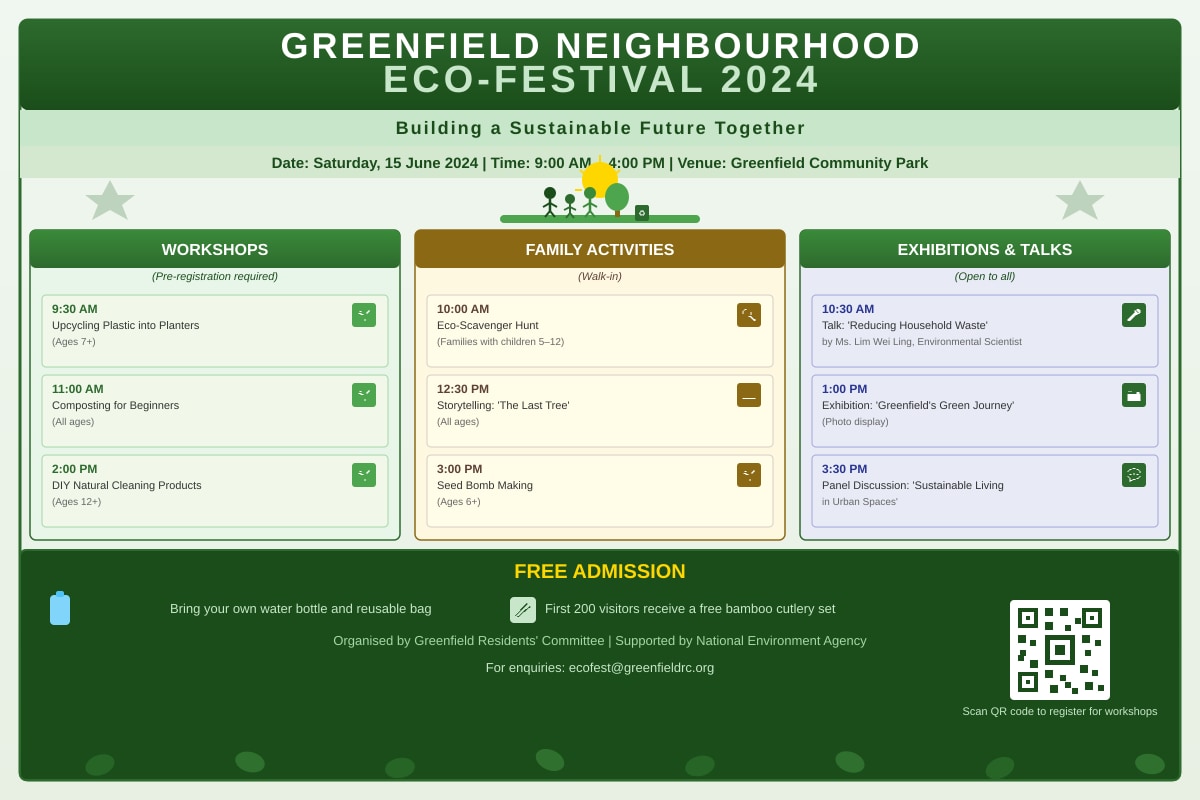
21. Answer: (1) To advertise a neighbourhood eco-festival
Explanation: The poster's primary function is to inform and attract residents to the "Greenfield Neighbourhood Eco-Festival 2024". It provides date, time, venue, activities, and registration details — all hallmarks of an advertisement.
Mark: 1
22. Answer: (3) DIY Natural Cleaning Products
Explanation: The poster clearly states "DIY Natural Cleaning Products (Ages 12+)" under WORKSHOPS. The other workshops have lower age requirements (7+ and all ages).
Mark: 1
23. Answer: (2) Storytelling: 'The Last Tree'
Explanation: The family has a 4-year-old. Eco-Scavenger Hunt is for ages 5-12. Seed Bomb Making is for ages 6+. Upcycling requires pre-registration and is for ages 7+. Storytelling is "All ages" and walk-in, making it the only suitable option.
Mark: 1
24. Answer: (2) A reusable bag and water bottle
Explanation: The footer explicitly states: "Bring your own water bottle and reusable bag".
Mark: 1
25. Answer: (1) 'Reducing Household Waste'
Explanation: Under EXHIBITIONS & TALKS, the 10:30 AM slot shows: "Talk: 'Reducing Household Waste' by Ms. Lim Wei Ling, Environmental Scientist".
Mark: 1
26. Answer: (1) Ms. Lim Wei Ling
Explanation: The poster lists "Ms. Lim Wei Ling, Environmental Scientist" as the speaker for the 10:30 AM talk.
Mark: 1
27. Answer: (2) A free bamboo cutlery set
Explanation: The footer states: "First 200 visitors receive a free bamboo cutlery set".
Mark: 1
28. Answer: (3) Eco-Scavenger Hunt
Explanation: Under FAMILY ACTIVITIES, it says "(Walk-in)" for all three activities. The WORKSHOPS column says "(Pre-registration required)". Eco-Scavenger Hunt is the only walk-in option listed.
Mark: 1
29. Answer: (3) Sustainable living in urban spaces
Explanation: The poster lists: "3:30 PM – Panel Discussion: 'Sustainable Living in Urban Spaces'".
Mark: 1
30. Answer: (3) Scan the QR code on the poster
Explanation: The footer states: "Scan QR code to register for workshops". While email is for enquiries, the QR code is specifically for workshop registration.
Mark: 1
SECTION D: EDITING (15 marks)
| Line | Error | Correction | Explanation |
|---|---|---|---|
| 1 | (Example) was | were | Subject "my family and I" is plural |
| 2 | has | had | Past perfect "had been looking" needed for action before another past action |
| 3 | arrive | arrival | Noun form needed after preposition "Upon" |
| 4 | give | gave | Past tense consistent with narrative |
| 5 | consist | consisted | Past tense consistent with narrative |
| 6 | wind | wound | Past tense of irregular verb "wind" (past: wound) |
| 7 | walk | walked | Past tense consistent with narrative |
| 8 | seemed | seem | After auxiliary "did not", use base form "seem" |
| 9 | herd | romp / raft | Collective noun for otters is "romp" or "raft"; "herd" is for cattle/deer |
| 10 | were | was | Collective noun "romp/raft" takes singular verb |
| 11 | pop | popped | Past tense consistent with narrative |
| 12 | saw | see | After modal "could", use base form "see" |
| 13 | feed | feeding | After verb of perception "see", use present participle for ongoing action |
| 14 | explain | explained | Past tense consistent with narrative |
| 15 | travel | travelled | Past tense consistent with narrative (or "travel" for habitual truth, but narrative is past) |
| 16 | pledge | pledged | Past tense consistent with narrative |
Marking: 1 mark per correct correction (15 marks total)
SECTION E: OPEN-ENDED COMPREHENSION (10 marks)
31. Answer: "steadfast" and "guardian" (or "steadfast guardian")
Explanation: "Steadfast" means unwavering, firm, and constant. "Guardian" implies a protective, watchful role. Together they emphasise the lighthouse's reliability over a century.
Mark: 2 (1 mark each word, or 2 marks for the phrase)
32. Answer: It suggests the fishing vessel was small, helpless, and completely at the mercy of the powerful waves / had no control over its movement.
Explanation: The simile "tossed like a toy" compares the boat to a plaything, emphasising its powerlessness against the storm's force. The waves control it entirely, just as a child controls a toy.
Mark: 2
33. Answer: He left the light to row out in his old rowboat to rescue the fishing vessel because the coastguard would take at least thirty minutes to arrive, and the vessel was too close to the rocks to wait.
Explanation: The passage states: "knowing the coastguard boat would take at least thirty minutes to arrive... the vessel was too close to the rocks to wait." This shows his urgency and sense of duty.
Mark: 2
34. Answer:
(a) False — Elias had tended the light for forty years (not less than thirty).
(b) False — The coastguard boat would take at least thirty minutes (not within ten minutes).
(c) True — He ran to the boathouse "where his old rowboat was stored" and "It was a desperate plan" to reach the vessel.
Mark: 3 (1 mark each)
35. Answer: Bravery / Courage / Selflessness (accept any one).
Evidence: He "acted without hesitation", left the light unattended (which he had not done in twenty years), raced into a ferocious storm where "the wind nearly knocked him off his feet", and rowed out in a small boat to rescue strangers.
Explanation: The question asks for a quality supported by evidence. Bravery/courage/selflessness are all demonstrated by his deliberate choice to risk his life in a dangerous storm to save others, abandoning his post (a serious dereliction normally) for a higher moral duty.
Mark: 3 (1 mark for quality, 2 marks for evidence + explanation)
TOTAL MARKS: 55
MARKING NOTES FOR TEACHERS
- Grammar/Vocabulary (MCQ): 1 mark each, no half marks.
- Visual Text: 1 mark each, answers must be derived from the poster.
- Editing: 1 mark per correction. Accept only the specified correction. For Line 9, accept "romp" or "raft" as correction for "herd". For Line 10, accept "was" (singular verb for collective noun).
- Open-Ended Comprehension:
- Q31: Require both words for full marks; 1 mark for one correct word.
- Q32: Must mention helplessness/smallness/lack of control.
- Q33: Must mention both the 30-minute wait AND the proximity to rocks.
- Q34: All three must be correct for full marks.
- Q35: Quality word (1 mark) + specific evidence from last paragraph (2 marks). Evidence must reference actions: leaving light, racing into storm, rowing boat.
Common Student Errors to Watch:
- Q3: Choosing "Although" or "In spite" without "of".
- Q4: Choosing "leaves" (not subjunctive).
- Q5: Choosing "she won" (no inversion).
- Q8: Choosing "were" (ignoring collective noun convention).
- Q9: Choosing "If not" or "Except".
- Editing Line 8: Writing "did not seem" as two words instead of correcting "seemed" to "seem".
- Editing Line 9: Not knowing collective noun for otters.
- Q32: Only saying "the boat was small" without "helpless/at mercy of waves".
- Q35: Giving a generic quality like "kind" without strong evidence from the last paragraph.