From Real Exams Exam Paper
Primary 6 PSLE English Semestral Assessment 2 (End of Year) Paper 5
Free P6 PSLE English SA2 Paper 5, Nemo3 Exam version, with questions, answers, and PSLE-focused practice for Singapore students.
These static practice materials are generated from the site's syllabus and paper-generation workflow, with source and model context shown so students and parents can evaluate the material before use.
Questions
Free quiz and exam paper access
Enter your details to view this paper
Your access is remembered on this device.
Answers
TuitionGoWhere Practice Paper - English Primary 6 PSLE (Answer Key)
Subject: English
Level: Primary 6 PSLE
Paper: SA2 (Version 5)
Total Marks: 95
BOOKLET A: GRAMMAR & VOCABULARY (28 marks)
Section A: Grammar MCQ (10 marks)
1. (1) is
Explanation: This is a first conditional sentence (real possibility in the future). The structure is "If + present simple, will + base verb". "If the weather is fine tomorrow..." is correct.
Common mistake: Using "will be" or "would be" in the if-clause.
2. (1) is
Explanation: With "Neither... nor...", the verb agrees with the noun closest to it (proximity rule). "Their older sister" is singular, so the verb is singular "is".
Common mistake: Choosing "are" because "twins" is plural.
3. (2) had to
Explanation: In reported speech, "must" changes to "had to" when the reporting verb is in the past tense ("told").
Common mistake: Keeping "must" or using "have to".
4. (2) completed
Explanation: "Having + past participle" forms a perfect participle clause showing an action completed before the main clause action. "Having completed his homework..."
Common mistake: Using "complete" (base form) or "completing" (present participle).
5. (1) which
Explanation: "Which" is the correct relative pronoun for things (the old mansion). The clause is non-defining (extra information), so "which" is used with commas.
Common mistake: Using "who" (for people) or "whom" (object pronoun for people).
6. (2) did he win
Explanation: "Not only" at the start of a sentence triggers inversion (auxiliary verb before subject). Past tense requires "did he win".
Common mistake: Forgetting inversion ("he won") or using wrong tense.
7. (1) tell
Explanation: After verbs of insistence/demand/recommendation (insist, demand, suggest, recommend), we use the subjunctive: base form of verb without "to". "Insisted that he tell..."
Common mistake: Using "tells" (3rd person singular) or "told" (past).
8. (1) had already attended to
Explanation: "By the time" + past simple ("arrived") requires past perfect in the main clause for the earlier action. "Had already attended to" shows completion before the ambulance arrived.
Common mistake: Using present perfect ("have attended") or simple past ("attended").
9. (1) Despite
Explanation: "Despite" is a preposition followed by a noun phrase ("the heavy rain"). "Although" is a conjunction needing a clause.
Common mistake: Choosing "Although" and not changing the structure.
10. (1) on
Explanation: The phrasal verb is "agree on" (a topic/issue). "Agree to" is for actions; "agree with" is for people/opinions.
Common mistake: Confusing prepositions after "agree".
Section B: Vocabulary MCQ (10 marks)
11. (1) extracted
Explanation: "Extracted" means to remove something carefully or with effort, often used for archaeological or medical contexts. "Withdrew", "removed", and "pulled" are less precise for delicate artefacts.
12. (3) resentment
Explanation: "Resentment" means bitter indignation at being treated unfairly. The context "concerns had been ignored" supports this. "Enthusiasm" and "curiosity" are positive; "indifference" means lack of interest.
13. (1) frail
Explanation: "Frail" means weak and delicate. The contrast "Despite his... appearance... remarkable strength" requires a word meaning weak. "Sturdy", "robust", "vigorous" all mean strong.
14. (3) paved
Explanation: "Paved the way" is a fixed collocation meaning to make future progress possible. "Blocked", "hindered", "obstructed" are antonyms.
15. (2) vague
Explanation: "Vague" means unclear. The result "leaving the police confused" shows the account was not clear. "Coherent", "detailed", "precise" would not cause confusion.
16. (3) tirelessly
Explanation: "Tirelessly" means with great effort and without tiring. Context: "putting in extra hours every day". "Leisurely", "reluctantly", "sporadically" contradict this.
17. (2) demise
Explanation: "Demise" means end or failure. "Remains a mystery" suggests something unknown about how it ended. "Origin", "expansion", "culture" don't fit "remains a mystery" as well in this context.
18. (3) insensitive
Explanation: "Insensitive" means showing lack of awareness of others' feelings. "Offended several colleagues" confirms this. "Tactful", "diplomatic", "considerate" are positive opposites.
19. (3) convoluted
Explanation: "Convoluted" means extremely complex and difficult to follow. "Kept readers guessing" supports this. "Predictable", "straightforward", "simple" are opposites.
20. (2) distributed
Explanation: "Distributed" means gave out to people. Context: charity giving to flood victims. "Hoarded", "collected", "stored" mean keeping, not giving out.
Section C: Vocabulary Cloze (8 marks)
21. F. unprecedented
Explanation: "Unprecedented challenges" = challenges never seen before. Collocation: "unprecedented" often pairs with "challenges", "scale", "level".
22. C. sceptical
Explanation: "Scientists were sceptical of his claims" = doubtful. Context: "believing that electric lighting was impractical" confirms doubt.
23. D. meticulous
Explanation: "Meticulous approach" = very careful and precise. "Documented every attempt carefully" directly supports this.
24. B. perseverance
Explanation: "Perseverance never wavered" = continued effort despite difficulty. Context: "thousands of failed attempts... would have given up" confirms this.
25. E. resilient
Explanation: "Resilient spirit allowed him to bounce back" = able to recover quickly. "Bounce back" is a key collocate of "resilient".
26. F. unprecedented — Wait, F already used!
Correction: The word box has 8 words for 8 blanks. Let me re-check: A. inevitable, B. perseverance, C. sceptical, D. meticulous, E. resilient, F. unprecedented, G. scrutinised, H. underestimated.
21. F. unprecedented
22. C. sceptical
23. D. meticulous
24. B. perseverance
25. E. resilient
26. A. inevitable
Explanation: "Inevitable success" = success that was certain to happen. "Changed the world forever" shows it was bound to happen.
27. H. underestimated
Explanation: "Critics who had underestimated his determination" = thought he was less determined than he was. "Proven wrong" confirms this.
28. G. scrutinised
Explanation: "Every detail... was scrutinised" = examined closely. "By the scientific community before being accepted" confirms careful examination.
BOOKLET B: GRAMMAR & VOCABULARY (22 marks)
Section D: Grammar Cloze (10 marks)
29. took
Explanation: Past tense for completed past event ("yesterday").
30. participated
Explanation: Past tense, plural subject "Teams".
31. was
Explanation: Past tense, singular subject "The topic".
32. argued
Explanation: Past tense for completed action in the past.
33. are designed / were designed
Explanation: Passive voice. "Platforms are/were designed to be addictive." Both acceptable; "are designed" (present passive for general truth) or "were designed" (past passive for past context). Mark both correct.
34. manipulate
Explanation: Present tense after "how algorithms" (plural subject). General truth about how algorithms work.
35. countered
Explanation: Past tense, parallel with "argued".
36. deliberated
Explanation: Past tense for completed action.
37. emerged
Explanation: Past tense. "Emerged as champions" = became champions.
38. had been preparing / have been preparing
Explanation: Past perfect continuous ("had been preparing") for action continuing up to a past point (the competition). Present perfect continuous ("have been preparing") also possible if speaking from present perspective. Accept both.
Section E: Editing for Spelling and Grammar (12 marks)
39. environment
Error: Spelling - missing 'n' after 'i'. Rule: "environment" = environ + ment.
40. received
Error: Spelling - 'i' before 'e' except after 'c'. "Receive" follows the exception.
41. were
Error: Grammar - subject-verb agreement. "Children" is plural, needs plural verb "were".
42. pursue
Error: Spelling - "pursue" not "persue". No 'e' after 'r'.
43. is
Error: Grammar - "Neither of the two candidates" takes singular verb "is". "Neither" = not either one.
44. accommodation
Error: Spelling - double 'c', double 'm'. "Accommodation".
45. were
Error: Grammar - Second conditional: "If I were you" (subjunctive mood for hypothetical). "Was" is common in informal speech but "were" is standard in exams.
46. principal
Error: Spelling/Word choice - "Principal" = head of school. "Principle" = rule/law.
47. could have
Error: Grammar - "Could of" is a common error from mishearing "could've". Correct: "could have".
48. separate
Error: Spelling - "separate" (sep-a-rate), not "seperate". Memory aid: "a rat" in separate.
49. has
Error: Grammar - "Each of the students" takes singular verb "has". "Each" is singular.
50. mischievous
Error: Spelling - "mischievous" (mis-chie-vous), not "mischievious". No 'i' after 'e'.
BOOKLET C: COMPREHENSION (45 marks)
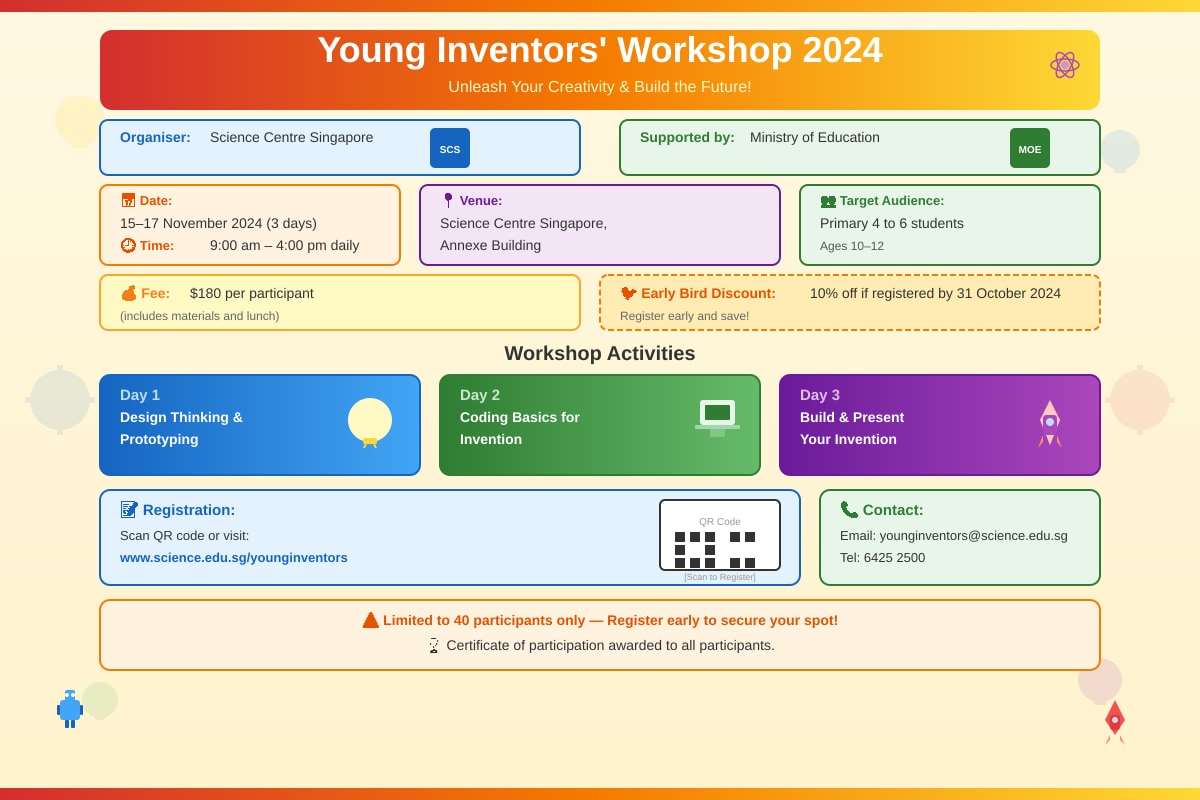
Section F: Visual Text Comprehension (8 marks)
51. Science Centre Singapore
Explanation: Directly stated under "Organiser" on the poster.
52. 3 days (15-17 November 2024)
Explanation: Date shows "15-17 November 2024 (3 days)".
53. Ministry of Education
Explanation: Stated under "Supported by".
54. 180 - 10% (162. Early bird discount applies if registered by 31 October.
55. 40 participants
Explanation: Stated in bottom note: "Limited to 40 participants."
56. Day 2
Explanation: Activities list: "Day 2: Coding Basics for Invention".
57. Scan QR code or visit www.science.edu.sg/younginventors
Explanation: Two registration methods listed under "Registration".
58. Certificate of participation
Explanation: Bottom note: "Certificate of participation awarded."
Section G: Comprehension Open-Ended (37 marks)
59. It suggests that libraries were central, vital, and essential to community life, just as a heart is to a body.
Marking: 1 mark for "central/vital/essential", 1 mark for explanation of metaphor.
60. "relics" and "bygone"
Marking: 1 mark each. Accept "relics" and "gone" or "demolished" if justified.
61. They considered it harmless nostalgia and a quaint hobby for a relic.
Marking: 1 mark for "harmless nostalgia", 1 mark for "quaint hobby".
62. The Archive subtly changes content — paragraphs rewritten, inconvenient facts omitted, entire chapters disappearing overnight. The algorithms shape knowledge rather than just store it.
Marking: 2 marks for any two distinct pieces of evidence (e.g., paragraphs rewritten + facts omitted; or algorithms shape knowledge).
63. It suggests she was professional, detached, systematic, and unemotional in her work.
Marking: 1 mark for any of: professional, detached, systematic, unemotional, businesslike.
64. "She moved among the shelves, her device scanning spines, cross-referencing with the Archive." OR "Each beep of her scanner felt like a judgement."
Marking: 1 mark for accurate quote showing thoroughness.
65. (1) History of the Pacific Rim: Archive differs in 17 passages, 7 chapters absent. (2) Climate Data Compendium: Archive shows steady decline in emissions from 2035; book shows sharp increase until 2042.
Marking: 2 marks (1 mark per discrepancy).
66. She was curious/doubtful about why he kept physical books when the Archive was accessible and comprehensive.
Marking: 1 mark for curiosity/doubt; 1 mark for contrast with Archive convenience.
67. Elias means the Archive may be easy to use (convenient) but not necessarily complete or truthful (comprehensive). Convenience does not guarantee accuracy.
Marking: 2 marks for distinguishing convenience vs. comprehensiveness/truth.
68. Confiscation and a fine of fifty thousand credits.
Marking: 1 mark for both parts.
69. She deliberately under-reported to protect Elias's hidden books (the 612 volumes behind the false back).
Marking: 2 marks for identifying deliberate action + reason (protecting hidden books).
70. Yes, she will return. Evidence: "He knew... that she would return. Or someone else would. The Archive could not tolerate competition."
Marking: 1 mark for "Yes", 2 marks for evidence from last paragraph.
71. "chilled"
Marking: 1 mark. Accept "certainty" if explained as chilling certainty, but "chilled" is the direct word for fear/cold feeling.
72. Society is highly technologically advanced, with direct brain-computer interfaces (neural implants) and algorithmic control of information.
Marking: 2 marks for two aspects: technology integration + information control.
73. It is ironic because if it were truly just a "quaint hobby", the authorities would not devote resources to audit and confiscate it. Their actions show they consider it a threat.
Marking: 2 marks for identifying contradiction between label and action.
74. It hides 612 volumes from the authorities, preserving the truth that the Archive has altered. It is Elias's safeguard against total manipulation of history.
Marking: 2 marks for function (hiding books) + significance (preserving truth).
75. Elias's private collection is the last remaining physical library in a world where all others have been digitised or destroyed. He is the last librarian guarding the last books.
Marking: 2 marks for "last physical library" + "last librarian/books" concept.
TOTAL MARKS: 95
Marking Notes:
- Grammar MCQ: 1 mark each, no half marks.
- Vocabulary MCQ: 1 mark each.
- Vocabulary Cloze: 1 mark each, word must be from box and used once.
- Grammar Cloze: 1 mark each, correct form required (tense, voice, number).
- Editing: 1 mark each, exact correction required.
- Visual Text: 1 mark each, direct lifting acceptable.
- Comprehension OE: Marks as indicated. Answers need not be in full sentences but must be complete. Lifting allowed if relevant. No marks for incomplete answers.