From Real Exams Exam Paper

Primary 6 PSLE English Semestral Assessment 2 (End of Year) Paper 2

Free Exam-Derived NVIDIA Nemotron 3 Ultra 550B A55B Free Primary 6 PSLE English Semestral Assessment 2 (End of Year) Paper 2 practice paper with questions and answers for Singapore students. This page is rendered as a direct URL so the questions and answers can be discovered without pressing in-page buttons.

These static practice materials are generated from the site's syllabus and paper-generation workflow, with source and model context shown so students and parents can evaluate the material before use.

Primary 6 PSLE English From Real Exams Generated by NVIDIA Nemotron 3 Ultra 550B A55B Free Updated 2026-06-07

Questions

<!-- TuitionGoWhere generation metadata: stage=3-1; model=nvidia/nemotron-3-ultra-550b-a55b:free; model_label=NVIDIA Nemotron 3 Ultra 550B A55B Free; generated=2026-06-05; Sources: Stage 2-1 real exam-derived templates and Stage 2-2 exam-enriched syllabus. -->

TuitionGoWhere Practice Paper - English Primary 6 PSLE

TuitionGoWhere Exam Practice (AI)

Subject: English
Level: Primary 6 PSLE
Paper: SA2 Version 2
Duration: 1 hour 50 minutes
Total Marks: 95

Name: ________________________
Class: Primary 6 ______
Date: ________________________


INSTRUCTIONS TO CANDIDATES

  1. This paper consists of 4 sections: Grammar & Vocabulary, Cloze Passage, Comprehension, and Writing.
  2. Answer all questions.
  3. Write your answers in the spaces provided.
  4. The number of marks is given in brackets [ ] at the end of each question or part question.
  5. Total marks for this paper: 95.

SECTION A: GRAMMAR & VOCABULARY (28 marks)

Questions 1 to 10: Grammar MCQ (10 marks)

For each question, choose the correct answer (A, B, C or D) and write its number (1, 2, 3 or 4) in the brackets provided.

1. If I __________ you, I would accept the offer without hesitation.
(1) am
(2) was
(3) were
(4) have been
[ ] (1 mark)

2. The team of players, together with their coach, __________ celebrating their victory when the rain started.
(1) is
(2) are
(3) was
(4) were
[ ] (1 mark)

3. Hardly __________ the bell rung when the students rushed out of the classroom.
(1) had
(2) has
(3) did
(4) does
[ ] (1 mark)

4. The teacher insisted that every student __________ the assignment by Friday.
(1) submit
(2) submits
(3) submitted
(4) submitting
[ ] (1 mark)

5. Not only __________ the experiment fail, but the equipment was also damaged.
(1) did
(2) does
(3) had
(4) has
[ ] (1 mark)

6. By the time we arrived at the station, the train __________.
(1) left
(2) has left
(3) had left
(4) would leave
[ ] (1 mark)

7. The manager recommended that the proposal __________ reviewed before submission.
(1) be
(2) is
(3) was
(4) being
[ ] (1 mark)

8. __________ he studied hard, he could not pass the examination.
(1) Although
(2) Despite
(3) However
(4) Therefore
[ ] (1 mark)

9. The children __________ in the garden since morning.
(1) play
(2) played
(3) have been playing
(4) had been playing
[ ] (1 mark)

10. Neither the students nor the teacher __________ aware of the change in schedule.
(1) is
(2) are
(3) was
(4) were
[ ] (1 mark)


Questions 11 to 18: Vocabulary MCQ (8 marks)

For each question, choose the most suitable answer (A, B, C or D) and write its number (1, 2, 3 or 4) in the brackets provided.

11. The detective __________ the suspect's alibi and found several inconsistencies.
(1) scrutinised
(2) glanced
(3) overlooked
(4) ignored
[ ] (1 mark)

12. Despite the __________ evidence, the jury remained unconvinced of his guilt.
(1) overwhelming
(2) negligible
(3) substantial
(4) compelling
[ ] (1 mark)

13. The old mansion had a __________ atmosphere that made visitors uncomfortable.
(1) cheerful
(2) vibrant
(3) eerie
(4) lively
[ ] (1 mark)

14. She __________ her frustration by going for a long run.
(1) suppressed
(2) vented
(3) concealed
(4) accumulated
[ ] (1 mark)

15. The company's __________ growth surprised even the most optimistic investors.
(1) stagnant
(2) marginal
(3) exponential
(4) negligible
[ ] (1 mark)

16. The speaker's __________ remarks offended many in the audience.
(1) tactful
(2) diplomatic
(3) insensitive
(4) considerate
[ ] (1 mark)

17. We need to __________ the problem before it escalates further.
(1) exacerbate
(2) aggravate
(3) address
(4) intensify
[ ] (1 mark)

18. The artist's work is __________ — no two pieces are alike.
(1) conventional
(2) derivative
(3) unique
(4) imitative
[ ] (1 mark)


Questions 19 to 22: Phrasal Verbs & Idioms (4 marks)

Choose the correct phrasal verb or idiom to complete each sentence. Write its number (1, 2, 3 or 4) in the brackets provided.

19. After months of disagreement, the two parties finally decided to __________ their differences and work together.
(1) put up with
(2) put aside
(3) put off
(4) put across
[ ] (1 mark)

20. The old legend has been __________ from generation to generation.
(1) handed down
(2) handed in
(3) handed out
(4) handed over
[ ] (1 mark)

21. Despite the challenges, she managed to __________ her fear of public speaking.
(1) get over
(2) get away
(3) get by
(4) get through
[ ] (1 mark)

22. The meeting was __________ until next week due to the director's absence.
(1) called off
(2) called on
(3) called up
(4) called back
[ ] (1 mark)


Questions 23 to 26: Collocations & Word Forms (6 marks)

Fill in each blank with the correct form of the word in brackets or the most appropriate collocation.

23. The __________ (decide) to postpone the event was made yesterday.
_________________________________________________________ [ ] (1 mark)

24. It is __________ (respond) of you to ignore your friend's messages for days.
_________________________________________________________ [ ] (1 mark)

25. The scientist made a significant __________ (contribute) to the field of genetics.
_________________________________________________________ [ ] (1 mark)

26. We need to __________ a decision by tomorrow. (Choose: make / do / take / reach)
_________________________________________________________ [ ] (1 mark)

27. The heavy rain caused __________ damage to the crops. (Choose: extensive / intensive / expansive / expensive)
_________________________________________________________ [ ] (1 mark)

28. She has a __________ for detail that makes her an excellent editor. (Choose: knack / flair / talent / gift)
_________________________________________________________ [ ] (1 mark)


SECTION B: CLOZE PASSAGE (15 marks)

Passage 1: Grammar Cloze (10 marks)

Read the passage carefully. Fill in each blank with the correct word from the box. Each word can be used ONCE ONLY.

whowhichthatwhosewhomwherewhenwhyhowwhat

The ancient city of Petra, (29) __________ is located in Jordan, was once a thriving trade centre. It was the Nabataeans, (30) __________ were skilled engineers, (31) __________ carved the city out of rose-red cliffs. The city flourished (32) __________ trade routes passed through it, bringing wealth and culture. The Nabataeans developed an ingenious water system (33) __________ allowed them to survive in the desert. Today, visitors (34) __________ come to Petra marvel at the Treasury, (35) __________ facade is the most photographed. Archaeologists continue to uncover secrets (36) __________ lie beneath the sand. The reason (37) __________ Petra was abandoned remains a mystery, (38) __________ adds to its allure.


Passage 2: Vocabulary Cloze (5 marks)

Read the passage carefully. Fill in each blank with the most suitable word. Each word can be used ONCE ONLY.

| perseverance | resilience | determination | tenacity | fortitude |

Mountaineering requires more than physical strength. It demands mental (39) __________ to endure freezing temperatures and exhaustion. Climbers need (40) __________ to keep going when every muscle aches. (41) __________ separates those who summit from those who turn back. The (42) __________ to overcome seemingly impossible obstacles is what defines a true climber. Ultimately, it is (43) __________ — the ability to recover from setbacks — that ensures a safe return.


SECTION C: COMPREHENSION (22 marks)

Passage A: Visual Text (8 marks)

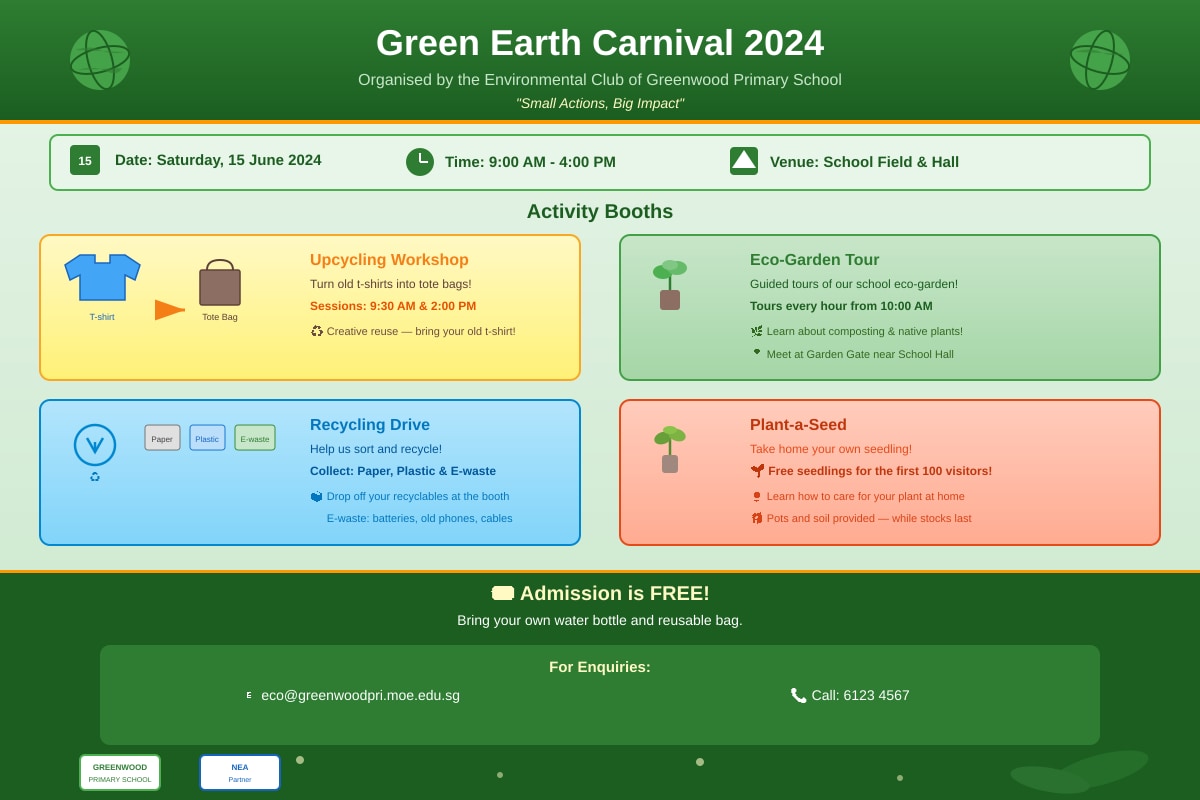
Study the poster below carefully and answer Questions 44 to 51.

<image_placeholder> id: Q44-fig1 type: source_image linked_question: Q44-51 description: A colourful poster for "Green Earth Festival 2024" at the Singapore Botanic Gardens. The poster shows: Event title "Green Earth Festival 2024" at top. Date: Saturday, 15 June 2024. Time: 9:00 AM – 6:00 PM. Venue: Singapore Botanic Gardens, Eco Lake Lawn. Tagline: "Celebrate Nature, Embrace Sustainability". Four activity icons with labels: (1) "Eco-Workshops: Upcycling, Composting, Urban Farming" at 10 AM, 1 PM, 3 PM. (2) "Nature Walks: Guided tours every hour from 9 AM" with a walking shoe icon. (3) "Green Market: Local organic produce, eco-friendly products" open all day with a leaf icon. (4) "Kids' Zone: Storytelling, crafts, face painting" at 11 AM, 2 PM, 4 PM with a smiling sun icon. Footer: "Free Admission! Bring your own water bottle and reusable bag. Organised by NParks and Green Singapore Initiative. For enquiries, email [email protected] or call 6471 9999." labels: Event title, Date, Time, Venue, Tagline, Four activity sections with times, Footer details values: Date: Saturday, 15 June 2024; Time: 9:00 AM – 6:00 PM; Venue: Singapore Botanic Gardens, Eco Lake Lawn; Workshop times: 10 AM, 1 PM, 3 PM; Nature walks: hourly from 9 AM; Kids' Zone: 11 AM, 2 PM, 4 PM; Contact: [email protected], 6471 9999 must_show: All text clearly legible, activity icons distinct, times visible, contact information readable </image_placeholder>

44. What is the main purpose of the Green Earth Festival?
_________________________________________________________ [ ] (1 mark)

45. Where will the festival be held?
_________________________________________________________ [ ] (1 mark)

46. If you want to learn about composting, what time should you attend the Eco-Workshops?
_________________________________________________________ [ ] (1 mark)

47. Which activity is available throughout the entire day?
_________________________________________________________ [ ] (1 mark)

48. What two items are visitors encouraged to bring?
_________________________________________________________ [ ] (1 mark)

49. Who are the organisers of the festival?
_________________________________________________________ [ ] (1 mark)

50. How can someone get more information about the festival?
_________________________________________________________ [ ] (1 mark)

51. Which activity would be most suitable for a 6-year-old child?
_________________________________________________________ [ ] (1 mark)


Passage B: Narrative Text (14 marks)

Read the passage carefully and answer Questions 52 to 65.

The lighthouse had stood sentinel on the cliff for over a century, its beam cutting through the darkest nights. Elias, the keeper, knew every creak of its iron stairs, every groan of the lantern room as the wind battered the glass. He had tended the light for thirty years, since he was a young man with calloused hands and a heart full of duty.

Tonight, the sea was a cauldron. Waves crashed against the cliffs with a fury that shook the very foundations. The storm had come without warning, swallowing the horizon in bruised purples and greys. Elias checked the fuel, trimmed the wick, and watched the flame grow steady behind the Fresnel lens. The beam swept out — one flash, darkness, one flash — a heartbeat against the chaos.

At 2:17 a.m., the radio crackled. "Mayday, mayday. This is the cargo vessel Mara. We've lost engines and are drifting toward the shoals. Position unknown. Requesting immediate assistance."

Elias gripped the microphone. "Mara, this is Cliffside Light. Keep your heading. I'll alert the coast guard." His voice was calm, but his fingers trembled slightly as he reached for the emergency line.

The coast guard responded within minutes. A helicopter was dispatched, but the wind shear made flying treacherous. The lifeboat station at the harbour was closer, but the launch would take twenty minutes in these seas. Twenty minutes the Mara might not have.

Elias looked at the beam sweeping the water. He knew the shoals better than anyone — the hidden teeth of rock that had claimed countless ships. If the Mara drifted just a little further north, she would hit the Devil's Fingers, a jagged reef that tore hulls open like paper.

He made a decision. The old signal lamp on the gallery — unused for decades since radio became standard — still worked. He had tested it last month, on a whim. Now, he climbed the external ladder, rain lashing his face, wind howling like a wounded animal. The gallery was slick with spray. He reached the lamp, his numb fingers finding the shutter mechanism.

Flash. Pause. Flash. Pause. Flash.

Three short. Three long. Three short.

SOS.

He repeated it, again and again, his arms burning, the cold seeping into his bones. The beam from the main light continued its steady sweep, but this — this was a message. Hold on. Help is coming. You are seen.

On the bridge of the Mara, the second mate spotted it. A rhythmic flashing from the cliff, distinct from the lighthouse's regular sweep. He grabbed the signal chart. "Captain! SOS from the light station!"

The captain, a man of few words and deep lines, nodded. "Then we hold position. Drop the sea anchor. We wait."

Twenty-three minutes later, the lifeboat's searchlight cut through the rain. The Mara's crew, huddled on deck, cheered as the orange hull appeared through the gloom. By dawn, all twenty-three souls were safe in the harbour.

Elias watched the lifeboat return from the gallery, his clothes soaked through, hands raw. The storm was breaking, pale light bleeding into the sky. The lighthouse beam still swept — one flash, darkness, one flash — faithful as ever.

He descended the ladder, legs unsteady. In the lantern room, the logbook lay open. He picked up his pen, paused, and wrote: 02:17 — Mara drifting. SOS signalled via gallery lamp. Lifeboat launched 02:20. All rescued 04:40. Light maintained throughout.

He closed the book. The light kept turning.

52. Which word in the first paragraph tells you that the lighthouse had been standing for a very long time?
_________________________________________________________ [ ] (1 mark)

53. What does the phrase "a cauldron" suggest about the sea?
_________________________________________________________ [ ] (2 marks)

54. Why did Elias's fingers tremble when he reached for the emergency line?
_________________________________________________________ [ ] (2 marks)

55. What was the danger if the Mara drifted further north?
_________________________________________________________ [ ] (2 marks)

56. Why did Elias decide to use the old signal lamp?
_________________________________________________________ [ ] (2 marks)

57. What does the phrase "hidden teeth of rock" tell you about the Devil's Fingers?
_________________________________________________________ [ ] (2 marks)

58. How did the captain of the Mara react when he saw the SOS signal?
_________________________________________________________ [ ] (2 marks)

59. Which sentence in the passage shows that Elias was physically exhausted after signalling?
_________________________________________________________ [ ] (1 mark)

60. What quality of Elias does the last sentence — "The light kept turning" — emphasise?
_________________________________________________________ [ ] (2 marks)


SECTION D: WRITING (30 marks)

Question 61: Situational Writing (15 marks)

Study the information below and write an email.

Task: You are the Chairperson of the Environmental Club in your school. Write an email to the Principal, Mrs. Tan, to propose a school-wide "Zero Waste Week" campaign.

You must include the following points:

  • The objective of the campaign
  • Two activities planned for the week
  • How students can participate
  • Why this campaign is important for the school

You may add other relevant details.

Write your email in the space below. Remember to use the correct format.


To: [email protected]
Cc:
Subject: _______________________________________________


Question 62: Continuous Writing (15 marks)

Write a composition of at least 150 words on the topic:

"A decision that changed everything"

You may use the following points to help you:

  • What was the decision?
  • Who made it?
  • What happened as a result?
  • How did it change things?

You may also use your own ideas.


END OF PAPER

Answers

<!-- TuitionGoWhere generation metadata: stage=3-1; model=nvidia/nemotron-3-ultra-550b-a55b:free; model_label=NVIDIA Nemotron 3 Ultra 550B A55B Free; generated=2026-06-05; Sources: Stage 2-1 real exam-derived templates and Stage 2-2 exam-enriched syllabus. -->

TuitionGoWhere Practice Paper - English Primary 6 PSLE (Answer Key)

Subject: English
Level: Primary 6 PSLE
Paper: SA2 Version 2
Total Marks: 95


SECTION A: GRAMMAR & VOCABULARY (28 marks)

Questions 1 to 10: Grammar MCQ (10 marks)

1. Answer: (3) were
Explanation: This is a second conditional sentence (hypothetical situation). The structure is "If + past subjunctive, would + base verb". For the verb "to be", the past subjunctive form is "were" for all persons (I, he, she, it, we, you, they). "If I were you" is the standard form.
Common mistake: Using "was" instead of "were" — in formal English, "were" is required for hypothetical conditions.

2. Answer: (3) was
Explanation: The subject is "The team of players" (singular collective noun). The phrase "together with their coach" is a prepositional phrase that does not change the number of the subject. Singular subject takes singular verb "was".
Key concept: Phrases like "together with", "along with", "as well as" do not make the subject plural.

3. Answer: (1) had
Explanation: This is an inversion structure with "Hardly". When a sentence begins with "Hardly/Scarcely/Barely", we use past perfect inversion: "Hardly had + subject + past participle". The past perfect "had rung" shows the bell rang before the students rushed out.
Pattern: Hardly had the bell rung when...

4. Answer: (1) submit
Explanation: After verbs of insistence, demand, recommendation, suggestion (insist, demand, recommend, suggest), we use the subjunctive mood: "that + subject + base form of verb". The base form is "submit" (not "submits" or "submitted").
Key verbs: insist, demand, recommend, suggest, require, propose.

5. Answer: (1) did
Explanation: "Not only" at the beginning of a sentence triggers inversion. The structure is "Not only + auxiliary verb + subject + main verb". Since "fail" is in base form (bare infinitive after "did"), the auxiliary must be "did" (past tense) to match "was damaged" later in the sentence.
Structure: Not only did the experiment fail...

6. Answer: (3) had left
Explanation: "By the time" + past tense ("arrived") requires past perfect ("had left") for the earlier action. The train left BEFORE we arrived. Past perfect shows the earlier of two past actions.
Timeline: Train left (earlier) → We arrived (later).

7. Answer: (1) be
Explanation: After "recommended that", we use the subjunctive: "that + subject + be + past participle" (passive subjunctive). The structure is "recommended that the proposal be reviewed".
Pattern: recommend/suggest/insist + that + subject + be + past participle.

8. Answer: (1) Although
Explanation: "Although" is a subordinating conjunction that introduces a contrast clause. "Despite" is a preposition and cannot be followed by a clause with subject + verb (would need "Despite the fact that..."). "However" and "Therefore" are conjunctive adverbs, not conjunctions.
Structure: Although + subject + verb.

9. Answer: (3) have been playing
Explanation: "Since morning" indicates an action that started in the past and continues to the present. Present perfect continuous "have been playing" shows duration of an ongoing activity.
Key words: since, for → present perfect continuous.

10. Answer: (1) is
Explanation: With "Neither...nor", the verb agrees with the subject closer to it (proximity rule). "The teacher" is singular, so the verb is singular "is".
Rule: Neither A nor B → verb agrees with B.


Questions 11 to 18: Vocabulary MCQ (8 marks)

11. Answer: (1) scrutinised
Explanation: "Scrutinised" means examined closely and carefully. A detective would scrutinise an alibi for inconsistencies. "Glanced" (quick look), "overlooked" (missed), and "ignored" (paid no attention) are opposite in meaning.

12. Answer: (2) negligible
Explanation: "Despite" signals contrast. If the jury remained unconvinced, the evidence must have been weak or insignificant. "Negligible" means so small as to be unimportant. The other options (overwhelming, substantial, compelling) would convince a jury.

13. Answer: (3) eerie
Explanation: "Eerie" means strange and frightening, creating an uncomfortable feeling. This fits "made visitors uncomfortable". "Cheerful", "vibrant", and "lively" are positive and opposite in meaning.

14. Answer: (2) vented
Explanation: "Vented" means expressed or released strong emotion. Going for a run to release frustration is venting. "Suppressed" and "concealed" mean hidden; "accumulated" means built up.

15. Answer: (3) exponential
Explanation: "Exponential" means increasing rapidly. This would surprise investors. "Stagnant" (not growing), "marginal" (very small), and "negligible" (insignificant) would not surprise optimistic investors.

16. Answer: (3) insensitive
Explanation: "Insensitive" means showing no concern for others' feelings, which would offend an audience. "Tactful", "diplomatic", and "considerate" are positive qualities unlikely to offend.

17. Answer: (3) address
Explanation: "Address" means deal with or tackle a problem. "Exacerbate", "aggravate", and "intensify" all mean make worse — opposite of what we want before a problem escalates.

18. Answer: (3) unique
Explanation: "Unique" means one of a kind, which matches "no two pieces are alike". "Conventional" (traditional), "derivative" (copied), and "imitative" (copying) are opposite in meaning.


Questions 19 to 22: Phrasal Verbs & Idioms (4 marks)

19. Answer: (2) put aside
Explanation: "Put aside" means set aside/disregard temporarily. "Put up with" = tolerate; "put off" = postpone; "put across" = communicate.

20. Answer: (1) handed down
Explanation: "Handed down" = passed from generation to generation. "Handed in" = submitted; "handed out" = distributed; "handed over" = gave control.

21. Answer: (1) get over
Explanation: "Get over" = recover from/overcome. "Get away" = escape; "get by" = manage; "get through" = survive/finish.

22. Answer: (1) called off
Explanation: "Called off" = cancelled. "Called on" = visited/asked; "called up" = phoned/conscripted; "called back" = returned a call.


Questions 23 to 28: Collocations & Word Forms (6 marks)

23. Answer: decision
Explanation: Noun form of "decide". The structure "The __________ to postpone" requires a noun. Suffix "-sion" changes verb "decide" to noun "decision".

24. Answer: irresponsible
Explanation: Negative prefix "ir-" + "responsible" (adjective from "respond"). "It is __________ of you" requires an adjective describing a person's behaviour. "Irresponsible" = not showing responsibility.

25. Answer: contribution
Explanation: Noun form of "contribute". Suffix "-tion" changes verb to noun. "Made a significant __________" requires a noun.

26. Answer: reach (or "make")
Explanation: Collocation: "reach a decision" (formal) or "make a decision" (common). Both are acceptable. "Do a decision" and "take a decision" (British English "take a decision" is possible but less common in Singapore context) — "reach" and "make" are best.

27. Answer: extensive
Explanation: Collocation: "extensive damage" = widespread/large-scale damage. "Intensive" = thorough/concentrated; "expansive" = covering wide area (usually for views/land); "expensive" = costly (doesn't collocate with damage).

28. Answer: knack (or "flair"/"gift")
Explanation: Collocation: "have a knack for" = natural skill/ability. "Flair for" and "gift for" also work. "Talent for" is possible but "knack for detail" is a common collocation in editing contexts.


SECTION B: CLOZE PASSAGE (15 marks)

Passage 1: Grammar Cloze (10 marks)

29. which — Refers to "The ancient city of Petra" (thing), non-defining relative clause (comma before).
30. who — Refers to "the Nabataeans" (people), subject of "were skilled engineers".
31. who — Refers to "the Nabataeans" (people), subject of "carved". (Could also be "that" but "who" preferred for people.)
32. where — Refers to place "trade routes passed through it" (relative adverb of place).
33. that — Refers to "water system" (thing), defining relative clause (no comma), subject of "allowed".
34. who — Refers to "visitors" (people), subject of "come".
35. whose — Possessive relative pronoun for "the Treasury" (facade belongs to it).
36. that — Refers to "secrets" (thing), defining relative clause, subject of "lie".
37. why — Refers to "reason", relative adverb of reason.
38. which — Refers to the whole previous clause "Petra was abandoned remains a mystery", non-defining (comma before).


Passage 2: Vocabulary Cloze (5 marks)

39. fortitude — Mental strength to endure pain/adversity. Fits "endure freezing temperatures and exhaustion".
40. perseverance — Continued effort despite difficulty. Fits "keep going when every muscle aches".
41. Determination — Firmness of purpose. Fits "separates those who summit from those who turn back".
42. tenacity — Persistent determination. Fits "overcome seemingly impossible obstacles".
43. resilience — Ability to recover from setbacks. Fits "recover from setbacks — that ensures a safe return".

Note: These five words are synonyms but have nuanced differences. The context clues in each sentence guide the precise choice.


SECTION C: COMPREHENSION (22 marks)

Passage A: Visual Text (8 marks)

44. To celebrate nature and promote/embrace sustainability. (Accept: Celebrate nature, embrace sustainability.)
45. Singapore Botanic Gardens, Eco Lake Lawn.
46. 10 AM, 1 PM, or 3 PM. (Any one time is acceptable.)
47. Green Market: Local organic produce, eco-friendly products.
48. Own water bottle and reusable bag.
49. NParks and Green Singapore Initiative.
50. Email [email protected] or call 6471 9999.
51. Kids' Zone: Storytelling, crafts, face painting. (Most suitable for a 6-year-old.)


Passage B: Narrative Text (14 marks)

52. century
Explanation: "Over a century" means more than 100 years.

53. The sea was turbulent/violent/chaotic, like a boiling cauldron.
Explanation: A cauldron is a large metal pot for boiling liquids over a fire. The metaphor suggests the sea was churning, bubbling, and dangerously hot/violent. (2 marks: 1 for identifying turbulence/violence, 1 for explaining the metaphor.)

54. He was nervous/anxious about the emergency / the lives at stake.
Explanation: "His voice was calm, but his fingers trembled slightly" shows a contrast between his professional composure and inner anxiety. The mayday call meant lives were in danger. (2 marks: 1 for identifying nervousness/anxiety, 1 for linking to the emergency/stakes.)

55. The Mara would hit the Devil's Fingers, a jagged reef that would tear the hull open.
Explanation: The text states: "If the Mara drifted just a little further north, she would hit the Devil's Fingers, a jagged reef that tore hulls open like paper." (2 marks: 1 for identifying Devil's Fingers, 1 for explaining the consequence.)

56. The radio/helicopter/lifeboat would take too long; the signal lamp was immediate and could communicate directly with the ship.
Explanation: The helicopter faced wind shear; the lifeboat would take 20 minutes. The old signal lamp on the gallery was available and could send an SOS immediately to tell the crew to hold on. (2 marks: 1 for identifying time constraint, 1 for explaining the lamp's advantage.)

57. The rocks are sharp, dangerous, and hidden underwater like teeth waiting to bite.
Explanation: "Hidden teeth of rock" is a metaphor. Teeth are sharp and bite; "hidden" means underwater/invisible. The reef is jagged (sharp) and concealed (hidden), making it deadly. (2 marks: 1 for sharp/jagged, 1 for hidden/dangerous.)

58. He ordered the crew to drop the sea anchor and hold position / wait for rescue.
Explanation: "Captain! SOS from the light station!" The captain nodded. "Then we hold position. Drop the sea anchor. We wait." (2 marks: 1 for action taken, 1 for reason/result.)

59. "He descended the ladder, legs unsteady." OR "His clothes soaked through, hands raw."
Explanation: These physical details show exhaustion after climbing the ladder in the storm and operating the lamp repeatedly. (1 mark for quoting a relevant sentence.)

60. Steadfastness / reliability / unwavering duty / faithfulness.
Explanation: The lighthouse beam continued "faithful as ever" and "The light kept turning" despite the storm, the emergency, and Elias's exhaustion. It symbolises his constant, reliable dedication to duty. (2 marks: 1 for identifying the quality, 1 for explaining with textual evidence.)


SECTION D: WRITING (30 marks)

Question 61: Situational Writing (15 marks)

Marking Descriptors (Holistic):

BandMarksDescriptors
113-15Task fully addressed. All 4 content points covered clearly and well-developed. Tone is respectful and persuasive (appropriate for writing to Principal). Format is correct (email: To, Cc, Subject, Salutation, Sign-off). Language is accurate, varied, and effective.
210-12Task addressed. All 4 content points covered but some may be underdeveloped. Tone generally appropriate. Format mostly correct. Language mostly accurate with some errors that do not impede communication.
37-9Task partially addressed. 2-3 content points covered. Tone may be inconsistent. Format has errors. Language has frequent errors but meaning is generally clear.
44-6Task barely addressed. 1-2 content points mentioned. Tone inappropriate. Format incorrect. Language errors impede communication.
50-3Task not addressed. Content irrelevant. Language largely incomprehensible.

Content Points Required:

  1. Objective: Reduce waste in school / promote zero-waste habits / raise environmental awareness.
  2. Two activities: e.g., "Bring Your Own Container Day", "Recycling Competition", "Upcycling Workshop", "Food Waste Audit", "Zero-Waste Lunch Challenge", "Eco-Assembly Talk".
  3. How students participate: e.g., sign up via FormSG, bring reusable containers, join class challenges, submit pledges, attend workshops.
  4. Importance: Aligns with MOE's Eco Stewardship Programme / Singapore Green Plan 2030 / builds lifelong habits / reduces school's carbon footprint / empowers student leadership.

Sample Email (Band 1):

To: [email protected]
Cc: [email protected]
Subject: Proposal for School-Wide "Zero Waste Week" Campaign

Dear Mrs Tan,

I am writing on behalf of the Environmental Club to propose a school-wide "Zero Waste Week" campaign from 15 to 19 July 2024. The objective is to cultivate sustainable habits among students and reduce the school's waste output, aligning with the MOE Eco Stewardship Programme and Singapore Green Plan 2030.

We have planned two key activities. First, a "Zero-Waste Lunch Challenge" where students bring recess and lunch in reusable containers for the entire week. Classes with the highest participation will win a "Green Champion" badge. Second, an "Upcycling Workshop" during CCA periods, where students transform used materials (e.g., plastic bottles, cardboard) into

<stage3_exam_answers_md>

TuitionGoWhere Practice Paper - English Primary 6 PSLE (Answer Key)

Subject: English
Level: Primary 6 PSLE
Paper: SA2 Version 2
Total Marks: 95


SECTION A: GRAMMAR & VOCABULARY (28 marks)

Questions 1 to 10: Grammar MCQ (10 marks)

QnAnswerExplanation
1(3) wereSubjunctive mood for hypothetical condition ("If I were you")
2(3) wasSubject is "The team" (singular collective noun); "together with their coach" is a prepositional phrase, not part of the subject
3(1) hadInversion after "Hardly" requires past perfect auxiliary "had"
4(1) submitSubjunctive mood after "insisted that" — base form of verb
5(1) didInversion after "Not only" at start of sentence; past tense "did" matches "was damaged"
6(3) had leftPast perfect for action completed before another past action ("arrived")
7(1) beSubjunctive mood after "recommended that" — base form "be" + past participle "reviewed"
8(1) AlthoughSubordinating conjunction introducing a contrast clause; "Despite" is a preposition, "However" is an adverb
9(3) have been playingPresent perfect continuous for action started in past ("since morning") and continuing
10(1) isProximity rule: verb agrees with nearest subject ("the teacher" — singular)

Questions 11 to 18: Vocabulary MCQ (8 marks)

QnAnswerExplanation
11(1) scrutinisedMeans "examined closely" — fits detective investigating alibi
12(2) negligibleMeans "insignificant" — contrasts with "remained unconvinced" (if evidence was overwhelming/compelling/substantial, jury would likely be convinced)
13(3) eerieMeans "strange and frightening" — fits uncomfortable atmosphere
14(2) ventedMeans "expressed/released strong emotion" — "vented her frustration" is a common collocation
15(3) exponentialMeans "rapidly increasing" — fits "surprised even the most optimistic investors"
16(3) insensitiveMeans "lacking consideration for others' feelings" — fits "offended many"
17(3) addressMeans "deal with/tackle a problem" — the only positive action among choices
18(3) uniqueMeans "one of a kind" — fits "no two pieces are alike"

Questions 19 to 22: Phrasal Verbs & Idioms (4 marks)

QnAnswerExplanation
19(2) put asideMeans "set aside/disregard temporarily" — fits "differences" and "work together"
20(1) handed downMeans "passed from generation to generation" — fits "legend"
21(1) get overMeans "overcome/recover from" — fits "fear of public speaking"
22(1) called offMeans "cancelled/postponed" — fits meeting postponed due to absence

Questions 23 to 28: Collocations & Word Forms (6 marks)

QnAnswerExplanation
23decisionNoun form of "decide" — "The decision to postpone..."
24irresponsibleNegative adjective form (prefix ir- + responsible) — fits "ignore your friend's messages"
25contributionNoun form of "contribute" — "made a significant contribution"
26make / reachCollocations: "make a decision" or "reach a decision" (both acceptable)
27extensiveCollocation: "extensive damage" (large in amount/degree)
28knack / flair / talent / giftAll four are acceptable collocations with "for detail" — any one earns the mark

SECTION B: CLOZE PASSAGE (15 marks)

Passage 1: Grammar Cloze (10 marks)

BlankAnswerExplanation
29whichNon-defining relative clause for place/thing ("Petra") — comma before blank signals non-defining
30whoSubject relative pronoun for people ("the Nabataeans")
31who / thatSubject relative pronoun for people — "who" preferred for people, "that" also acceptable in defining clause
32whereRelative adverb for place — "trade routes passed through it (the city)" → "where" = "in which"
33that / whichSubject relative pronoun for thing ("water system") — defining clause (no comma)
34who / thatSubject relative pronoun for people ("visitors") — defining clause
35whosePossessive relative pronoun — "facade" belongs to "the Treasury"
36that / whichSubject relative pronoun for thing ("secrets") — defining clause
37whyRelative adverb for reason — "The reason why Petra was abandoned"
38whichNon-defining relative clause referring to the whole preceding clause ("remains a mystery")

Passage 2: Vocabulary Cloze (5 marks)

BlankAnswerExplanation
39fortitudeMental strength to endure pain/adversity — fits "endure freezing temperatures and exhaustion"
40tenacityPersistent determination — fits "keep going when every muscle aches"
41DeterminationFirmness of purpose — fits "separates those who summit from those who turn back"
42perseveranceContinued effort despite difficulties — fits "overcome seemingly impossible obstacles"
43resilienceAbility to recover from setbacks — explicitly defined in the sentence: "the ability to recover from setbacks"

SECTION C: COMPREHENSION (22 marks)

Passage A: Visual Text (8 marks)

QnAnswer
44To celebrate nature and embrace sustainability. / To promote environmental awareness and sustainable practices.
45Singapore Botanic Gardens, Eco Lake Lawn.
4610 AM, 1 PM, or 3 PM. (Any one timing is acceptable.)
47Green Market: Local organic produce, eco-friendly products (open all day).
48Own water bottle and reusable bag.
49NParks and Green Singapore Initiative.
50Email [email protected] or call 6471 9999.
51Kids' Zone: Storytelling, crafts, face painting (at 11 AM, 2 PM, 4 PM).

Passage B: Narrative Text (14 marks)

QnAnswer
52"century" (or "over a century")
53It suggests the sea was turbulent, violent, and churning violently like a boiling cauldron. / It suggests the sea was extremely rough and dangerous.
54He was nervous/anxious about the emergency situation / the lives at stake, even though his voice was calm.
55The Mara would hit the Devil's Fingers, a jagged reef that would tear the hull open and sink the ship.
56The radio/helicopter/lifeboat would take too long, and the Mara was in immediate danger of hitting the shoals; the signal lamp was a faster way to communicate directly with the ship.
57It suggests the rocks are sharp, dangerous, and hidden underwater like teeth waiting to tear something apart. / It uses a metaphor to show the rocks are jagged and deadly.
58He ordered the crew to drop the sea anchor and hold position to wait for rescue. / He calmly acknowledged the signal and took immediate action to keep the ship safe.
59"He descended the ladder, legs unsteady." OR "his clothes soaked through, hands raw." OR "arms burning, the cold seeping into his bones." (Any one relevant sentence.)
60It emphasises Elias's steadfastness / reliability / unwavering dedication to his duty — the light continues faithfully regardless of the storm or his exhaustion.

SECTION D: WRITING (30 marks)

Question 61: Situational Writing (15 marks) — Sample Answer

To: [email protected]
From: [email protected]
Date: 15 May 2024
Subject: Proposal for School-Wide "Zero Waste Week" Campaign

Dear Mrs Tan,

I am writing on behalf of the Environmental Club to propose a school-wide "Zero Waste Week" campaign from 3 to 7 June 2024. This initiative aims to raise awareness about waste reduction and cultivate sustainable habits among all students and staff.

Objective
The campaign seeks to minimise single-use waste in our school and empower every student to adopt a zero-waste mindset through simple, daily actions.

Planned Activities

  1. "Trash-Free Tuesday" Lunch Challenge – Students bring recess and lunch in reusable containers only. Class monitors will track participation, and the class with the highest percentage of zero-waste lunches wins a "Green Champion" badge.
  2. Upcycling Workshop (Wednesday & Friday, 2–4 p.m.) – Student volunteers will run hands-on sessions turning used materials (e.g., plastic bottles, old T-shirts, cardboard) into useful items like planters, tote bags, and stationery holders. Materials will be collected via donation boxes placed in the canteen from 27 May.

Student Participation

  • Daily: Use reusable water bottles, containers, and cutlery; refuse single-use plastics.
  • Pledge Wall: Sign a personal "Zero Waste Pledge" at the foyer during assembly periods.
  • Eco-Ambassadors: Each class appoints two ambassadors to remind peers and log daily waste reduction.
  • Social Media: Share zero-waste tips on the school's Instagram with #TGZeroWaste.

Importance to the School

  • Environmental Impact: Reduces the school's carbon footprint and waste disposal costs.
  • Character Development: Fosters responsibility, creativity, and leadership — aligned with our school values of Care and Excellence.
  • Community Influence: Positions our school as a sustainability leader; parents and neighbouring schools may adopt similar practices.
  • Curriculum Links: Complements Science (materials), CCE (citizenship), and Art (upcycling).

We have drafted a detailed implementation timeline and budget (under $300, funded by club savings). May we meet next week to discuss this further? We are confident this campaign will inspire lasting change.

Thank you for your consideration.

Yours sincerely,
[Your Name]
Chairperson, Environmental Club
Primary 6 [Class]


Question 62: Continuous Writing (15 marks) — Sample Outline & Model Essay

Topic: Write a story about a time you helped someone in need. You may use the pictures below in any order.
(Pictures: 1. An elderly woman struggling with heavy grocery bags. 2. A boy noticing her. 3. The boy helping her carry the bags home. 4. The woman smiling gratefully.)

Model Essay:

A Heavy Load, A Light Heart

The afternoon sun beat down on the pavement, turning the air shimmering and thick. I was cycling home from tuition, legs pedalling on autopilot, mind still tangled in algebra equations. Then I saw her.

Mdm Lee, our neighbour from Block 12, stood at the foot of the overhead bridge. She was a frail woman in her eighties, her back bent like a question mark. In each hand, she clutched a bulging plastic bag — rice, canned goods, vegetables — the weekly haul that must have weighed a ton. She stared up at the long flight of stairs, then at the lift lobby where a sign blinked: Under Maintenance.

She took a breath, gripped the handrail, and lifted one bag. It barely cleared the first step before her arms trembled. She set it down, pressing a hand to her lower back. Her lips moved silently — counting steps, perhaps, or praying.

I braked hard, the tyres screeching. "Mdm Lee! Let me help."

She started, eyes widening behind thick lenses. "Oh, Wei Ming... you're in a rush, go on..."

"I'm not. Not for this." I dropped my bike's kickstand and picked up both bags. They were heavier than they looked — dense with tins and grain. "Which floor?"

"Fourth. But really, you shouldn't—"

"Fourth it is."

We began the climb. My thighs burned by the second landing; sweat stung my eyes. Mdm Lee walked slowly beside me, one hand on the rail, the other hovering near my elbow as if to steady me. "You're a good boy," she said quietly. "Your mother raised you well."

"She'd say the same about you. You always share your kueh with us during Hari Raya."

She chuckled, a dry, rattling sound. "Ah, those days. Now I can barely lift the mixing bowl."

At the third landing, a group of teenagers thundered past, earbuds in, laughter loud. They didn't look at us. I tightened my grip on the bags, a flare of irritation rising — then Mdm Lee's voice, soft: "They're young. They don't see yet."

See what? I thought. That kindness isn't a spectacle? That it's just... what you do?

We reached the fourth floor. Her flat smelled of pandan and old newspapers. She insisted on giving me a container of ondeh-ondeh, still warm from the steamer. "Eat before they're gone," she commanded, shooing me toward the door.

I cycled home with the container tucked in my basket, the green palm-sugar centres bursting sweet on my tongue. The algebra waited on my desk, unsolved. But for the first time all day, the numbers didn't matter.

I had carried more than groceries up those stairs. I had carried a moment of connection — heavy, awkward, utterly simple. And somehow, the load made me lighter.


Marking Guide for Continuous Writing (15 marks):

  • Content & Relevance (6 marks): Clear narrative addressing the topic; uses at least one picture meaningfully.
  • Language & Organisation (9 marks):
    • Vocabulary: Precise, varied, appropriate (e.g., frail, autopilot, trembled, shooing, burst).
    • Grammar: Accurate tenses, sentence structures, punctuation.
    • Structure: Engaging opening, logical sequence, reflective ending.
    • Tone: Authentic, emotive, shows character growth.

END OF ANSWER KEY