From Real Exams Quiz
Primary 6 PSLE Chinese Writing Quiz
Free P6 PSLE Chinese Writing quiz, Nemo3 Exam version, with questions, answers, and PSLE-focused practice for Singapore students.
These static practice materials are generated from the site's syllabus and paper-generation workflow, with source and model context shown so students and parents can evaluate the material before use.
Questions
Free quiz and exam paper access
Enter your details to view this paper
Your access is remembered on this device.
Answers
Primary 6 PSLE Chinese Quiz - Writing (Answer Key)
Total Marks: 40
Section A: Vocabulary & Sentence Construction [10 marks]
Q1 (1 mark)
Answer: B
Explanation: “扣人心弦” means gripping or deeply moving, often used for plots/stories. “平淡无奇” = ordinary; “一成不变” = unchanged; “毫不在意” = not caring. The context “让观众看得津津有味” (audience watched with great interest) requires a positive, engaging description.
Q2 (1 mark)
Answer: C
Explanation: “迎难而上” means to face difficulties head-on. “知难而退” = retreat when facing difficulty; “半途而废” = give up halfway; “因噎废食” = stop doing something because of a minor problem. The phrase “而不是轻言放弃” (instead of giving up easily) signals a positive, persevering idiom.
Q3 (1 mark)
Answer: A
Explanation: “粗糙” (rough) contrasts with “充满了力量” (full of strength), typical for describing an elderly person’s hands that have done hard work. The other options describe smooth, fair, or slender hands, which do not fit the contrast.
Q4 (1 mark)
Answer: D
Explanation: “表现出” is used with abstract nouns like feelings, qualities, or attitudes (e.g., 思念, 关心, 诚意). “表达/表达出” typically collocates with words like 意见, 思想, 感谢. “表现出深深思念” is the standard collocation.
Q5 (1 mark)
Answer: A
Explanation: “坚持不懈地” is an adverbial phrase modifying “努力”. The particle “地” is required for adverbs. “坚持不懈” (without “地”) is an adjective/predicate; “坚持” and “不懈” alone are incomplete.
Q6 (1 mark)
Answer: 我被妈妈准备了丰盛的早餐。 / 丰盛的早餐被妈妈为我准备了。
Explanation: “被”字句 structure: Receiver + 被 + Doer + Verb + (Result/Particle). Original: 妈妈 (doer) 为 我 (receiver) 准备了 早餐. Passive: 我 被 妈妈 为 准备了 丰盛的早餐. Note: “为我” is retained or rephrased. Common student answer: “我被妈妈准备了丰盛的早餐。”
Q7 (1 mark)
Answer: 尽管天气很冷,他还是坚持晨跑。
Explanation: “尽管……还是……” is a fixed concession structure. “虽然……但……” → “尽管……还是……”. “但” changes to “还是” to emphasize the action continues despite the condition.
Q8 (1 mark)
Answer: 这个问题如此难,以至于我们无法解决。
Explanation: “如此……以至于……” expresses degree/result. Structure: Subject + 如此 + Adjective/Verb + ,以至于 + Result. “非常” changes to “如此”; a comma is needed before “以至于”.
Q9 (1 mark)
Answer: 同学们难道不喜欢这位幽默风趣的老师吗? / 谁不喜欢这位幽默风趣的老师呢?
Explanation: Rhetorical question (反问句) affirms the opposite. Positive statement → Negative rhetorical question. Add “难道……吗?” or “谁不……呢?”. Must end with a question mark.
Q10 (1 mark)
Answer: 他不但获得了比赛第一名,而且让全校师生感到骄傲。
Explanation: “不但……而且……” connects two clauses. Subject “他” is shared. Clause 1: 获得了比赛第一名. Clause 2: 让全校师生感到骄傲. Ensure “不但” precedes the first verb phrase, “而且” precedes the second.
Section B: Picture Composition & Guided Writing [12 marks]
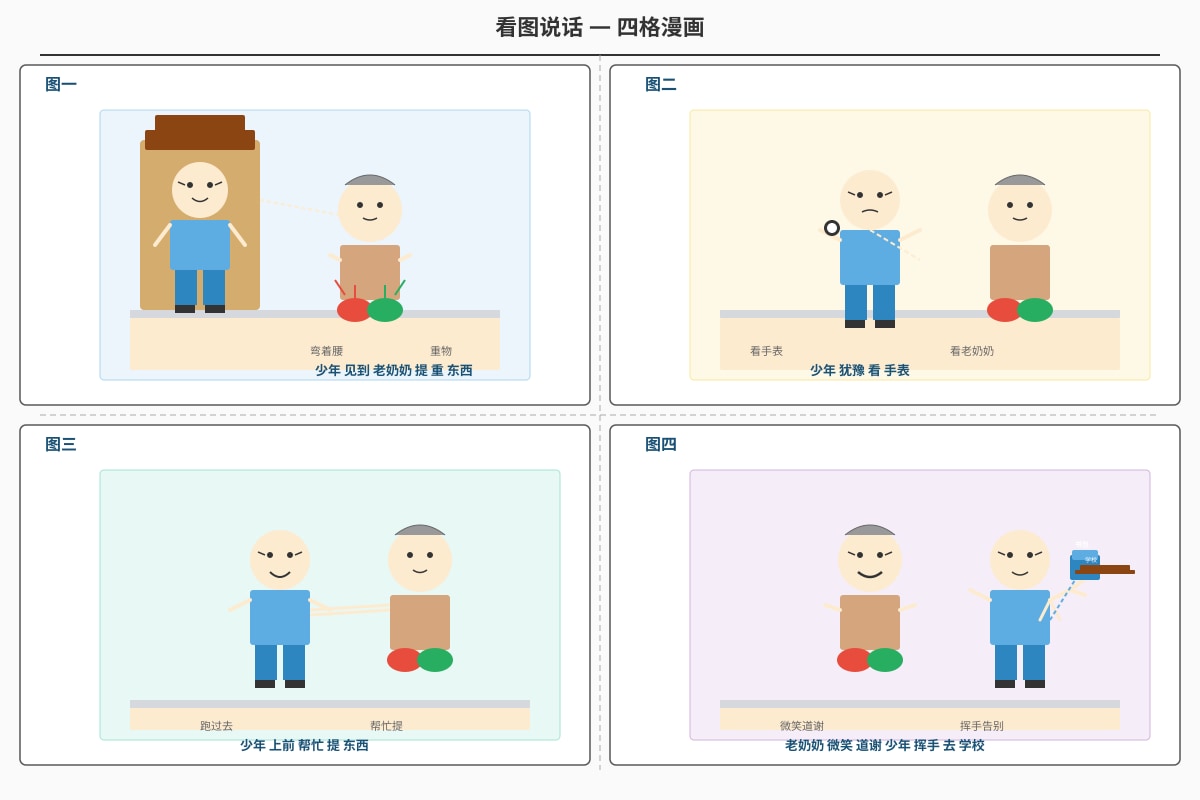
Q11 (4 marks) – Picture Sequence Description
Marking Guide (1 mark each):
- ✅ Correct sequence (Panel 1→4) with connectors (首先/接着/后来/最后).
- ✅ Key actions included: 看见老奶奶提重物、犹豫看表、上前帮忙、老奶奶道谢/挥手去学校.
- ✅ At least one description of facial expression/inner thought (e.g., 犹豫、微笑、感激).
- ✅ Coherent paragraph, 80–100 characters, proper punctuation.
Sample Answer:
首先,小明在搭铺底层看见一位老奶奶吃力地提着两大袋菜。接着,他看了看手表,又看了看老奶奶,心里犹豫了一会儿。后来,小明鼓起勇气跑上前,笑着帮老奶奶提起沉重的菜袋。最后,老奶奶感激地笑着直道谢,小明挥挥手,高高兴兴地跑向学校。
Q12 (3 marks) – Expanding a Sentence
Marking Guide (1 mark each):
- ✅ Actions described (e.g., 撒娇、跺脚、擦泪、抽泣).
- ✅ Facial expressions described (e.g., 嘟嘴、眼眶红、泪珠滚落).
- ✅ Surroundings/Context included (e.g., 手里掉落的冰淇淋、地上的蚂蚁、妈妈安慰的身影).
- Length 60–80 characters; fluent sentences.
Sample Answer:
妹妹手里的冰淇淋不小心掉在地上,瞬间化作一滩甜腻的糖水。她瞪大了眼睛,嘴巴一瘪,眼眶瞬间红了,大颗大颗的泪珠像断了线的珠子滚落下来。她跺着小脚,嘴里嘟囔着“冰淇淋……我的冰淇淋……”,声音里带着哭腔,引来路人侧目。
Q13 (3 marks) – Writing a Proper Ending
Marking Guide:
- ✅ Change in feeling shown (fear → courage/relief/affection) – 1 mark.
- ✅ Lesson learnt or meaningful action (e.g., feeding the dog, realizing it’s friendly) – 1 mark.
- ✅ Natural closure, 50–70 characters, emotional resonance – 1 mark.
Sample Answer:
就在这千钧一发之际,大黄狗只是友好地摇着尾巴,把一个沾满口水的球塞到小华脚边。小华惊讶地捡起球扔出去,大黄狗欢快地追去了。原本紧绷的心瞬间松下来,小华摸了摸它的头,笑着说:“原来你不是坏狗啊。”从此,他不再怕狗,反而交到了个毛茸茸的朋友。
Q14 (2 marks) – Dialogue Writing
Marking Guide (0.5 mark per exchange):
- ✅ Proper dialogue punctuation (colon, quotation marks).
- ✅ Student shows honesty (admits forgetting, gives reason).
- ✅ Teacher shows guidance (reminds, encourages, sets consequence).
- ✅ Natural tone, 3–4 exchanges.
Sample Answer:
老师:“小明,你的作业呢?怎么没交?”
学生:“老师,对不起。我昨晚做完了,但今早太赶时间,忘记放进书包了。”
老师:“诚实是好孩子,但粗心要改。放学前去我办公室拿回去补交,下次记得自检清单。”
学生:“好的,老师。我一定改,谢谢老师提醒。”
Section C: Continuous Writing [18 marks]
Q15 (2 marks) – Topic Analysis
Answer:
Key word 1: 一次 (one time / a single event – specificity)
Key word 2: 难忘 (unforgettable – emotional impact / significance)
Explanation: “一次” limits the composition to one specific incident, not a general habit. “难忘” requires the writer to show why it is memorable (emotion, lesson, uniqueness). Missing either = off-topic.
Q16 (2 marks) – Flashback Opening
Marking Guide:
- ✅ Uses flashback (starts from present reflection, then goes back) – 1 mark.
- ✅ Engaging hook (emotion, sensory detail, or question) – 0.5 mark.
- ✅ 40–50 characters, correct punctuation – 0.5 mark.
Sample Answer:
每当夜深人静,那一次的经历总像电影般在脑海重播。那是三年前的一个雷雨夜,我独自在家,听见敲门声……
Q17 (3 marks) – Sensory Details for Climax
Marking Guide (1 mark per detail):
- ✅ Sense clearly labelled (Sight/Sound/Touch/Smell/Taste).
- ✅ Specific, vivid description (not generic “I was scared”).
- ✅ Relevant to the climax of the chosen experience.
Sample Answer:
Detail 1 (Sense: Sight): 闪电撕裂夜空,惨白的光映照出门外那个佝偻的身影,手里举着一把伞。
Detail 2 (Sense: Sound): 雷声轰鸣中,传来一声沙哑轻咳,夹杂着雨滴敲打伞面的“啪嗒”声。
Detail 3 (Sense: Touch): 我颤抖着手握住冰凉的门把手,掌心全是冷汗,指尖因用力而发白。
Q18 (2 marks) – Reflective Conclusion
Marking Guide:
- ✅ Expresses lesson learnt / personal growth – 1 mark.
- ✅ 30–40 characters, emotionally resonant – 1 mark.
Sample Answer:
那一夜,我懂得了“守望”比“等待”更有温度,也学会了用行动去回应爱。
Q19 (6 marks) – Full Composition
Marking Rubric (Holistic, mapped to 6 marks):
| Band | Marks | Descriptors |
|---|---|---|
| Excellent | 5–6 | • ≥200 chars, tight structure (Intro-Body-Conclusion).<br>• Flashback intro + reflective conclusion.<br>• Climax rich in Show-Not-Tell (3+ sensory details).<br>• ≥2 idioms/proverbs used naturally.<br>• Dialogue + inner thoughts integrated.<br>• Fluent, varied sentences; minimal errors. |
| Good | 3–4 | • ≥180 chars, clear structure.<br>• Basic intro/conclusion (may lack technique).<br>• Some sensory details but uneven.<br>• 1–2 idioms used.<br>• Dialogue or inner thoughts present.<br>• Minor language errors. |
| Fair | 1–2 | • <180 chars or loose structure.<br>• Narrative flat, mostly “telling”.<br>• Few/no idioms.<br>• Limited dialogue/thoughts.<br>• Frequent errors affecting flow. |
| Weak | 0 | • Off-topic / <100 chars / incomprehensible. |
Key Content Expectations for 《一次难忘的经历》:
- Introduction: Flashback hook → introduce the “one time”.
- Body: Build-up → Climax (detailed sensory/psychological description) → Resolution.
- Conclusion: Reflection (lesson/change/gratitude).
- Idioms examples: 心惊胆战、千钧一发、感激涕零、铭记于心、受益匪浅.
- Proverbs examples: 患难见真情、一份耕耘一份收获.
Q20 (3 marks) – Self-Editing Checklist
Scoring: Each ✓ = 0.5 mark. Total ticks × 0.5 = Marks (max 3).
Teacher Note: This question assesses metacognitive awareness. Students must honestly self-evaluate. Award marks based on ticks shown, but verify against actual composition (Q19) during marking. If a student ticks “用了成语” but none appear, deduct 0.5 mark for that item.
End of Answer Key