From Real Exams Quiz
Primary 6 PSLE Chinese Speaking Quiz
Free P6 PSLE Chinese Speaking quiz, Nemo3 Exam version, with questions, answers, and PSLE-focused practice for Singapore students.
These static practice materials are generated from the site's syllabus and paper-generation workflow, with source and model context shown so students and parents can evaluate the material before use.
Questions
Free quiz and exam paper access
Enter your details to view this paper
Your access is remembered on this device.
Answers
Primary 6 PSLE Chinese Quiz - Speaking (Answer Key)
Total Marks: 40
Section A: Reading Aloud (朗读短文) [10 marks]
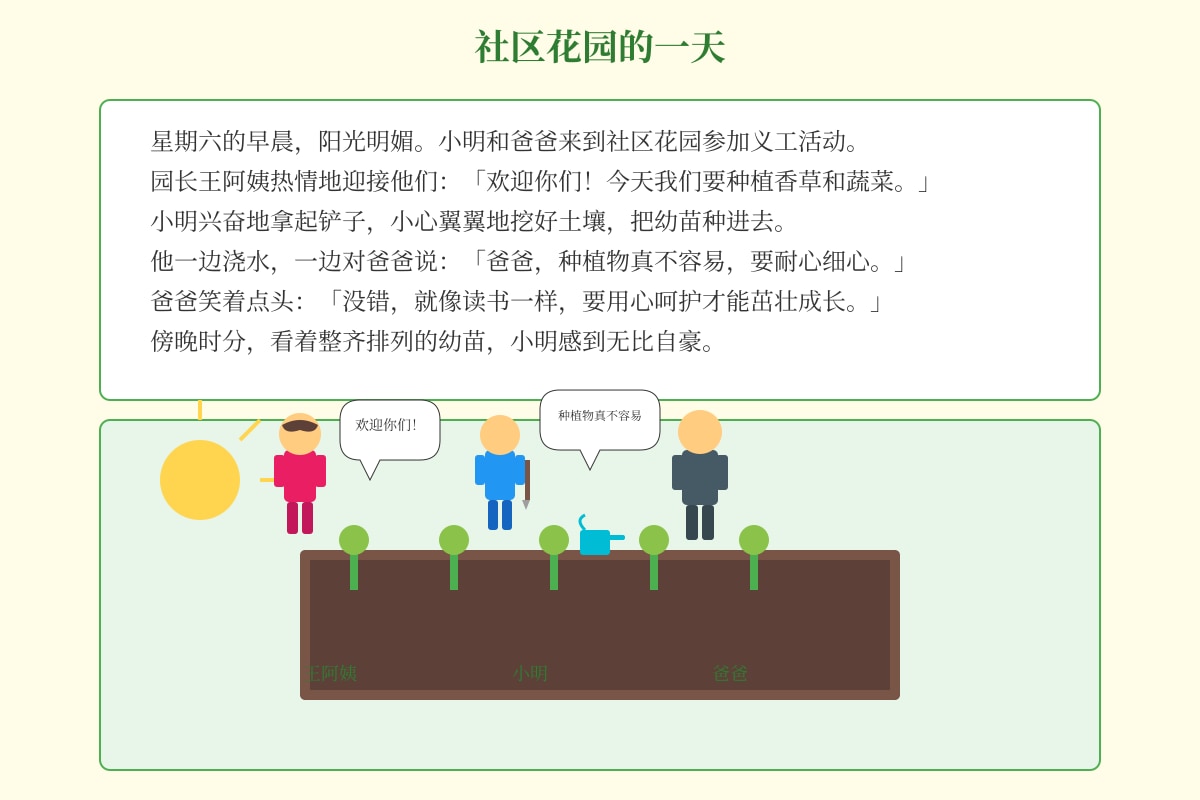
Q1. Read the passage aloud. [10 marks]
Marking Criteria (10 marks total):
- Pronunciation & Articulation (4 marks): Accurate pronunciation of all characters, clear articulation, correct tones. Key words: 阳光明媚 (yáng guāng míng mèi), 义工 (yì gōng), 热情 (rè qíng), 幼苗 (yòu miáo), 耐心细心 (nài xīn xì xīn), 呵护 (hē hù), 茁壮成长 (zhuó zhuàng chéng zhǎng), 自豪 (zì háo).
- Fluency & Pace (3 marks): Smooth reading without unnecessary pauses, appropriate speed (not too fast/slow), proper phrasing according to punctuation.
- Expression & Intonation (3 marks): Varied tone to convey excitement (小明兴奋地), warmth (爸爸笑着点头), pride (感到无比自豪). Appropriate pauses at commas and full stops. Dialogue read with character differentiation (园长 vs 小明 vs 爸爸).
Common Errors to Note:
- Mispronouncing 幼苗 as yāo miáo, 呵护 as kē hù, 茁壮 as zhuó zhuāng.
- Monotone reading without emotional variation.
- Ignoring punctuation, leading to run-on sentences.
Section B: Picture Conversation (看图会话) [15 marks]
Q2. Describe what you see in the picture in detail. [3 marks]
Expected Response Structure:
- Overall setting (1 mark): "这是学校食堂在课间休息时的景象,有很多学生在排队买吃的。"
- Key details (2 marks): Mention at least 3 distinct elements: food stalls (鸡饭、面摊、素食摊), students queuing, incident (student dropping food), prefect helping younger student, cleaners working, posters on wall, teacher on duty.
Sample Good Answer: "图里是学校食堂课间休息的情况。有三个摊位卖鸡饭、面和素食,很多学生排队买吃的。一个学生不小心把饭菜洒在地上,一位领生正在帮助一位低年级同学。两位清洁阿姨在擦桌子,墙上贴着'爱惜粮食'和'排队秩序'的海报,一位值日老师在旁边观察。"
Marking Notes:
- 3 marks: Comprehensive, well-organised, vivid vocabulary.
- 2 marks: Covers main scene but misses some details or lacks organisation.
- 1 mark: Fragmented, limited vocabulary, major omissions.
Q3. What do you think the student who dropped the food should do next? Why? [3 marks]
Expected Response:
- Action (1-2 marks): Pick up the food, inform the cleaner, apologise if necessary, be more careful next time.
- Reason (1-2 marks): Responsibility, hygiene, respect for cleaners' work, not wasting food.
Sample Good Answer: "那个学生应该马上把洒在地上的饭菜捡起来,或者叫清洁阿姨帮忙清理,因为这是他弄脏的,要负责任。同时也要向阿姨道歉,下次小心一点,不浪费粮食。"
Marking Notes:
- 3 marks: Clear action + thoughtful reason, good language.
- 2 marks: Action given but reason weak, or vice versa.
- 1 mark: Vague or incomplete.
Q4. How do the prefects and teachers help maintain order in the canteen? [3 marks]
Expected Response:
- Prefects (1-2 marks): Help younger students, remind students to queue, report issues.
- Teachers (1-2 marks): Supervise overall, intervene in conflicts, ensure safety, reinforce rules.
Sample Good Answer: "领生会帮助低年级同学买东西,提醒大家排队不插队,看到有人跑跑跳跳会制止。值日老师会巡视食堂,处理冲突,确保同学们安全、有秩序地用餐。"
Marking Notes:
- 3 marks: Distinct roles for both, specific examples.
- 2 marks: Mentions both but lacks specificity.
- 1 mark: Only mentions one role or very general.
Q5. The posters say "Save Food" and "Queue Orderly". Why are these reminders important? [3 marks]
Expected Response:
- Save Food (1-2 marks): Avoid waste, appreciate farmers' hard work, environmental responsibility, many people lack food.
- Queue Orderly (1-2 marks): Fairness, safety (prevent pushing), efficiency, respect for others.
Sample Good Answer: "'爱惜粮食'提醒我们不要浪费,因为粮食来之不易,农民辛苦种植,浪费也不好。'排队秩序'让大家公平买吃的,不插队、不推挤,避免意外受伤,也让食堂运作更顺利。"
Marking Notes:
- 3 marks: Both reasons well-explained with values.
- 2 marks: One reason strong, one weak.
- 1 mark: Superficial answers like "因为要好" without elaboration.
Q6. If you were the student dropping the food, how would you feel and what would you do? [3 marks]
Expected Response:
- Feelings (1-2 marks): Embarrassed, sorry, worried, anxious.
- Actions (1-2 marks): Clean up, apologise, learn to be careful, not repeat.
Sample Good Answer: "我会觉得很不好意思,也很愧疚,因为弄脏了地面,还要麻烦清洁阿姨。我会马上道歉,自己捡起来或请阿姨帮忙,下次拿餐盘会更小心。"
Marking Notes:
- 3 marks: Authentic feelings + responsible actions, expressive language.
- 2 marks: Feelings or actions only, or generic.
- 1 mark: Minimal response.
Section C: Conversation (会话) [15 marks]
Each question: 2 marks. Mark holistically for content relevance, elaboration, clarity, and language quality.
General Marking Descriptors (per question):
- 2 marks: Relevant, elaborated with personal detail/reasoning, clear expression, good vocabulary/grammar.
- 1 mark: Relevant but brief/underdeveloped, or some language errors affecting clarity.
- 0 marks: Irrelevant, unintelligible, or no response.
Q7. What is your favourite school activity? Why do you enjoy it? [2 marks]
Sample Answer: "我最喜欢运动会,因为可以和同学一起加油、比赛,增强班级凝聚力,还能锻炼身体,很开心。"
Key Points: Names activity + gives personal reason (social, physical, emotional).
Q8. Tell me about a time you helped someone at school. How did you feel? [2 marks]
Sample Answer: "有一次同学跌倒膝盖擦伤,我扶他去医务室,陪他等老师。我觉得很有意义,看到他笑了我也很开心。"
Key Points: Specific incident + reflection on feelings.
Q9. How do you usually spend your recess time? [2 marks]
Sample Answer: "我通常先去食堂买面包吃,然后和朋友在走廊聊天,或者去图书馆看书,有时也会在楼下跑跑跳跳。"
Key Points: Routine described with variety.
Q10. What qualities do you think a good classmate should have? [2 marks]
Sample Answer: "好同学应该乐于助人、诚实守信、尊重别人,遇到困难会伸出援手,不说谎,也不会欺负人。"
Key Points: At least 2 qualities with brief explanation.
Q11. Describe a memorable experience you had during a school excursion or camp. [2 marks]
Sample Answer: "去年露营时我们要自己搭帐篷,一开始不会,大家互相帮忙,最后成功了,晚上看星星特别美,我学会了团队合作。"
Key Points: Specific event + personal takeaway.
Q12. If you could change one school rule, what would it be and why? [2 marks]
Sample Answer: "我想把'不能带零食'改成'可以带健康零食',因为课间饿的时候可以吃点坚果或水果,补充能量,上课才有精神。"
Key Points: Specific rule change + logical justification.
Q13. How do you handle disagreements with your friends? [2 marks]
Sample Answer: "我们会冷静下来,轮流说各自的想法,不吵架。如果还是意见不合,就找老师帮忙调解,或者妥协一下。"
Key Points: Constructive strategy (communication, mediation, compromise).
Q14. What do you do when you face difficulties in your studies? [2 marks]
Sample Answer: "我会先重读课本、查字典,还是不懂就问老师或同学,也会做笔记复习,不懂就问直到懂为止。"
Key Points: Proactive strategies (self-help, seeking help, persistence).
Q15. Share an experience where you learned something important outside the classroom. [2 marks]
Sample Answer: "去年跟爷爷学种菜,我以为很简单,结果要松土、施肥、除虫,很辛苦。我学会了粒粒皆辛苦,也要耐心等待收成。"
Key Points: Real-life experience + meaningful lesson.
Q16. How can students contribute to keeping the school environment clean and green? [2 marks]
Sample Answer: "自己不乱丢垃圾,看到垃圾主动捡起来,参加绿色大使活动,提醒同学分类回收,爱护花草树木不践踏草坪。"
Key Points: Concrete actions (personal + collective).
Q17. What does "responsibility" mean to you as a Primary 6 student? [2 marks]
Sample Answer: "责任是做好自己的事:按时交作业、照顾弟弟妹妹、当好领生、承认错误不推卸,也是为班级争光。"
Key Points: Personal definition with age-appropriate examples.
Q18. If you were the principal for a day, what would you do to make school more enjoyable? [2 marks]
Sample Answer: "我会增加一节'快乐课',让同学分享爱好;把食堂加个水果摊;操场开放更久;老师少布置一点繁琐作业。"
Key Points: Creative but realistic suggestions.
Q19. How do you prepare for an important examination like PSLE? [2 marks]
Sample Answer: "我会制定复习表,每天复习两科,做历年试卷找弱项,错题重做,考前早睡早起,调整心态不焦虑。"
Key Points: Structured plan + wellbeing awareness.
Q20. What are your hopes and goals for secondary school? [2 marks]
Sample Answer: "希望交到好朋友,参加喜欢的CCA,学好更难的课程,变得更独立、自律,为未来打好基础。"
Key Points: Social, academic, personal growth goals.
End of Answer Key