From Real Exams Quiz
Primary 6 PSLE Chinese Reading Quiz
Free P6 PSLE Chinese Reading quiz, Nemo3 Exam version, with questions, answers, and PSLE-focused practice for Singapore students.
These static practice materials are generated from the site's syllabus and paper-generation workflow, with source and model context shown so students and parents can evaluate the material before use.
Questions
Free quiz and exam paper access
Enter your details to view this paper
Your access is remembered on this device.
Answers
Primary 6 PSLE Chinese Quiz - Reading (Answer Key)
Total Marks: 40
Section A: Vocabulary in Context (10 marks)
Question 1 (1 mark)
Answer: A. 描绘
Explanation:
- 描绘 means "to depict, portray, or describe in detail (often with words or pictures)", commonly used for painting or vividly describing scenes.
- 描述 is more general narration/description.
- 刻画 emphasizes detailed portrayal of character or features.
- 形容 means "to describe" but is less used for artistic rendering.
The context "把眼前的景色______在纸上" (put the scenery onto paper) fits 描绘 best.
Question 2 (1 mark)
Answer: A. 坚持
Explanation:
- 坚持 means "to persist, persevere, stick to" — fits "鼓励他继续______" (encourage him to continue persisting).
- 坚决 = resolute/firm (adjective).
- 坚固 = sturdy/solid (physical).
- 坚强 = strong/resilient (character).
Only 坚持 functions as a verb meaning "to keep going".
Question 3 (1 mark)
Answer: A. 退缩
Explanation:
- 退缩 means "to shrink back, flinch, lose courage" — fits "没有______" in face of strong opponents.
- 后退 = move backward (physical).
- 撤退 = withdraw (military/formal).
- 退让 = yield/concede.
The context describes mental courage, so 退缩 is correct.
Question 4 (1 mark)
Answer: A. 震撼
Explanation:
- 震撼 means "to deeply move, shock profoundly" — often used for words/ideas impacting the heart/mind. "深深______了每一位队员的心" collocates perfectly.
- 震动 = vibrate/shake (physical).
- 震惊 = shock/surprise (often negative).
- 震慑 = deter/intimidate (by force).
震撼 carries the positive, inspiring connotation needed.
Question 5 (1 mark)
Answer: A. 绘声绘色
Explanation:
- 绘声绘色 describes narrating vividly with voice and expression, "lifelike storytelling" — fits "讲得______,仿佛历历在目".
- 栩栩如生 = lifelike (usually for visual art/images).
- 活灵活现 = vivid/lively (for descriptions or imitations).
- 有声有色 = vivid and impressive (broader).
For oral storytelling, 绘声绘色 is the most precise idiom.
Question 6 (1 mark)
Answer: D. 无论怎么
Explanation:
- 无论怎么 = "no matter how" — fits the concessive structure "这道题太难了,我______想不出办法".
- 怎么/怎样/如何 alone cannot form the "no matter how" meaning without 无论.
Common mistake: choosing A/B/C without the concessive marker.
Question 7 (1 mark)
Answer: B. 只有
Explanation:
- 只有……才…… = "only if... then..." — standard conditional structure for necessary condition.
- 只要……就…… = "as long as... then..." (sufficient condition).
- 无论……都…… = "no matter... still...".
- 即使……也…… = "even if... still...".
The sentence expresses a necessary condition, so 只有 is correct.
Question 8 (1 mark)
Answer: A. 不但……而且
Explanation:
- 不但……而且…… = "not only... but also..." — connects two positive qualities.
- 虽然……但是…… = "although... but..." (contrast).
- 因为……所以…… = "because... so..." (cause-effect).
- 如果……就…… = "if... then..." (condition).
The sentence lists two positive attributes, so 不但……而且 fits.
Question 9 (1 mark)
Answer: C. 想方设法
Explanation:
- 想方设法 = "think of every possible way/method" (idiom) — fits "我们都要______克服它".
- 想办法/想方法 are phrases, not idioms, less formal.
- 想方设计 is not a standard idiom.
想方设法 is the standard four-character idiom for "by all means".
Question 10 (1 mark)
Answer: A. 精彩绝伦
Explanation:
- 精彩绝伦 = "splendid, unparalleled" — describes performances/speeches. Fits "演讲______,赢得全场掌声".
- 精益求精 = "strive for perfection" (attitude, not description of result).
- 精雕细琢 = "meticulously carved" (for craftsmanship/writing process).
- 精疲力竭 = "exhausted" (negative).
Only 精彩绝伦 describes a brilliant speech outcome.
Section B: Short Passage Comprehension (15 marks)
Question 11 (2 marks)
Answer: B. 兴奋又害怕
Evidence: Text states "心里既兴奋又害怕" (heart both excited and afraid).
Marking: 2 marks for correct option. No partial credit.
Question 12 (2 marks)
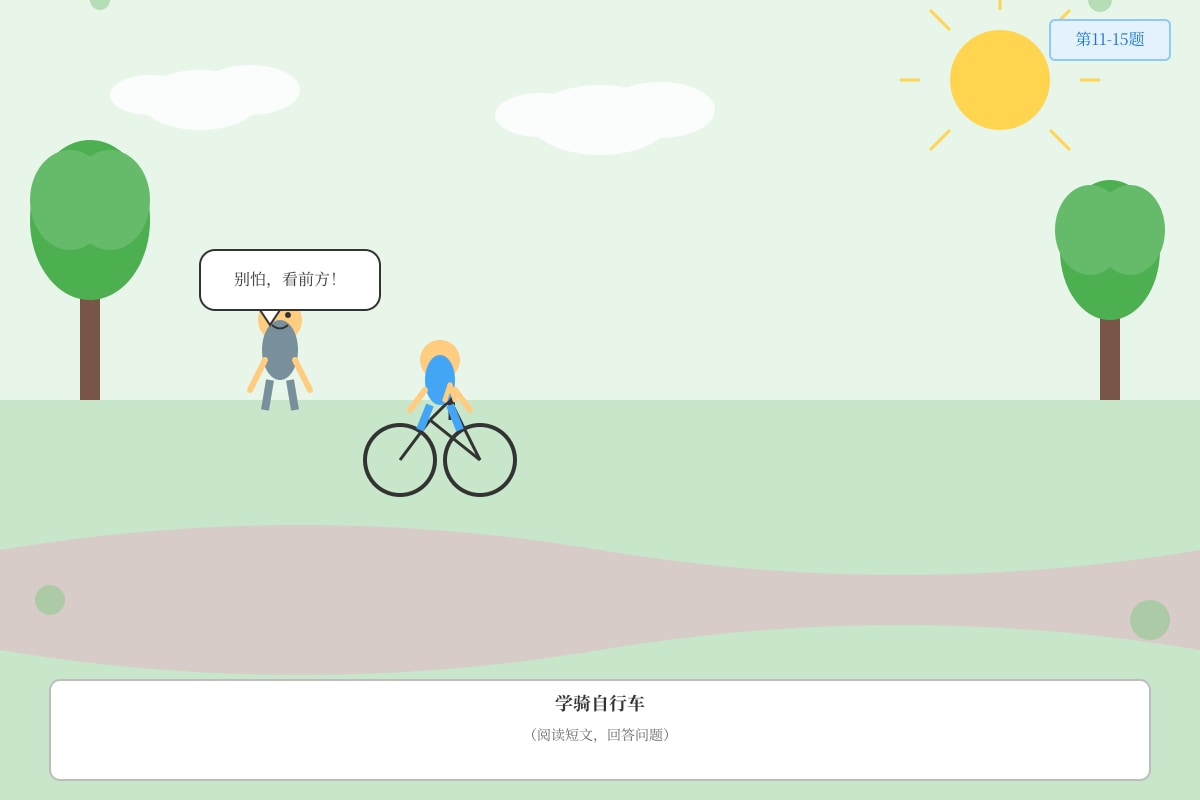
Answer: 爸爸建议作者「目光要放远,身体自然就稳了」/「别怕,看前方,放松身体」。
Marking:
- 1 mark for "看前方/目光放远"
- 1 mark for "放松身体/身体自然就稳了"
Note: Must capture the key advice about looking ahead and relaxing.
Question 13 (3 marks)
Answer:
这句话除了指骑车时看远处能保持平衡,还比喻做人做事要有长远眼光、目标明确,心态才会稳定,不易动摇。
Marking:
- 1 mark for literal meaning (looking far → balance)
- 2 marks for metaphorical meaning (long-term vision → steady mindset)
Teaching note: This tests inference (推论性问题) — going beyond literal text.
Question 14 (4 marks)
Answer:
作者用「学骑车」比喻「成长」:
- 需要勇气迈出第一步 — 学骑车要克服恐惧上车;成长要敢于尝试新事物。
- 过程中会摇晃、跌倒 — 学骑车会摇摇晃晃、差点摔倒;成长会遇到挫折困难。
- 需要有人在背后默默支持 — 爸爸扶车座、鼓励、最后松手;成长需要亲师长的陪伴指导与放手。
- 最终能独自前行,获得喜悦 — 独自骑出几米感到喜悦;成长后能独立面对生活,收获成就感。
Marking: 1 mark per valid point (max 4). Accept any 4 reasonable points linked to text.
Question 15 (4 marks)
Answer:
爸爸的父爱是耐心陪伴、鼓励支持、适时放手的爱。
细节一:爸爸「在后面扶着车座,大声鼓励我:『别怕,看前方,放松身体!』」——体现耐心指导与情感支持。
细节二:爸爸「耐心地说:『目光要放远,身体自然就稳了。』」——体现循循善诱的教导。
细节三:爸爸「松开了手」并「站在原地,脸上洋溢着欣慰的笑容」——体现适时放手、为孩子成长欣慰。
(任选两个细节即可)
Marking:
- 1 mark for describing father's love nature
- 1.5 marks per detail (detail + explanation) × 2 = 3 marks
Total: 4 marks
Section C: Extended Reading Comprehension (15 marks)
Question 16 (3 marks)
Answer:
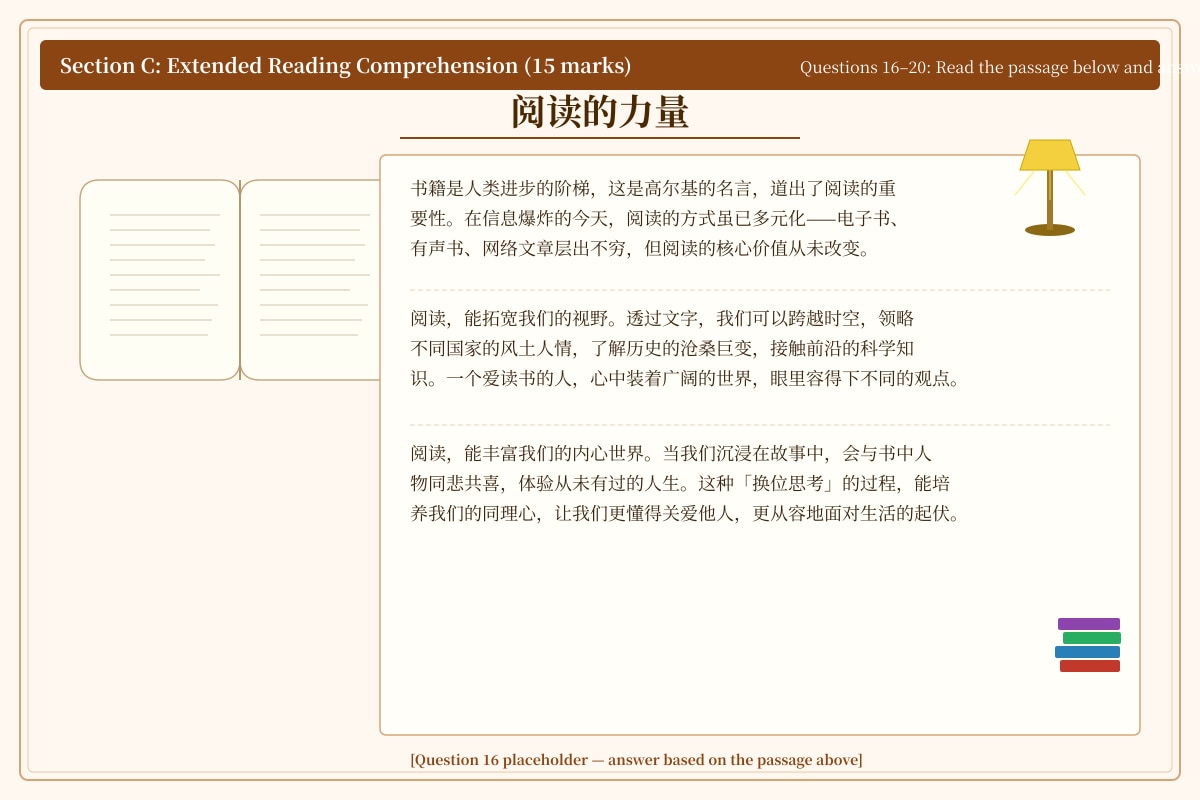
(a) ✗ — 文中指出「阅读的核心价值从未改变」
(b) ✓ — 文中提到「领略不同国家的风土人情,了解历史的沧桑巨变」
(c) ✗ — 文中强调「深度阅读显得尤为珍贵」,暗示碎片化阅读不如深度阅读有价值
Marking: 1 mark each. Must have correct symbol and correct reasoning implied.
Question 17 (3 marks)
Answer:
(i) 拓宽视野 — 跨越时空,领略风土人情,了解历史,接触科学知识
(ii) 丰富内心世界 — 与书中人物同悲共喜,体验不同人生,培养同理心
(iii) 磨练思维 — 独立思考,不盲从,汲取字里行间的智慧
Marking: 1 mark per benefit. Key phrases required.
Question 18 (3 marks)
Answer:
「换位思考」的过程能培养同理心。这能让我们更懂得关爱他人,更从容地面对生活的起伏。
Marking:
- 1 mark for "同理心"
- 1 mark for "更懂得关爱他人"
- 1 mark for "更从容地面对生活的起伏"
Question 19 (3 marks)
Answer:
深度阅读珍贵是因为碎片化阅读盛行,人们习惯浅层快速获取信息,缺乏深度思考。深度阅读要求我们放慢脚步,细细咀嚼字里行间的智慧,进行独立思考。
Marking:
- 1 mark for why precious (contrast with fragmented reading)
- 1 mark for "放慢脚步/细细咀嚼"
- 1 mark for "独立思考/不盲从"
Question 20 (3 marks)
Answer:
这句话意思是:阅读的价值不在于数量炫耀,而在于内化为个人气质。
- 「藏在气质里」:阅读塑造一个人的精神面貌、举止神态。
- 「藏在谈吐里」:阅读丰富语言表达,使言谈有深度、有温度。
- 「藏在对世界的宽容里」:阅读让人理解多元、包容差异、心胸开阔。
真正的阅读是灵魂的丰盈,外化为一个人的一举一动、一言一行。
Marking: - 1 mark for overall understanding (internalization, not show)
- 1 mark for explaining any two of the three phrases
- 1 mark for personal insight/synthesis
Note: Accept reasonable interpretations grounded in text.
End of Answer Key