AI Generated Exam Paper
Primary 6 PSLE Chinese Practice Paper 5
Free P6 PSLE Chinese Practice Paper 5, Kimi2.6 AI version, with questions, answers, and PSLE-focused practice for Singapore students.
These static practice materials are generated from the site's syllabus and paper-generation workflow, with source and model context shown so students and parents can evaluate the material before use.
Questions
Free quiz and exam paper access
Enter your details to view this paper
Your access is remembered on this device.
Answers
TuitionGoWhere Practice Paper - Chinese Primary 6 PSLE: Answer Key
Version 5 of 5
Total Marks: 80
Duration: 1 hour 15 minutes
Section A: Vocabulary, Grammar & Sentence Construction (20 marks)
Question 1 (2 marks)
Correct answer: B. 实现 (1 mark)
Explanation required (1 mark):
- "实现梦想" is the correct collocation in modern Chinese.
- "完成" typically pairs with tasks, work, or homework (完成任务、完成作业)
- "达到" is used for levels, standards, or goals that are measurable (达到标准、达到目标)
- "举行" means to hold or conduct an event (举行会议、举行比赛)
- "实现" specifically means to make real or actualize dreams, ideals, or wishes
Common mistake: Choosing "达到" without understanding the specific collocation. "梦想" is abstract and requires "实现" rather than the more concrete "达到".
Question 2 (2 marks)
Error identification (1 mark): The error is the redundant use of "虽然……但是……" (although...but...) together. In Chinese, only one conjunction from this correlative pair is needed in a standard sentence.
Corrected sentence (1 mark): "虽然天气很冷,他仍然坚持每天早晨去公园跑步锻炼身体。" OR "天气很冷,但是他仍然坚持每天早晨去公园跑步锻炼身体。"
Teaching note: This is a very common error in PSLE Chinese. The pattern is: 虽然...,可是/但/却... OR ...,但是... Remember: 虽然 and 但是 are mutually exclusive in standard written Chinese.
Question 3 (2 marks)
Correct rewrite (2 marks):
"被困在火场里的孩子们被消防员勇敢地救出了。"
OR
"孩子们被困在火场里,被消防员勇敢地救出了。"
Step-by-step working:
- Identify the original agent ( firefighters = 消防员) and patient (children = 孩子们)
- In 被-structure: Patient + 被 + Agent + Verb + Complement
- Original: [Agent] + [adverb] + [verb] + [patient + relative clause]
- Transformed: [Patient + relative clause] + 被 + [Agent] + [adverb] + [verb + complement]
Common mistake: Forgetting to include "勇敢地" (bravely) or misplacing it after the verb. The adverb should precede the verb in the 被-construction.
Question 4 (3 marks)
Analysis of rhetorical effect:
This sentence uses metaphor/比喻 (1 mark), comparing time to flowing water (流水).
Expression effect analysis (2 marks):
- Concreteness: Time is abstract; flowing water is concrete and visible. The comparison makes the abstract concept tangible
- Irreversibility: Flowing water moves in one direction and cannot return, emphasizing that past time is permanently lost
- Speed and stealth: Water flows continuously, suggesting time passes quickly and unnoticed
- Emotional weight: The natural imagery carries a melancholic tone about life's transience
Teaching note: The phrase "一去不复返" (gone forever, never to return) reinforces this irreversibility. This is a classic Chinese expression originating from historical texts, now common in modern writing.
Question 5 (3 marks)
(a) Correct answer: "同学们陆续走进教室,准备上课。" (1 mark)
(b) Correct answer: "这座城市已经连续下了三天大雨,许多地方都积水了。" (1 mark)
(c) Key difference (1 mark):
| 连续 | 陆续 |
|---|---|
| Continuous/uninterrupted; one after another without break | Successive/intermittent; appearing one after another over time |
| Emphasizes no interruption in sequence | Emphasizes individual arrivals/actions over a period |
| Often used with time periods (连续三天) | Often used with people or discrete events |
Teaching note: Both indicate sequence, but 连续 stresses the unbroken nature (continuous rain), while 陆续 stresses the distributed, intermittent nature (students arriving at different times).
Question 6 (2 marks)
(a) Correct answer: A. 一丝不苟 (1 mark)
- 一丝不苟: "not a single thread loose" = meticulous, conscientious
- 一尘不染: "not a speck of dust" = spotlessly clean OR morally pure
- 一举两得: "one action, two gains" = killing two birds with one stone
- 一帆风顺: "sail with the wind" = smooth sailing, without obstacles
(b) Correct answer: B. 柳暗花明 (1 mark)
- 山穷水尽: "mountains exhausted, waters ended" = at the end of one's rope
- 柳暗花明: "dark willows, bright flowers" = a sudden beautiful turn; hope at the darkest moment
- 纸上谈兵: "discuss warfare on paper" = armchair theorizing
- 井底之蛙: "frog at the bottom of a well" = person with limited experience
Question 7 (3 marks)
Correct order: 2 → 4 → 1 → 3 (3 marks)
Logical analysis:
- Sentence 2 introduces the event (今年春天...种了一棵小桃树) — Setting/introduction
- Sentence 4 has "First" (First, 爷爷挖了一个坑) — First step
- Sentence 1 continues with the planting action (把树苗放进坑里,培上土) — Second step
- Sentence 3 has "Finally" (最后,我们提来一桶水) — Final step
Deduction method: Look for sequence markers: 今年春天 (time setting) → First → [implied next step] → 最后. The action sequence in planting is logically: dig hole → place tree → fill soil → water.
Partial marks: Deduct 1 mark for each misplaced number; award 1 mark minimum for identifying first or last correctly.
Question 8 (3 marks)
Two simpler sentences (3 marks):
"This boy was usually playful. However, to do well in the piano competition, he practiced at school every day after class. He even practiced on weekends. Finally, he won the judges' unanimous praise."
OR equivalent breakup preserving all information:
- 这个男孩平时贪玩。
- 为了能在钢琴比赛中获得好成绩,他每天放学后都主动留在学校练习,连周末也不休息。
- 最终,他赢得了评委的一致赞赏。
Marking breakdown:
- Identify the three main information units (1 mark)
- Separate without losing: purpose, actions, result (1 mark)
- Grammatical correctness and coherence (1 mark)
Teaching note: Complex sentences in Chinese often stack multiple adverbial phrases and clauses. The key is identifying: [Background] + [Purpose] + [Actions] + [Result].
Section B: Reading Comprehension - Narrative Text (25 marks)
Question 9 (2 marks)
Answer (2 marks):
The narrator was "坐立不安" (restless/anxious) because (1) his parents worked in another city and he lived with his grandparents, unlike classmates who had parents to give gifts to; (2) he didn't know who he should prepare a gift for, as his family situation was different from others.
Marking breakdown:
- Identify his special family situation (parents absent, lives with grandparents) (1 mark)
- Explain the dilemma of not having an obvious recipient (1 mark)
Evidence: Lines 4-7 describe his family situation explicitly.
Question 10 (3 marks)
Comparison (3 marks):
| Classmates | Narrator |
|---|---|
| Have parents present (有的说要送给妈妈) (0.5 mark) | Parents work in another city (父母在外地工作) (0.5 mark) |
| Can easily choose gift recipients (0.5 mark) | Lives with elderly grandparents (和爷爷奶奶住在一起) (0.5 mark) |
| Typical nuclear family structure (0.5 mark) | Grandfather is ill, grandmother works hard (爷爷大病、奶奶早出晚归卖菜) (0.5 mark) |
| General ease about the activity | Anxiety and uncertainty about the activity (0.5 mark for overall contrast) |
Evidence required from lines 4-7: Must cite at least two specific details from the text for full marks.
Question 11 (3 marks)
Rhetorical device (1 mark): Metaphor/比喻 — comparing mood to weather
Expression effect (2 marks):
- Emotional projection: The narrator projects his inner sadness onto the external rainy weather, a technique called "emotional environmental resonance" or "以景抒情"
- Reinforcement: The gloomy, wet, gray characteristics of rainy weather visually and emotionally reinforce his loneliness and uncertainty
- Foreshadowing: Sets the melancholic tone for his family background revelation
Teaching note: This is a classic "融情于景" (merging emotion into scenery) technique common in Chinese narrative writing. The physical environment mirrors psychological state.
Question 12 (4 marks)
| How he earned money | What this reveals |
|---|---|
| (a) Saved three months of pocket money ($12) (1 mark) | Long-term planning and patience; he understood the value of the gift and was willing to delay gratification (1 mark) |
| (b) Worked for Auntie Zhang doing gardening (weeding, watering, collecting leaves) (1 mark) | Hard work and sacrifice; endured physical pain (blisters, sore back) for grandmother's benefit; shows maturity and filial piety (孝心) (1 mark) |
Key character traits to identify: filial piety (孝心), perseverance (毅力), self-sacrifice (自我牺牲), maturity beyond his years.
Question 13 (3 marks)
Answer (3 marks):
Purpose of inclusion (1 mark): To show that the narrator's action moved not only his grandmother but also an objective observer (the teacher), validating the emotional significance of the moment.
Effect on reader (2 marks):
- Credibility: Teacher's tears confirm this is genuinely touching, not just family sentiment
- Emotional amplification: The reader is guided to feel moved; "旁观者" (bystander) reaction validates our own emotional response
- Theme reinforcement: Suggests that sincerity and effort in gratitude are universally recognized values
Teaching note: This is called "侧面描写" (indirect/side characterization) — using secondary characters' reactions to emphasize the main scene's impact.
Question 14 (5 marks)
Explanation of realization (3 marks):
The narrator realizes that true gratitude is not measured by money or material value (1 mark). The crucial elements are:
- Effort and sacrifice: He worked hard, enduring pain to earn money
- Thoughtfulness: He noticed his grandmother's worn scarf and her daily hardship
- Intention over cost: The "心意" (thoughtful intention) matters more than the gift's price
Personal evaluation with reasons (2 marks):
Agree (preferred answer with reasons):
- Gratitude expressed through personal effort is more meaningful than expensive purchases
- The process of earning/giving creates deeper emotional connection
- Material gifts without thought are empty; poor but sincere gifts carry authentic emotion
OR Disagree (acceptable with strong reasoning):
- Sometimes practical help (money, time) is more needed than symbolic gestures
- The grandmother's sacrifice is financial; reciprocating with labor doesn't address systemic needs
Teaching note: The passage's intended theme clearly supports "agree." Credit well-reasoned "disagree" responses but note they go against textual evidence.
Question 15 (5 marks)
Character sketch of 奶奶 (approx. 80字) — 5 marks:
Content points to include:
- Physical/circumstantial: Elderly, works hard (sells vegetables at market), leaves early returns late, rides old bicycle (2 marks)
- Economic situation: Poor, old patched scarf, relies on small income (1 mark)
- Relationship with narrator: Caring (doesn't mention parents to protect him), self-sacrificing, deeply moved by his gift, expresses love through action not words (2 marks)
Sample response (scoring 5/5):
奶奶是一位辛劳慈爱的老人。她年近古稀,每天清晨顶着寒风骑旧自行车去菜市场帮工,赚取微薄收入供孙儿上学。她的围巾破旧褪色,却从不抱怨生活艰辛。她深爱着孙儿,从不提他父母以免他伤心,收到礼物时泪光闪烁,紧搂孙儿说"有你这份心就够了",展现出老一辈隐忍而深沉的爱。
Marking note: Character sketches require selection of relevant traits from text, not invention. Stick to evidence-provided characteristics.
Section C: Reading Comprehension - Expository Text (20 marks)
Question 16 (4 marks)
| Challenge | Measure taken |
|---|---|
| (a) Resource scarcity / lack of resources (刚脱离殖民统治、资源匮乏的小岛国) (1 mark) | Legislation: 1967《公园与树木法令》required tree replacement; institutional: 1975 National Parks Board (1 mark) |
| (b) Doubt/skepticism from citizens / lack of public confidence (许多人怀疑这样的目标是否现实) (1 mark) | Community engagement: "植树周"等活动让市民参与绿化,培养环保意识 (1 mark) |
Alternative valid pairing:
- Challenge: Urban development competing with green space
- Measure: Systematic "立体绿化" (vertical gardens, rooftop greening) to maximize limited land
Teaching note: The passage explicitly pairs challenges in paragraph 2 with solutions in paragraph 4. Train students to track problem-solution structure in expository texts.
Question 17 (4 marks)
Meaning explanation (2 marks): The phrase means that "garden city" was not merely about planting trees, but a comprehensive planning philosophy requiring:
- Balance between economic development and environmental protection
- Harmonious coexistence between humans and nature
- Long-term, integrated thinking rather than isolated projects
Analysis of "哲学" vs "计划" (2 marks):
The author uses "哲学" because:
- Depth: A philosophy is foundational, guiding all decisions; a plan is tactical and operational
- Holism: Philosophy implies integrated worldview; plan suggests discrete steps
- Permanence: Philosophies endure and evolve; plans have fixed timeframes
- Values foundation: Philosophy incorporates ethical commitments to future generations
Teaching note: Word choice analysis requires examining connotative (implied) meanings, not just dictionary definitions. "哲学" elevates the concept from practical policy to governing principle.
Question 18 (5 marks)
Data description — TWO trends (2 marks):
| Trend | Evidence |
|---|---|
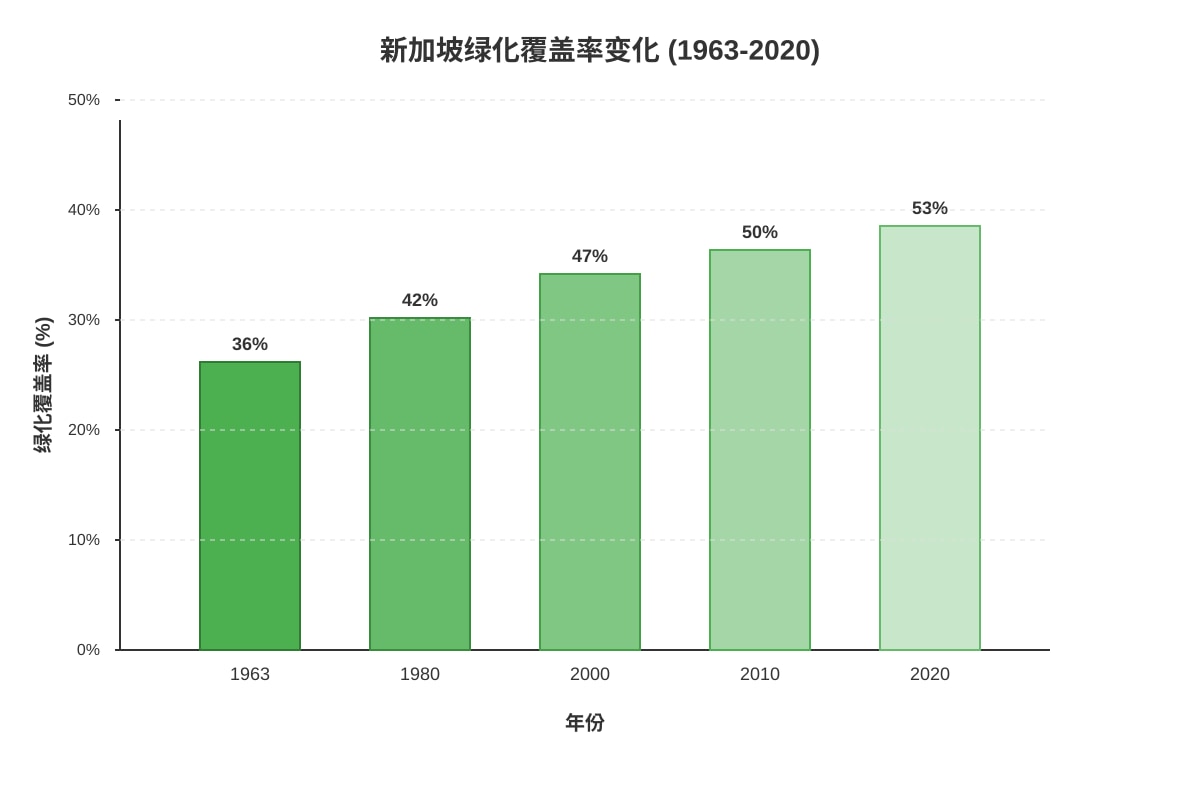
| (1) Consistent upward trend | Every data point shows increase: 36% → 42% → 47% → 50% → 53% |
| (2) Rapid acceleration in early period; slower growth recently | 1963-1980: +6% in 17 years; 2000-2020: +6% in 20 years. Initial catch-up faster, now approaching saturation |
Most significant factor with justification (3 marks):
Preferred answer: Institutional innovation / legislative foundation
Reasoning:
- Timing match: The 1967 law and 1975 Board establishment precede and enable the sustained increases
- Systematic nature: Green coverage requires long-term institutional commitment, not temporary campaigns
- Passage emphasis: The word "首先" (first/foremost) introduces legislation, signaling priority
Alternative acceptable: Community engagement — with strong justification about sustained cultural change being necessary for maintenance
Marking: Factor identification (1 mark); passage evidence (1 mark); logical reasoning connecting factor to trend (1 mark)
Expected visual features from Q18 image placeholder:
- Five bars ascending left to right
- 1963 shortest (36%), 2020 tallest (53%)
- Steepest visual jump between 1963-1980
- Labels in Chinese: 绿化覆盖率 (%), 年份
Question 19 (7 marks)
| Aspect | Garden City | City in Nature |
|---|---|---|
| Focus | Green coverage, aesthetic and recreational green spaces (种树栽花, 公园) (1 mark) | Biodiversity, ecological integration, nature permeating urban life (大自然中的城市) (1 mark) |
| Methods | Legislation, systematic planning, vertical/3D greening | Recovery of natural habitats, ecological corridors, every residence near park (1 mark) |
| Ultimate goals | Livable, competitive, beautiful city | Sustainable ecosystem where humans and wildlife coexist; climate resilience (1 mark) |
Personal view with reasons (3 marks):
City in Nature is more suitable (preferred):
| Reason | Explanation |
|---|---|
| Addresses new challenges | Climate change and biodiversity loss weren't urgent in 1963; now they are |
| Higher quality of life | "步行10分钟到公园" improves daily wellbeing beyond visual green |
| Global leadership | Positions Singapore as innovator in urban sustainability, not follower |
| Future-proofing | Prepares for rising temperatures and ecological pressures |
OR Garden City continuation (acceptable with strong reasoning):
- Already successful; "if it ain't broke, don't fix it"
- More achievable with limited land
- International recognition already secured
Teaching note: "Suitable for Singapore's future" requires considering: land constraints, climate vulnerability, economic competitiveness, and quality of life. Best answers synthesize multiple factors.
Section D: Classical & Cultural Literacy (15 marks)
Question 20
Part (a) — Translation and Analysis (8 marks)
(i) Translation (5 marks):
Sentence 1 (2 marks): "学而时习之,不亦说乎?"
- 学: to learn/study
- 而: and (connecting sequential actions)
- 时习: regularly practice/review (时: at appropriate times; 习: practice, review, not merely "repeat")
- 说: 悦 (yuè), pleased, happy (archaic form, later written 悦)
- Translation: "Having learned something, to practice it at due times — is this not pleasant?"
Sentence 2 (1.5 marks): "有朋自远方来,不亦乐乎?"
- 朋: friend (specifically, fellow learner/student in Confucian context)
- 自: from
- 乐: happy, joyful
- Translation: "When friends come from distant places — is this not delightful?"
Sentence 3 (1.5 marks): "人不知而不愠,不亦君子乎?"
- 知: understand, recognize (one's worth)
- 愠: yùn, angry, resentful, displeased
- 君子: person of moral cultivation, ideal person
- Translation: "When others do not understand me, yet I am not resentful — is this not the mark of a cultivated person?"
Quality marks: Accurate key terms (1 mark); fluent modern Chinese (1 mark); preservation of rhetorical questions (1 mark)
(ii) Confucius's view (3 marks):
Learning: Learning brings intrinsic joy when applied/practiced; knowledge should be active, not passive (1 mark)
Friendship: Intellectual companionship transcends distance; shared learning creates bonds; community enhances individual growth (1 mark)
Self-cultivation: True virtue includes emotional self-regulation; moral maturity means not needing external validation; inner strength over outward recognition (1 mark)
Teaching note: The three sentences form a progression: personal learning → social connection → internal moral achievement. This structure is intentional in the original.
Part (b) — Cultural Application (7 marks)
(i) Story summary (3 marks):
杨时 (Yang Shi) and his classmate 游酢 (You Zuo) went to visit their teacher 程颐 (Cheng Yi). (1 mark) They found Cheng Yi sitting in meditation/rest. Not daring to disturb him, they waited quietly outside the door. (1 mark) Snow fell heavily; by the time Cheng Yi awoke, snow had accumulated more than a foot deep where they stood. (1 mark)
Key elements: Who (杨时、游酢、程颐), What (waited respectfully), Circumstance (snow, deep accumulation), Result (demonstrated respect)
(ii) Learning attitude and modern relevance (4 marks):
Attitude identified (1 mark):
- 尊师重道 (respect for teachers and the Way/learning)
- 谦虚好学 (modesty and eagerness to learn)
- 耐心坚持 (patience and perseverance)
- 对知识的敬畏 (reverence for knowledge)
Modern relevance (3 marks):
| Why still important | Application |
|---|---|
| Respect for teachers creates optimal learning environment | Modern students sometimes challenge authority prematurely; balanced respect enables guidance |
| Patience in learning — complex subjects require sustained attention | Instant gratification culture (short videos, quick answers) undermines deep learning |
| Humility — acknowledging one's limits | Arrogance prevents growth; best learners maintain beginner's mindset |
| Physical discomfort as symbol of commitment | Dedication to goals despite inconvenience distinguishes serious from casual learners |
Sample strong response:
这种"程门立雪"的态度体现了尊师重道、谦虚耐心的学习精神。在现代学习中,这种态度仍然重要:网络时代信息爆炸,学生容易浮躁自满,而真正的学问需要沉下心来,尊重老师的专业指导,甘守寂寞、不怕吃苦。只有保持谦虚和毅力,才能在学业上取得真正的成就。
MARKING SUMMARY CHECK
| Section | Marks | Verifying |
|---|---|---|
| A: Vocabulary & Grammar | 20 | Q1-8: 2+2+2+3+3+2+3+3 = 20 ✓ |
| B: Narrative Reading | 25 | Q9-15: 2+3+3+4+3+5+5 = 25 ✓ |
| C: Expository Reading | 20 | Q16-19: 4+4+5+7 = 20 ✓ |
| D: Classical & Cultural | 15 | Q20: 8+7 = 15 ✓ |
| TOTAL | 80 | ✓ |
Duration verification: 15 + 25 + 20 + 10 = 70 minutes; 5-minute buffer = 75 minutes total. Achievable for prepared P6 students.
Syllabus alignment check: Vocabulary (P6 target 1800-1900 characters), complex sentence structures, reading comprehension of narrative and expository texts at 200-300字 length, classical Chinese foundational understanding, cultural literacy. All within syllabus parameters.