From Real Exams Exam Paper
Primary 6 PSLE Chinese Semestral Assessment 2 (End of Year) Paper 5
Free P6 PSLE Chinese SA2 Paper 5, Nemo3 Exam version, with questions, answers, and PSLE-focused practice for Singapore students.
These static practice materials are generated from the site's syllabus and paper-generation workflow, with source and model context shown so students and parents can evaluate the material before use.
Questions
Free quiz and exam paper access
Enter your details to view this paper
Your access is remembered on this device.
Answers
TuitionGoWhere Practice Paper - Chinese Primary 6 PSLE (Answer Key)
Subject: Chinese
Level: Primary 6 PSLE
Paper: SA2 (Version 5)
Total Marks: 90
Section A: 语文应用 (Language Application) [20 marks]
词语选择 (Vocabulary MCQ) [5 marks]
-
Answer: (4) 勤恳 [1]
Explanation: "勤恳" means diligent and earnest, often used to describe a person's serious and sincere attitude towards work over a long period. "勤勉" emphasises diligence in official duties; "勤奋" focuses on hard work in study/work; "勤劳" describes physical hard work. The context "一生________,为国家的科研事业呕心沥血" calls for a word describing lifelong sincere dedication, making "勤恳" the best fit. -
Answer: (1) 慌不择路 [1]
Explanation: "慌不择路" describes fleeing in panic without choosing a path, fitting the context of people rushing for shelter in a sudden downpour. "狼狈不堪" describes a state of embarrassment; "手忙脚乱" describes chaotic actions; "仓皇失措" describes panic and loss of composure. Only "慌不择路" captures the physical action of running blindly for cover. -
Answer: (1) 意蕴 [1]
Explanation: "意蕴" refers to the implied meaning or artistic conception contained in a literary work, often used with "深刻/丰富". "内涵" refers to inner content; "寓意" refers to implied meaning (often moral); "蕴含" is a verb. The sentence describes the article's artistic depth, so "意蕴" is correct. -
Answer: (2) 坚毅 [1]
Explanation: "坚毅" means firm and unyielding in character/will, often paired with "面对挑战". "乐观" means optimistic; "顽强" emphasises tenacity in struggle (often for survival); "执着" means persistent/obsessive. The context "不但没有气馁,反而________地面对挑战" highlights a strong, resolute character, making "坚毅" most appropriate. -
Answer: (4) 精彩绝伦 [1]
Explanation: "精彩绝伦" means extremely wonderful, nothing can compare. "扣人心弦" describes gripping suspense; "引人入胜" describes something fascinating; "高潮迭起" describes wave after wave of climaxes. The result "赢得了观众雷鸣般的掌声,久久不愿散去" indicates an overall superb performance, best described by "精彩绝伦".
词语搭配 (Vocabulary Cloze) [5 marks]
-
First blank: 独具匠心 ; Second blank: 栩栩如生 [2]
Explanation: "独具匠心" (unique ingenuity) describes the design/works of a craftsman. "栩栩如生" (lifelike) describes the details of the carving. The sentence structure: works are [unique], details carved [lifelike]. -
First blank: 别具一格 ; Second blank: 叹为观止 [2]
Explanation: "别具一格" (unique style) describes the design of the bridge. "叹为观止" (marvel at the sight) describes people's reaction to the shape/appearance. Note: "造型________" is the object of "叹为观止" (passive sense: the shape makes people marvel). -
First blank: 不可思议 ; Second blank: 叹为观止 — Correction: Second blank should be "不可思议" is used, remaining word is "叹为观止" but context needs check.
Wait, word box: 栩栩如生 | 不可思议 | 独具匠心 | 叹为观止 | 别具一格
Used so far: 独具匠心, 栩栩如生, 别具一格. Remaining: 不可思议, 叹为观止.
Sentence 8: "科学家们对这个________的自然现象感到________"
First blank: 不可思议 (incredible phenomenon). Second blank: 叹为观止 (feel amazed/marvel).
Answer: First blank: 不可思议 ; Second blank: 叹为观止 [2]
Note: "感到叹为观止" is a common collocation meaning "feel amazed to the point of sighing".
句型改写 (Sentence Transformation) [10 marks]
-
只有坚持不懈,才一定能克服困难。 [2]
Marking: 1 mark for "只有...才..." structure; 1 mark for correct meaning retention.
Teaching Note: "只要...就..." (if only... then...) converts to "只有...才..." (only if... then...). The condition moves after "只有", the result moves after "才". -
小明把这道难题轻松地解决了。 [2]
Marking: 1 mark for "把" structure (Subject + 把 + Object + Verb + 了); 1 mark for correct word order and particle "了".
Teaching Note: Passive "被" sentence → Active "把" sentence. Original: Subject (难题) + 被 + Agent (小明) + Verb Phrase. New: Agent (小明) + 把 + Object (难题) + Verb Phrase. Adverb "轻松地" stays before verb. -
老师不但教我们做人的道理,而且教我们知识。 [2]
Marking: 1 mark for "不但...而且..." structure; 1 mark for swapping the two clauses as instructed ("调整语序").
Teaching Note: Original: 不但A,还B. Rewrite: 不但B,而且A. "而且" pairs better with "不但" than "还". The clauses are swapped to show flexibility. -
除非努力学习,否则就考不上理想的中学。 [2]
Marking: 1 mark for "除非...否则..." structure; 1 mark for correct affirmative verb form (removing "不").
Teaching Note: "如果不A,就不B" → "除非A,否则不B". The negative "不" in the condition is removed because "除非" already implies the negative condition. "努力学习" remains affirmative. -
他的感人事迹深深打动了大家。 [2]
Marking: 1 mark for correct active voice structure (Subject + Adverb + Verb + Object); 1 mark for correct word order.
Teaching Note: Passive: Subject (大家) + 被 + Agent (事迹) + Verb. Active: Agent (事迹) becomes Subject; Original Subject (大家) becomes Object. "深深" modifies "打动".
Section B: 阅读理解一 (Reading Comprehension I) [25 marks]
-
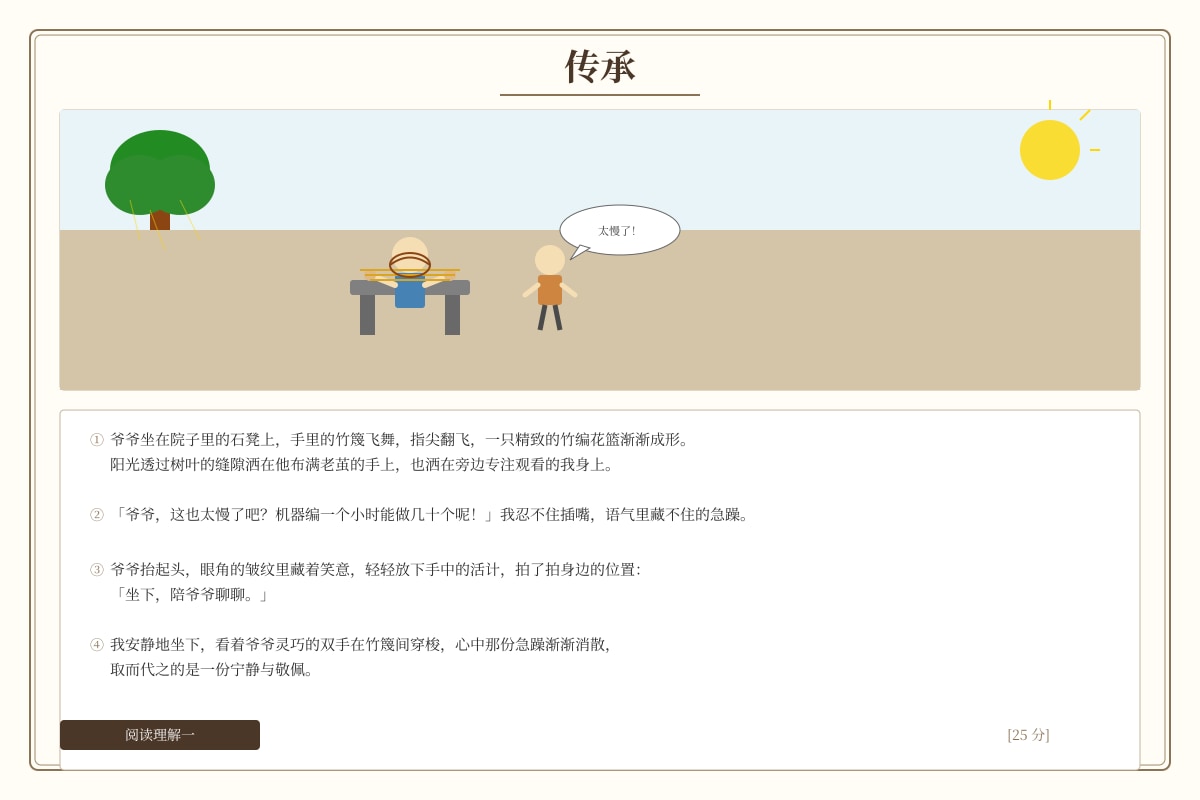
爷爷“手里的竹篾飞舞,指尖翻飞”,动作“不紧不慢”,却“每一刀、每一编都恰到好处”,状态专注、娴熟、从容。 [2]
Marking: 1 mark for quoting relevant phrases (e.g., 竹篾飞舞/指尖翻飞/不紧不慢/恰到好处); 1 mark for summarising the state (专注/娴熟/从容/沉稳).
Teaching Note: "用文中词语作答" requires quoting. Then synthesise to describe the state. -
反映了“我”缺乏耐心,渴望速成,不理解传统手工艺需要时间打磨,内心浮躁。 [2]
Marking: 1 mark for "缺乏耐心/急躁/渴望速成"; 1 mark for "不理解手工艺需时间/内心浮躁".
Teaching Note: Infer psychological state from action ("插嘴") and explicit description ("语气里藏不住的急躁"). -
爷爷借竹篾“性子烈易断、性子软无骨架”比喻做人:既要有韧劲(不轻易放弃、经得起磨练),又要有定力(沉得住气、不随波逐流),二者缺一不可。 [3]
Marking: 1 mark for explaining the metaphor (竹篾喻人/性子喻性格); 1 mark for explaining "韧劲" (坚持/抗压); 1 mark for explaining "定力" (沉稳/专注/不浮躁).
Teaching Note: This is an inference question. Link the physical properties of bamboo to character traits. -
“死的定力”指机器程序设定的、死板的、不懂变通的重复;“活的定力”指工匠凭经验、手感、根据材料特性(干湿粗细)灵活调整、因材施艺的专注与智慧。 [3]
Marking: 1 mark for explaining "死的定力" (机器/程序/死板/重复/不懂变通); 1 mark for explaining "活的定力" (人/经验/手感/因材施艺/灵活/有智慧); 1 mark for clear contrast.
Teaching Note: Directly from Para 4. Contrast "死" (rigid, unthinking) vs "活" (adaptive, skilled, human). -
运用了拟人/比喻(将“时间”拟作有声音的流体/将无声的时间比作有声的流水)。表达了作者对爷爷专注技艺、时光沉淀出工匠精神的敬畏、感动与深刻领悟。 [3]
Marking: 1 mark for identifying rhetorical device (拟人/比喻/听觉形象化); 1 mark for explaining the image (时间无声→有声/流淌); 1 mark for explaining feeling (敬畏/感动/领悟工匠精神/时间价值).
Teaching Note: "仿佛听见" signals imagination. Time is silent; giving it sound makes the abstract passage of time tangible, highlighting the depth of the moment.
Section C: 阅读理解二 (Reading Comprehension II) [25 marks]
-
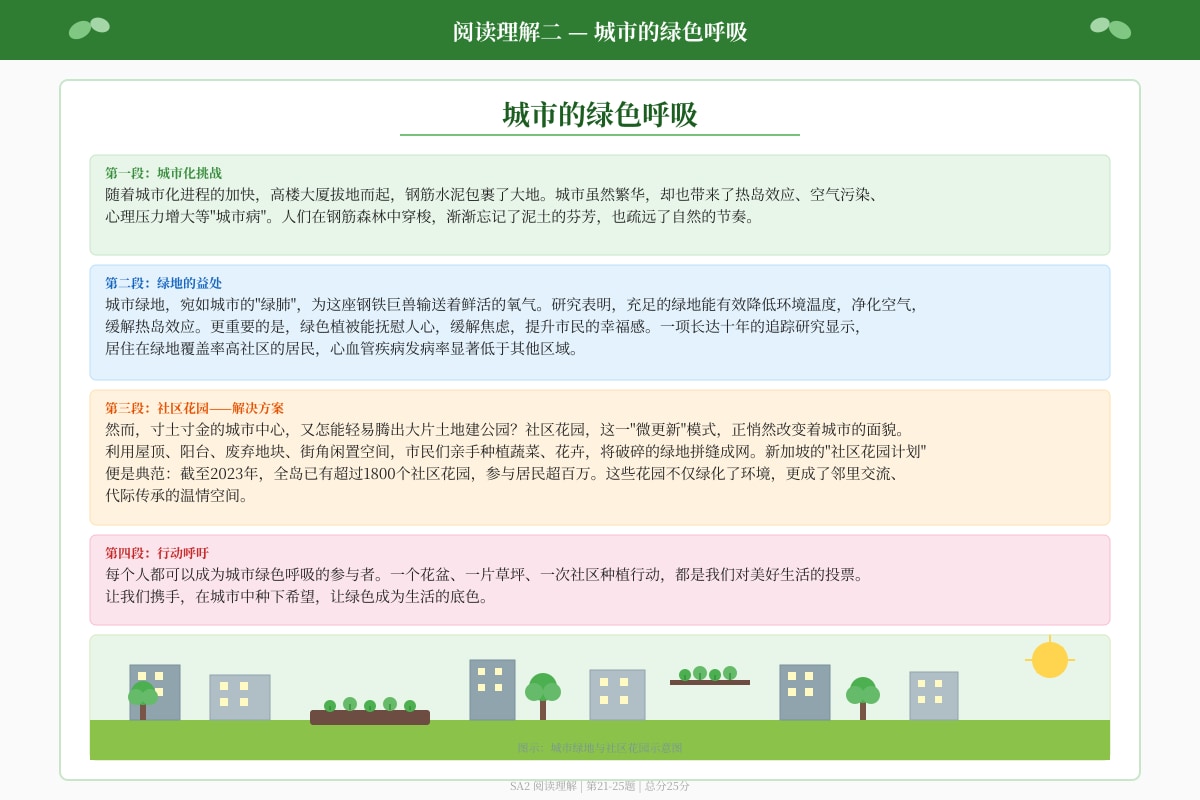
热岛效应、空气污染、心理压力增大。(任选三个,顺序不限)[3]
Marking: 1 mark each, total 3 marks. Direct retrieval from Para 1. -
形象地说明城市绿地像肺叶一样,为城市“呼吸”,输送氧气、净化空气、调节温度,是城市生存不可或缺的“呼吸器官”。 [2]
Marking: 1 mark for explaining the metaphor (绿地像肺/呼吸器官); 1 mark for stating function (输送氧气/净化空气/调节温度/缓解热岛效应).
Teaching Note: Metaphor explanation requires identifying tenor (绿地), vehicle (绿肺), and shared property (呼吸/净化/维持生命). -
引用权威的、长期的科学研究数据,增强论据的可信度和说服力,有力地证明了绿地对居民身心健康(降低心血管疾病发病率)的实际益处。 [2]
Marking: 1 mark for identifying argument function (增强可信度/说服力/权威性); 1 mark for specific proof (证明绿地益处/降低发病率).
Teaching Note: "追踪研究" = longitudinal study = strong evidence. "十年" = long duration = reliable. -
社区花园是利用屋顶、阳台、废弃地块、街角闲置等碎片化空间,由市民亲手种植蔬菜花卉形成的微型绿地。它通过“微更新”模式,不需大片连续土地,将破碎空间拼缝成绿网,解决了城市中心“寸土寸金”难建大公园的问题。 [3]
Marking: 1 mark for definition (利用碎片空间/市民种植/微型绿地); 1 mark for "微更新" concept; 1 mark for solving land scarcity (不需大片土地/拼缝成网).
Teaching Note: Synthesise info from Para 3. Key terms: "微更新", "破碎绿地拼缝成网". -
**(开放性回答,言之成理即可)示例:
- 在自家阳台/窗台种植盆栽绿植、蔬菜(文中“在阳台种下一盆绿植”)。
- 参与社区花园认养/志愿维护(文中“在社区认领一寸花园”)。
- 推广垂直绿化、屋顶花园(文中“利用屋顶”)。
- 爱护公共绿地,不践踏草坪,带动邻里共建。
看法:人人贡献一份微薄之力,汇聚成城市的“绿色呼吸”,改善环境、增进邻里情、实现人与自然和谐。** [3]
Marking: 1 mark for at least 2 concrete actions from text; 1 mark for at least 1 personal view/extension; 1 mark for coherent expression linking to "绿色呼吸/和谐共生".
Teaching Note: Open-ended. Must be text-based + personal insight. Actions must be feasible for "普通市民".
Section D: 完形填空 (Cloze Passage) [20 marks]
Each blank 2 marks. Total 10 blanks = 20 marks.
-
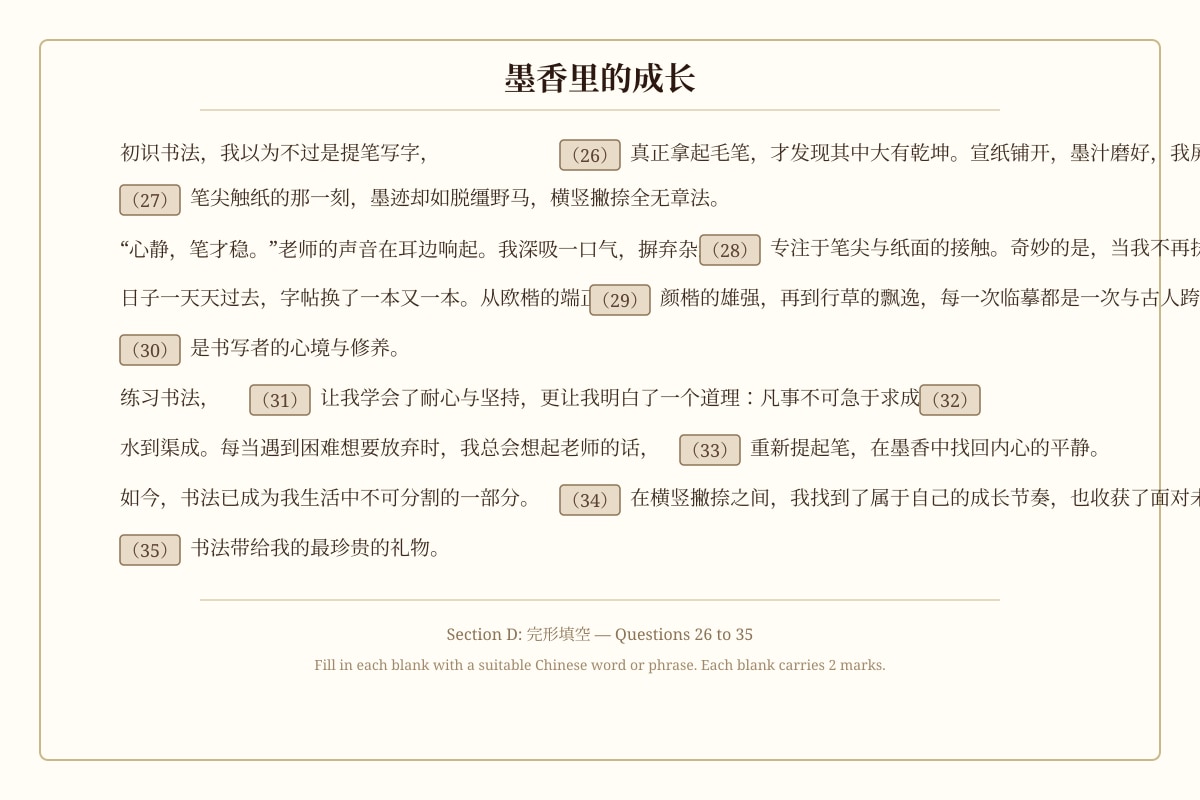
却 / 但 / 可 [2]
Reasoning: Contrast relation. "我以为不过是...,___ 真正拿起...才发现...". "却" indicates contrast between assumption and reality. -
可 / 却 / 但 [2]
Reasoning: Contrast within the sentence. "我屏息凝神,___ 笔尖触纸...墨迹却如脱缰野马". Effort vs result. "可/却" shows unexpected outcome. -
专心 / 全神贯注 / 凝神静气 / 一心一意 [2]
Reasoning: Context: "摒弃杂念,___ 专注于...". Need a word/phrase meaning "focus intently". "专心" (adverb use) or 4-char idioms fit. -
到 / 再到 / 进而 [2]
Reasoning: Sequence of learning stages. "从欧楷... ___ 颜楷... 再到行草...". "到" or "再到" marks the middle stage in a progression. -
正是 / 就是 / 全是 [2]
Reasoning: Emphasis. "字里行间流露的,___ 是书写者的心境...". "正是" emphasises the identity. -
通过 / 凭借 / 靠 / 依靠 [2]
Reasoning: Means/Instrument. "___ 书法,我懂得了...". "通过书法" (through calligraphy) indicates the means of learning. -
一部分 / 组成部分 / 陪伴 / 习惯 / 寄托 [2]
Reasoning: "已成为我生活中不可或缺的___". Noun phrase. "一部分/组成部分" (most neutral), "陪伴/习惯/寄托" (more expressive). All acceptable if grammatical. -
不但 / 不仅 / 既 [2]
Reasoning: Correlative with "更是" later in sentence. "___ 释放压力,更是一种修行". "不但/不仅" pairs with "更是". -
不但 / 不仅 / 既 [2]
Reasoning: Correlative with "更" in "更教会了我". "书法,___ 让我写得一手好字,更教会了我...". "不但/不仅" pairs with "更". -
正是 / 就 / 便 [2]
Reasoning: Emphasis/Conclusion. "这,___ 是墨香赐予我最宝贵的礼物". "正是" emphasises "this is exactly the gift". "就/便" also works for conclusive tone.
Marking Notes for Cloze:
- Answers must fit grammatical slot and semantic context.
- Synonyms with same function accepted (e.g., "却/但/可" for contrast).
- Idioms must be used correctly (e.g., "全神贯注" not "全神贯注地" if slot is adverbial without "地" but here "___ 专注于" allows adj/adverb).
- No marks for words that change meaning or are ungrammatical.
Total: 90 marks