AI Generated Quiz
Primary 5 Science Systems Quiz
Free AI-Generated Qwen3.7 Plus Primary 5 Science Systems quiz with questions and answers for Singapore students. This page is rendered as a direct URL so the questions and answers can be discovered without pressing in-page buttons.
These static practice materials are generated from the site's syllabus and paper-generation workflow, with source and model context shown so students and parents can evaluate the material before use.
Questions
Primary 5 Science Quiz - Systems
Name: __________________________
Class: __________ Date: __________
Score: ________ / 30
Duration: 45 minutes
Total Marks: 30
Instructions:
- Answer all questions.
- Write your answers in the spaces provided.
- For questions requiring explanations, use clear scientific terms.
Section A: Multiple Choice Questions (10 marks)
Choose the correct answer and write its number (1, 2, 3, or 4) in the brackets provided.
1. Which of the following is the correct function of the heart?
(1) To filter waste from the blood
(2) To pump blood to all parts of the body
(3) To exchange gases with the air
(4) To break down food into simpler substances
[ ]
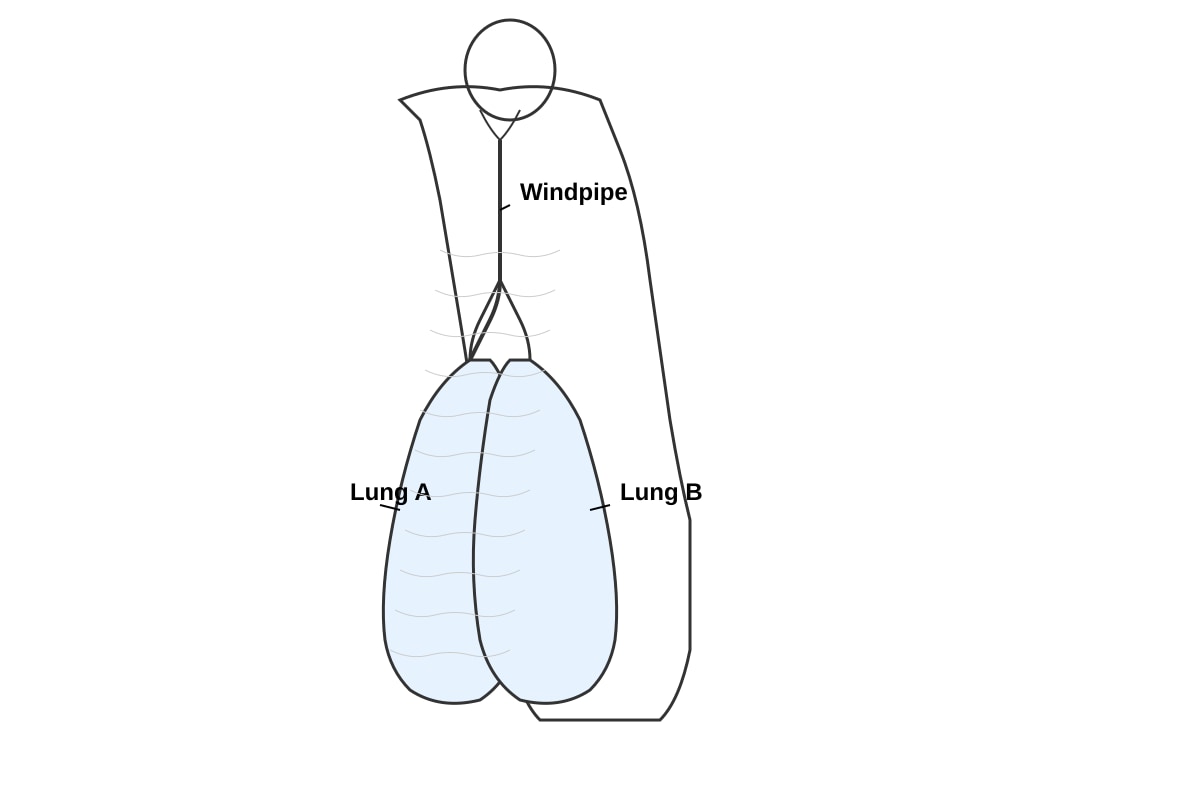
2. The diagram below shows the human respiratory system.
<image_placeholder>
id: Q2-fig1
type: diagram
linked_question: Q2
description: A simplified outline of the human upper body showing the windpipe branching into two lungs.
labels: Windpipe, Lung A, Lung B
must_show: The windpipe connecting to the two lungs.
</image_placeholder>
Which part of the respiratory system is responsible for the exchange of gases?
(1) Windpipe
(2) Nose
(3) Lungs
(4) Mouth
[ ]
3. In plants, which part is responsible for transporting water and mineral salts from the roots to the leaves?
(1) Phloem tubes
(2) Xylem tubes
(3) Stomata
(4) Root hairs
[ ]
4. Which of the following statements about the circulatory system is true?
(1) Blood vessels carry only oxygenated blood.
(2) The heart has three chambers.
(3) Blood transports digested food and oxygen to cells.
(4) Veins carry blood away from the heart.
[ ]
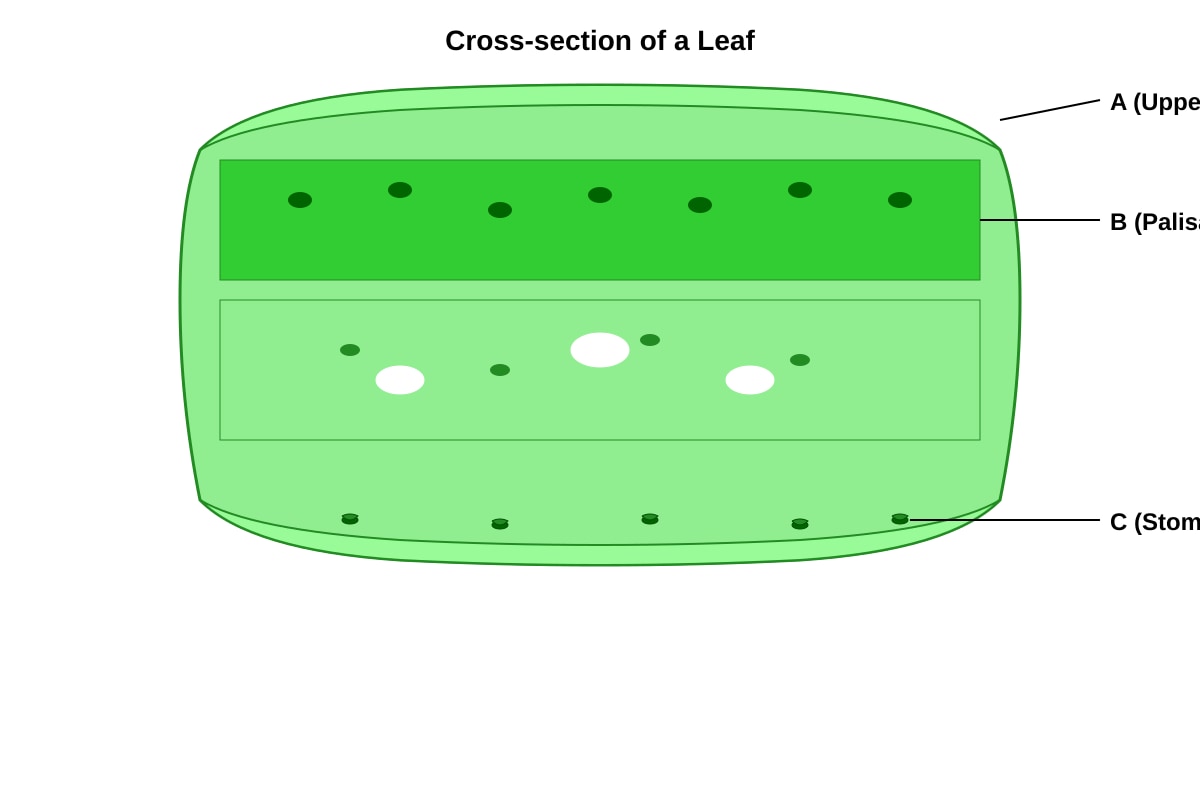
5. Look at the diagram of a leaf cross-section below.
<image_placeholder>
id: Q5-fig1
type: diagram
linked_question: Q5
description: A cross-section of a leaf showing the upper epidermis, palisade layer, spongy layer, and lower epidermis with small openings.
labels: A (Upper surface), B (Palisade layer), C (Stomata)
must_show: Small openings labelled C on the lower surface.
</image_placeholder>
What is the function of part C?
(1) To absorb sunlight
(2) To allow gases to enter and leave the leaf
(3) To transport water to the leaf
(4) To protect the leaf from insects
[ ]
6. Which of the following organs is part of the digestive system?
(1) Kidney
(2) Stomach
(3) Heart
(4) Brain
[ ]
7. Why do plants need a transport system?
(1) To move around to find sunlight
(2) To transport water and food to all parts of the plant
(3) To reproduce quickly
(4) To protect themselves from animals
[ ]
8. In the human body, where does the digestion of food begin?
(1) Stomach
(2) Small intestine
(3) Mouth
(4) Large intestine
[ ]
9. Which of the following best describes the function of the kidneys?
(1) To pump blood
(2) To remove liquid waste from the blood
(3) To break down proteins
(4) To absorb oxygen
[ ]
10. A student ran a race and started breathing faster. Why did this happen?
(1) His body needed more oxygen to release energy.
(2) His heart stopped pumping blood.
(3) His lungs needed to cool down.
(4) He needed to take in more carbon dioxide.
[ ]
Section B: Structured Questions (20 marks)
Answer all questions in the spaces provided.
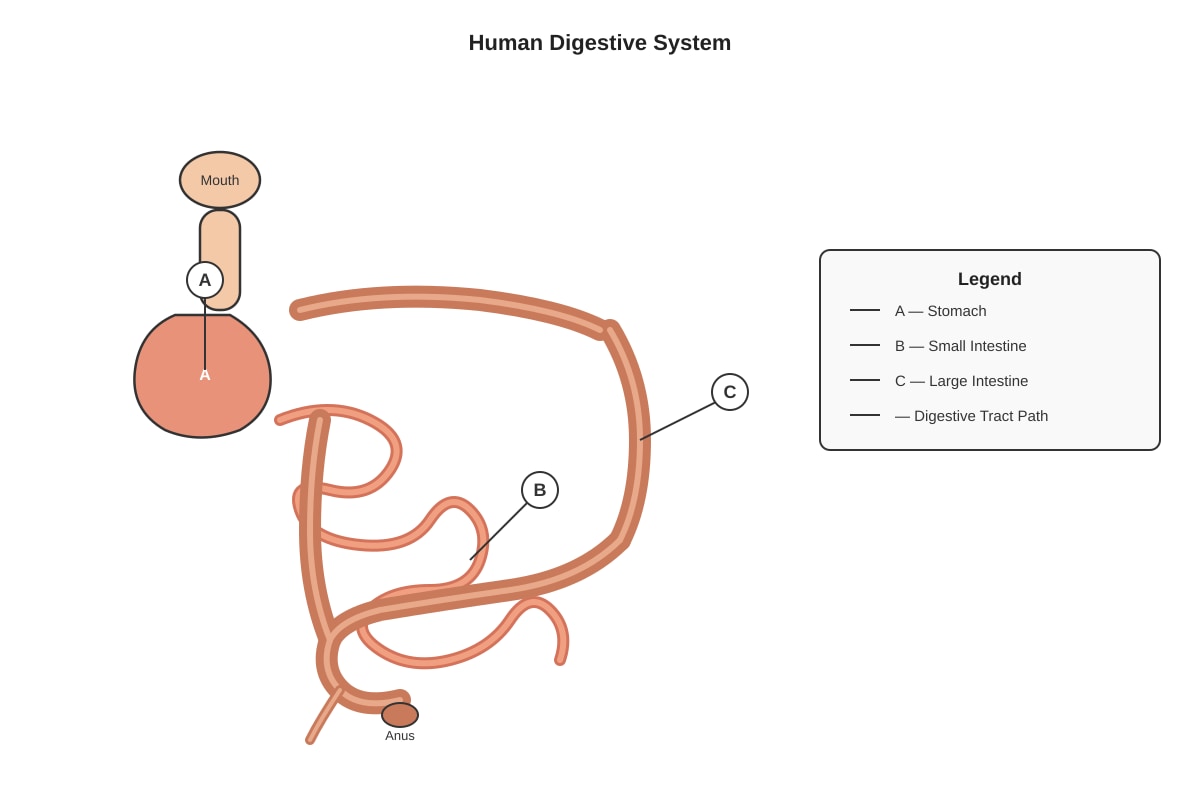
11. The diagram below shows the human digestive system.
<image_placeholder>
id: Q11-fig1
type: diagram
linked_question: Q11
description: Outline of human digestive tract. Labels point to: A (Stomach), B (Small Intestine), C (Large Intestine).
labels: A, B, C
must_show: The coiled small intestine (B) and the wider large intestine (C) surrounding it.
</image_placeholder>
(a) Name parts A and B. [2]
Part A: __________________________
Part B: __________________________
(b) State one function of Part A. [1]
(c) In which part (A, B, or C) is most of the digested food absorbed into the blood? [1]
Answer: _________
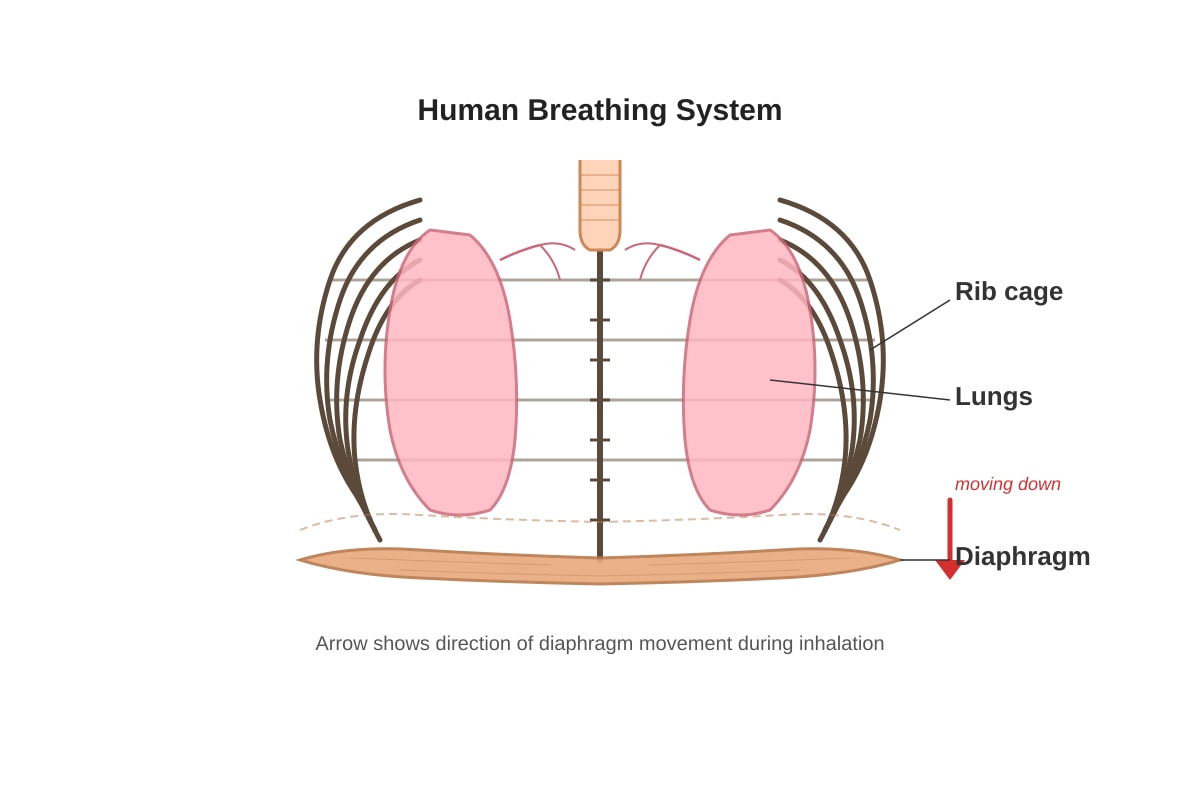
12. Study the diagram of the human breathing system below.
<image_placeholder>
id: Q12-fig1
type: diagram
linked_question: Q12
description: Diagram showing the rib cage, lungs, and diaphragm. An arrow points downwards indicating the diaphragm moving down.
labels: Rib cage, Lungs, Diaphragm
must_show: Diaphragm in a flattened/downward position. Arrow pointing down.
</image_placeholder>
(a) The diagram shows the diaphragm moving downwards. Is the person inhaling or exhaling? [1]
Answer: __________________________
(b) Explain what happens to the volume of the chest cavity when the diaphragm moves downwards. [1]
(c) Why is breathing important for our body cells? [1]
13. The table below shows the amount of water lost by a plant through its leaves under different conditions.
| Condition | Amount of Water Lost (ml/hour) |
|---|---|
| Windy and Hot | 50 |
| Still and Hot | 30 |
| Windy and Cool | 20 |
| Still and Cool | 10 |
(a) Based on the table, state two factors that affect the rate of water loss from the plant. [2]
(b) Explain why the plant loses the most water when it is windy and hot. [2]
14. The diagram below shows an experiment set up to investigate the transport system in plants.
<image_placeholder>
id: Q14-fig1
type: diagram
linked_question: Q14
description: A beaker with red coloured water. A white celery stalk with leaves is placed in the water.
labels: Red coloured water, Celery stalk
must_show: The base of the celery stalk submerged in red liquid.
</image_placeholder>
After 2 hours, the veins in the celery leaves turned red.
(a) What does this show about the function of the veins in the leaves? [1]
(b) Name the tubes responsible for transporting the red water up the stem. [1]
Answer: __________________________
(c) If the celery stalk was left in the red water for 2 days, what would happen to the colour of the stem? [1]
15. Read the passage below and answer the questions.
"John ate a bowl of rice for lunch. The rice contains starch. As he chewed, the starch began to break down. The food then travelled down his gullet to his stomach. In the stomach, the food was churned and mixed with juices. Later, the food moved to the small intestine where digestion was completed."
(a) Name the enzyme found in the mouth that helps to break down starch. [1]
Answer: __________________________
(b) Why is the food churned in the stomach? [1]
(c) State the final product of starch digestion. [1]
Answer: __________________________
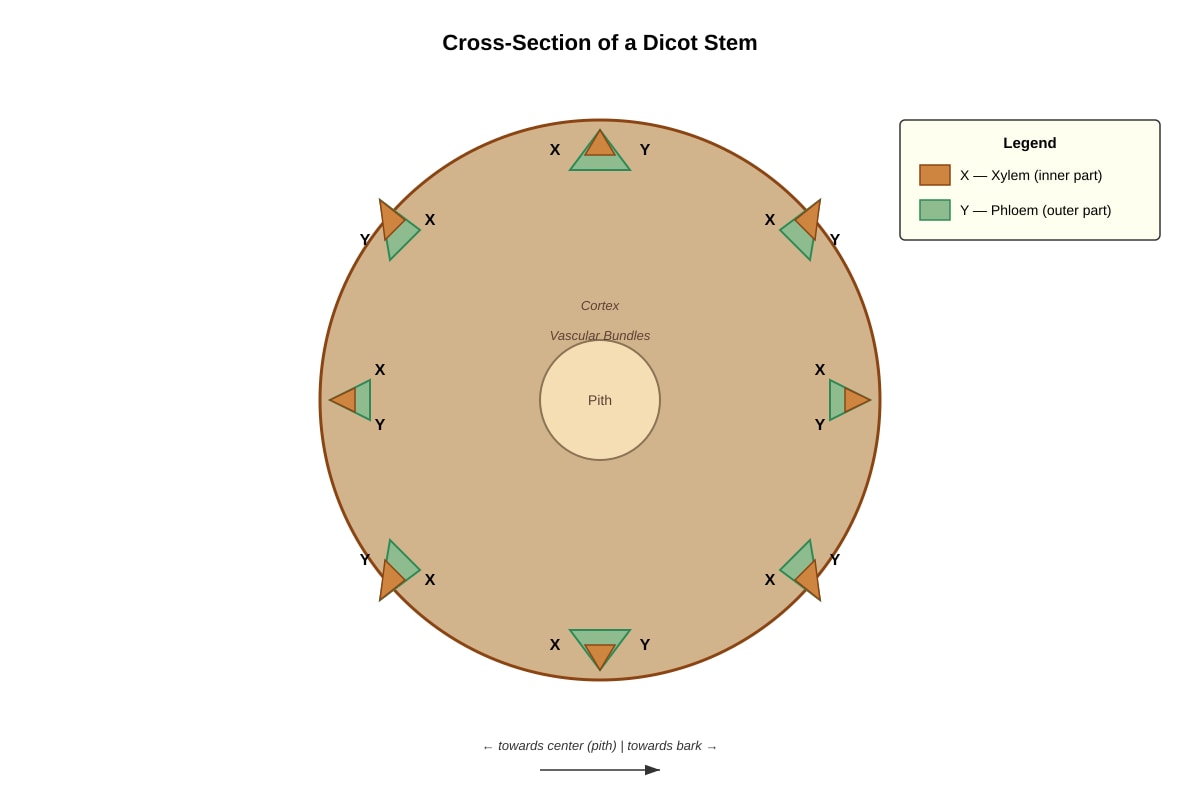
16. The diagram below shows the cross-section of a stem.
<image_placeholder>
id: Q16-fig1
type: diagram
linked_question: Q16
description: Cross section of a dicot stem. Two types of bundles are visible. One bundle is labelled X (inner part) and Y (outer part).
labels: X, Y
must_show: Distinct vascular bundles. X is towards the center, Y is towards the bark.
</image_placeholder>
(a) Which part (X or Y) contains the phloem tubes? [1]
Answer: _________
(b) What is transported in the phloem tubes? [1]
Answer: __________________________
(c) If a ring of bark containing part Y is removed from the stem, the roots will eventually die. Explain why. [2]
17. The table below compares the composition of air inhaled and exhaled.
| Gas | Inhaled Air (%) | Exhaled Air (%) |
|---|---|---|
| Oxygen | 21 | 16 |
| Carbon Dioxide | 0.04 | 4 |
| Nitrogen | 78 | 78 |
(a) Why is there less oxygen in exhaled air than in inhaled air? [1]
(b) Why is there more carbon dioxide in exhaled air? [1]
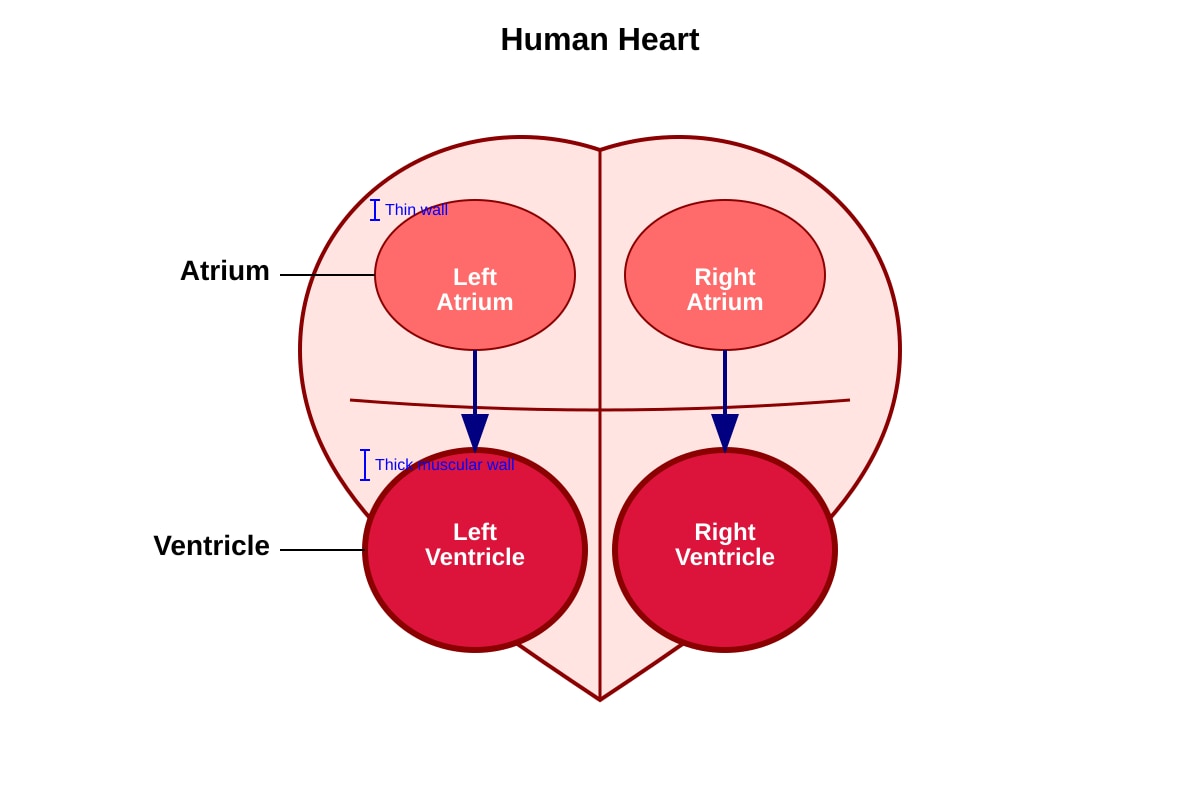
18. Study the diagram of the human heart below.
<image_placeholder>
id: Q18-fig1
type: diagram
linked_question: Q18
description: Simplified heart diagram with four chambers. Top two are atria, bottom two are ventricles. Arrows show blood flow from Atria to Ventricles.
labels: Atrium, Ventricle
must_show: Thick muscular walls of the ventricles compared to atria.
</image_placeholder>
(a) Why are the walls of the ventricles thicker than the walls of the atria? [1]
(b) Name the liquid that is pumped by the heart. [1]
Answer: __________________________
19. Plants and humans both have transport systems.
(a) State one similarity between the transport system of plants and humans. [1]
(b) State one difference between the transport system of plants and humans. [1]
20. A patient has a blockage in the arteries leading to his heart.
(a) How might this affect the patient’s ability to exercise? [1]
(b) Explain your answer in (a). [1]
End of Quiz
Answers
Primary 5 Science Quiz - Systems (Answer Key)
Section A: Multiple Choice Questions
1. (2)
Explanation: The heart is a muscular organ that pumps blood to all parts of the body. The kidneys filter waste, lungs exchange gases, and the digestive system breaks down food.
2. (3)
Explanation: Gas exchange (oxygen in, carbon dioxide out) occurs in the lungs, specifically in the tiny air sacs called alveoli. The windpipe only transports air.
3. (2)
Explanation: Xylem tubes transport water and mineral salts from roots to leaves. Phloem tubes transport food (sugars) made in the leaves to other parts.
4. (3)
Explanation: Blood transports digested food (glucose, amino acids), oxygen, and hormones to cells. It also carries waste away. Veins carry blood to the heart, arteries carry it away.
5. (2)
Explanation: Part C represents the stomata. Stomata are tiny openings on the leaf surface that allow gases (carbon dioxide and oxygen) and water vapour to enter and leave the leaf.
6. (2)
Explanation: The stomach is part of the digestive system. The kidney is excretory, the heart is circulatory, and the brain is nervous.
7. (2)
Explanation: Plants cannot move to find food or water. They need a transport system (xylem and phloem) to move water/minerals up and food down/to other parts.
8. (3)
Explanation: Digestion begins in the mouth where teeth chew food (physical) and saliva contains enzymes (chemical) to break down starch.
9. (2)
Explanation: The kidneys filter the blood to remove liquid waste (urea, excess water, salts) which forms urine.
10. (1)
Explanation: During exercise, muscles need more energy. Energy is released through respiration, which requires oxygen. Therefore, breathing rate increases to take in more oxygen.
Section B: Structured Questions
11.
(a) Part A: Stomach [1]
Part B: Small Intestine [1]
(b) To churn/mix food with digestive juices OR To kill bacteria OR To begin protein digestion. [1]
(c) B [1]
Note: Most absorption happens in the small intestine due to its large surface area.
12.
(a) Inhaling [1]
Note: When the diaphragm moves down, the chest volume increases, pressure decreases, and air rushes in.
(b) The volume of the chest cavity increases. [1]
(c) To provide oxygen for respiration to release energy. [1]
Common Mistake: Students often say "to breathe." The biological purpose is energy release via respiration.
13.
(a) 1. Wind / Air movement [1]
2. Temperature / Heat [1]
(b) When it is hot, water evaporates faster. When it is windy, the water vapour around the leaf is blown away, maintaining a high concentration gradient, so water loss is faster. [2]
Marking: 1 mark for mentioning evaporation/heat, 1 mark for wind removing vapour/concentration gradient concept (simplified for P5: "wind blows away moist air").
14.
(a) The veins contain tubes that transport water. [1]
(b) Xylem tubes [1]
(c) The stem will turn red. [1]
Explanation: The xylem tubes run through the stem, carrying the coloured water up.
15.
(a) Salivary amylase (or just Amylase) [1]
(b) To break food into smaller pieces and mix it thoroughly with digestive juices. [1]
(c) Glucose (or Sugar) [1]
Note: Starch breaks down into maltose then glucose. Glucose is the final simple sugar absorbed.
16.
(a) Y [1]
Note: In dicot stems, phloem is usually on the outer side of the vascular bundle, xylem on the inner.
(b) Food (or Sugars / Glucose) [1]
(c) The phloem tubes are cut. Food made in the leaves cannot be transported down to the roots. The roots starve and die. [2]
Marking: 1 mark for identifying phloem/food transport blocked, 1 mark for consequence (roots starve/die).
17.
(a) Oxygen is used by body cells for respiration. [1]
(b) Carbon dioxide is produced as a waste product of respiration. [1]
18.
(a) The ventricles need to pump blood out of the heart to the lungs and body, which requires more force/pressure than the atria which only pump blood to the ventricles. [1]
(b) Blood [1]
19.
(a) Both have tubes/vessels to transport materials. OR Both transport water/nutrients. [1]
(b) Humans have a pump (heart); plants do not. OR Human blood carries oxygen; plant xylem carries water/minerals. [1]
Note: Any valid structural or functional difference is accepted.
20.
(a) He will get tired easily / He will have shortness of breath. [1]
(b) Less blood/oxygen reaches the heart muscles. The heart muscles cannot respire enough to release the energy needed for pumping blood during exercise. [1]
Marking: Link between blocked artery -> less oxygen -> less energy -> poor performance.