AI Generated Quiz
Primary 5 Science Systems Quiz
Free AI-Generated NVIDIA Nemotron 3 Ultra 550B A55B Free Primary 5 Science Systems quiz with questions and answers for Singapore students. This page is rendered as a direct URL so the questions and answers can be discovered without pressing in-page buttons.
These static practice materials are generated from the site's syllabus and paper-generation workflow, with source and model context shown so students and parents can evaluate the material before use.
Questions
Primary 5 Science Quiz - Systems
Name: ___________________________
Class: Primary 5 ______
Date: _______________
Score: ______ / 40
Duration: 45 minutes
Total Marks: 40
Instructions:
- Answer all questions.
- Write your answers in the spaces provided.
- For multiple-choice questions, write the letter (A, B, C, or D) in the bracket provided.
- For open-ended questions, write your answers clearly in complete sentences.
- Diagrams are not drawn to scale unless stated.
Section A: Multiple-Choice Questions (10 × 1 mark = 10 marks)
For each question, choose the correct answer and write its letter in the bracket.
1. Which of the following systems in the human body is responsible for transporting oxygen and nutrients to all parts of the body?
A. Digestive system
B. Respiratory system
C. Circulatory system
D. Nervous system
[ ]
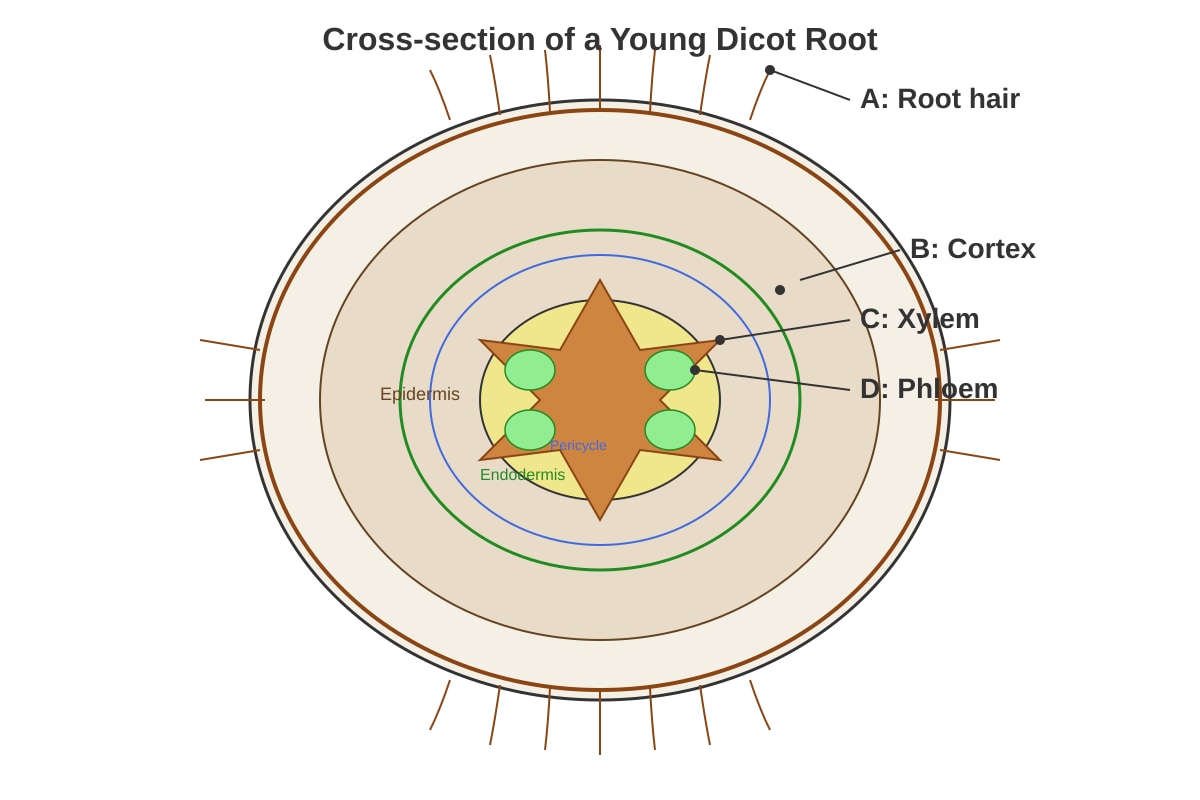
2. In the plant transport system, which tube carries water and mineral salts from the roots to the leaves?
A. Phloem
B. Xylem
C. Stomata
D. Root hair
[ ]
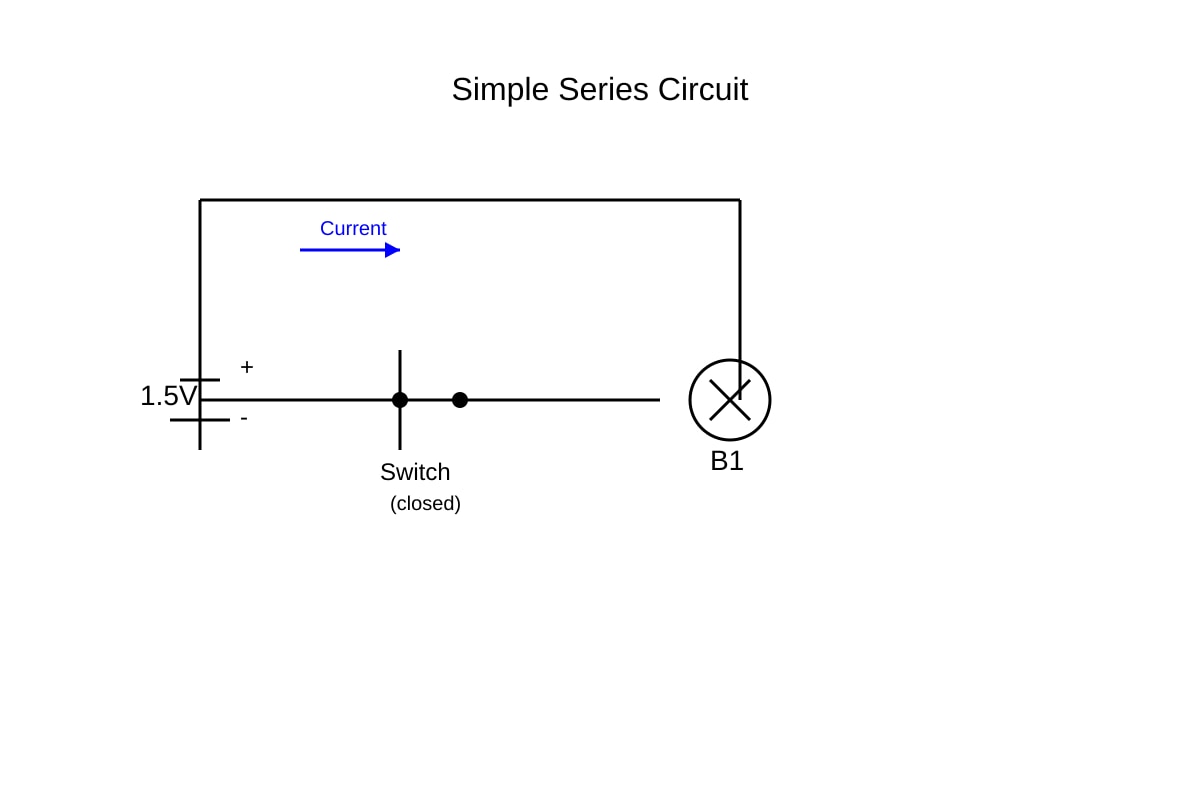
3. The diagram below shows a simple electrical circuit.
<image_placeholder>
id: Q3-fig1
type: diagram
linked_question: Q3
description: A simple series circuit with a battery, a switch, and two bulbs connected in series. The switch is open. Both bulbs are labelled Bulb 1 and Bulb 2.
labels: Battery (+ and - terminals), Switch (open), Bulb 1, Bulb 2, Connecting wires
values: None
must_show: Open switch, series connection, two bulbs, battery polarity
</image_placeholder>
What will happen to the bulbs when the switch is closed?
A. Only Bulb 1 will light up.
B. Only Bulb 2 will light up.
C. Both bulbs will light up.
D. Neither bulb will light up.
[ ]
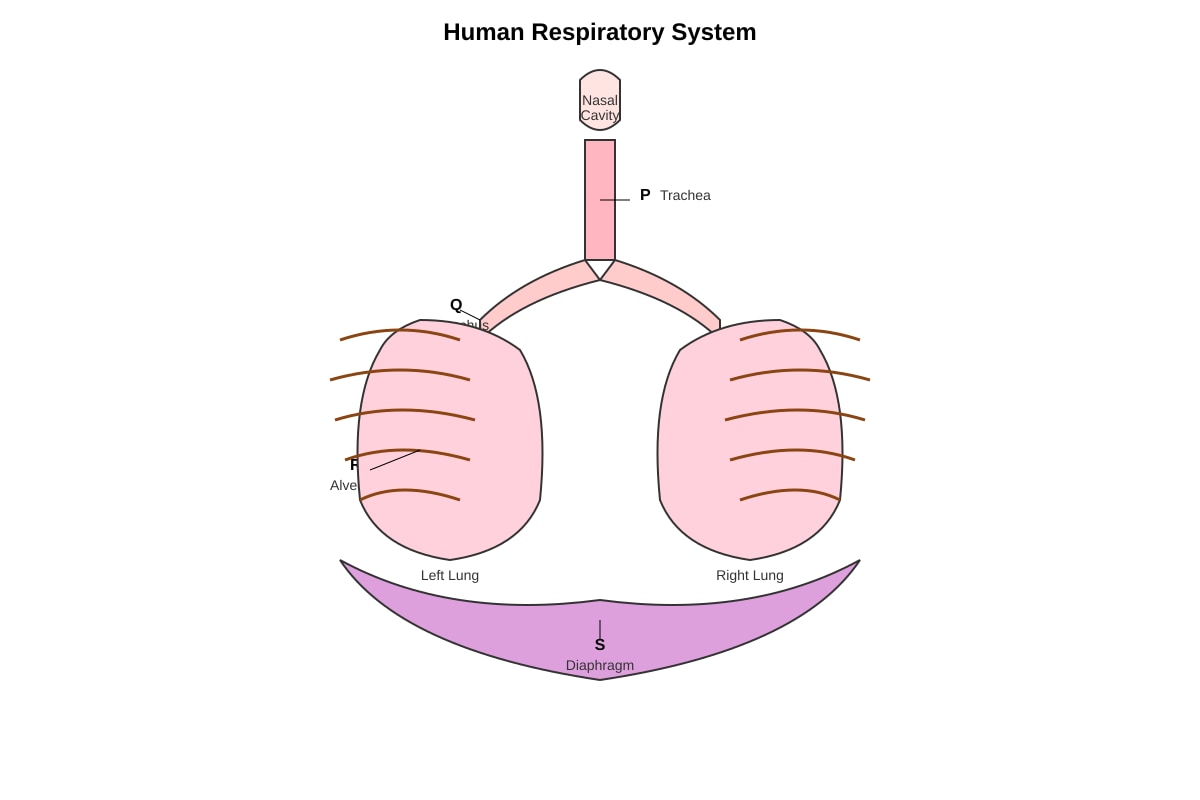
4. Which part of the human respiratory system is the site of gaseous exchange?
A. Trachea
B. Bronchi
C. Alveoli
D. Diaphragm
[ ]
5. In a flowering plant, which part develops into the fruit after fertilisation?
A. Ovary
B. Ovule
C. Stigma
D. Style
[ ]
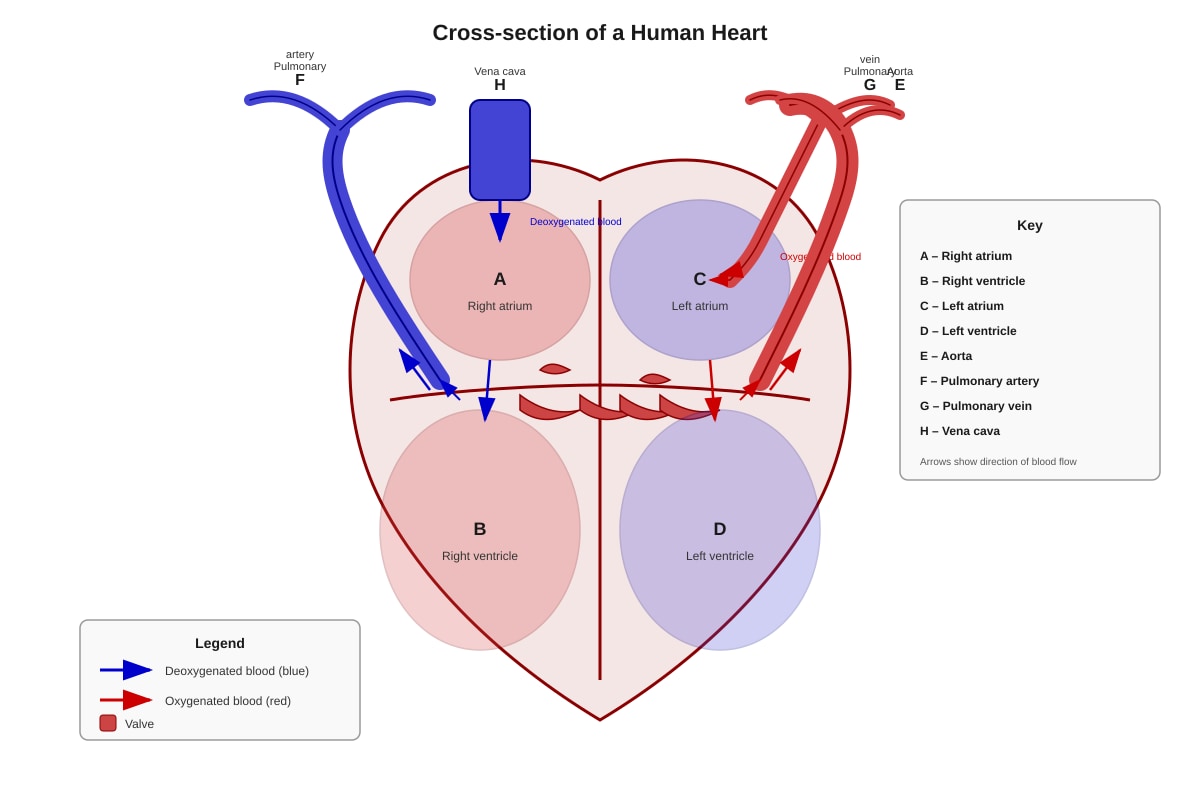
6. The diagram below shows the human heart.
<image_placeholder>
id: Q6-fig1
type: diagram
linked_question: Q6
description: A cross-section of the human heart showing four chambers, major blood vessels, and valves. Arrows indicate blood flow direction.
labels: Right atrium, Right ventricle, Left atrium, Left ventricle, Aorta, Pulmonary artery, Pulmonary vein, Vena cava, Tricuspid valve, Bicuspid valve
values: None
must_show: Four chambers, major vessels, valves, blood flow direction arrows
</image_placeholder>
Which chamber receives deoxygenated blood from the body?
A. Right atrium
B. Left atrium
C. Right ventricle
D. Left ventricle
[ ]
7. Which of the following is a function of the phloem in plants?
A. Transport water from roots to leaves
B. Transport food from leaves to other parts
C. Absorb water from the soil
D. Carry out photosynthesis
[ ]
8. In an electrical circuit, which component is used to measure the current flowing through the circuit?
A. Voltmeter
B. Ammeter
C. Rheostat
D. Switch
[ ]
9. The diagram below shows the reproductive parts of a flower.
<image_placeholder>
id: Q9-fig1
type: diagram
linked_question: Q9
description: A longitudinal section of a flower showing sepals, petals, stamens (anther and filament), and pistil (stigma, style, ovary, ovules).
labels: Sepal, Petal, Anther, Filament, Stigma, Style, Ovary, Ovule
values: None
must_show: All floral parts clearly labelled, ovules inside ovary
</image_placeholder>
Where are the male reproductive cells (pollen grains) produced?
A. Stigma
B. Ovary
C. Anther
D. Style
[ ]
10. Which of the following statements about the water cycle is correct?
A. Evaporation only occurs at 100°C.
B. Condensation releases heat to the surroundings.
C. Precipitation only occurs as rain.
D. Transpiration is the same as evaporation.
[ ]
Section B: Short-Answer Questions (10 × 2 marks = 20 marks)
Write your answers in the spaces provided.
11. The diagram below shows a cell.
<image_placeholder>
id: Q11-fig1
type: diagram
linked_question: Q11
description: A typical plant cell with cell wall, cell membrane, cytoplasm, nucleus, chloroplasts, and a large central vacuole.
labels: Cell wall, Cell membrane, Cytoplasm, Nucleus, Chloroplast, Vacuole
values: None
must_show: All organelles clearly labelled, distinct plant cell features (cell wall, chloroplasts, large vacuole)
</image_placeholder>
(a) Identify the part labelled X (the green structures in the cytoplasm).
______________________________________________________________________________ [1]
(b) State the function of part X.
______________________________________________________________________________ [1]
12. Complete the table below by stating one function for each human organ system listed.
| Organ System | Function |
|---|---|
| Digestive system | ______________________________________________________________________ |
| Respiratory system | ______________________________________________________________________ |
| Circulatory system | ______________________________________________________________________ |
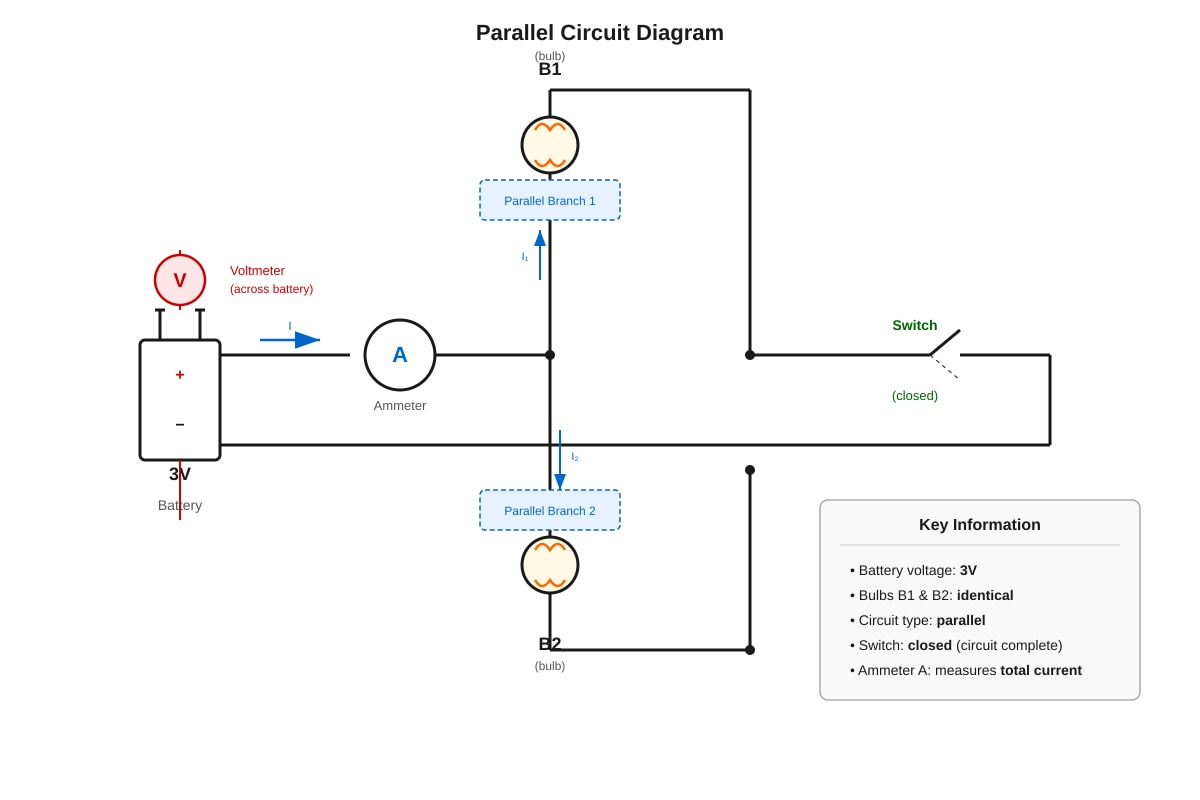
13. The diagram below shows a simple circuit with two bulbs arranged in parallel.
<image_placeholder>
id: Q13-fig1
type: diagram
linked_question: Q13
description: A parallel circuit with a battery, a switch, and two bulbs (Bulb A and Bulb B) connected in parallel. The switch is closed.
labels: Battery, Switch (closed), Bulb A, Bulb B, Connecting wires
values: None
must_show: Parallel connection, closed switch, two bulbs, battery
</image_placeholder>
(a) If Bulb A fuses (blows), what will happen to Bulb B?
______________________________________________________________________________ [1]
(b) Explain your answer in (a).
______________________________________________________________________________ [1]
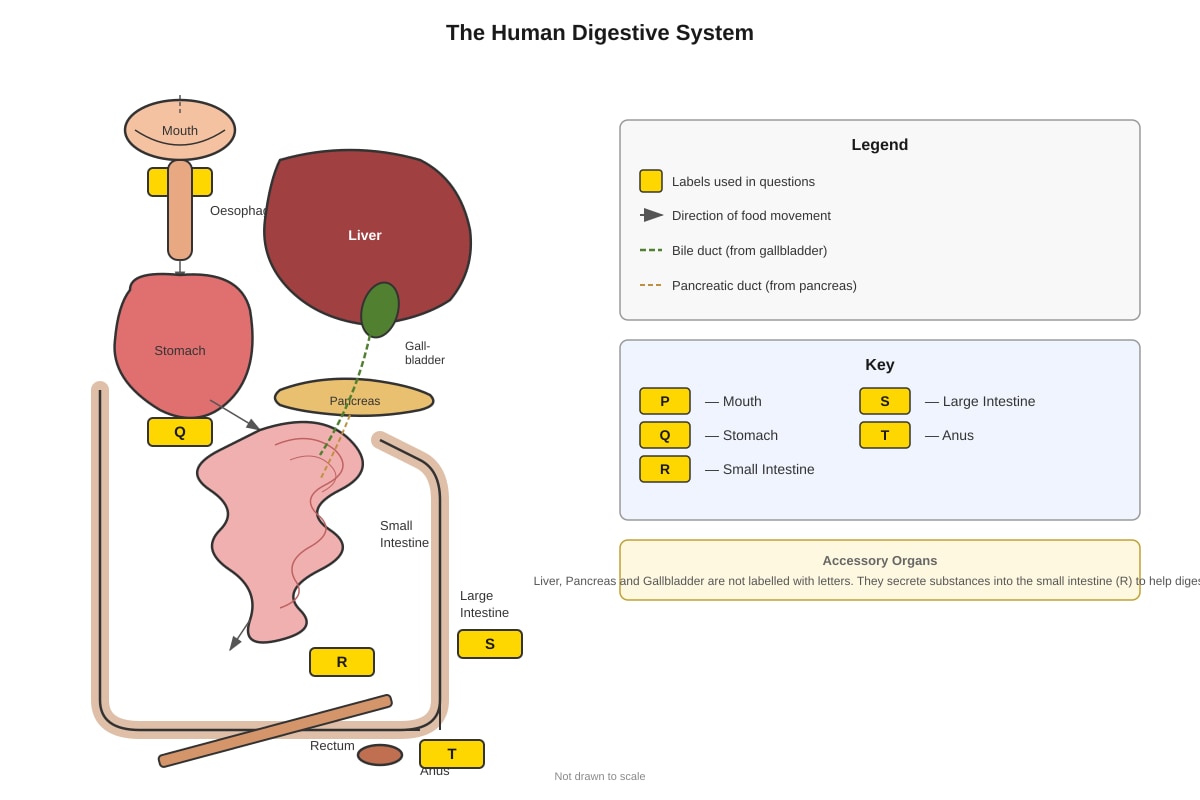
14. The diagram below shows the human digestive system.
<image_placeholder>
id: Q14-fig1
type: diagram
linked_question: Q14
description: The human digestive system showing mouth, oesophagus, stomach, small intestine, large intestine, rectum, anus, and accessory organs (liver, pancreas, gall bladder).
labels: Mouth, Oesophagus, Stomach, Small intestine, Large intestine, Rectum, Anus, Liver, Pancreas, Gall bladder
values: None
must_show: All organs in correct anatomical position, accessory organs connected
</image_placeholder>
(a) In which organ does most absorption of digested food take place?
______________________________________________________________________________ [1]
(b) Name the finger-like projections found on the inner wall of this organ that increase the surface area for absorption.
______________________________________________________________________________ [1]
15. Study the flowchart below.
<image_placeholder>
id: Q15-fig1
type: diagram
linked_question: Q15
description: A flowchart showing the path of air during inhalation: Nose → Trachea → Bronchi → Bronchioles → Alveoli. Arrows show direction of airflow.
labels: Nose, Trachea, Bronchi, Bronchioles, Alveoli
values: None
must_show: Sequential flow from nose to alveoli, branching at bronchi
</image_placeholder>
(a) Name the process that occurs at the alveoli.
______________________________________________________________________________ [1]
(b) State one difference between inhaled air and exhaled air at the alveoli.
______________________________________________________________________________ [1]
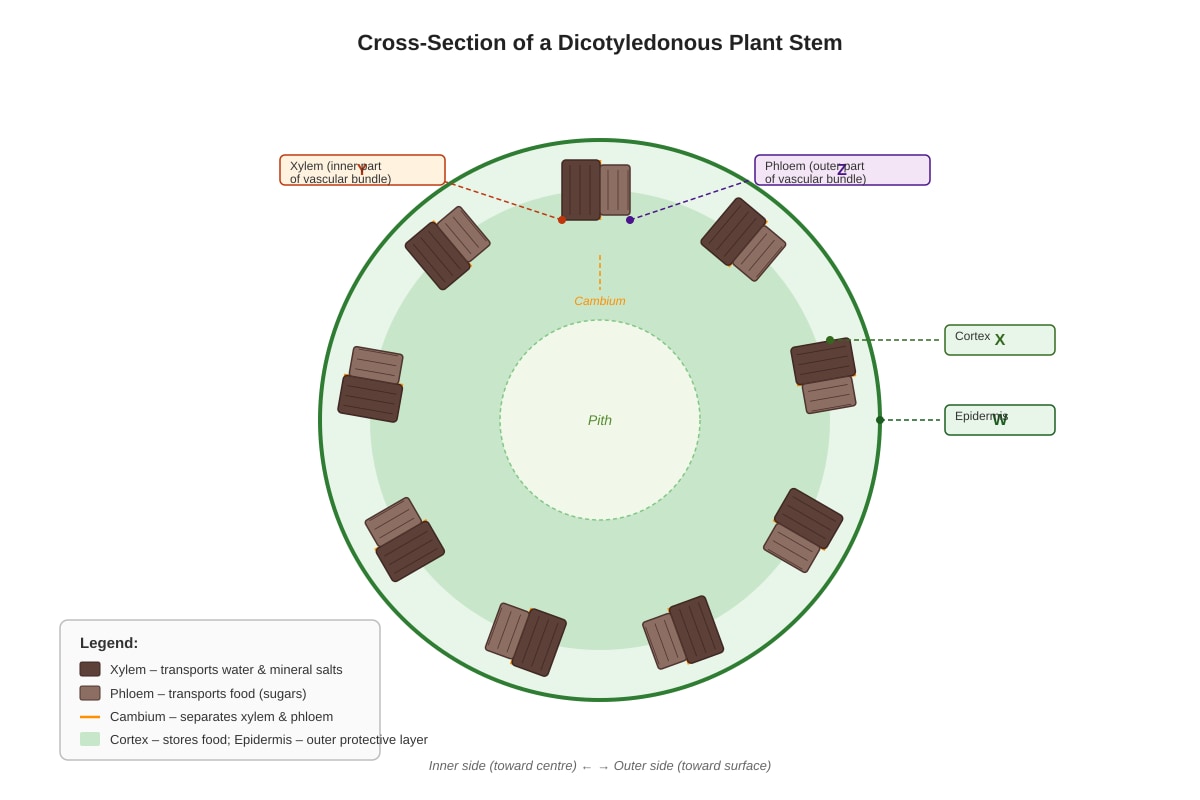
16. The diagram below shows a cross-section of a stem.
<image_placeholder>
id: Q16-fig1
type: diagram
linked_question: Q16
description: A cross-section of a dicotyledonous stem showing epidermis, cortex, vascular bundles (xylem and phloem), and pith. Xylem is on the inner side, phloem on the outer side of each vascular bundle.
labels: Epidermis, Cortex, Xylem, Phloem, Pith, Vascular bundle
values: None
must_show: Distinct vascular bundles in a ring, xylem and phloem positions, all tissues labelled
</image_placeholder>
(a) Label the part that transports water and mineral salts.
______________________________________________________________________________ [1]
(b) Label the part that transports food made by the leaves.
______________________________________________________________________________ [1]
17. In sexual reproduction of flowering plants, pollination must occur before fertilisation.
(a) Define pollination.
______________________________________________________________________________ [1]
(b) State one difference between self-pollination and cross-pollination.
______________________________________________________________________________ [1]
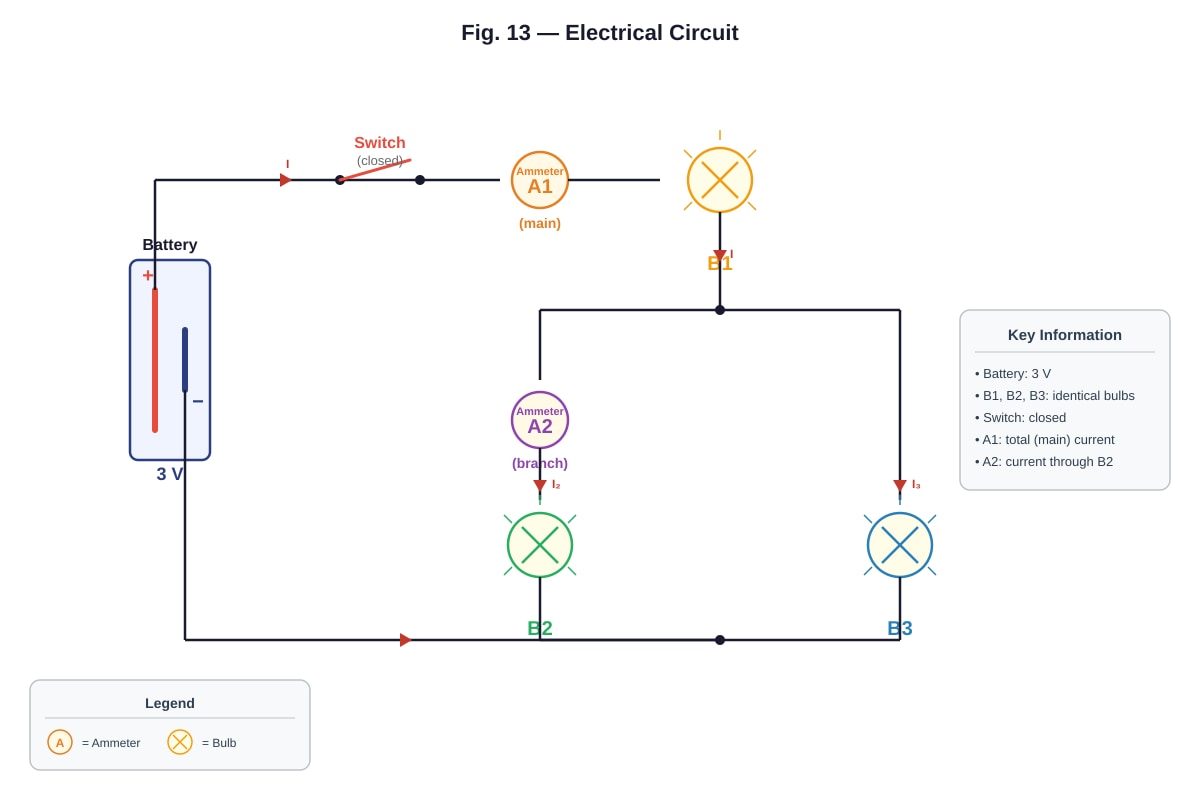
18. The diagram below shows an electrical circuit with three identical bulbs.
<image_placeholder>
id: Q18-fig1
type: diagram
linked_question: Q18
description: A circuit with a battery and three identical bulbs. Bulb 1 is in series with a parallel combination of Bulb 2 and Bulb 3.
labels: Battery, Bulb 1, Bulb 2, Bulb 3, Connecting wires
values: None
must_show: Series-parallel arrangement clearly shown, all bulbs identical
</image_placeholder>
(a) Which bulb(s) will be the brightest?
______________________________________________________________________________ [1]
(b) Explain your answer in (a).
______________________________________________________________________________ [1]
19. The table below shows the composition of inhaled and exhaled air.
| Gas | Inhaled Air (%) | Exhaled Air (%) |
|---|---|---|
| Oxygen | 21 | 16 |
| Carbon dioxide | 0.04 | 4 |
| Nitrogen | 78 | 78 |
| Water vapour | Variable | Saturated |
(a) Which gas shows the greatest percentage change between inhaled and exhaled air?
______________________________________________________________________________ [1]
(b) Explain why the percentage of nitrogen remains the same.
______________________________________________________________________________ [1]
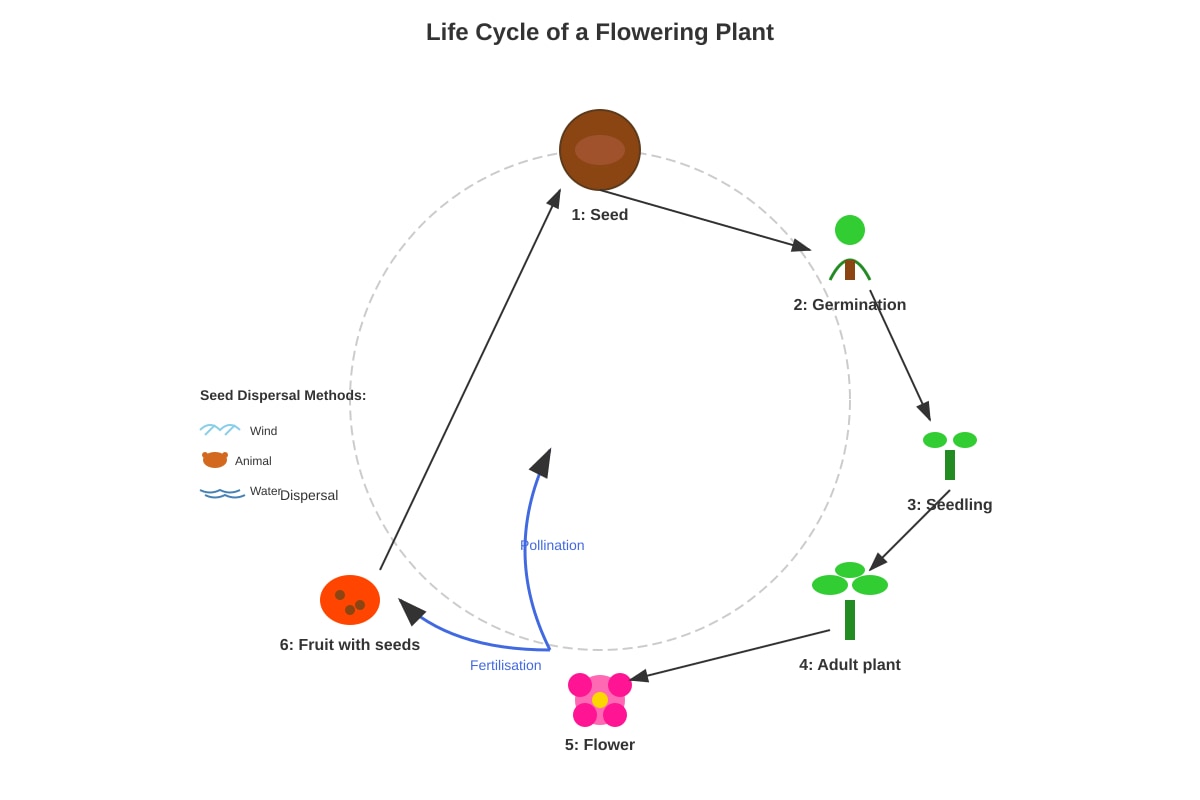
20. The diagram below shows the life cycle of a flowering plant.
<image_placeholder>
id: Q20-fig1
type: diagram
linked_question: Q20
description: A circular life cycle diagram of a flowering plant: Seed → Germination → Seedling → Adult plant → Flowering → Pollination → Fertilisation → Seed formation → Seed dispersal → (back to Seed)
labels: Seed, Germination, Seedling, Adult plant, Flowering, Pollination, Fertilisation, Seed formation, Seed dispersal
values: None
must_show: All stages in correct cyclic order, arrows showing direction
</image_placeholder>
(a) Name the process that occurs after pollination and leads to the formation of seeds.
______________________________________________________________________________ [1]
(b) Why is seed dispersal important for the plant?
______________________________________________________________________________ [1]
Section C: Structured / Open-Ended Questions (2 × 5 marks = 10 marks)
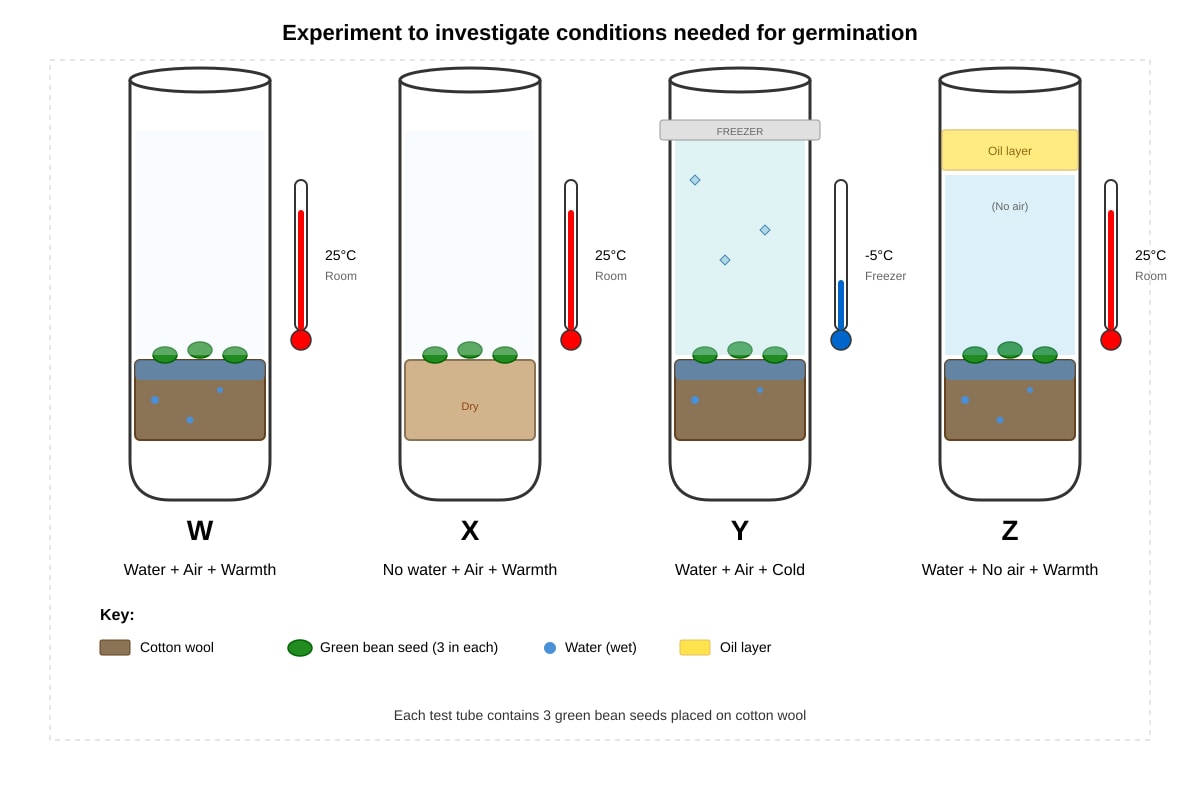
16. The diagram below shows a set-up to investigate the conditions needed for germination.
<image_placeholder>
id: Q16-fig1
type: experimental_setup
linked_question: Q16
description: Four test tubes labelled A, B, C, D. Test tube A: Wet cotton wool, seeds, room temperature. Test tube B: Dry cotton wool, seeds, room temperature. Test tube C: Wet cotton wool, seeds, in a refrigerator (4°C). Test tube D: Wet cotton wool, boiled seeds (dead), room temperature.
labels: Test tube A, B, C, D; Wet/Dry cotton wool; Seeds/Boiled seeds; Room temperature/Refrigerator
values: Temperature: Room temp (~27°C), Refrigerator (4°C)
must_show: Four distinct setups with clear labels showing variables: water, temperature, seed viability
</image_placeholder>
(a) In which test tube(s) will the seeds germinate?
______________________________________________________________________________ [1]
(b) State the three conditions necessary for germination based on this experiment.
______________________________________________________________________________ [2]
(c) What is the purpose of Test tube D (boiled seeds)?
______________________________________________________________________________ [1]
(d) State one observable change in the seed that shows germination has occurred.
______________________________________________________________________________ [1]
17. The diagram below shows two circuits, Circuit X and Circuit Y, each with two identical bulbs and identical batteries.
<image_placeholder>
id: Q17-fig1
type: diagram
linked_question: Q17
description: Circuit X: Two bulbs in series with a battery. Circuit Y: Two bulbs in parallel with a battery. Both circuits have closed switches.
labels: Circuit X, Circuit Y, Battery, Bulb, Switch (closed), Connecting wires
values: None
must_show: Clear series vs parallel arrangement, identical components
</image_placeholder>
(a) In which circuit (X or Y) will the bulbs be brighter?
______________________________________________________________________________ [1]
(b) Explain your answer in (a).
______________________________________________________________________________ [2]
(c) If one bulb in Circuit X fuses, what happens to the other bulb?
______________________________________________________________________________ [1]
(d) If one bulb in Circuit Y fuses, what happens to the other bulb?
______________________________________________________________________________ [1]
18. The diagram below shows the human circulatory system.
<image_placeholder>
id: Q18-fig1
type: diagram
linked_question: Q18
description: A simplified diagram of the human circulatory system showing the heart (four chambers), lungs, and body. Arrows show blood flow: Heart → Lungs → Heart → Body → Heart. Labels: Right atrium, Right ventricle, Left atrium, Left ventricle, Lungs, Body, Pulmonary artery, Pulmonary vein, Aorta, Vena cava.
labels: Right atrium, Right ventricle, Left atrium, Left ventricle, Lungs, Body, Pulmonary artery, Pulmonary vein, Aorta, Vena cava
values: None
must_show: Double circulation path clearly shown, all chambers and major vessels labelled, oxygenated/deoxygenated blood paths distinct
</image_placeholder>
(a) Name the blood vessel that carries oxygenated blood from the heart to the rest of the body.
______________________________________________________________________________ [1]
(b) State the function of the valves in the heart.
______________________________________________________________________________ [1]
(c) Explain why the blood must go to the lungs before going to the rest of the body.
______________________________________________________________________________ [2]
(d) The heart is described as a "double pump". Explain what this means.
______________________________________________________________________________ [1]
19. The diagram below shows a flowering plant.
<image_placeholder>
id: Q19-fig1
type: diagram
linked_question: Q19
description: A whole flowering plant showing roots, stem, leaves, flowers, and fruits. Labels: Roots, Stem, Leaves, Flower, Fruit.
labels: Roots, Stem, Leaves, Flower, Fruit
values: None
must_show: Complete plant with all parts labelled, flower and fruit shown
</image_placeholder>
(a) State the function of the roots.
______________________________________________________________________________ [1]
(b) State the function of the leaves.
______________________________________________________________________________ [1]
(c) After fertilisation, the ovule develops into the _______________ and the ovary develops into the _______________.
______________________________________________________________________________ [2]
(d) Name the process by which green plants make food.
______________________________________________________________________________ [1]
20. The diagram below shows the water cycle.
<image_placeholder>
id: Q20-fig1
type: diagram
linked_question: Q20
description: The water cycle showing evaporation from water bodies, transpiration from plants, condensation forming clouds, precipitation (rain), and collection in water bodies. Arrows show the continuous cycle. Sun provides heat energy.
labels: Sun, Evaporation, Transpiration, Condensation, Clouds, Precipitation, Collection, Water bodies, Groundwater
values: None
must_show: All processes labelled, continuous cyclic arrows, sun as energy source
</image_placeholder>
(a) Name the process marked X where water vapour changes into tiny water droplets to form clouds.
______________________________________________________________________________ [1]
(b) State one difference between evaporation and boiling.
______________________________________________________________________________ [1]
(c) Explain how the water cycle ensures a continuous supply of fresh water on Earth.
______________________________________________________________________________ [2]
(d) Plants play a role in the water cycle. Name the process by which plants release water vapour.
______________________________________________________________________________ [1]
End of Quiz
Answers
Primary 5 Science Quiz - Systems (Answer Key)
Total Marks: 40
Section A: Multiple-Choice Questions (10 marks)
- C – The circulatory system transports oxygen and nutrients to all parts of the body.
- B – Xylem carries water and mineral salts from roots to leaves.
- C – Closing the switch completes the series circuit, allowing current to flow through both bulbs.
- C – Gaseous exchange occurs in the alveoli where oxygen enters the blood and carbon dioxide leaves.
- A – The ovary develops into the fruit after fertilisation.
- A – The right atrium receives deoxygenated blood from the body via the vena cava.
- B – Phloem transports food (sucrose) made in the leaves to other parts of the plant.
- B – An ammeter measures current flowing through a circuit.
- C – Pollen grains (male reproductive cells) are produced in the anther.
- B – Condensation is an exothermic process; it releases heat to the surroundings.
Section B: Short-Answer Questions (20 marks)
11.
(a) Chloroplasts
(b) Contain chlorophyll to trap light energy for photosynthesis / Make food for the plant.
12.
| Organ System | Function |
|---|---|
| Digestive system | Breaks down food into simpler substances that can be absorbed by the body. |
| Respiratory system | Takes in oxygen and removes carbon dioxide from the body (gaseous exchange). |
| Circulatory system | Transports oxygen, nutrients, and waste products around the body. |
13.
(a) Bulb B will remain lit / continue to light up.
(b) In a parallel circuit, the bulbs are on separate branches. If one bulb fuses, the circuit for the other bulb remains complete / unbroken, so current can still flow through it.
14.
(a) Small intestine
(b) Villi
15.
(a) Gaseous exchange
(b) Inhaled air has more oxygen (21%) and less carbon dioxide (0.04%) than exhaled air (16% oxygen, 4% carbon dioxide). / Exhaled air is saturated with water vapour while inhaled air has variable water vapour.
16.
(a) Xylem
(b) Phloem
17.
(a) Pollination is the transfer of pollen grains from the anther to the stigma of a flower.
(b) Self-pollination involves pollen from the same flower or plant, while cross-pollination involves pollen from a different plant of the same species.
18.
(a) Bulb 1
(b) Bulb 1 is in series with the battery and receives the full circuit current. Bulbs 2 and 3 are in parallel and share the current, so each receives half the current through Bulb 1. Brightness depends on current; higher current = brighter bulb.
19.
(a) Oxygen (greatest change in percentage composition: 5% decrease from 21% to 16%)
(b) Nitrogen is an inert gas; it is not used up or produced during respiration, so its percentage remains unchanged.
20.
(a) Fertilisation
(b) To prevent overcrowding and competition for sunlight, water, nutrients, and space between the parent plant and seedlings or among seedlings.
Section C: Structured / Open-Ended Questions (10 marks)
16.
(a) Test tube A
(b) Water (moisture), air (oxygen), and suitable temperature (warmth).
(c) To act as a control / to show that living seeds are necessary for germination (dead seeds cannot germinate even with water and warmth).
(d) The seed coat splits / radicle (root) emerges / plumule (shoot) emerges.
17.
(a) Circuit Y
(b) In Circuit Y (parallel), each bulb receives the full voltage from the battery / the current through each bulb is higher. In Circuit X (series), the voltage is shared between the two bulbs / the current through each bulb is lower. Higher current/voltage = brighter bulbs.
(c) The other bulb will go out / not light up because the circuit becomes open / broken.
(d) The other bulb will remain lit / continue to light up because it is on a separate branch and its circuit remains complete.
18.
(a) Aorta
(b) To prevent the backflow of blood / ensure blood flows in one direction only.
(c) Blood goes to the lungs to pick up oxygen (and release carbon dioxide) so that oxygenated blood can be pumped to the rest of the body for respiration.
(d) The right side of the heart pumps deoxygenated blood to the lungs, and the left side pumps oxygenated blood to the body — two separate pumps in one organ.
19.
(a) Absorb water and mineral salts from the soil / anchor the plant firmly to the ground.
(b) Trap light energy to make food through photosynthesis / gaseous exchange.
(c) After fertilisation, the ovule develops into the seed and the ovary develops into the fruit.
(d) Photosynthesis
20.
(a) Condensation
(b) Evaporation occurs at any temperature / only at the surface / slowly, while boiling occurs at a fixed temperature (100°C) / throughout the liquid / rapidly. (Any one valid difference)
(c) The water cycle continuously recycles water through evaporation, condensation, and precipitation, returning fresh water to Earth's surface (rivers, lakes, groundwater) for living things to use.
(d) Transpiration
End of Answer Key