AI Generated Quiz
Primary 5 Science Systems Quiz
Free P5 Science Systems quiz, GLM5.3 AI version, with questions, answers, and syllabus-aligned practice for Singapore students.
These static practice materials are generated from the site's syllabus and paper-generation workflow, with source and model context shown so students and parents can evaluate the material before use.
Questions
Free quiz and exam paper access
Enter your details to view this paper
Your access is remembered on this device.
Answers
Primary 5 Science Quiz - Systems: Answer Key
Answer 1.
B. nitrogen
Answer 2.
C. steel spoon (steel is a conductor of electricity)
Answer 3.
B. Food-carrying tubes carry food made in the leaves to all other parts of the plant.
Answer 4.
D. It carries air from the nose to the lungs.
Answer 5.
B. It becomes brighter (two batteries give more electrical energy).
Answer 6.
Any two:
- Transports oxygen and digested food/nutrients to all parts of the body.
- Carries waste substances such as carbon dioxide away from body parts.
- Helps protect the body against diseases / helps keep body temperature steady.
Answer 7.
All three take in oxygen and give out carbon dioxide during respiration.
- Human: oxygen in; carbon dioxide out
- Fish: oxygen (dissolved in water) in; carbon dioxide out
- Plant: oxygen in; carbon dioxide out
Answer 8.
Any two:
- The circuit is not complete (open circuit / loose connection).
- The battery is flat or wrongly connected.
- The bulb is fused/blown.
Answer 9.
- Conductors: copper wire, iron nail
- Insulators: glass, plastic straw
Answer 10.
Any two:
- It opens and closes the circuit to control the flow of electricity.
- It saves energy by turning off appliances when not needed.
- It improves safety by cutting off electricity quickly.
Answer 11.
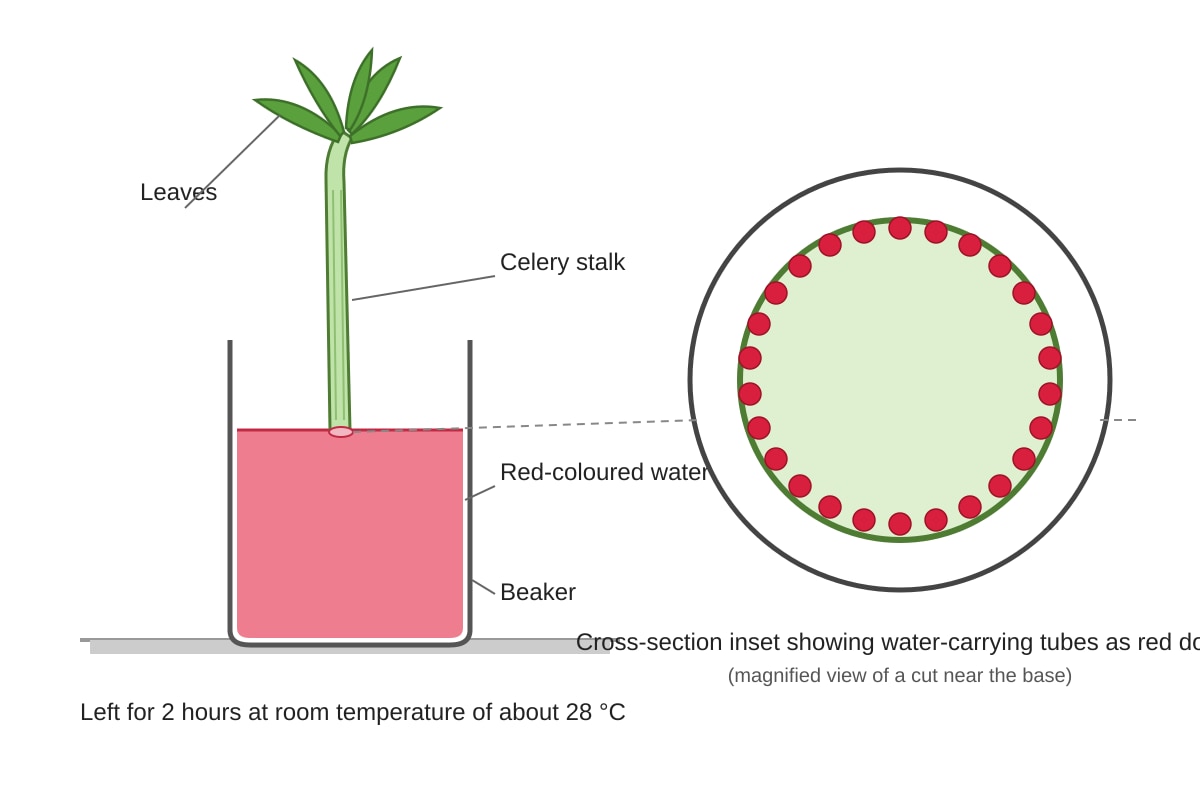
- (a) Water moved upwards from the roots/stem base to the leaves through the stem.
- (b) The water-carrying tubes.
- (c) It holds/supports the plant upright (accept: stores food).
Answer 12.
- (a) Mouth → gullet → stomach → small intestine → large intestine.
- (b) The small intestine.
- (c) Food is chewed, moistened by saliva and digestion of starch begins.
Answer 13.
- (a) The heartbeat / the pumping action of the heart.
- (b) Higher.
- (c) Running muscles need more oxygen and food; the heart pumps faster to deliver them and remove carbon dioxide.
Answer 14.
- (a) The other bulb goes off. Removing one bulb breaks the series circuit, so no current can flow.
- (b) Connect the bulbs in parallel instead of in series.
Answer 15.
- (a) Anchors the plant firmly in the soil; absorbs water and dissolved mineral salts from the soil.
- (b) The stem (its water-carrying tubes).
Answer 16.
- (a) nose; windpipe; lungs
- (b) In the air sacs (alveoli) of the lungs.
- (c) Muscles work harder and need more oxygen, and more carbon dioxide must be removed.
Answer 17.
- (a) Circuit Y. Two batteries in series provide more electrical energy, so the bulb shines brighter.
- (b) It becomes dimmer (the same energy is shared between two bulbs).
Answer 18.
- (a) The gills.
- (b) Oxygen, taken in from the air dissolved in the water as water flows over the gills.
- (c) Like human lungs, the gills take oxygen into the body and release carbon dioxide (gas exchange).
Answer 19.
- (a) Similarity: both use tubes/vessels to carry useful substances to all parts of the organism.
- (b) Difference: the plant's tubes carry only water/minerals or food, while human blood also carries oxygen and wastes and is pumped by a heart.
- (c) Substances such as water, food and oxygen must reach every part of the body, and wastes must be removed, for the organism to stay alive.
Answer 20.
- (a) Place the object between the two crocodile clips to close the gap in the circuit.
- (b) The bulb lights up, showing current flows through the object.
- (c) Plastic is an insulator, so it protects users from electric shocks.
— END OF ANSWER KEY —