AI Generated Quiz
Primary 5 Science Materials Quiz
Free AI-Generated NVIDIA Nemotron 3 Ultra 550B A55B Free Primary 5 Science Materials quiz with questions and answers for Singapore students. This page is rendered as a direct URL so the questions and answers can be discovered without pressing in-page buttons.
These static practice materials are generated from the site's syllabus and paper-generation workflow, with source and model context shown so students and parents can evaluate the material before use.
Questions
Primary 5 Science Quiz - Materials
Name: ___________________________
Class: Primary 5 _______
Date: ___________________________
Score: _______ / 50
Duration: 45 minutes
Total Marks: 50
Instructions:
- Answer all questions.
- Write your answers in the spaces provided.
- For multiple-choice questions, write the letter (A, B, C, or D) in the bracket provided.
- For open-ended questions, write your answers clearly in complete sentences where appropriate.
- The number of marks for each question is shown in brackets [ ].
Section A: Multiple-Choice Questions (10 × 1 mark = 10 marks)
For each question, choose the correct answer and write its letter in the bracket provided.
1. Which of the following is NOT a property of metals?
A. Good conductor of heat
B. Malleable (can be hammered into shape)
C. Transparent
D. Lustrous (shiny)
[ ]
2. A student wants to make a handle for a cooking pot. Which property is most important for the material used?
A. Flexibility
B. Poor conductor of heat
C. Transparency
D. Magnetic
[ ]
3. Which of the following objects is made from a material that is waterproof?
A. Paper towel
B. Cotton T-shirt
C. Rubber raincoat
D. Wooden spoon
[ ]
4. Study the classification table below.
| Group X | Group Y |
|---|---|
| Iron nail | Plastic ruler |
| Steel key | Wooden chopstick |
| Copper wire | Glass marble |
What is the most suitable heading for Group X and Group Y?
| Group X | Group Y |
|---|---|
| A. Magnetic | Non-magnetic |
| B. Metals | Non-metals |
| C. Conductors of electricity | Insulators of electricity |
| D. Flexible | Rigid |
[ ]
5. Which material is most suitable for making a window pane?
A. Wood
B. Metal
C. Glass
D. Rubber
[ ]
6. Four strips of different materials of the same size and thickness are tested for flexibility. The results are shown below.
| Material | Distance bent (cm) |
|---|---|
| P | 2 |
| Q | 8 |
| R | 5 |
| S | 1 |
Which material is the most flexible?
A. P
B. Q
C. R
D. S
[ ]
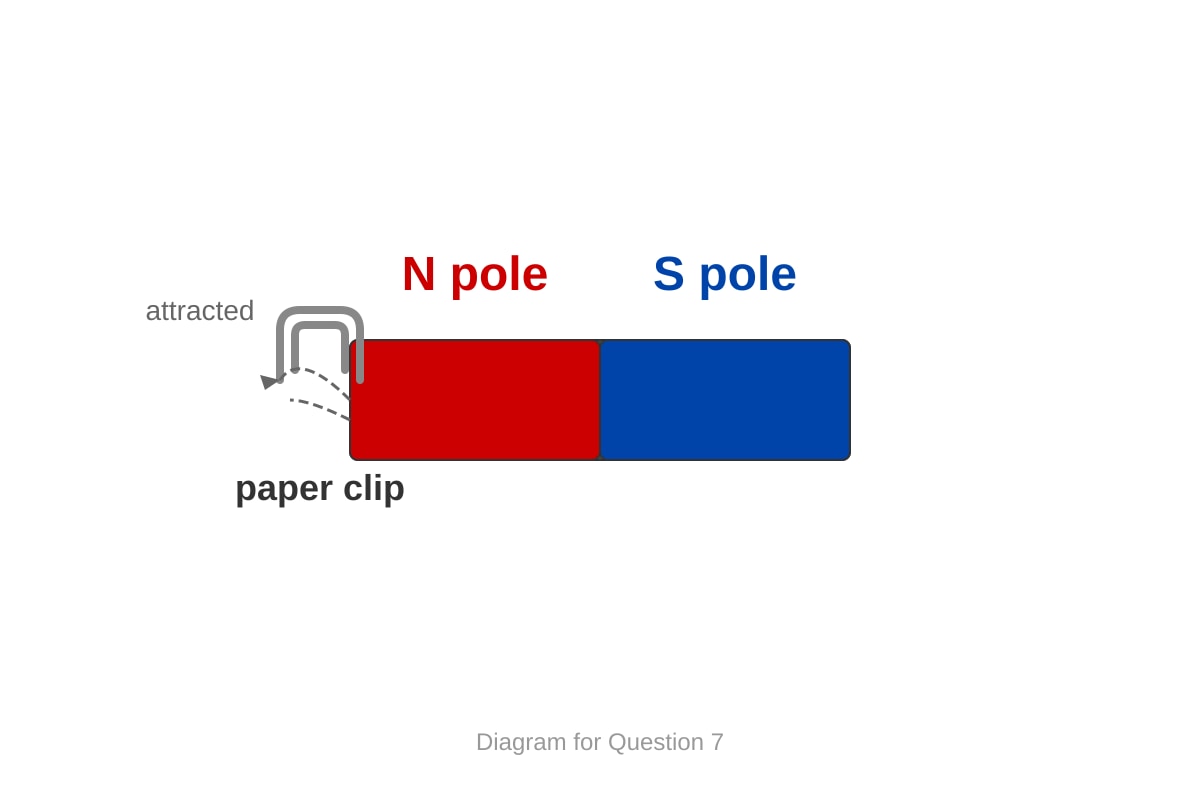
7. A magnet is brought near four objects: an iron nail, a steel paper clip, a copper coin, and an aluminium can. Which objects will be attracted to the magnet?
A. Iron nail and steel paper clip only
B. Iron nail and copper coin only
C. Steel paper clip and aluminium can only
D. All four objects
[ ]
8. Which of the following statements about materials is correct?
A. All metals are magnetic.
B. All plastics are flexible.
C. Ceramics are good conductors of heat.
D. Rubber is a good insulator of electricity.
[ ]
9. The diagram below shows a simple circuit tester used to test if a material conducts electricity.
<image_placeholder> id: Q9-fig1 type: diagram linked_question: Q9 description: A simple circuit tester with a battery, a bulb, two wires with crocodile clips, and a gap between the clips where a material can be placed to complete the circuit. labels: Battery, bulb, wire, crocodile clips, gap for test material values: Battery: 1.5V; Bulb: rated for 1.5V must_show: Open circuit with gap between clips; components connected in series </image_placeholder>
When the crocodile clips touch a metal paper clip, what will happen?
A. The bulb will not light up.
B. The bulb will light up brightly.
C. The bulb will light up dimly.
D. The battery will explode.
[ ]
10. Jenny wants to choose a material to make a food container that can be heated in a microwave oven. Which property is least important?
A. Heat-resistant
B. Non-toxic
C. Transparent
D. Magnetic
[ ]
Section B: Short-Answer Questions (5 × 2 marks = 10 marks)
Write your answers in the spaces provided.
11. State two properties of glass that make it suitable for making window panes.
[2]
12. The diagram below shows three rods made of different materials: wood, metal, and plastic. Each rod has a drawing pin attached to its end with wax. The other ends of the rods are placed in a beaker of hot water.
<image_placeholder> id: Q12-fig1 type: experimental_setup linked_question: Q12 description: Three rods (wood, metal, plastic) of equal length and thickness placed in a beaker of hot water. Each rod has a drawing pin attached at the far end with wax. labels: Wood rod, metal rod, plastic rod, drawing pins, wax, beaker, hot water, heat direction arrows values: Water temperature: 80°C; Rod length: 20 cm; Rod diameter: 1 cm must_show: Three rods side by side in hot water; drawing pins at far ends; wax holding pins </image_placeholder>
(a) On which rod will the drawing pin drop off first?
[1]
(b) Explain your answer in (a).
[1]
13. Classify the following materials into the correct groups in the table below.
Cotton, Steel, Rubber, Glass
| Natural Materials | Man-made Materials |
|---|---|
[2]
14. A student wants to test the strength of four different strings (A, B, C, D) by hanging weights from them until they break. The results are shown below.
| String | Maximum weight held before breaking (g) |
|---|---|
| A | 200 |
| B | 500 |
| C | 350 |
| D | 100 |
(a) Which string is the strongest?
[1]
(b) If the student wants to make a bag to carry heavy books, which string should she choose? Explain why.
[1]
15. The diagram below shows a magnet attracting a steel paper clip through a sheet of material.
<image_placeholder> id: Q15-fig1 type: diagram linked_question: Q15 description: A magnet on top, a sheet of material in the middle, and a steel paper clip at the bottom being attracted through the sheet. labels: Magnet, sheet of material, steel paper clip, magnetic force arrows values: Distance between magnet and paper clip: 2 cm; Sheet thickness: 0.5 cm must_show: Magnet above sheet; paper clip below sheet; attraction through sheet </image_placeholder>
Which of the following materials cannot be the sheet of material?
A. Plastic
B. Wood
C. Glass
D. Iron
Answer: ___________________
[2]
Section C: Structured and Open-Ended Questions (5 × 6 marks = 30 marks)
16. The table below shows the properties of four materials: W, X, Y, and Z.
| Material | Waterproof | Flexible | Transparent | Strong | Conducts electricity |
|---|---|---|---|---|---|
| W | Yes | No | Yes | No | No |
| X | Yes | Yes | No | Yes | No |
| Y | No | Yes | No | Yes | Yes |
| Z | Yes | No | No | Yes | No |
(a) Which material is most suitable for making a raincoat? Give two reasons based on the table.
Material: ___________________
Reason 1: ___________________________________________________________________
Reason 2: ___________________________________________________________________
[3]
(b) Which material is most suitable for making electrical wires? Give two reasons based on the table.
Material: ___________________
Reason 1: ___________________________________________________________________
Reason 2: ___________________________________________________________________
[3]
17. Ali conducted an experiment to compare the absorbency of four materials: cotton, polyester, silk, and wool. He cut equal-sized pieces of each material, weighed them, soaked them in water for 5 minutes, then weighed them again.
<image_placeholder> id: Q17-fig1 type: experimental_setup linked_question: Q17 description: Four beakers each containing water and a piece of fabric (cotton, polyester, silk, wool) of equal size. A weighing balance is shown nearby. labels: Beaker, water, fabric samples (cotton, polyester, silk, wool), weighing balance, timer values: Fabric size: 5 cm × 5 cm; Soaking time: 5 minutes; Water volume: 100 mL per beaker must_show: Four separate beakers with labelled fabric samples; balance for weighing </image_placeholder>
(a) What is the changed variable (independent variable) in this experiment?
[1]
(b) State two variables that Ali must keep the same (constant variables) to ensure a fair test.
[2]
(c) The results are shown below.
| Material | Mass before soaking (g) | Mass after soaking (g) | Mass of water absorbed (g) |
|---|---|---|---|
| Cotton | 2.0 | 8.0 | 6.0 |
| Polyester | 2.0 | 3.0 | 1.0 |
| Silk | 2.0 | 4.0 | 2.0 |
| Wool | 2.0 | 7.0 | 5.0 |
Which material is the most absorbent? Explain how you know from the table.
[2]
(d) Ali wants to make a towel. Based on the results, which material should he choose? Give a reason.
[1]
18. The diagram below shows a composite object — a saucepan with a metal body and a plastic handle.
<image_placeholder> id: Q18-fig1 type: diagram linked_question: Q18 description: A saucepan with a metal body and a plastic handle. Labels pointing to the metal body and plastic handle. labels: Metal body, plastic handle values: Metal: stainless steel; Handle: thermosetting plastic must_show: Clear distinction between metal body and plastic handle </image_placeholder>
(a) Why is metal used for the body of the saucepan? State two properties of metal that make it suitable.
Property 1: ___________________________________________________________________
Property 2: ___________________________________________________________________
[2]
(b) Why is plastic used for the handle? State two properties of plastic that make it suitable.
Property 1: ___________________________________________________________________
Property 2: ___________________________________________________________________
[2]
(c) The metal body becomes hot during cooking, but the plastic handle remains cool. Explain why.
[2]
19. Study the flowchart below which classifies materials based on their properties.
<image_placeholder> id: Q19-fig1 type: diagram linked_question: Q19 description: A flowchart for classifying materials. Start: "Is the material waterproof?" Yes → "Is it flexible?" Yes → Material A; No → Material B. No → "Is it transparent?" Yes → Material C; No → Material D. labels: Decision diamonds: Waterproof? Flexible? Transparent?; Terminal boxes: Material A, B, C, D values: N/A must_show: Clear flowchart with yes/no branches and four material outcomes </image_placeholder>
Four materials are classified using this flowchart: rubber sheet, glass, wooden block, plastic bag.
(a) Complete the table below by matching each material to the correct Material (A, B, C, or D).
| Material | Flowchart Outcome (A, B, C, or D) |
|---|---|
| Rubber sheet | |
| Glass | |
| Wooden block | |
| Plastic bag |
[2]
(b) Based on the flowchart, state one property of Material C.
[1]
(c) A new material is waterproof, not flexible, and not transparent. Which material (A, B, C, or D) would it be classified as?
[1]
(d) Suggest what Material B could be. Give a reason.
[2]
20. Mei Ling wants to design a lunch box for primary school students. She considers three materials: stainless steel, plastic, and wood.
The table below shows some properties of these materials.
| Property | Stainless Steel | Plastic | Wood |
|---|---|---|---|
| Waterproof | Yes | Yes | No (unless treated) |
| Strong | Yes | Yes | Yes |
| Light | No | Yes | Yes |
| Heat conductor | Good | Poor | Poor |
| Easy to clean | Yes | Yes | No |
| Cost | High | Low | Medium |
(a) Based on the table, which material is the most suitable for making the lunch box?
[1]
(b) Give three reasons for your choice in (a), using information from the table.
Reason 1: ___________________________________________________________________
Reason 2: ___________________________________________________________________
Reason 3: ___________________________________________________________________
[3]
(c) State one disadvantage of the material you chose in (a).
[1]
(d) Mei Ling decides to add a rubber seal around the lid of the lunch box. What property of rubber makes it suitable for this purpose?
[1]
End of Quiz
Answers
Primary 5 Science Quiz - Materials (Answer Key)
Total Marks: 50
Section A: Multiple-Choice Questions (10 × 1 mark = 10 marks)
1. C — Transparent
Explanation: Metals are typically opaque, not transparent. They are good conductors of heat, malleable, and lustrous (shiny). Transparency is a property of materials like glass and clear plastics.
2. B — Poor conductor of heat
Explanation: A cooking pot handle must not conduct heat well, otherwise it would burn the user's hand. Materials that are poor conductors of heat (insulators) like plastic or wood are used for handles.
3. C — Rubber raincoat
Explanation: Rubber is waterproof — it does not allow water to pass through. Paper towels, cotton T-shirts, and wooden spoons all absorb water.
4. B — Metals / Non-metals
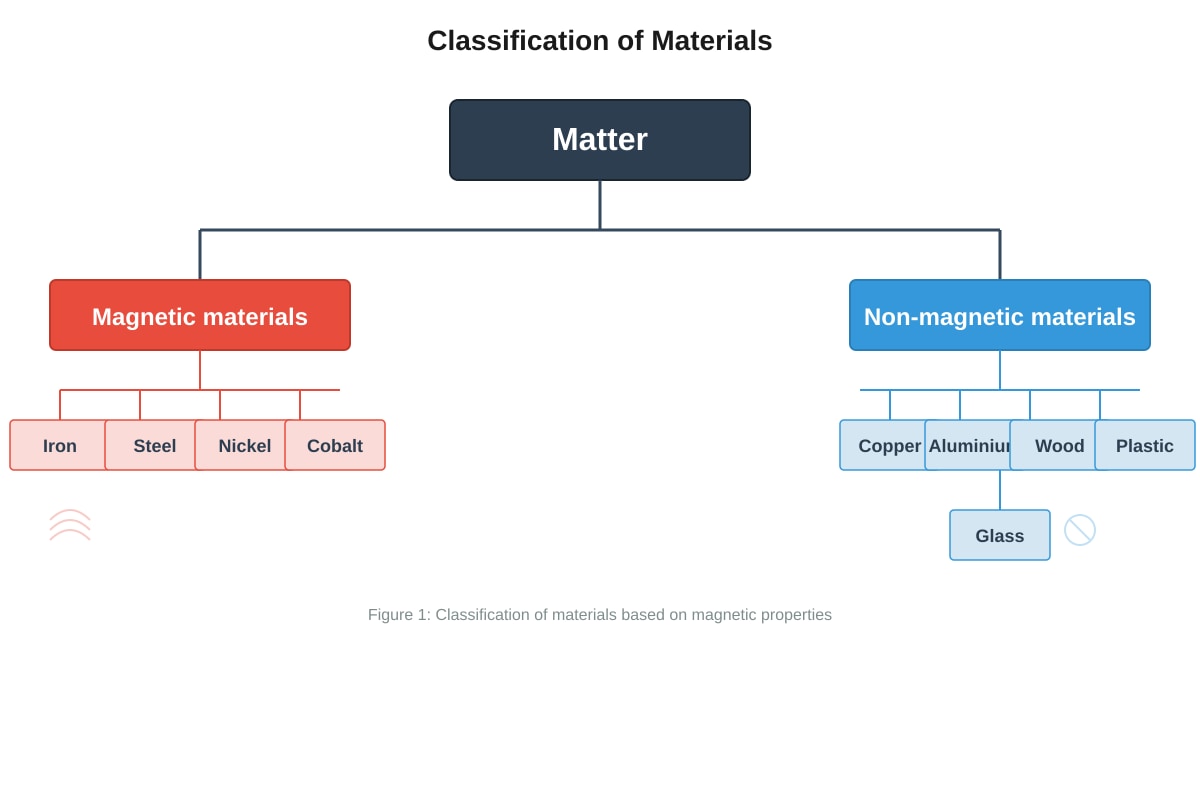
Explanation: Group X contains iron, steel, and copper — all metals. Group Y contains plastic, wood, and glass — all non-metals. While metals are generally magnetic (except copper) and conduct electricity, the broadest correct classification is metals vs non-metals.
5. C — Glass
Explanation: Window panes need to be transparent to let light in. Glass is transparent, waterproof, and rigid. Wood and metal are opaque; rubber is not transparent.
6. B — Q
Explanation: Flexibility is measured by how far a material bends. Material Q bent the most (8 cm), making it the most flexible.
7. A — Iron nail and steel paper clip only
Explanation: Magnets attract magnetic materials. Iron and steel (which contains iron) are magnetic. Copper and aluminium are non-magnetic metals.
8. D — Rubber is a good insulator of electricity.
Explanation:
- A is incorrect: Not all metals are magnetic (e.g., copper, aluminium, gold).
- B is incorrect: Not all plastics are flexible (e.g., rigid plastic chairs).
- C is incorrect: Ceramics are poor conductors of heat (insulators).
- D is correct: Rubber does not conduct electricity, making it a good electrical insulator.
9. B — The bulb will light up brightly.
Explanation: A metal paper clip is a good conductor of electricity. It completes the circuit, allowing current to flow and the bulb to light up brightly.
10. D — Magnetic
Explanation: For a microwave-safe food container, the material must be heat-resistant (won't melt), non-toxic (safe for food), and preferably transparent (to see food). Being magnetic is irrelevant and undesirable (metal objects cause sparks in microwaves).
Section B: Short-Answer Questions (5 × 2 marks = 10 marks)
11.
Any two of the following:
- Transparent (allows light to pass through)
- Waterproof (does not let water through)
- Rigid / strong (keeps its shape)
- Easy to clean
- Does not rust
Marking: 1 mark per correct property (max 2 marks).
12.
(a) Metal rod (or "the rod made of metal")
[1 mark]
(b) Metal is a good conductor of heat. Heat travels quickly from the hot water through the metal rod to the wax, melting it and causing the drawing pin to drop off first. Wood and plastic are poor conductors of heat, so heat travels slowly through them.
[1 mark — must mention metal is a good conductor of heat and heat travels fast]
13.
| Natural Materials | Man-made Materials |
|---|---|
| Cotton | Steel |
| Wool (if listed) / Silk (if listed) | Rubber |
| Glass | |
| Plastic |
Correct classification:
- Natural: Cotton
- Man-made: Steel, Rubber, Glass
Marking: 1 mark for each correct column (2 marks total).
Note: Steel is an alloy (man-made), rubber is processed (man-made), glass is manufactured (man-made). Cotton is from plants (natural).
14.
(a) String B
[1 mark]
(b) String B because it held the maximum weight (500 g) before breaking, making it the strongest. A bag for heavy books needs a strong string that won't break easily.
[1 mark — must identify String B and link to highest weight/strength]
15. D — Iron
Explanation: Iron is a magnetic material. If the sheet were iron, the magnet would attract the iron sheet itself, not the paper clip through it. The magnetic force would not pass through a magnetic material to reach the paper clip. Plastic, wood, and glass are non-magnetic, so magnetic force passes through them.
[2 marks — 1 for correct answer, 1 for explanation]
Section C: Structured and Open-Ended Questions (5 × 6 marks = 30 marks)
16.
(a) Material X
Reason 1: Waterproof — keeps rain out.
Reason 2: Flexible — comfortable to wear and allows movement.
[3 marks — 1 for correct material, 1 for each reason (max 2)]
(b) Material Y
Reason 1: Conducts electricity — allows electric current to flow through.
Reason 2: Strong — can withstand tension and installation without breaking easily.
[3 marks — 1 for correct material, 1 for each reason (max 2)]
Note: Flexibility is also useful for wires, but "conducts electricity" is the essential property.
17.
(a) Type of material (cotton, polyester, silk, wool)
[1 mark]
(b) Any two of:
- Size of fabric pieces (5 cm × 5 cm)
- Volume of water (100 mL)
- Soaking time (5 minutes)
- Temperature of water
- Initial mass of each fabric (2.0 g)
[2 marks — 1 mark each for any two valid constant variables]
(c) Cotton — It absorbed the most water (6.0 g), which is the highest mass of water absorbed among the four materials.
[2 marks — 1 for correct material, 1 for correct explanation using data]
(d) Cotton — It is the most absorbent, so it will dry the body/hands effectively by soaking up water.
[1 mark — must choose cotton and link to absorbency]
18.
(a) Property 1: Good conductor of heat — heats food quickly and evenly.
Property 2: Strong / durable — withstands high temperatures and physical handling.
[2 marks — 1 mark per property]
(b) Property 1: Poor conductor of heat (heat insulator) — handle stays cool to touch.
Property 2: Strong / rigid — supports the weight of the pan and food.
[2 marks — 1 mark per property]
(c) Metal is a good conductor of heat, so heat from the stove travels quickly through the metal body. Plastic is a poor conductor of heat (insulator), so heat does not travel easily to the handle, keeping it cool.
[2 marks — must contrast good vs poor conductor of heat]
19.
(a)
| Material | Flowchart Outcome (A, B, C, or D) |
|---|---|
| Rubber sheet | A (Waterproof → Yes, Flexible → Yes) |
| Glass | C (Waterproof → No? Wait — glass IS waterproof. Let's re-evaluate.) |
Correction on flowchart logic:
The flowchart starts: "Is the material waterproof?"
- Glass IS waterproof → Yes → "Is it flexible?" → No → Material B
- Rubber sheet: Waterproof → Yes, Flexible → Yes → Material A
- Wooden block: Waterproof → No → "Is it transparent?" → No → Material D
- Plastic bag: Waterproof → Yes, Flexible → Yes → Material A
Wait — both rubber sheet and plastic bag give Material A. That's fine — multiple materials can map to same outcome.
Let's re-check glass: Glass is waterproof (water doesn't pass through), not flexible, so: Waterproof → Yes → Flexible → No → Material B.
Wooden block: Not waterproof (absorbs water), not transparent → Material D.
Plastic bag: Waterproof, flexible → Material A.
So:
| Material | Flowchart Outcome |
|---|---|
| Rubber sheet | A |
| Glass | B |
| Wooden block | D |
| Plastic bag | A |
[2 marks — 0.5 per correct match, or 2 marks for all 4 correct]
(b) Material C is reached by: Waterproof → No → Transparent → Yes.
So Material C is not waterproof but transparent.
Property: Transparent (or "allows light to pass through" / "not waterproof").
[1 mark]
(c) Waterproof → Yes → Flexible → No → Material B
[1 mark]
(d) Material B could be glass.
Reason: Glass is waterproof, not flexible, and not transparent? Wait — glass IS transparent.
Re-check: Material B = Waterproof + Not flexible.
Glass is waterproof, not flexible, BUT transparent → that would go to Material C if the second question is "Is it transparent?" after "No" to flexible.
Let's trace carefully:
Start → Waterproof?
- Yes → Flexible?
- Yes → Material A
- No → Material B
- No → Transparent?
- Yes → Material C
- No → Material D
So Material B = Waterproof AND Not flexible.
Glass = Waterproof, Not flexible, Transparent → but the flowchart doesn't ask about transparency after "No" to flexible. It stops at Material B. So glass → Material B.
But wait — if glass is transparent, why isn't that property checked? The flowchart only checks transparency for non-waterproof materials. So for waterproof materials, it only checks flexibility. So glass (waterproof, rigid) → Material B.
Material C = Not waterproof AND Transparent. Example: Tracing paper / thin fabric / some plastics? Actually, tracing paper is not waterproof but transparent. Or cellophane.
Material D = Not waterproof AND Not transparent. Example: Wood, cotton, paper.
So for (d): Material B = Waterproof, not flexible.
Suggestion: Glass (or ceramic, metal sheet).
Reason: It is waterproof and rigid (not flexible).
[2 marks — 1 for valid example, 1 for correct reason matching properties]
20.
(a) Plastic
[1 mark]
(b) Reason 1: Waterproof — keeps food dry and prevents leaks.
Reason 2: Light — easy for primary school students to carry.
Reason 3: Easy to clean — hygienic for food storage.
Other acceptable reasons: Low cost, strong, poor heat conductor (safe to touch if warm food inside).
[3 marks — 1 mark per valid reason from table]
(c) Poor heat conductor — cannot be used to heat food directly on a stove / food gets cold quickly.
OR Not as strong as stainless steel — may crack if dropped.
OR Not environmentally friendly (if non-biodegradable plastic).
[1 mark — any valid disadvantage from table or general knowledge]
(d) Flexible and waterproof — forms a tight, leak-proof seal that can stretch to fit the lid.
OR Elastic / flexible — allows the lid to close tightly and prevent spills.
[1 mark — must mention flexibility/elasticity and/or waterproof nature]
End of Answer Key