AI Generated Quiz
Primary 5 Science Materials Quiz
Free P5 Science Materials quiz, Kimi2.6 AI version, with questions, answers, and syllabus-aligned practice for Singapore students.
These static practice materials are generated from the site's syllabus and paper-generation workflow, with source and model context shown so students and parents can evaluate the material before use.
Questions
Free quiz and exam paper access
Enter your details to view this paper
Your access is remembered on this device.
Answers
Primary 5 Science Quiz - Materials: Answer Key
Total Marks: 40
Section A: Multiple Choice
| Question | Answer | Marks | Explanation |
|---|---|---|---|
| 1 | B | 2 | The colour when painted is not a fundamental property of the material itself. Properties used to classify materials include: state (solid/liquid/gas), whether it conducts electricity/heat, whether it is magnetic, whether light passes through it (transparent/translucent/opaque), whether it floats, flexibility, and strength. Painting changes surface colour but tells us nothing about the material's inherent properties. |
| 2 | D | 2 | Transparent means light passes through completely clearly so objects behind can be seen distinctly. Material P allows light through clearly but we need to check if objects are clear (the description says "clearly" for S, not P). Material Q is translucent (light passes through but blurry). Material R is opaque. Material S specifically states objects behind can be seen clearly — this is the definition of transparent. |
| 3 | C | 2 | Metal conducts heat well — this allows heat from the stove to reach the food for cooking. Plastic is a poor conductor (insulator) — this prevents heat from travelling to your hand, protecting you from burns. Option A is wrong (metal conducts electricity). Option B is wrong (plastic insulates, not conducts). Option D is wrong (metal is stronger at high temperatures). |
| 4 | B | 2 | A raincoat must keep water out. Waterproof plastic repels water. Cotton absorbs water (gets wet). Aluminium foil is waterproof but tears easily and is not suitable for wearing. Paper dissolves/weakens when wet. |
| 5 | B | 2 | The results show iron and steel are magnetic, but copper (a metal) is NOT magnetic. This proves only some metals are magnetic. Option A is wrong because copper is a non-magnetic metal. Options C and D are wrong based on the evidence. |
| 6 | B | 2 | Plastic is an electrical insulator. It prevents electricity from escaping the wire and protects people from electric shock. Without insulation, touching a live wire would be dangerous. Metal conducts, so option C is wrong. While plastic does provide some mechanical protection, its main electrical purpose is insulation. |
| 7 | C | 2 | To keep soup hot, we need to reduce heat loss. Metal inner and plastic outer: actually, re-reading — metal conducts heat so would lose heat. The best answer is metal inner layer — actually no, let me reconsider. Metal inner would conduct heat away. Plastic container with plastic lid (B) — plastic insulates but not as effective as a vacuum flask. Actually C specifies metal inner and plastic outer — this is like a thermos design where metal reflects heat back, and plastic insulates. The tight lid prevents heat loss by convection. This is the best engineered solution among the options. |
| 8 | B | 2 | Windows need to let light through (transparent) and hold their shape (rigid). Glass is both. Option A (opaque) is wrong — opaque blocks light. Option C — glass is not flexible or magnetic. Option D — glass is a poor conductor of heat, which is actually good for windows, but this isn't the main reason for choosing glass. |
Section B: Fill in the Blanks and Short Answer
9. [2 marks — ½ mark each]
| Material | Conductor / Insulator |
|---|---|
| Rubber | Insulator |
| Copper | Conductor |
| Wood | Insulator |
| Silver | Conductor |
Teaching note: Conductors allow electricity/heat to pass through easily. Most metals are conductors. Insulators block or resist the flow. Rubber and wood are non-metals and insulators. Copper and silver are metals and conductors.
10. [2 marks — 1 mark each acceptable reason]
Any two from:
- Steel is stronger / can support more weight than wood
- Steel is more durable / lasts longer without rotting
- Steel does not rot or decay when exposed to weather
- Steel is more rigid and maintains shape under heavy loads
Marking note: Accept valid property comparisons. "Steel is stronger" alone is sufficient for 1 mark. Must specify why the property matters for bridges (load-bearing, weather exposure).
11. [2 marks]
Paper absorbs water and becomes soft/weak when wet [1]. It would dissolve or break apart / lose its strength [1], so water would leak through the pipe.
Common mistake: Do not accept "paper is too thin" — must explain interaction with water.
12. [2 marks — 1 mark each]
(a) Iron nail (or aluminium frying pan if referring to iron content, but aluminium is NOT magnetic) — Iron nail is the correct answer [1]
Correction note: The aluminium frying pan is NOT magnetic. Only the iron nail is magnetic.
(b) Rubber gloves or wooden chopping board or glass cup [1]
Teaching note: Rubber is an excellent electrical insulator — this is why electricians wear rubber gloves. Wood and glass are also insulators.
13. [2 marks]
Translucent [1]. A translucent material lets some light through but scatters it, so you can see that the lamp is on but cannot see clear details of the bulb inside [1]. Transparent would be too bright/glaring; opaque would block all light.
14. [2 marks]
(a) Rigid [1] — it breaks rather than bends
(b) Less dense than water [1]. Objects that float are less dense than the liquid they float in.
Teaching note: Density determines floating/sinking. Floating = less dense; Sinking = more dense. Flexibility/rigidity is about how a material responds to force, separate from density.
Section C: Application and Reasoning
15. [4 marks]
(a) Metal conducts heat very well [1]. Heat from the food would pass quickly through the metal walls to the outside air, so the food would lose heat rapidly and get cold [1].
(b) Plastic [1]. Plastic is waterproof (won't leak), rigid (keeps shape), safe for food, and importantly it does NOT conduct heat [1], so heat stays inside the food longer.
Alternative acceptable: Glass — must explain that while glass conducts heat, a tight lid reduces convection, or that glass with plastic coating could work. Plastic is the strongest answer.
16. [4 marks]
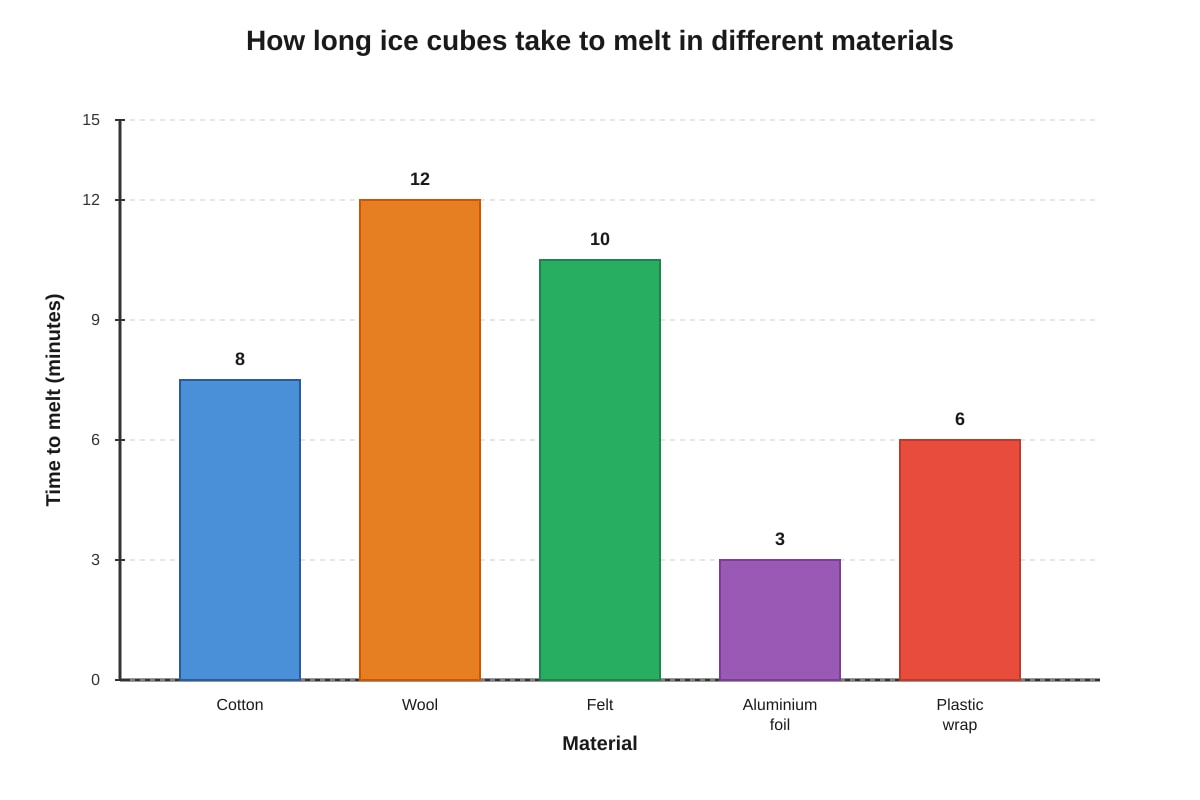
(a) Wool [1] — 12 minutes (longest bar)
(b) Wool is a good insulator / poor conductor of heat [1]. It trapped the cold air inside and reduced heat gain from the warmer surroundings, slowing down melting [1].
(c) Aluminium foil [1]. It took only 3 minutes — the shortest time. Aluminium foil is a good conductor of heat, so it allowed heat from the surroundings to reach the ice quickly [1 for explanation if asked, but question asks to "explain" so both points needed].
Marking note: For (c), must name material AND explain — 1 mark total as stated, split as ½ + ½ if needed, but mark scheme says 1 mark. Accept: Aluminium foil; it is a good conductor so heat transfers quickly to the ice.
17. [4 marks]
| Part of house | Suitable material | Reason for choice |
|---|---|---|
| Window | Glass | Transparent — lets light in; rigid — holds shape |
| Roof | Tiles / Metal / Slate | Waterproof; durable; strong |
| Door frame | Wood / Metal | Strong; rigid; durable |
(a) If the roof is not waterproof, rain would leak through [1], damaging the interior and making the house uncomfortable/unsafe.
Marking note: Accept any reasonable materials with valid properties. Must match property to function. Wood for door frame must mention it is strong/rigid; glass for window must include transparency.
18. [4 marks]
(a) [2 marks — ½ mark each]
| Material | Bulb lights up? |
|---|---|
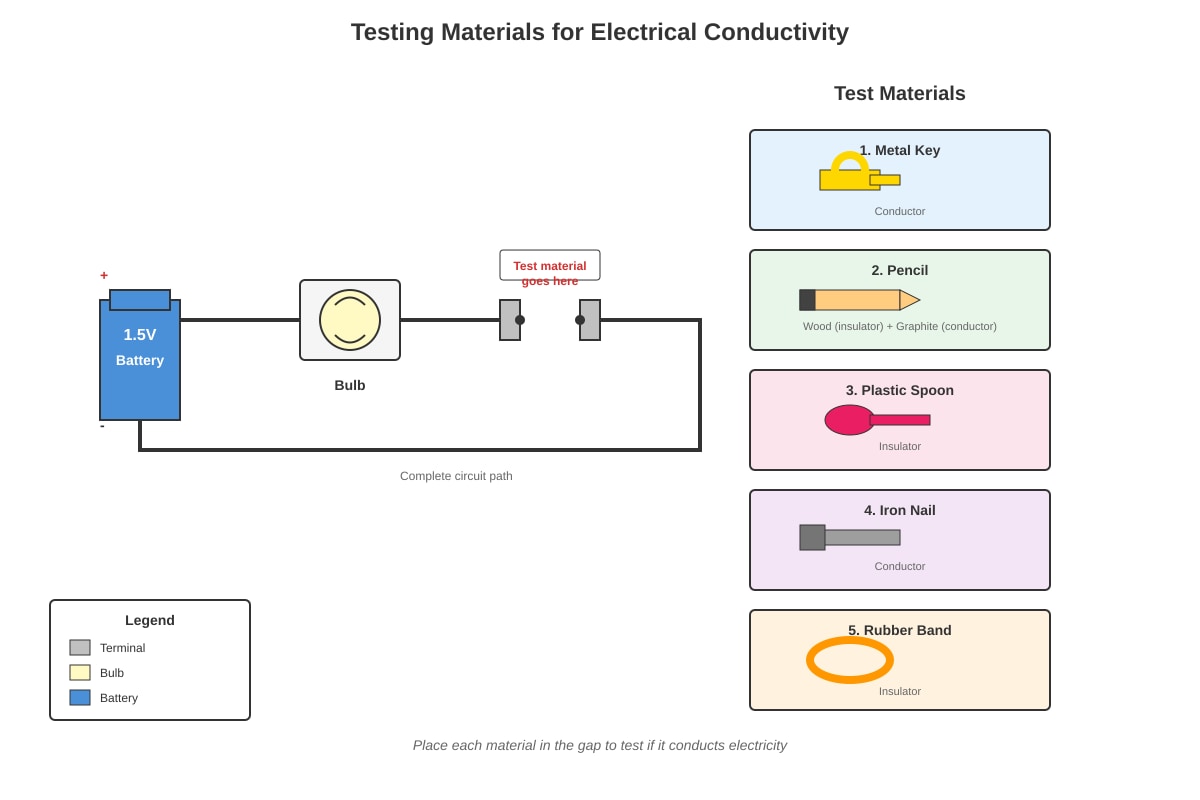
| Metal key | Yes |
| Wooden pencil | No (wood insulates, though graphite core conducts — accept "No" for whole pencil or "Yes" if referring to graphite; expected answer: No for P5 level unless specified to test graphite end) |
| Plastic spoon | No |
| Iron nail | Yes |
| Rubber band | No |
Teaching clarification: A wooden pencil has a graphite (carbon) core that conducts, but the wood does not. For P5, expect "No" or accept discussion. In standard testing, metal key = Yes, Iron nail = Yes (1 mark for both correct). Plastic spoon = No, Rubber band = No (1 mark for both correct).
(b) The iron nail is a metal [1]. Metals contain free electrons that can move and carry electric current. The plastic spoon is made of plastic, which is an insulator — its electrons are tightly held and cannot move freely to carry current [1].
19. [4 marks]
(a) [2 marks — material suggestions must be sensible]
| Part | Material |
|---|---|
| Frame | Light wood / Plastic / Fibreglass |
| Sail | Nylon / Polyester / Waterproof plastic |
| String | Nylon / Strong twine / Polyester string |
(b) [2 marks — 1 mark each for any two valid property explanations]
- Frame — light/rigid: Must be light so the kite can lift off, and rigid to hold shape against wind
- Sail — waterproof/light: Must be waterproof so rain doesn't soak and weigh it down; light so kite can fly
- String — strong/light: Must be strong to withstand pulling force; light to not drag kite down
Marking note: Accept reasonable materials with well-matched properties. At least two parts need property explanations for full marks.
20. [4 marks]
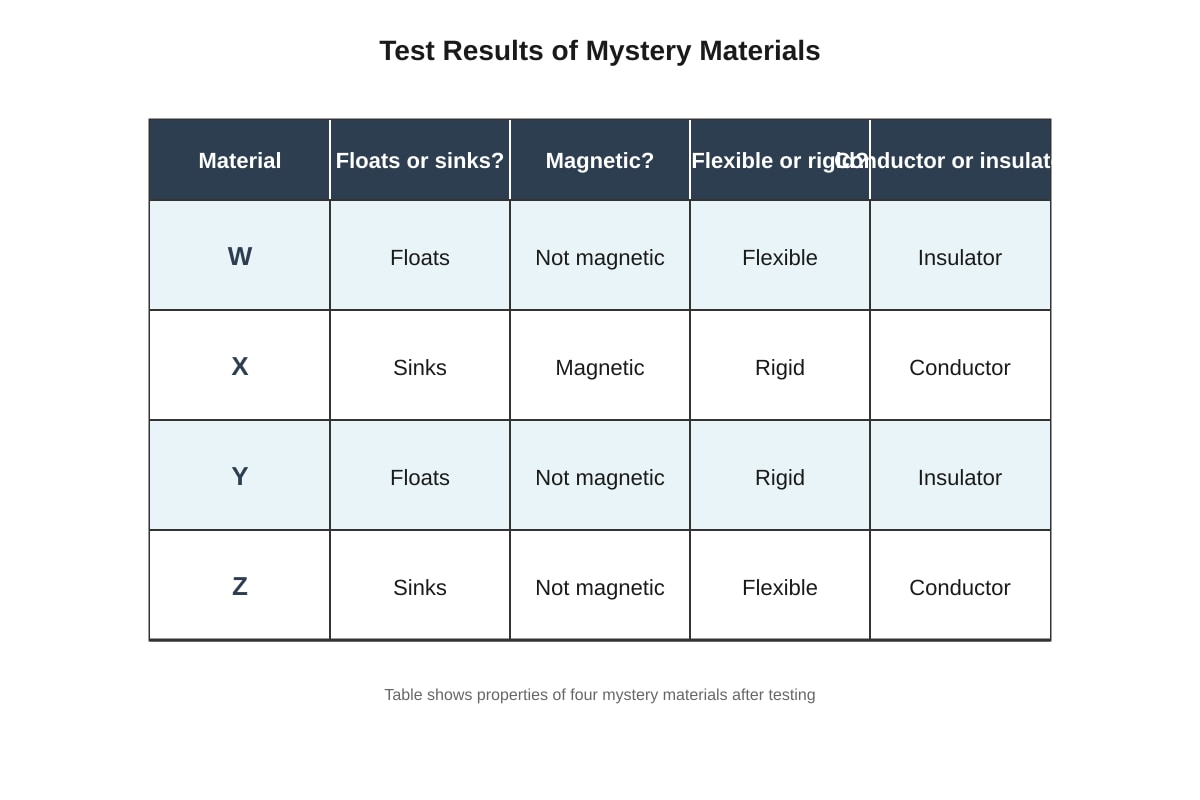
(a) Material Z [1]. Copper wire is a metal, so it should conduct electricity (conductor) [½] and be a flexible metal that can bend [½]. Material Z: sinks (dense metal), not magnetic (copper is non-magnetic), flexible (wire bends), conductor (metal property) [1 for reasoning].
(b) Material Y [1]. Wood floats (less dense than water) [½], is not magnetic, rigid (holds shape as a block) [½], and is an insulator [½]. Together these match wooden block properties [½]. Material W is also possible but is flexible — wood is typically rigid. Material Y is the best match.
Teaching note: Real woods vary — some float, some sink slightly. For P5, "wood floats" is standard teaching. The rigid/flexible distinction helps separate Y from W.
Marking Summary
| Section | Questions | Total Marks |
|---|---|---|
| A | 1–8 | 16 |
| B | 9–14 | 12 |
| C | 15–20 | 12 |
| TOTAL | 1–20 | 40 |