AI Generated Quiz
Primary 5 Science Materials Quiz
Free P5 Science Materials quiz, GLM5.3 AI version, with questions, answers, and syllabus-aligned practice for Singapore students.
These static practice materials are generated from the site's syllabus and paper-generation workflow, with source and model context shown so students and parents can evaluate the material before use.
Questions
Free quiz and exam paper access
Enter your details to view this paper
Your access is remembered on this device.
Answers
Primary 5 Science Quiz - Materials: Answer Key
Total Marks: 50
Answer 1.
(b) flexible and can stretch - 2 marks.
Teaching note: Rubber bands must stretch when pulled and return to their original shape. This property is flexibility (stretchiness). Hard and stiff materials cannot stretch, so options (a) and (d) are wrong. Weight and sinking (c) do not matter for an elastic band.
Common mistake: Choosing "hard" because rubber feels firm - remember the key job of the band is to stretch.
Answer 2.
(c) waterproof fabric, which keeps rain out - 2 marks.
Teaching note: An umbrella canopy must stop rain from passing through. Waterproof fabric does this. Tissue paper tears when wet, cotton wool soaks water up, and mesh has holes - all would let the user get wet. Always match the material's property to the object's purpose.
Answer 3.
(b) is lighter than an equal volume of water - 2 marks.
Teaching note: Objects float when they are lighter than the same volume of water. Foam contains many air pockets, making it very light for its size, so the life jacket floats and supports the wearer. Soaking water (c) would make it heavier; hardness and heat conduction are unrelated to floating.
Answer 4.
(c) wool - 2 marks.
Teaching note: Natural materials come from plants or animals. Wool comes from sheep. Glass, nylon and steel are man-made - people make them in factories from other substances. Check the source of the material, not whether it feels natural.
Answer 5.
**(a) size of towel and volume of water poured
<stage5_quiz_answers_md>
Primary 5 Science Quiz - Materials: Answer Key
Total Marks: 50
Answer 1.
(b) flexible and can stretch (2 marks)
Teaching note: An elastic band must stretch when pulled and return to its original shape. Hard, stiff or heavy materials cannot do this job.
Answer 2.
(c) waterproof fabric, which keeps rain out (2 marks)
Teaching note: The canopy must stop rain passing through. Tissue tears when wet, cotton wool soaks up water, and mesh has holes - all would let the user get wet.
Answer 3.
(b) is lighter than an equal volume of water (2 marks)
Teaching note: Foam contains many air pockets, so it floats and supports the wearer. Soaking up water would make it heavier; hardness and heat conduction do not affect floating.
Answer 4.
(c) wool (2 marks)
Teaching note: Natural materials come from plants or animals. Wool comes from sheep. Glass, nylon and steel are man-made in factories.
Answer 5.
(a) size of towel and volume of water poured (2 marks)
Teaching note: For a fair test, only the thing being compared may change; everything else affecting the result must stay the same.
Answer 6.
Metal is hard and strong (it does not break easily), so a metal key will not snap when turning a lock. (Accept: durable.) (1 mark)
Answer 7.
(i) Wood is strong and hard, so it can support heavy objects placed on the table. (1 mark) (ii) Wood can be cut and polished easily into a smooth, attractive surface (accept: does not break easily). (1 mark)
Answer 8.
Plastic is waterproof, so paint and water cannot soak through to Jun Jie's clothes. Cotton absorbs liquids, so paint or water would soak through a cotton apron and stain his clothes. (2 marks)
Answer 9.
| Material | Natural | Man-made |
|---|---|---|
| silk | ✓ | |
| polyester | ✓ | |
| leather | ✓ | |
| glass | ✓ |
(½ mark per correct tick.)
Silk comes from silkworms and leather from animal skins (natural); polyester and glass are made in factories (man-made).
Answer 10.
Cotton suits the towel because it absorbs water, so it can soak up water to dry the body. Plastic suits the raincoat because it is waterproof, so rain cannot pass through it. Each material matches what the object must do with water. (3 marks)
Answer 11.
(i) Thick cloth is a poor conductor of heat, so heat from the hot oven does not reach the hand. (1 mark) (ii) Rubber is flexible and hard-wearing (non-slip), so the tyre bends over bumps and grips the road. (1 mark)
Answer 12.
The wooden block is lighter than an equal volume of water, so it floats. Although the coin has the same mass, its volume is much smaller, so it is heavier than an equal volume of water and sinks. (2 marks)
Answer 13.
(a) She changes the brand of paper towel. (1 mark) (b) She measures the amount of water each towel absorbs (e.g., volume of water soaked up). (1 mark) (c) She keeps the size of the towels and the volume of water poured the same (accept: same time, same water temperature). (1 mark)
Answer 14.
(a) Material B (1 mark) (b) The type of material the strip was made of. (1 mark) (c) Material B is the strongest and material A is the weakest, because B held the greatest mass (1500 g) before snapping while A snapped at the smallest mass (400 g). (1 mark)
Answer 15.
(a) Flexible rubber hose (1 mark) (b) (i) Rubber is flexible, so the hose can bend around the corner of the wall. (1 mark) (ii) Rubber is waterproof, so water will not leak out on the way to the pond. (1 mark) (c) Example: garden hose (accept: rubber band, elastic band, bicycle inner tube). (1 mark)
Answer 16.
(i) Hard plastic is hard and strong, so it does not crack easily and protects the cyclist's head in a fall. (1 mark) (ii) It is lightweight, so the helmet is comfortable to wear. (1 mark)
Answer 17.
Choice: Paper cups (1 mark) Reason 1: Paper cups are light, so they are easy to carry to the picnic. (1 mark) Reason 2: They are disposable, so there is no washing up; ceramic mugs are heavy and break easily when dropped. (1 mark)
Answer 18.
Choice: Reusable cloth bag (1 mark) Reason 1: Woven cloth is strong and does not tear easily, so it carries heavy items safely. (1 mark) Reason 2: It can be used again and again, creating less waste than thin plastic bags, which tear easily. (1 mark)
Answer 19.
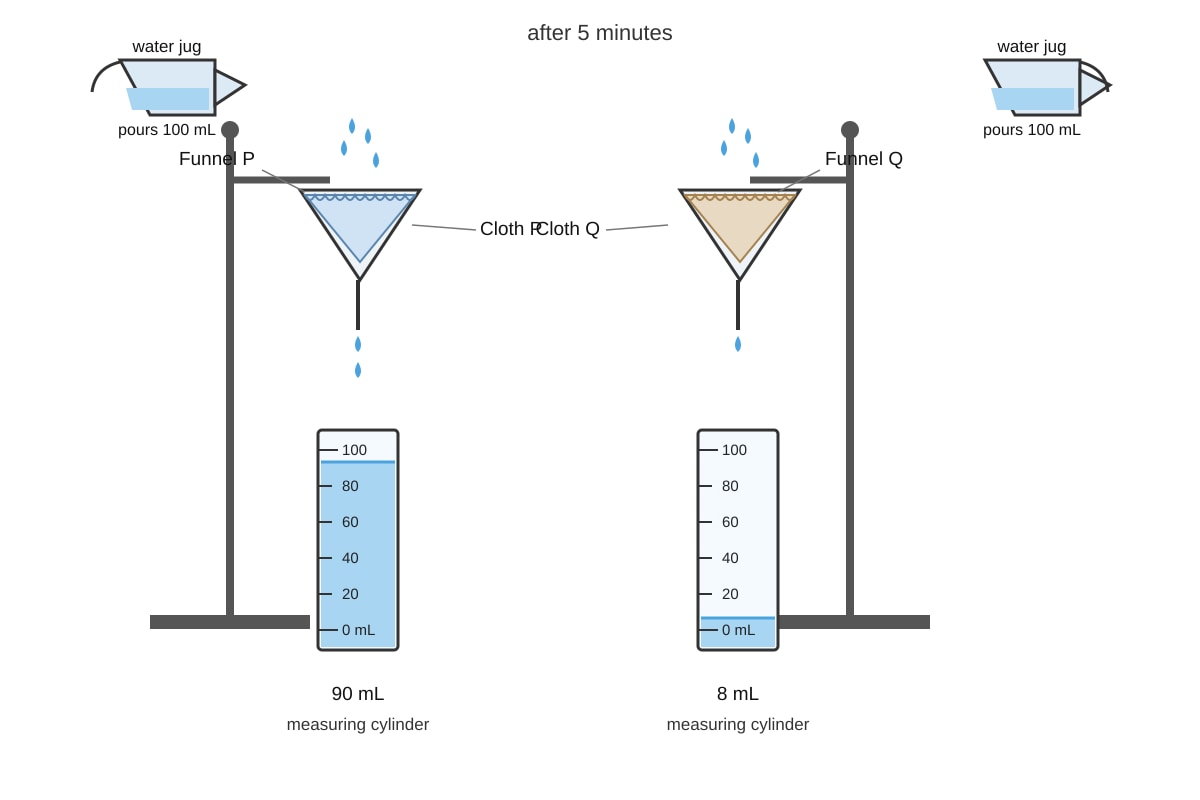
(a) Cloth Q (1 mark) (b) After 5 minutes, only 8 mL of water passed through Cloth Q, while 90 mL passed through Cloth P. Since almost no water passed through Cloth Q, it did not let water soak through, so it is waterproof. (2 marks) (c) Cloth Q (1 mark)
Answer 20.
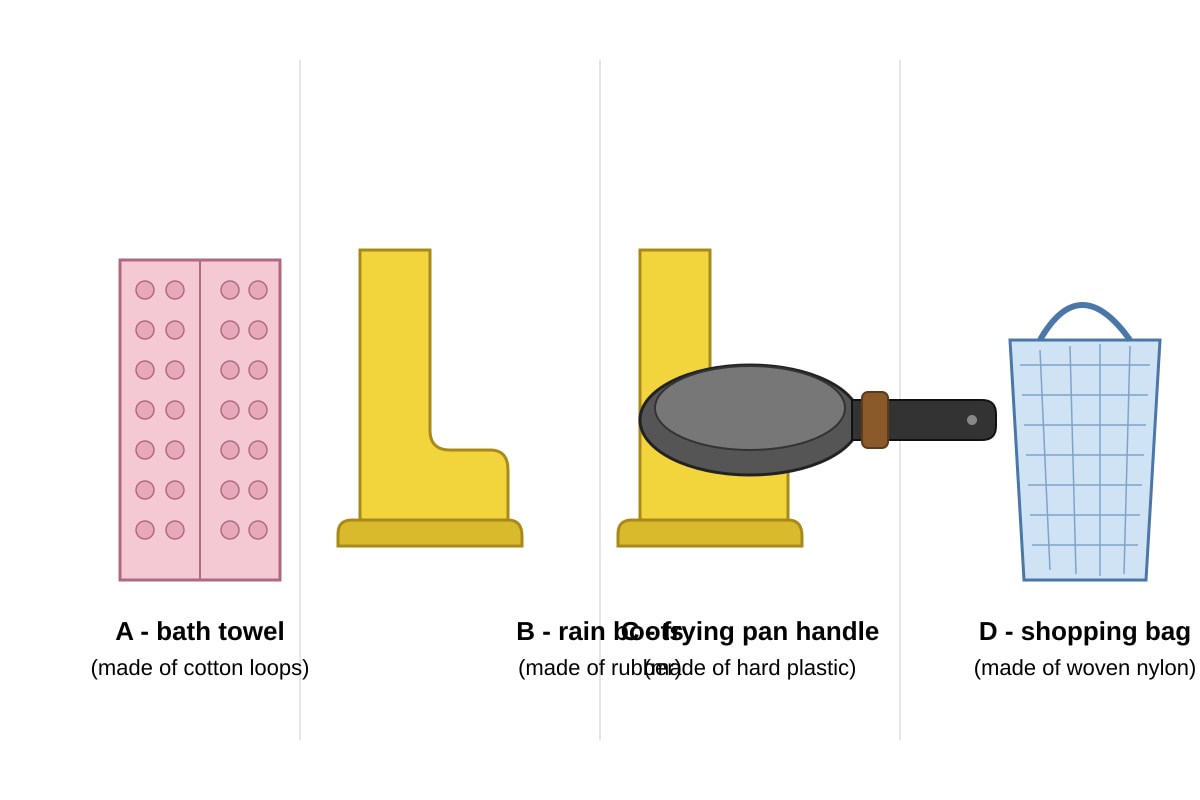
A (cotton towel): Cotton absorbs water, so the towel can dry the body. (1 mark) B (rubber boots): Rubber is waterproof, so rain and puddles cannot get in and the feet stay dry. (1 mark) C (hard plastic pan handle): Hard plastic is a poor conductor of heat, so the handle stays cool and the hand is not burnt. (1 mark) D (nylon shopping bag): Nylon is strong and does not tear easily, so it holds heavy groceries. (1 mark)
End of answer key.