AI Generated Quiz
Primary 5 Science Magnets Quiz
Free P5 Science Magnets quiz, AI version, with questions, answers, and syllabus-aligned practice for Singapore students.
These static practice materials are generated from the site's syllabus and paper-generation workflow, with source and model context shown so students and parents can evaluate the material before use.
Questions
Free quiz and exam paper access
Enter your details to view this paper
Your access is remembered on this device.
Answers
Answer Key: Primary 5 Science Quiz - Magnets
Total Marks: 40
Section A: Multiple-Choice Questions (2 marks each)
1. (B) Only some of the paper clips will be attracted to the magnet.
Explanation: Paper clips are usually made of steel, which contains iron and is magnetic. However, the magnetic force is strongest at the poles of the magnet. Paper clips that are closer to the poles will be attracted, while those further away or near the middle may not be attracted because the magnetic force is weaker there. Not all paper clips will be attracted unless they are all very close to the poles.
Marking note: Award 2 marks for (B). Award 1 mark if student selects (A) but shows understanding that the magnet attracts magnetic materials.
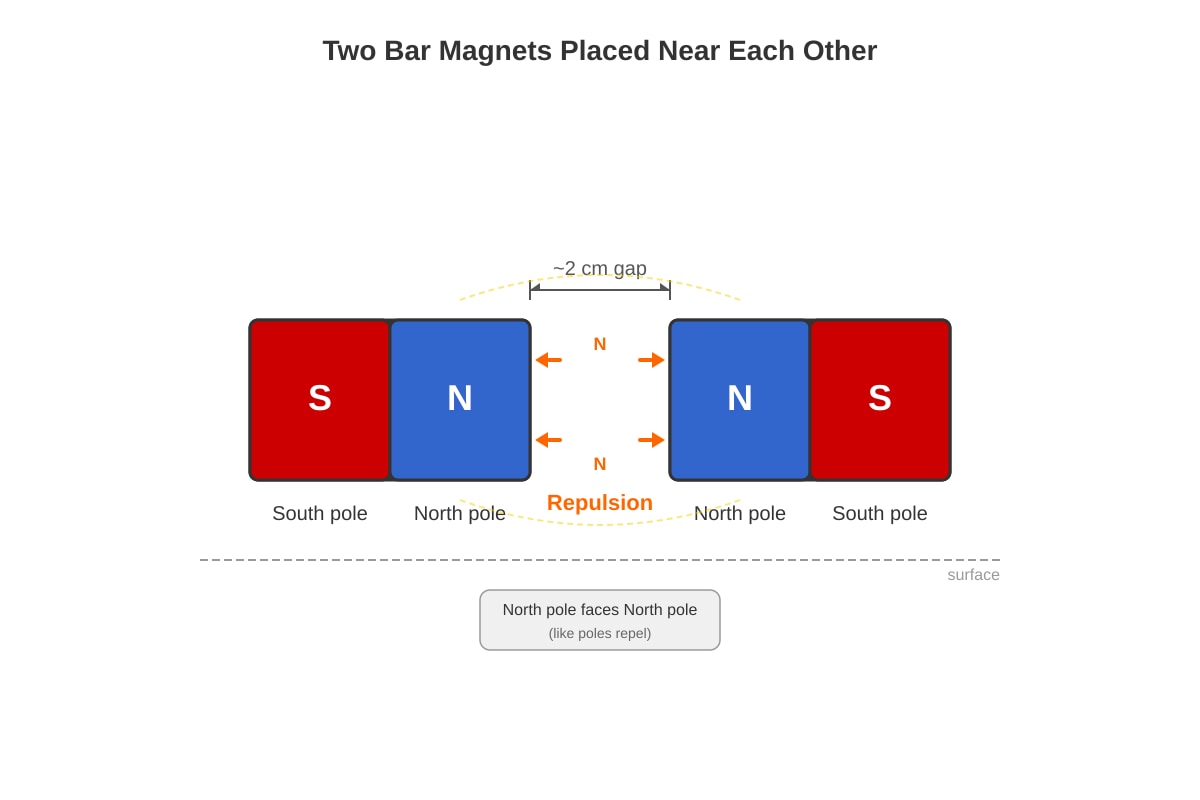
2. (B) The magnets will repel each other.
Explanation: Like poles repel each other. In the diagram, the north pole of the left magnet is facing the north pole of the right magnet. Since both are north poles, they will push away from each other (repel).
Common mistake: Students may confuse attraction and repulsion. Remember: like poles repel, unlike poles attract.
3. (C) An iron nail
Explanation: Only magnetic materials are attracted to magnets. Iron, steel, nickel, and cobalt are magnetic materials. Plastic, wood, and glass are non-magnetic materials and will not be attracted to a magnet.
Marking note: Award 2 marks for (C).
4. (A) The iron bar will be attracted to the magnet.
Explanation: Iron is a magnetic material. When a magnet is brought near an iron bar, the iron bar becomes temporarily magnetised (induced magnetism) and is attracted to the magnet. This happens regardless of which pole of the magnet is used.
Common mistake: Students may think only certain poles attract iron. In fact, both poles of a magnet attract magnetic materials like iron.
5. (C) A magnet has two poles: a north pole and a south pole.
Explanation: All magnets have two poles. Option (A) is false because not all metals are magnetic (e.g., copper, aluminium). Option (B) is false because magnetic force is strongest at the poles, not the middle. Option (D) is false because if you cut a magnet in half, each half becomes a new magnet with both a north and a south pole.
6. (A) The north pole will point towards the Earth's north pole.
Explanation: A freely suspended magnet aligns itself with the Earth's magnetic field. The north pole of the magnet points towards the Earth's geographic north pole because the Earth's magnetic south pole is located near the geographic north pole. Opposite poles attract, so the magnet's north pole is attracted to the Earth's magnetic south pole.
Marking note: Accept (A) as the correct answer. The concept of Earth's magnetic poles is introduced at this level.
7. (C) A copper wire
Explanation: Copper is not a magnetic material. Steel contains iron and is magnetic. Nickel and cobalt are also magnetic materials. Only magnetic materials are attracted to magnets.
Marking note: Award 2 marks for (C).
8. (B) They will repel each other.
Explanation: Like poles repel. When two south poles face each other, they will push away from each other. This is a fundamental property of magnets: like poles repel, unlike poles attract.
9. (B) Stroking an iron nail with a magnet in one direction
Explanation: Stroking an iron or steel object with a magnet in one direction aligns the magnetic domains in the material, making it a temporary magnet. Hitting, heating, or dropping will not magnetise the nail and may actually demagnetise it.
Marking note: Award 2 marks for (B).
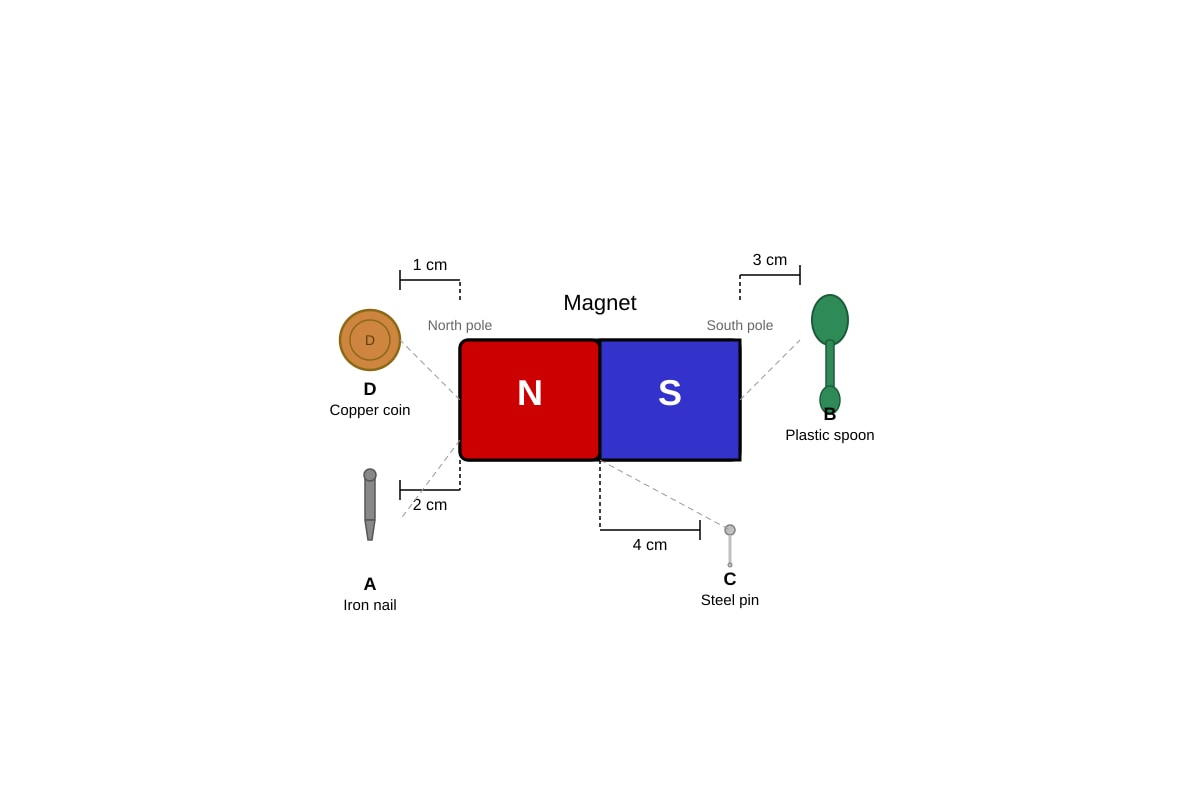
10. (B) A and C only
Explanation: Object A is an iron nail (magnetic material) and Object C is a steel pin (steel contains iron, so it is magnetic). Object B is a plastic spoon (non-magnetic) and Object D is a copper coin (non-magnetic). Only magnetic materials are attracted to magnets. Distance from the magnet affects the strength of attraction but does not change whether a material is attracted.
Marking note: Award 2 marks for (B). Award 1 mark if student selects (A) only, as they may have overlooked that steel is magnetic.
Section B: Short-Answer Questions (3 marks each)
11. Answer: The student can bring one end of Bar A near one end of Bar B. If they attract, the student should try bringing the other end of Bar A near the same end of Bar B. If they repel, then Bar A is the magnet and Bar B is the iron bar. This is because a magnet has two poles and can both attract and repel, while an iron bar can only be attracted to a magnet but never repel it.
Marking scheme:
- 1 mark: Describes a test involving bringing the bars near each other
- 1 mark: Mentions that repulsion indicates which is the magnet
- 1 mark: Explains that only a magnet can repel another magnet
Explanation: The key idea is that only a magnet can repel another magnet. An iron bar that is not magnetised will always be attracted to a magnet, never repelled. So if the student observes repulsion between the two bars, the one she is holding must be a magnet.
Common mistake: Students may suggest seeing which bar picks up paper clips. Both bars might pick up paper clips if the magnet is strong enough to induce magnetism in the iron bar.
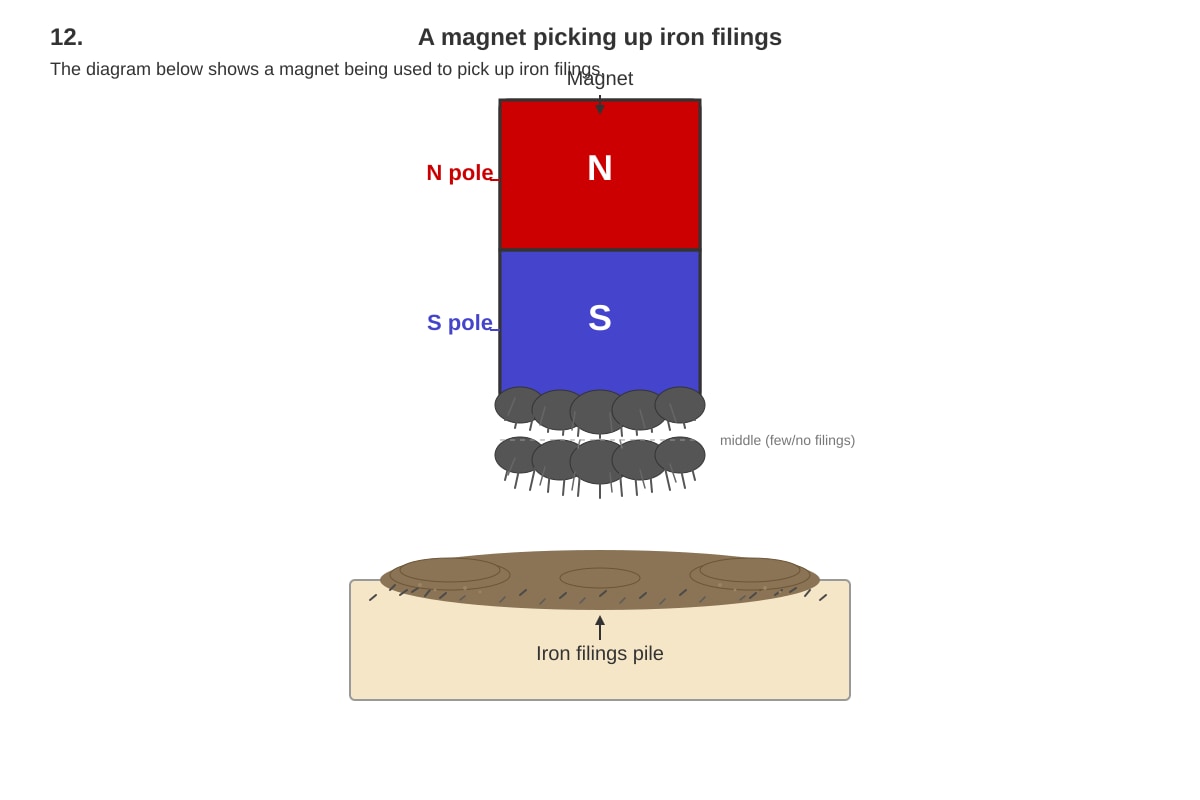
12. (a) The magnetic force is strongest at the poles (ends) of the magnet. [1 mark]
(b) This tells us that the magnetic force is not the same at all parts of the magnet. The magnetic force is strongest at the poles and weakest at the middle of the magnet. [2 marks]
Marking scheme:
- (a) 1 mark: States that magnetic force is strongest at the poles/ends
- (b) 1 mark: States that magnetic force varies at different parts
- (b) 1 mark: States that force is strongest at poles and weakest in the middle
Explanation: Iron filings are attracted to the magnet and cluster where the magnetic force is strongest. The filings concentrate at the poles, showing that the magnetic force is strongest there. Very few filings attach to the middle, showing the force is weakest there.
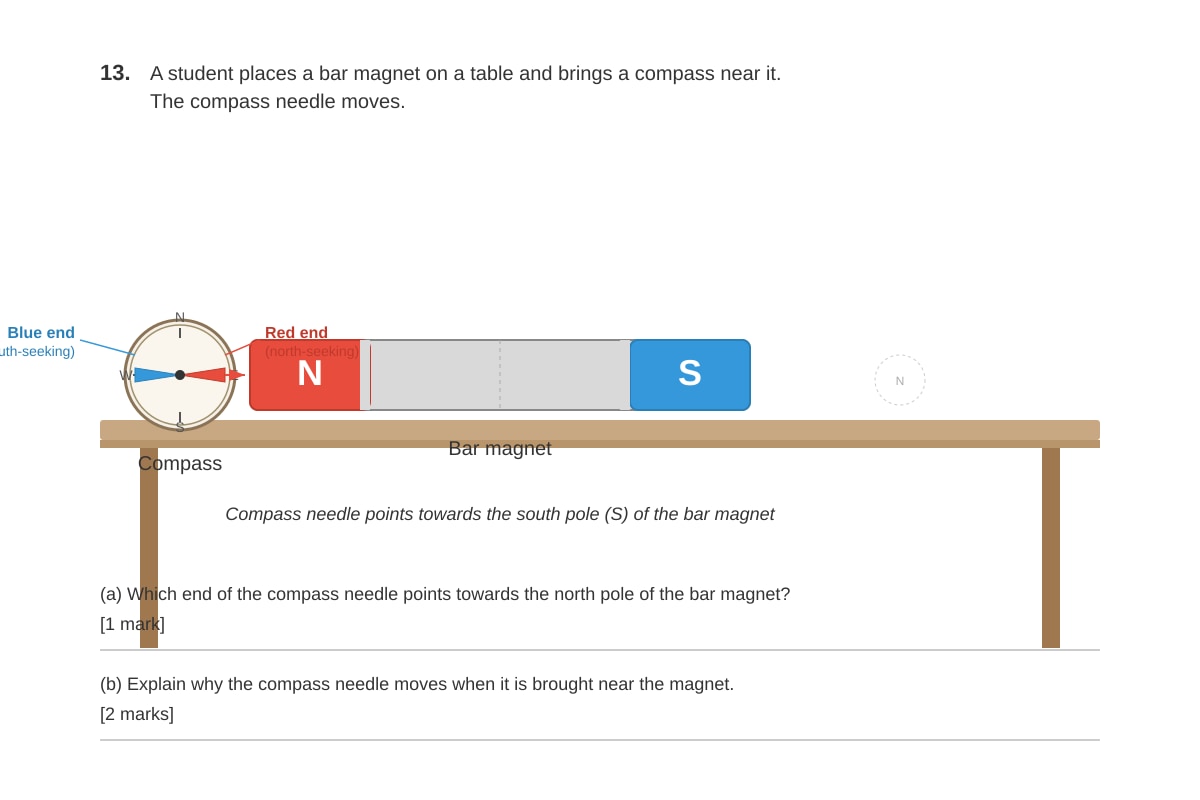
13. (a) The south-seeking end (blue end) of the compass needle points towards the north pole of the bar magnet. [1 mark]
(b) The compass needle moves because it is a small magnet itself. When brought near another magnet, the compass needle experiences a magnetic force that causes it to align with the magnetic field of the bar magnet. The north-seeking end of the compass needle is attracted to the south pole of the bar magnet. [2 marks]
Marking scheme:
- (a) 1 mark: Correctly identifies which end points towards the north pole
- (b) 1 mark: States that the compass needle is a magnet
- (b) 1 mark: Explains that opposite poles attract, causing the needle to move
Explanation: A compass contains a small magnetised needle. The north-seeking end (usually red) of the compass needle points towards the Earth's magnetic south pole (near geographic north). When near another magnet, the compass needle aligns with that magnet's field. Opposite poles attract, so the compass needle's south-seeking end points towards the bar magnet's north pole.
14. (a) The north pole of Magnet Y is facing the north pole of Magnet X (since they repel). So the end of Magnet Y that was tested is a north pole. [1 mark]
(b) The south pole of Magnet Z is facing the north pole of Magnet X (since they attract). So the end of Magnet Z that was tested is a south pole. [1 mark]
(c) They will repel each other. This is because like poles repel. Both ends being brought together are south poles. [1 mark]
Marking scheme:
- (a) 1 mark: Correctly identifies the pole of Magnet Y
- (b) 1 mark: Correctly identifies the pole of Magnet Z
- (c) 1 mark: States repulsion and gives correct reason
Explanation: This question tests understanding of the rule: like poles repel, unlike poles attract. By tracking the interactions, we can determine the poles of unknown magnets.
15. Answer: The student can pass the magnet over the mixture. The iron filings will be attracted to the magnet and stick to it, while the sand will be left behind. The student can then lift the magnet with the iron filings attached and scrape them off into a separate container. This method works because iron is a magnetic material and is attracted to the magnet, while sand is non-magnetic and is not attracted.
Marking scheme:
- 1 mark: Describes using the magnet to attract the iron filings
- 1 mark: Mentions that sand is not attracted and remains
- 1 mark: Explains that iron is magnetic and sand is non-magnetic
Explanation: This is a practical application of magnetism. Magnetic materials (like iron) are attracted to magnets, while non-magnetic materials (like sand) are not. This property can be used to separate mixtures where one component is magnetic.
Section C: Structured Questions (1 mark each)
16. Answer: This tells us that the Earth itself behaves like a giant magnet with magnetic poles. The Earth's magnetic south pole is located near the geographic north pole, which attracts the north pole of the magnet.
Explanation: A freely suspended magnet aligns with the Earth's magnetic field. The fact that the magnet's north pole points north tells us that the Earth has a magnetic field and that opposite poles attract.
Marking note: Award 1 mark for stating that the Earth acts like a magnet or has a magnetic field.
17. Answer: The needle has become a temporary magnet (magnetised). The stroking aligned the magnetic domains in the needle, giving it magnetic properties.
Explanation: Stroking a magnetic material with a magnet in one direction aligns the tiny magnetic domains within the material. This causes the material to become magnetised and able to attract other magnetic objects.
Marking note: Award 1 mark for stating that the needle has become magnetised.
18. Answer: Yes, the magnet will still attract the nail. Magnetic force can pass through non-magnetic materials like cardboard. The cardboard does not block the magnetic field.
Explanation: Magnetic fields can pass through non-magnetic materials. The cardboard is not a magnetic material, so it does not block or shield the magnetic field. The nail will still experience the magnetic force.
Marking note: Award 1 mark for stating that the magnet will still attract the nail and explaining that magnetic force passes through cardboard.
19. Answer: The force of attraction will become weaker. The magnetic force decreases as the distance between the magnet and the object increases.
Explanation: Magnetic force follows an inverse-square law: as distance increases, the force decreases rapidly. At 5 cm, the force is much weaker than at 1 cm.
Marking note: Award 1 mark for stating that the force becomes weaker and explaining that magnetic force decreases with distance.
20. Answer: Magnetic force can act at a distance without direct contact. The magnet does not need to touch the iron bar for the force to be felt.
Explanation: Magnetism is a non-contact force. The magnetic field extends around the magnet, and any magnetic material within this field will experience a force. This shows that magnets can attract objects without touching them.
Marking note: Award 1 mark for stating that magnetic force can act without contact or at a distance.
End of Answer Key