AI Generated Quiz
Primary 5 Science Magnets Quiz
Free P5 Science Magnets quiz, AI version, with questions, answers, and syllabus-aligned practice for Singapore students.
These static practice materials are generated from the site's syllabus and paper-generation workflow, with source and model context shown so students and parents can evaluate the material before use.
Questions
Free quiz and exam paper access
Enter your details to view this paper
Your access is remembered on this device.
Answers
Answer Key: Primary 5 Science Quiz - Magnets
Section A: Multiple-Choice Questions
1. (C) Iron
- Explanation: Iron is a magnetic material. Wood, plastic, and glass are non-magnetic materials.
- Marking: 1 mark for correct answer.
2. (C) Each piece will become a complete magnet with both a north and a south pole.
- Explanation: When a magnet is cut, each piece becomes a smaller magnet with its own north and south poles. This is because the magnetic domains within the material realign to form new poles at the cut ends.
- Marking: 1 mark for correct answer.
3. (D) Aluminium
- Explanation: Cobalt, nickel, and steel (which is mostly iron) are all magnetic materials. Aluminium is not magnetic.
- Marking: 1 mark for correct answer.
4. (B) They will attract each other.
- Explanation: Opposite poles of magnets attract each other. The north pole of one magnet attracts the south pole of another.
- Marking: 1 mark for correct answer.
5. (D) Both poles equally
- Explanation: The magnetic field is strongest at the poles of a magnet. Both the north and south poles have equal magnetic strength.
- Marking: 1 mark for correct answer.
6. (B) Store it with a piece of iron (keeper) across its poles.
- Explanation: A keeper (a piece of iron) placed across the poles of a magnet helps maintain its magnetic strength by providing a path for the magnetic field lines, preventing them from spreading out and weakening the magnet.
- Marking: 1 mark for correct answer.
7. (B) North-South
- Explanation: A freely suspended magnet will align itself with the Earth's magnetic field, pointing roughly north-south. The end that points north is the north pole of the magnet.
- Marking: 1 mark for correct answer.
8. (B) The magnetic field is invisible but can be detected using iron filings.
- Explanation: Magnetic fields are invisible, but their presence and shape can be observed using iron filings, which align along the field lines.
- Marking: 1 mark for correct answer.
9. (C) A temporary magnet
- Explanation: When a magnetic material like steel is brought into contact with a magnet, it becomes temporarily magnetised. It can then attract other small magnetic objects, but it will lose its magnetism when the original magnet is removed.
- Marking: 1 mark for correct answer.
10. (B) An iron nail
- Explanation: Iron is a magnetic material and will be strongly attracted to a magnet. Copper, plastic, and glass are non-magnetic.
- Marking: 1 mark for correct answer.
Section B: Short-Answer Questions
11. A magnet can attract an iron nail because iron is a magnetic material. The magnetic field of the magnet exerts a force on the iron atoms in the nail, pulling it towards the magnet. A plastic spoon is made of a non-magnetic material, so the magnetic field has no effect on it.
- Marking Scheme:
- 1 mark for correctly stating that iron is magnetic.
- 1 mark for correctly stating that plastic is non-magnetic.
- Common Mistake: Students may think that all metals are magnetic. Emphasise that only iron, nickel, cobalt, and their alloys (like steel) are magnetic.
12. The student can hold one bar near the middle of the other bar. If the bars attract, the held bar is the magnet. If there is no attraction, the held bar is the non-magnetised iron. (Alternatively, the student can try to pick up a small iron object with each bar; the one that picks it up is the magnet.)
- Marking Scheme:
- 1 mark for describing a valid test (e.g., using the middle of one bar to test the other).
- 1 mark for correctly interpreting the result.
- Explanation: The magnetic field is strongest at the poles and weakest at the middle. A magnet will attract an iron bar at any point, but a non-magnetised iron bar will only be attracted to the poles of a magnet, not the middle.
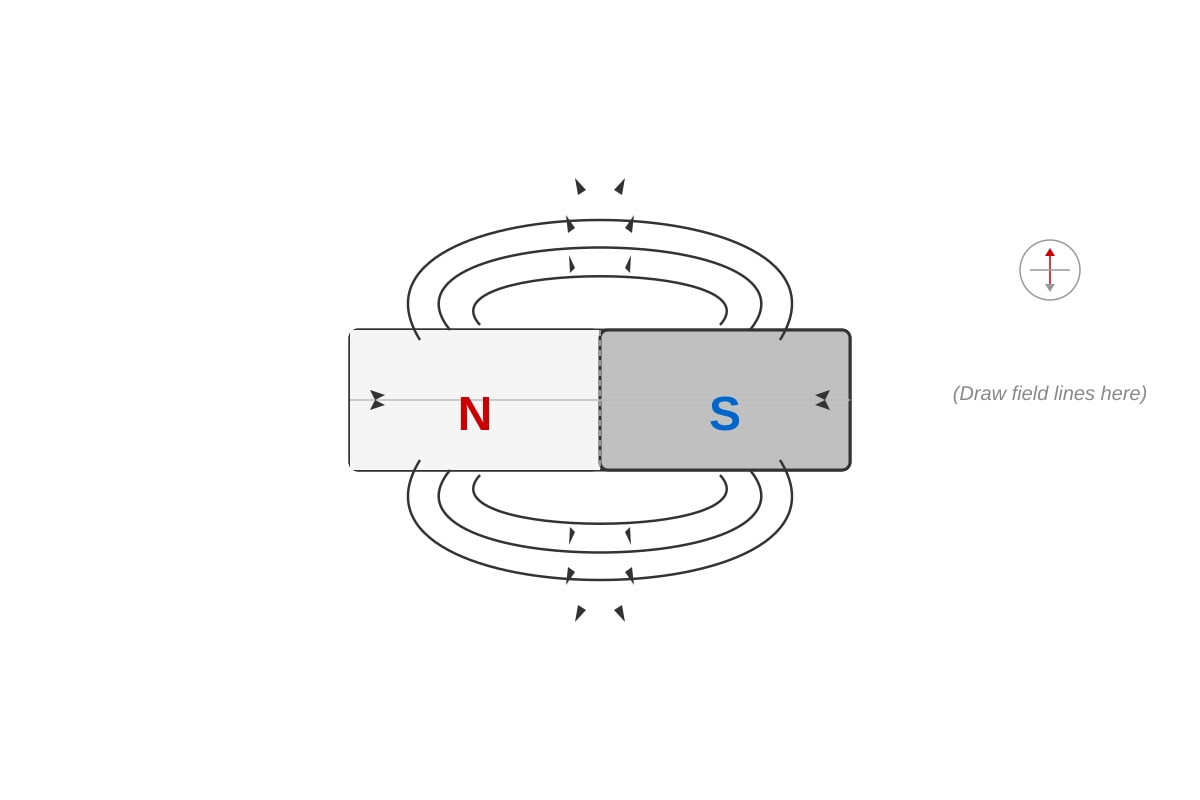
13. The diagram should show magnetic field lines emerging from the north pole (N), curving around the magnet, and entering the south pole (S). The lines should be continuous and should not cross each other.
- Marking Scheme:
- 1 mark for drawing lines that emerge from N and enter S.
- 1 mark for drawing continuous, non-crossing lines.
- Common Mistake: Students may draw lines that start and end at the same pole or that cross each other. Remind them that field lines always go from north to south outside the magnet.
14. A compass contains a small, freely suspended magnet (the needle). When the compass is brought near another magnet, the magnetic field of the magnet exerts a force on the compass needle, causing it to turn and point towards the magnet. The north pole of the compass needle is attracted to the south pole of the magnet.
- Marking Scheme:
- 1 mark for stating that the compass needle is a magnet.
- 1 mark for explaining that the magnetic field of the magnet attracts the compass needle.
- Explanation: This is the same principle as a compass pointing north; the Earth's magnetic field acts on the compass needle.
15. Example: A refrigerator door uses a magnet to keep it closed. The magnet is embedded in the door seal, and it attracts the metal frame of the refrigerator, holding the door shut.
- Marking Scheme:
- 1 mark for a valid example of a household device that uses a magnet.
- 1 mark for explaining the role of the magnet in that device.
- Other examples: Speakers (magnet moves the cone), electric motors (magnet interacts with electric current), magnetic catch on a cabinet door.
Section C: Structured Questions
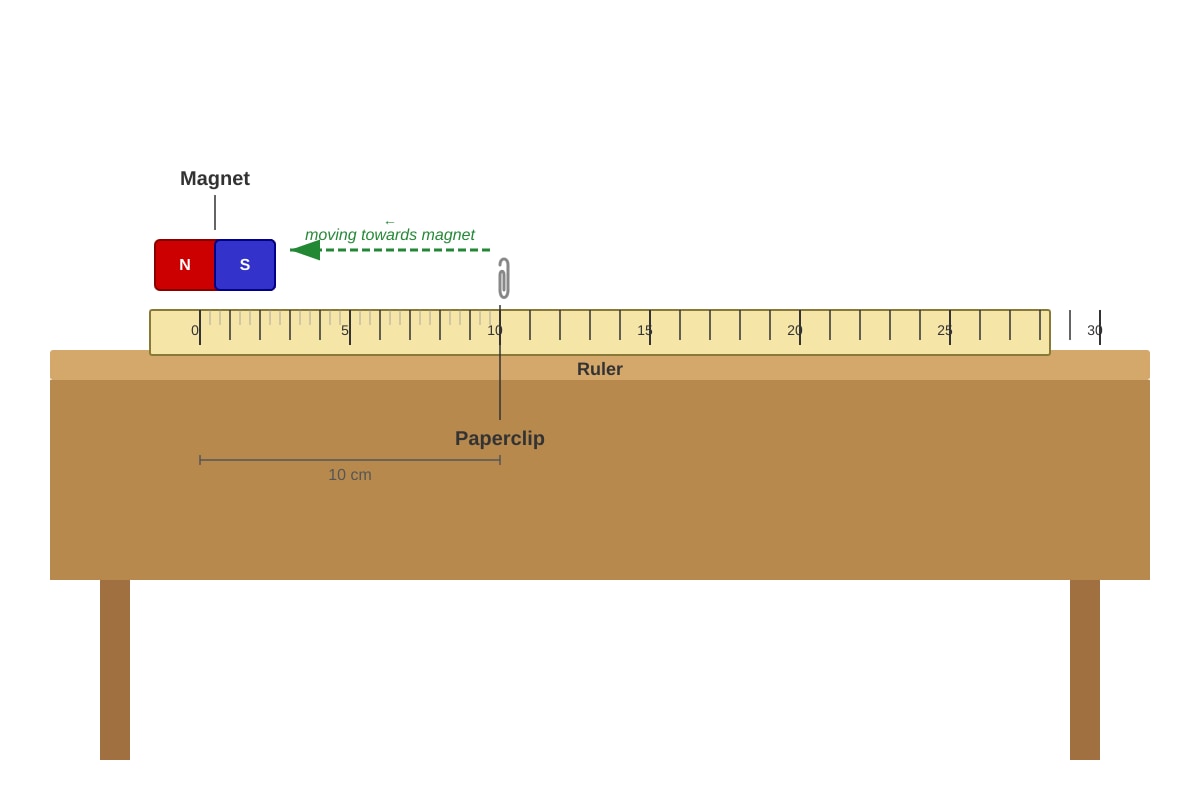
16. (a) The independent variable is the type of magnet (or the magnet itself).
- Explanation: The independent variable is what the experimenter changes. In this case, the student is changing the magnet to see how it affects the distance at which the paperclip is attracted.
- Marking: 1 mark for correct answer.
(b) The dependent variable is the distance at which the paperclip is first attracted to the magnet.
- Explanation: The dependent variable is what is measured. The student is measuring the distance to see how it changes with different magnets.
- Marking: 1 mark for correct answer.
17. (a) Tie the string to the middle of the magnet and suspend it so it can spin freely. The end that points towards the Earth's north is the north pole of the magnet.
- Explanation: A freely suspended magnet aligns with the Earth's magnetic field. The end that points north is the north pole.
- Marking: 1 mark for correct description.
(b) The south pole is the opposite end of the magnet from the north pole.
- Explanation: Once the north pole is identified, the south pole is simply the other end.
- Marking: 1 mark for correct answer.
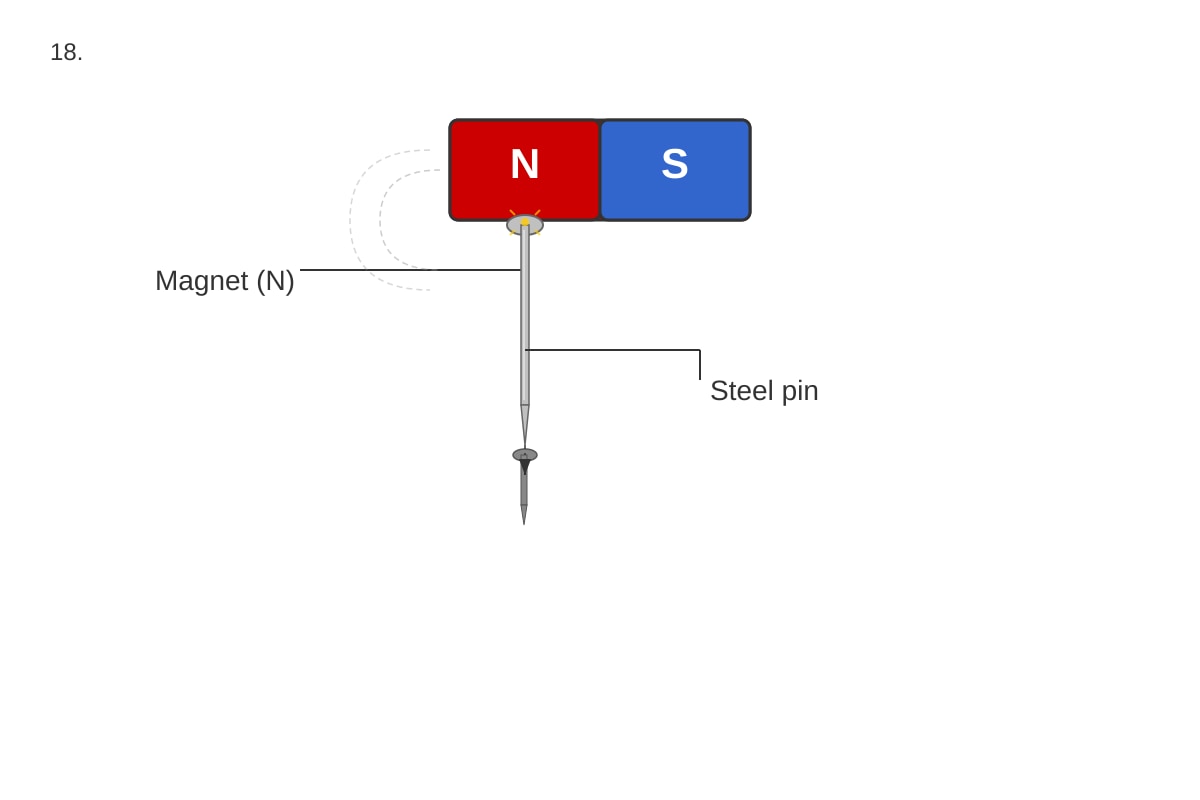
18. (a) The steel pin will become attracted to the magnet and will stick to it.
- Explanation: Steel is a magnetic material, so it is attracted to the magnet.
- Marking: 1 mark for correct answer.
(b) The steel pin becomes temporarily magnetised when it is in contact with the magnet. It can then attract other small magnetic objects like the iron nail.
- Explanation: This is an example of magnetic induction. The magnetic field of the magnet aligns the magnetic domains in the steel pin, turning it into a temporary magnet.
- Marking: 1 mark for correct explanation.
19. (a) She can place each magnet (B and C) at the same distance from a pile of paper clips and count how many paper clips each magnet can pick up. The magnet that picks up more paper clips is stronger.
- Explanation: This is a fair test because the distance and the type of object (paper clips) are kept the same.
- Marking: 1 mark for a valid description.
(b) She must keep the distance from the paper clips the same for both magnets.
- Explanation: To make it a fair test, only one variable (the magnet) should be changed. All other variables, like the distance, must be kept constant.
- Marking: 1 mark for identifying a controlled variable.
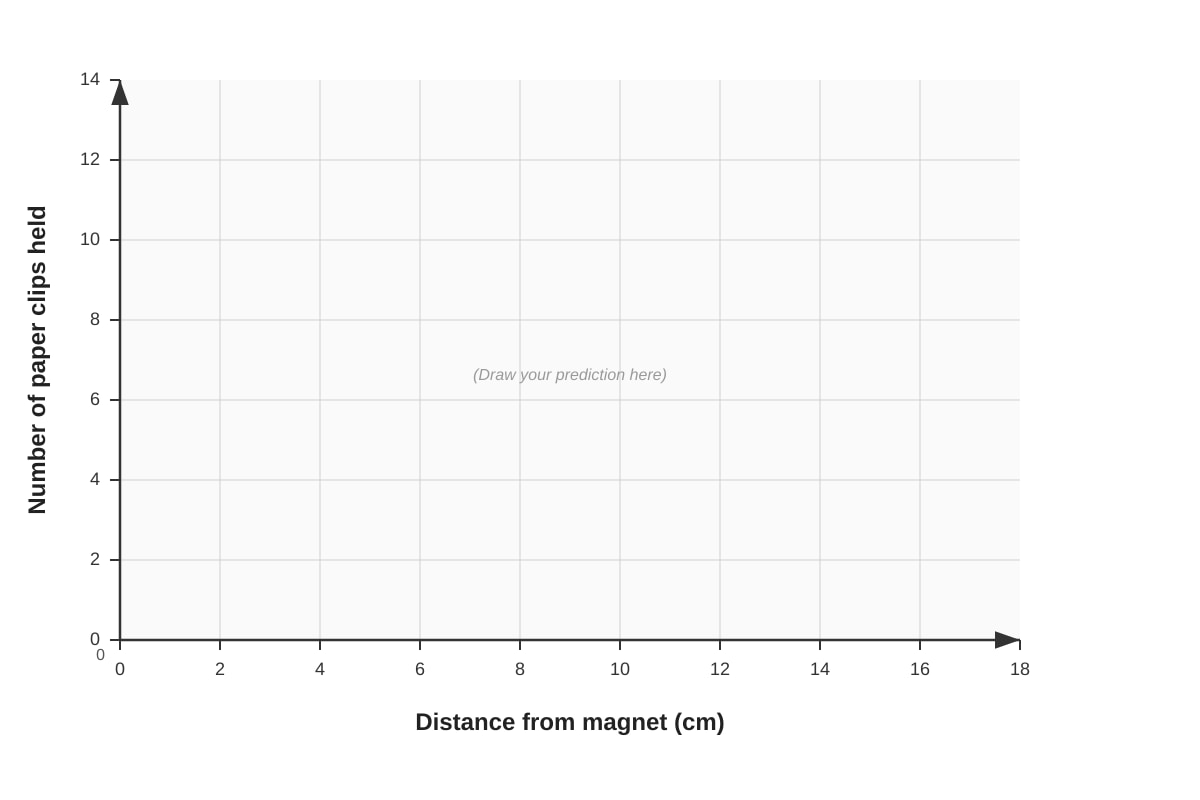
20. (a) The graph should show a curve that starts high on the y-axis (many paper clips held) and decreases as the distance on the x-axis increases, eventually reaching zero.
- Marking Scheme:
- 1 mark for drawing a curve that shows a decrease in the number of paper clips held as distance increases.
- Explanation: The magnetic field strength decreases with distance. The closer the paperclip is to the magnet, the stronger the magnetic force, and the more paper clips it can hold.
(b) The magnetic force is strongest when the paperclip is close to the magnet. As the distance increases, the magnetic force becomes weaker, so it can hold fewer paper clips. Eventually, at a large enough distance, the magnetic force is too weak to hold any paper clips.
- Marking Scheme:
- 1 mark for explaining that magnetic force decreases with distance.
- Common Mistake: Students may think the magnetic force is constant. Emphasise that it weakens rapidly with distance.