AI Generated Quiz
Primary 5 Science Magnets Quiz
Free P5 Science Magnets quiz, AI version, with questions, answers, and syllabus-aligned practice for Singapore students.
These static practice materials are generated from the site's syllabus and paper-generation workflow, with source and model context shown so students and parents can evaluate the material before use.
Questions
Free quiz and exam paper access
Enter your details to view this paper
Your access is remembered on this device.
Answers
Answer Key: Primary 5 Science Quiz - Magnets
Total Marks: 50
Section A: Multiple-Choice Questions (10 marks)
| Question | Answer | Marks |
|---|---|---|
| 1 | 3 | 2 |
| 2 | 2 | 2 |
| 3 | 3 | 2 |
| 4 | 3 | 2 |
| 5 | 3 | 2 |
Explanations for Section A:
1. (3) Iron
- Explanation: Only magnetic materials are attracted to magnets. The common magnetic materials are iron, steel (which is mostly iron), nickel, and cobalt. Plastic, aluminium, and wood are non-magnetic materials and are not attracted to magnets.
2. (2) North-South
- Explanation: A freely suspended bar magnet will align itself with the Earth's magnetic field. The end of the magnet that points towards the Earth's geographic North is called the north-seeking pole, or simply the north pole. The other end points towards the geographic South. This is the principle behind a compass.
3. (3) Rod X could be either a magnet or an iron bar.
- Explanation: A magnet will attract a magnetic material like iron. However, a magnet will also attract the opposite pole of another magnet (attraction between unlike poles). Since both a magnet and an iron bar would be attracted to a known magnet, the student cannot tell which one Rod X is based on attraction alone. To determine if Rod X is a magnet, the student should test for repulsion. Only two magnets can repel each other (when like poles are brought together).
- Common Mistake: Students often think that attraction only proves something is a magnet. Remind them that magnetic materials are also attracted to magnets.
4. (3) Each piece will become a magnet with its own north and south poles.
- Explanation: Breaking a magnet does not destroy its magnetic properties. Each broken piece becomes a smaller, complete magnet with its own north and south pole. This is because the magnetic domains (tiny regions of aligned atoms) are still present in each piece.
5. (3) The iron filings will still be attracted to the magnet because magnetic force can pass through non-magnetic materials like paper.
- Explanation: Magnetic force can pass through non-magnetic materials such as paper, plastic, wood, and air. The paper does not block the magnetic field. However, if a thick magnetic material like iron is placed between the magnet and the filings, the magnetic field can be redirected or blocked (magnetic shielding).
Section B: Short-Answer Questions (12 marks)
6. (a) [1 mark]
- Answer: Magnetic field (or magnetic force field).
- Marking Note: Accept "magnetic field" or "area/region of magnetic force". Do not accept just "force".
6. (b) [2 marks]
- Answer: The iron filings are most concentrated at the poles of the magnet. This is because the magnetic force is strongest at the poles.
- Marking Note: Award 1 mark for identifying the correct location (poles) and 1 mark for the correct explanation (strongest magnetic force).
7. [2 marks]
- Answer: Stroke the iron nail repeatedly (e.g., 30-50 times) with one pole of the bar magnet, always stroking in the same direction.
- Explanatory Notes: This method aligns the magnetic domains within the nail, turning it into a temporary magnet. The nail will retain some magnetism for a while, especially if it is made of steel.
- Marking Note: Award 1 mark for the action (stroking with a magnet) and 1 mark for the correct detail (using one pole / stroking in one direction).
8. [2 marks]
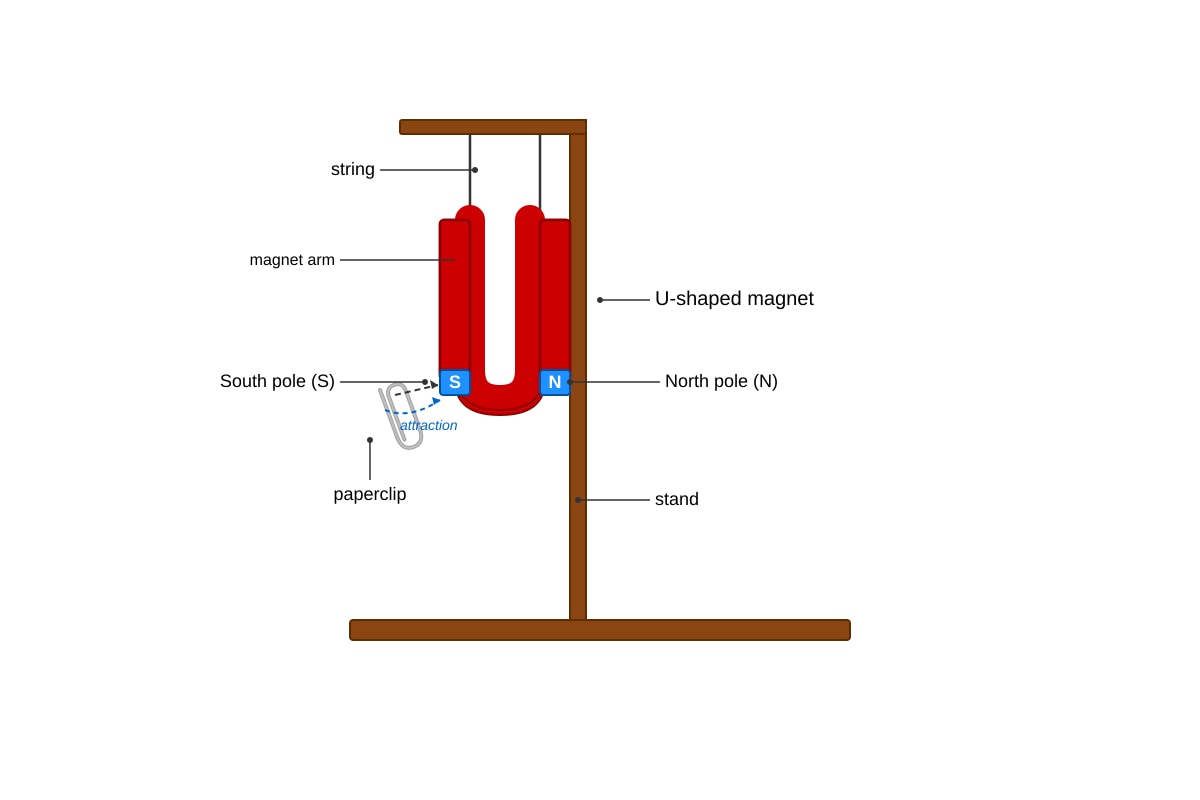
- Answer: The paperclip will be attracted more strongly at the south pole. The magnetic force is strongest at the poles of the magnet and weakest in the middle.
- Marking Note: Award 1 mark for identifying the south pole and 1 mark for explaining that the magnetic force is strongest at the poles.
9. [3 marks]
- Answer: No, this claim is not always true. The strength of a magnet depends on the material it is made of and how it is magnetised, not just its size. For example, a small but strong neodymium magnet can be much stronger than a large, weak ferrite magnet.
- Marking Note: Award 1 mark for stating the claim is not always true, 1 mark for an example that contrasts size and strength, and 1 mark for mentioning other factors like material or magnetisation.
10. [2 marks]
- Answer: The north pole of Rod P will attract Rod Q. This is because Rod Q is a magnetic material (steel) and will be attracted to a magnet, regardless of which pole is used.
- Marking Note: Award 1 mark for the observation (attraction) and 1 mark for the explanation (steel is a magnetic material).
Section C: Experimental Investigation and Data Analysis (16 marks)
11. (a) [2 marks]
- Answer: Only Material A (the steel needle) would point in the North-South direction. Steel is a magnetic material and can be magnetised. Copper and plastic are non-magnetic and cannot be magnetised.
- Marking Note: Award 1 mark for identifying Material A and 1 mark for explaining why (steel is magnetic / can be magnetised).
11. (b) [1 mark]
- Answer: To ensure that the material is fully or sufficiently magnetised.
- Marking Note: Accept "to make it magnetic" or "to turn it into a magnet". The idea is to ensure the process is effective.
12. (a) [1 mark]
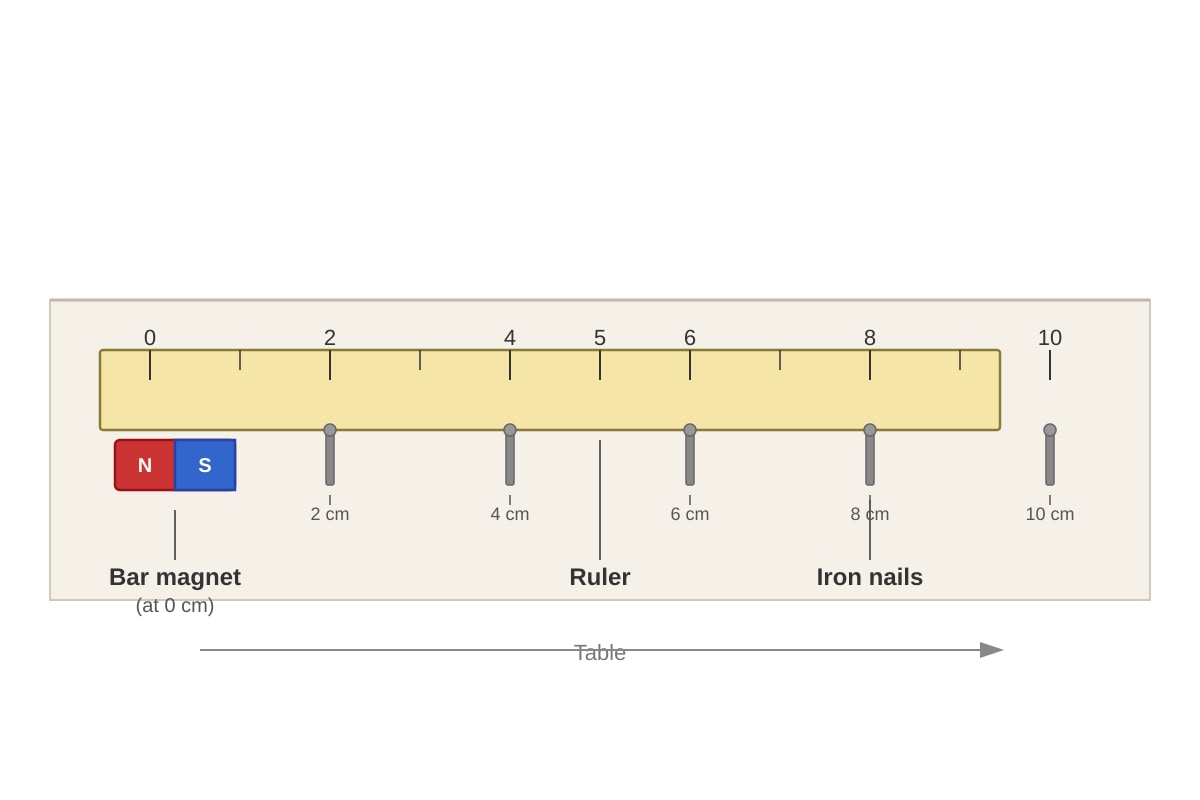
- Answer: The iron nails would start to be attracted to the magnet from a certain distance, and the attraction would become stronger as the magnet gets closer.
- Marking Note: Accept "the nails will be attracted to the magnet".
12. (b) [1 mark]
- Answer: The stronger magnet would attract the nails from a greater distance.
- Marking Note: The key idea is that the range of the magnetic force is greater.
13. (a) [1 mark]
- Answer: The strength of the magnetic force on the paperclip (or how many paperclips are attracted / the distance the paperclip jumps).
- Explanatory Notes: The dependent variable is what is being measured. Here, it is the effect of the magnet's force.
13. (b) [1 mark]
- Answer: The number of magnets used (or the arrangement of the magnets).
- Explanatory Notes: The independent variable is what the student changes.
13. (c) [3 marks]
- Answer: The magnetic force would be stronger when the second magnet is stacked on top of the first. Stacking the magnets increases the overall magnetic field strength because the magnetic fields add together. Placing them side-by-side may not have the same effect, depending on the alignment of their poles.
- Marking Note: Award 1 mark for stating the force is stronger, 1 mark for explaining that stacking adds to the field, and 1 mark for contrasting it with the side-by-side arrangement (optional but good detail).
14. (a) [1 mark]
- Answer: The iron filings would arrange themselves in a pattern as they are attracted to the magnet through the wood.
- Marking Note: The key is that the magnetic force passes through the wood.
14. (b) [3 marks]
- Answer: The observation would NOT be the same. An iron sheet is a magnetic material. The magnetic force would be diverted or "shielded" through the iron sheet, so much less force would reach the iron filings on the other side. The filings would show little or no attraction to the magnet.
- Marking Note: Award 1 mark for stating the observation is not the same, 1 mark for identifying iron as a magnetic material, and 1 mark for explaining magnetic shielding or the redirection of the magnetic field.
15. [2 marks]
- Answer: Steps: 1. Magnetise a needle by stroking it with a magnet. 2. Push the needle through a small piece of cork. 3. Float the cork with the needle in a bowl of water. The needle will rotate and point in the North-South direction because the magnetised needle aligns with the Earth's magnetic field.
- Marking Note: Award 1 mark for describing the steps (magnetise needle, float in water) and 1 mark for the explanation (alignment with Earth's magnetic field).
Section D: Applied Science and Higher-Order Thinking (12 marks)
16. (a) [1 mark]
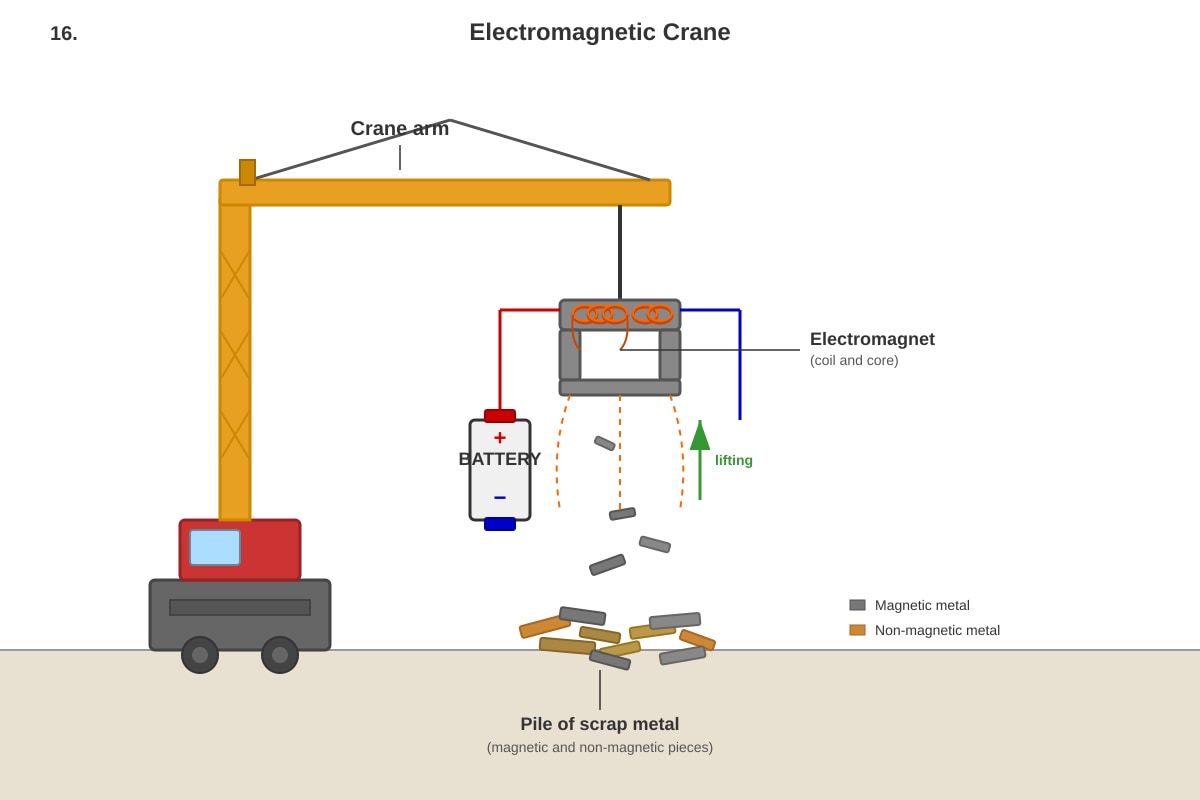
- Answer: Magnetic metals (e.g., iron, steel, nickel, cobalt).
- Marking Note: Accept "iron" or "steel" as specific examples.
16. (b) [1 mark]
- Answer: Turn off the electricity supply to the electromagnet.
- Explanatory Notes: An electromagnet only works when an electric current is flowing through its coil. When the current is switched off, the magnetic field disappears, and the scrap metal will be released.
- Marking Note: Accept "switch off the current" or "disconnect the battery".
17. [3 marks]
-
Answer: Experiment: Test for repulsion. Take one bar (call it Bar A). Bring one end of Bar A near one end of Bar B. Observe what happens. Repeat by bringing a different end of Bar A near the same end of Bar B. If repulsion is observed at any point, then Bar B is a magnet. If only attraction is observed, Bar B is a magnetic material (iron). Since Al is non-magnetic, there will be no interaction.
Reasoning: Only two magnets can repel each other (when like poles are brought together). If you test all three bars with each other, the one that never repels any other bar but is attracted to the magnet is the iron bar. The one that shows no interaction (neither attraction nor repulsion) is the aluminium bar.
-
Marking Scheme:
- 1 mark: Describes an experiment that tests for repulsion.
- 1 mark: Correct identification of the magnet based on the experiment.
- 1 mark: Correct differentiation between the iron and aluminium bars.
18. [2 marks]
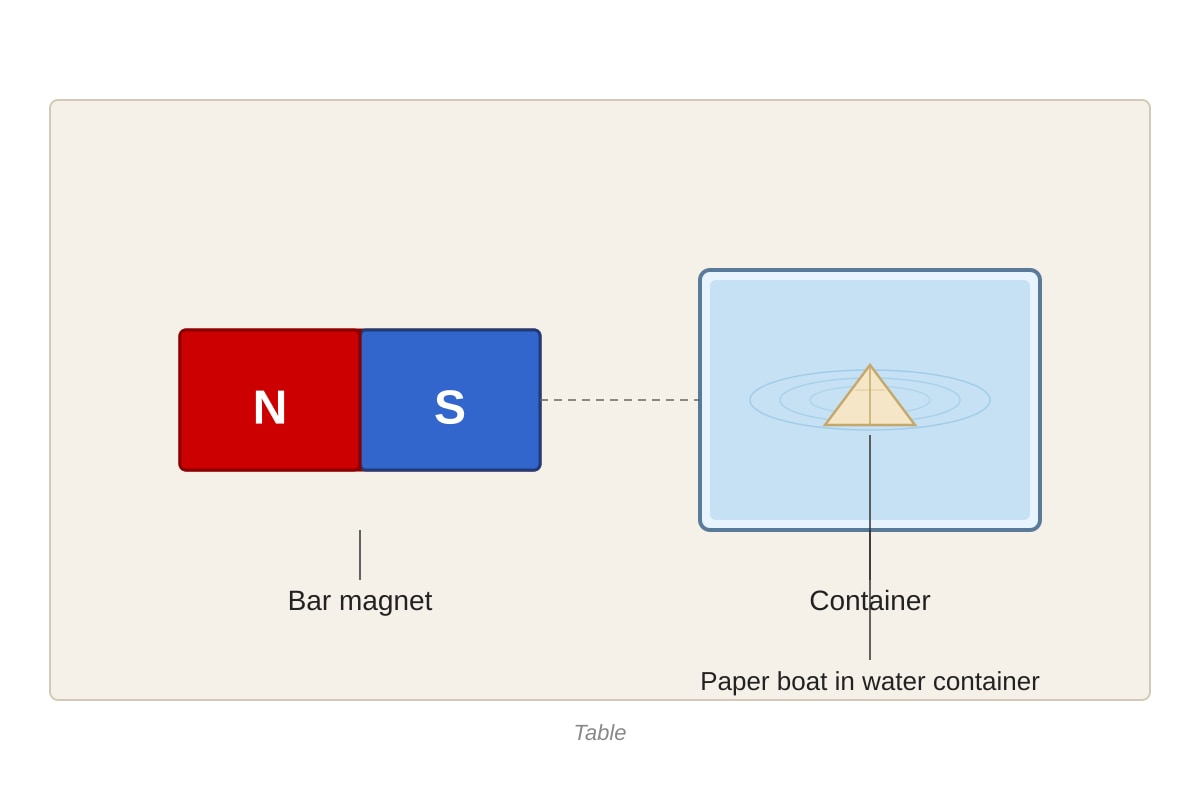
- Answer: The paper boat will be attracted towards the bar magnet and move towards the south pole. This is because the magnetised needle in the boat has its own north and south poles. The opposite poles will attract, causing the boat to move towards the magnet.
- Marking Note: Award 1 mark for describing the movement (towards the magnet) and 1 mark for explaining the attraction of opposite poles.
19. [3 marks]
- Answer: The longer nail would likely pick up the same number (or slightly more) paperclips. The strength of a temporary magnet depends on the material and the magnetising process. Since the same magnet was used, the same number of strokes were applied, and the stroking method was the same, the level of magnetisation should be similar. However, a longer nail has more magnetic material, so it might be able to support a slightly higher load. The key factor is the magnetisation, not just the length, so the difference might be small.
- Marking Scheme:
- Award 1 mark for a clear prediction (same or slightly more).
- Award 1 mark for explaining that the magnetisation process is the same.
- Award 1 mark for explaining that a longer nail has more magnetic material or for discussing other relevant factors (like the material being steel).
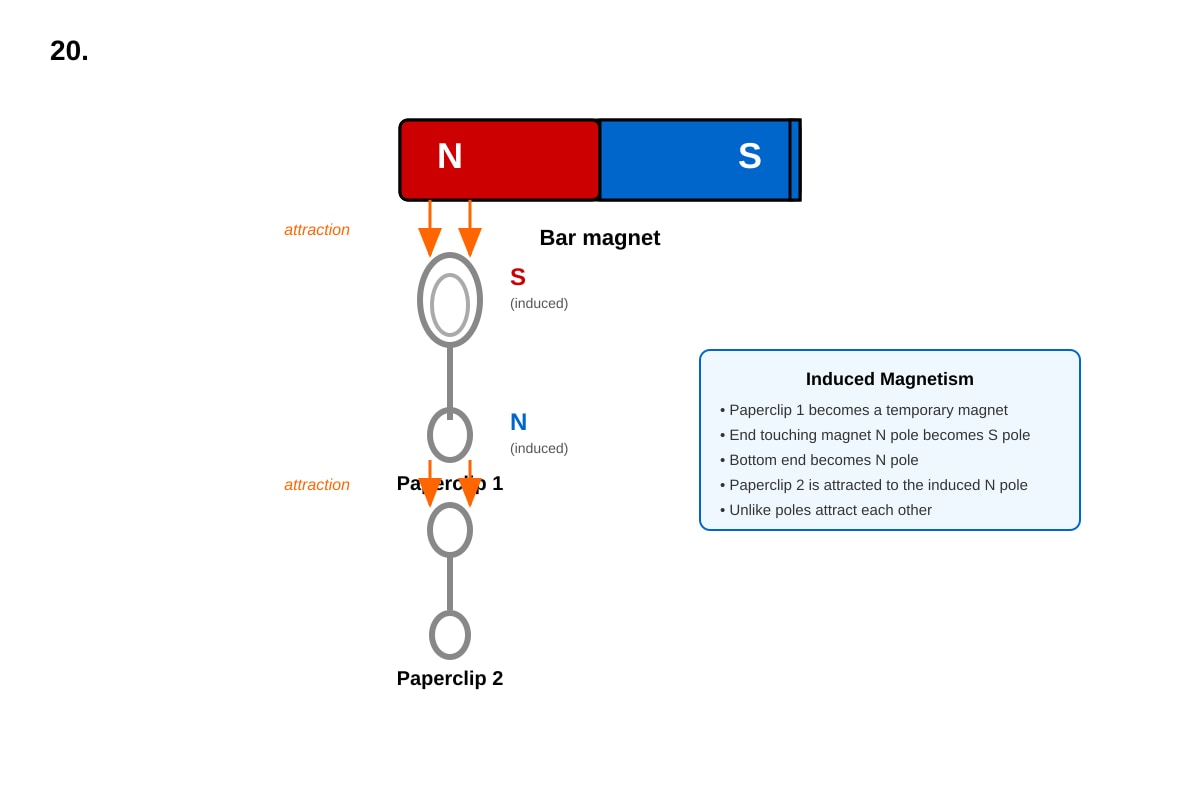
20. [2 marks]
- Answer: When the first paperclip (Paperclip 1) is attached to the north pole of the magnet, it becomes a temporary magnet by induction. The end of Paperclip 1 touching the magnet's north pole becomes an induced south pole. The other end of Paperclip 1 becomes an induced north pole. This induced north pole then attracts the south pole end of Paperclip 2, which is also temporarily induced.
- Marking Note: Award 1 mark for explaining that the first paperclip becomes an induced magnet and 1 mark for correctly identifying the attraction between the induced north pole of Paperclip 1 and the induced south pole of Paperclip 2.