AI Generated Quiz
Primary 5 Science Light Quiz
Free AI-Generated NVIDIA Nemotron 3 Ultra 550B A55B Free Primary 5 Science Light quiz with questions and answers for Singapore students. This page is rendered as a direct URL so the questions and answers can be discovered without pressing in-page buttons.
These static practice materials are generated from the site's syllabus and paper-generation workflow, with source and model context shown so students and parents can evaluate the material before use.
Questions
Primary 5 Science Quiz - Light
Name: ___________________________
Class: Primary 5 _______
Date: ___________________________
Score: ________ / 50
Duration: 45 minutes
Total Marks: 50
Instructions:
- Answer all questions.
- Write your answers in the spaces provided.
- For multiple-choice questions, write the letter (A, B, C, or D) in the brackets provided.
- For open-ended questions, write your answers clearly in complete sentences.
- Diagrams are not drawn to scale unless stated.
Section A: Multiple-Choice Questions (10 × 2 marks = 20 marks)
1. Which of the following is a natural source of light?
A. Torch
B. Candle flame
C. The Sun
D. Television screen
[_____]
2. Light travels in a __________.
A. curved line
B. zigzag line
C. straight line
D. circular path
[_____]
3. Which of the following objects is transparent?
A. Wooden door
B. Frosted glass
C. Clear glass window
D. Cardboard box
[_____]
4. A shadow is formed when __________.
A. light passes through an object
B. light is blocked by an opaque object
C. light is reflected by a mirror
D. light bends around an object
[_____]
5. When light hits a smooth, shiny surface like a mirror, it is __________.
A. absorbed
B. refracted
C. reflected
D. transmitted
[_____]
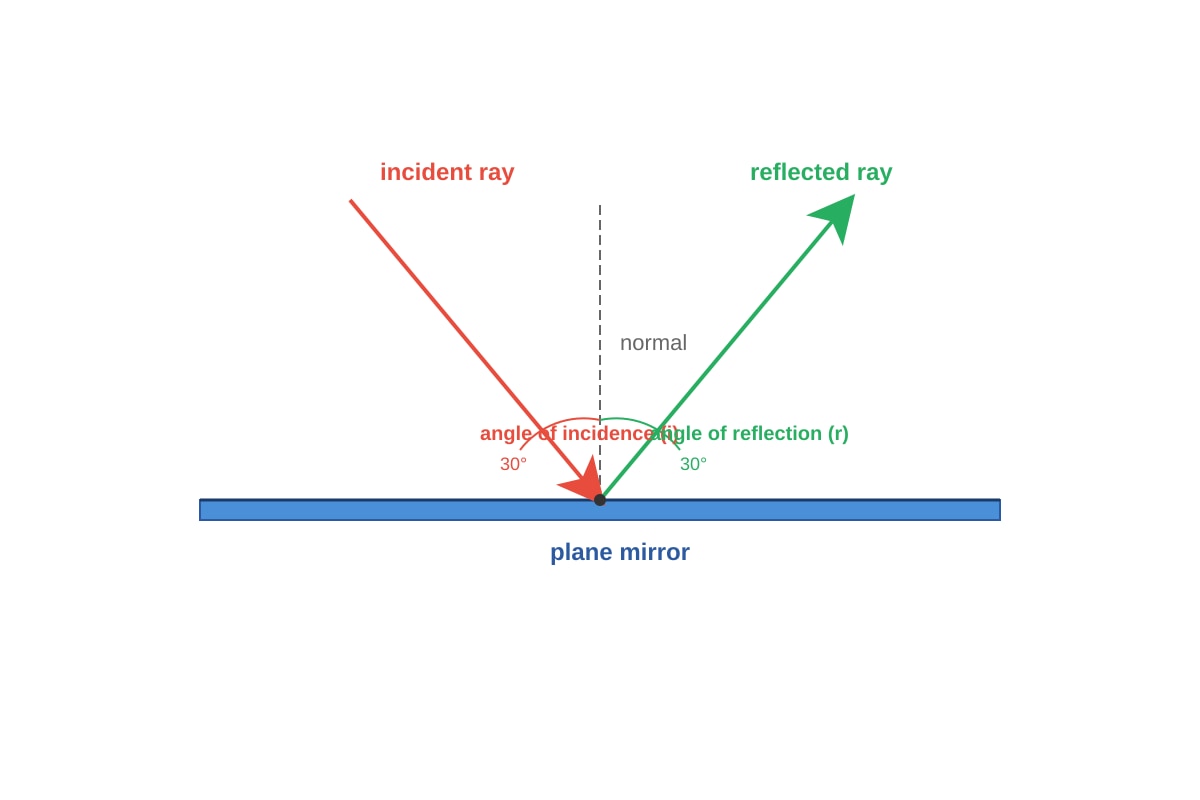
6. The diagram below shows a light ray hitting a plane mirror.
<image_placeholder>
id: Q6-fig1
type: diagram
linked_question: Q6
description: A light ray (incident ray) striking a plane mirror at an angle of 30° to the normal. The normal line is drawn perpendicular to the mirror surface. The reflected ray should be shown leaving the mirror at 30° to the normal on the opposite side.
labels: incident ray, reflected ray, normal, angle of incidence (30°), angle of reflection (30°), plane mirror
values: angle of incidence = 30°, angle of reflection = 30°
must_show: incident ray, reflected ray, normal line, mirror surface, angle labels
</image_placeholder>
What is the angle of reflection?
A. 30°
B. 60°
C. 90°
D. 120°
[_____]
7. Which of the following statements about shadows is correct?
A. Shadows are formed only in darkness.
B. The size of a shadow does not change.
C. A shadow is formed on the side of the object facing the light source.
D. A shadow is formed on the side of the object opposite the light source.
[_____]
8. An object appears red because it __________.
A. absorbs red light and reflects all other colours
B. reflects red light and absorbs all other colours
C. transmits red light only
D. produces red light
[_____]
9. When light passes from air into water, it bends. This phenomenon is called __________.
A. reflection
B. refraction
C. absorption
D. dispersion
[_____]
10. The diagram below shows a pencil placed in a beaker of water.
<image_placeholder>
id: Q10-fig1
type: diagram
linked_question: Q10
description: A beaker half-filled with water. A pencil is placed at an angle, partially submerged in the water. The pencil appears bent at the water surface. Light rays from the submerged part of the pencil bend away from the normal as they exit the water into air.
labels: air, water, pencil, apparent position of pencil, actual position of pencil, light rays, normal
values: refractive index of water ≈ 1.33, refractive index of air ≈ 1.00
must_show: beaker, water level, pencil at angle, bent appearance at water surface, light rays bending at interface
</image_placeholder>
The pencil appears bent because __________.
A. the pencil is actually bent
B. light travels slower in water than in air
C. light travels faster in water than in air
D. water absorbs light
[_____]
Section B: Short-Answer Questions (5 × 2 marks = 10 marks)
11. State two differences between a luminous object and a non-luminous object.
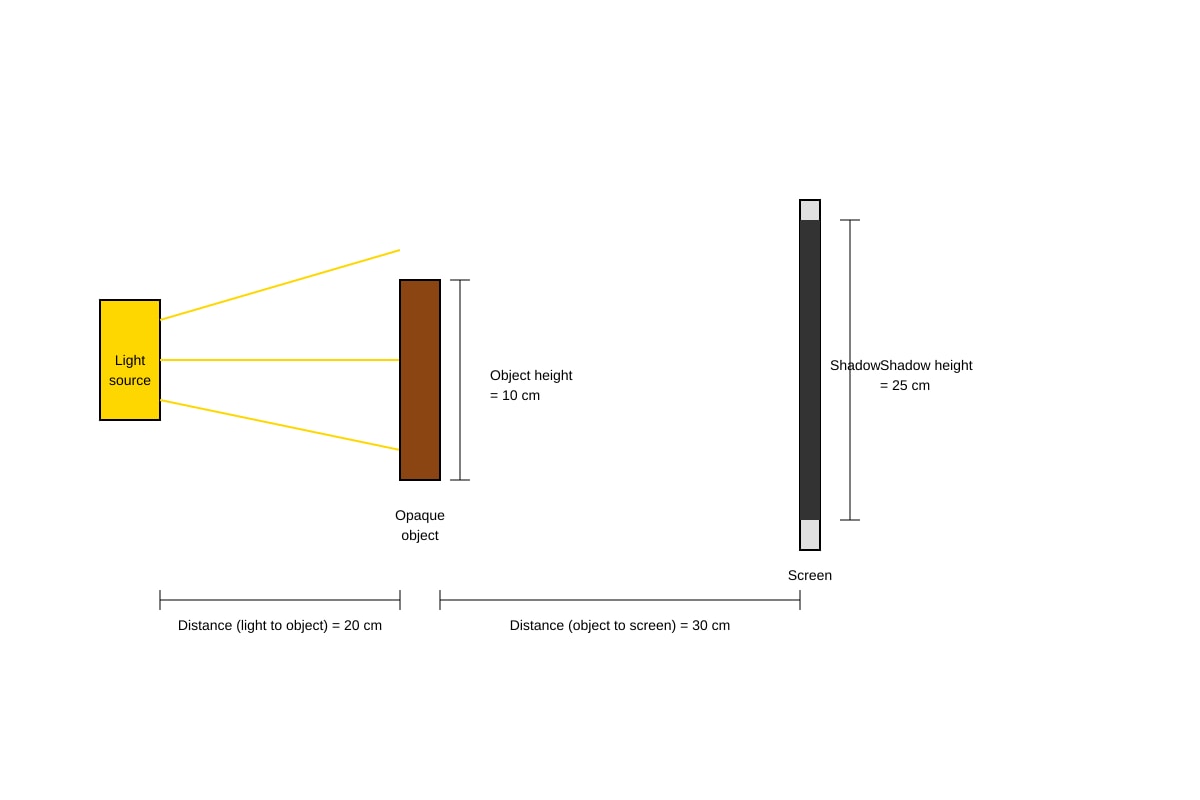
12. The diagram below shows a torch shining on a wooden ball. A shadow is formed on the screen.
<image_placeholder>
id: Q12-fig1
type: diagram
linked_question: Q12
description: A torch on the left, a wooden ball in the middle, and a vertical screen on the right. Light rays from the torch travel in straight lines, are blocked by the ball, and form a shadow on the screen. The shadow is larger than the ball.
labels: torch (light source), wooden ball (opaque object), screen, light rays (straight lines), shadow on screen
values: distance from torch to ball = 20 cm, distance from ball to screen = 30 cm, ball diameter = 5 cm
must_show: torch, ball, screen, straight light rays, shadow larger than ball, umbra region
</image_placeholder>
(a) On the diagram, draw the shadow of the wooden ball on the screen.
(b) Explain why the shadow is larger than the wooden ball.
13. Complete the table below by writing "Transparent", "Translucent", or "Opaque" for each object.
| Object | Classification |
|---|---|
| Clear plastic ruler | ______________ |
| Tracing paper | ______________ |
| Aluminium foil | ______________ |
| Sunglasses lens | ______________ |
| Clean window glass | ______________ |
14. A student shines a torch at a mirror in a dark room. The light ray hits the mirror at an angle of 40° to the normal.
(a) What is the angle of reflection? __________
(b) State the law of reflection.
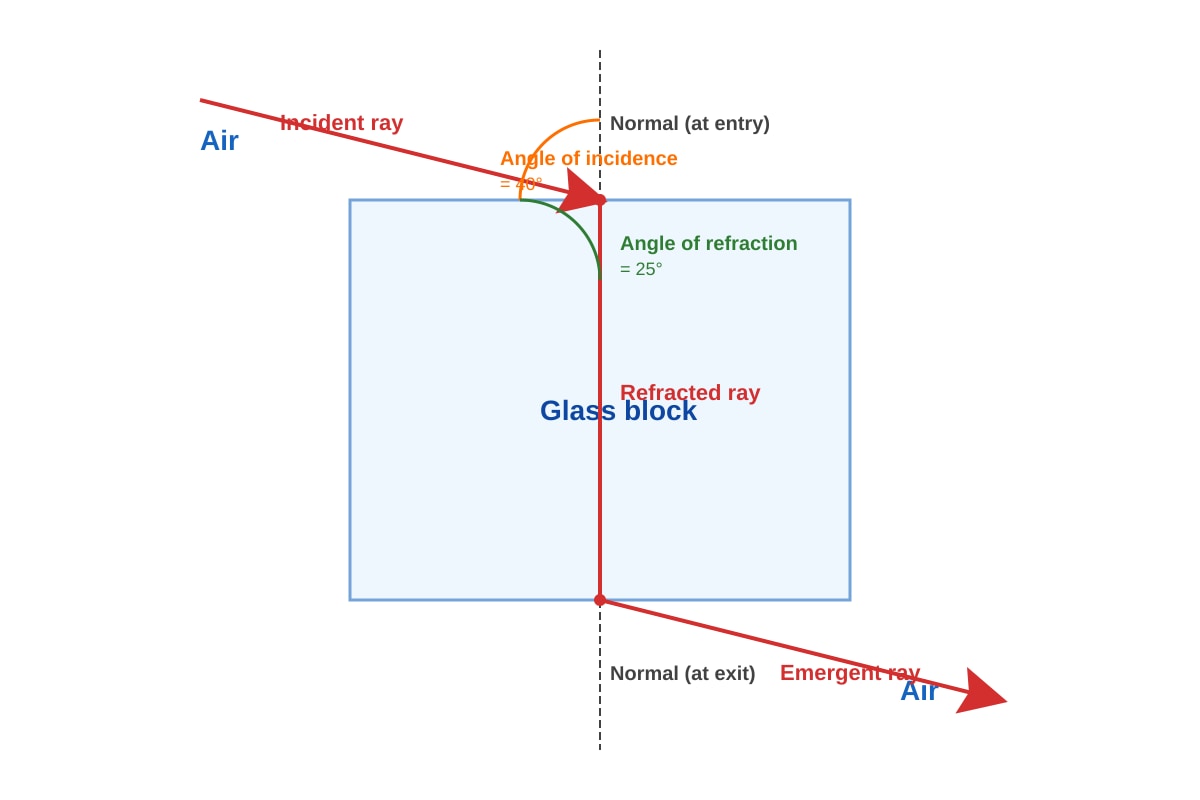
15. The diagram below shows a ray of light passing from air into a glass block.
<image_placeholder>
id: Q15-fig1
type: diagram
linked_question: Q15
description: A rectangular glass block. A light ray enters the block from air at an angle of incidence of 45°. The ray bends towards the normal inside the glass. It exits the block parallel to the incident ray but laterally displaced.
labels: air, glass block, incident ray, refracted ray, emergent ray, normal, angle of incidence (45°), angle of refraction, lateral displacement
values: angle of incidence = 45°, refractive index of glass ≈ 1.5
must_show: rectangular glass block, incident ray at 45°, refracted ray bending towards normal, emergent ray parallel to incident ray, normals at both surfaces
</image_placeholder>
(a) On the diagram, label the angle of incidence and the angle of refraction.
(b) Does the light ray bend towards or away from the normal when it enters the glass block? ________________
(c) Explain why the light ray bends when it enters the glass block.
Section C: Structured and Open-Ended Questions (4 × 5 marks = 20 marks)
16. The diagram below shows an experiment to investigate how the distance between the light source and an object affects the size of the shadow.
<image_placeholder>
id: Q16-fig1
type: diagram
linked_question: Q16
description: A vertical screen on the right. An opaque object (cardboard circle, diameter 4 cm) on a stand. A torch on a movable stand. Three positions for the torch marked A, B, C from left to right (A closest to object, C furthest). Shadows cast on screen at each position.
labels: torch positions A, B, C; opaque object (cardboard circle); screen; shadows at each position
values: object diameter = 4 cm; distance from object to screen = 50 cm; position A: torch 10 cm from object; position B: torch 30 cm from object; position C: torch 50 cm from object
must_show: three torch positions, object, screen, three shadows of different sizes (largest at A, smallest at C)
</image_placeholder>
The table below shows the results.
| Torch Position | Distance from Torch to Object (cm) | Diameter of Shadow on Screen (cm) |
|---|---|---|
| A | 10 | 24 |
| B | 30 | 10 |
| C | 50 | 7 |
(a) Based on the results, state the relationship between the distance of the torch from the object and the size of the shadow.
(b) Explain why the shadow is largest when the torch is at Position A.
(c) If the screen is moved further away from the object (while the torch remains at Position B), how would the size of the shadow change? Explain your answer.
(d) State one variable that must be kept constant to ensure a fair test.
(e) The actual diameter of the object is 4 cm. Why is the shadow diameter at Position C (7 cm) larger than the object?
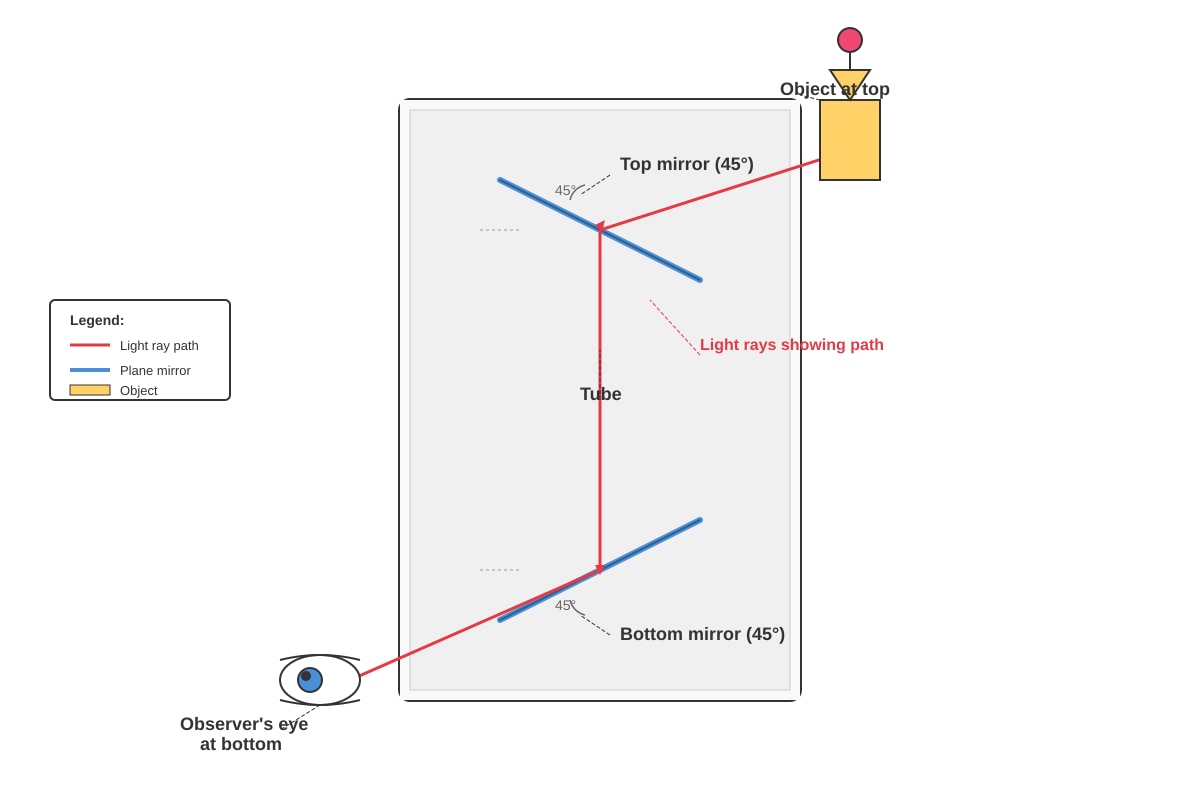
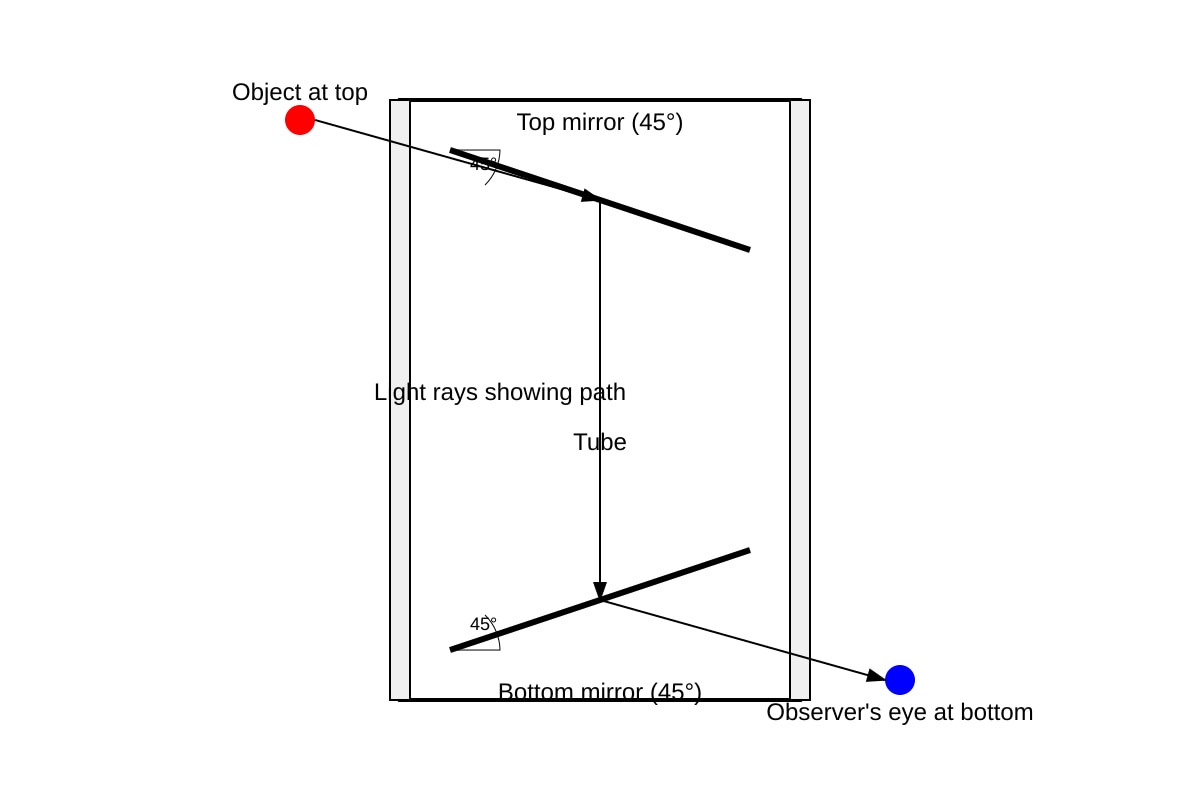
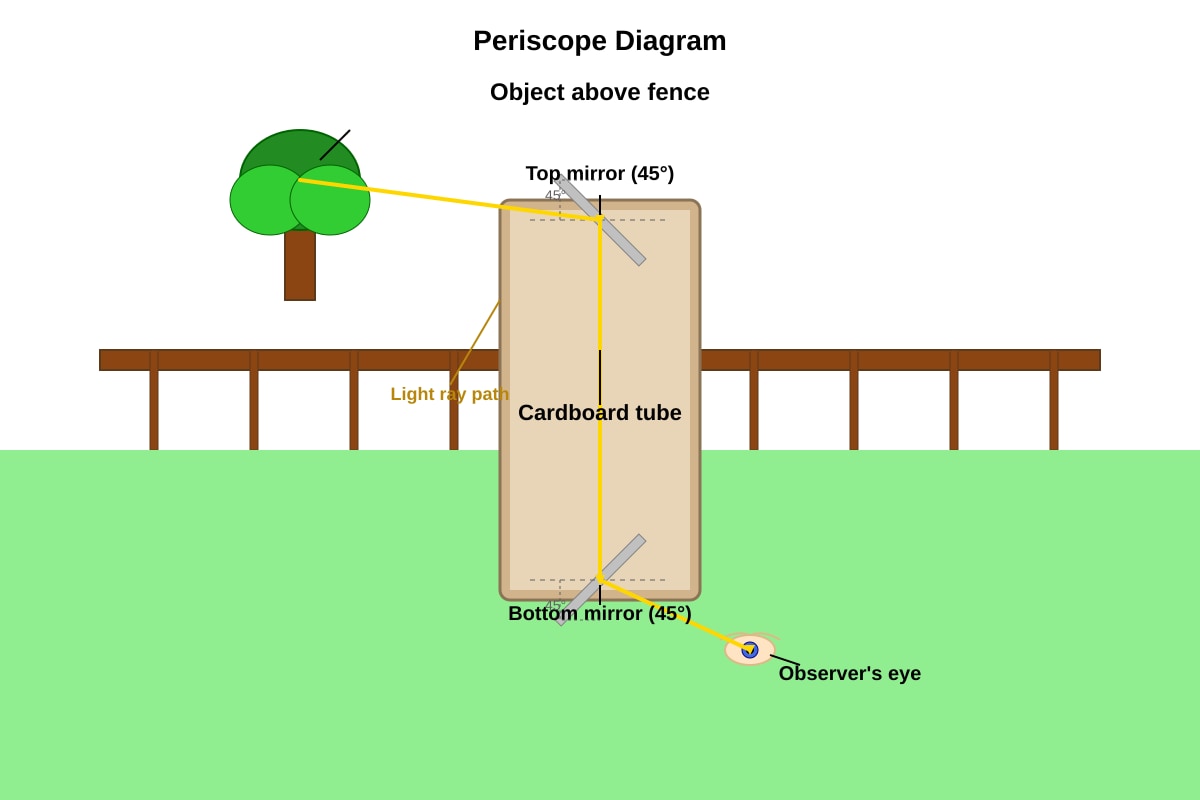
17. The diagram below shows a periscope made using two plane mirrors.
<image_placeholder>
id: Q17-fig1
type: diagram
linked_question: Q17
description: A periscope - a long tube with two plane mirrors fixed at 45° at each end. The top mirror faces down, the bottom mirror faces up. An eye at the bottom looks into the bottom mirror. An object (tree) is at the top. Light rays from the tree hit the top mirror, reflect down the tube, hit the bottom mirror, reflect into the eye.
labels: top mirror (45°), bottom mirror (45°), tube, object (tree), eye, light rays (straight lines with arrows), normal lines at each mirror
values: angle of incidence = 45° at each mirror, angle of reflection = 45° at each mirror
must_show: periscope tube, two mirrors at 45°, object at top, eye at bottom, light ray path with two reflections, normals and angles
</image_placeholder>
(a) On the diagram, draw the path of a light ray from the top of the tree to the eye. Show the normal and angles at each mirror.
(b) State the angle of incidence and angle of reflection at the top mirror.
Angle of incidence: __________
Angle of reflection: __________
(c) Explain why the mirrors must be placed at 45° to the vertical.
(d) If the top mirror is rotated slightly so that it is no longer at 45°, what would the observer see?
(e) State one advantage of using a periscope instead of looking directly over a wall.
18. A student conducts an experiment to compare how much light passes through three different materials: clear glass, frosted glass, and cardboard. She uses a light sensor to measure the light intensity.
The results are shown below.
| Material | Light Intensity Detected (lux) |
|---|---|
| Clear glass | 850 |
| Frosted glass | 320 |
| Cardboard | 0 |
(a) Which material allows the most light to pass through? ________________
(b) Classify each material as transparent, translucent, or opaque.
Clear glass: ________________
Frosted glass: ________________
Cardboard: ________________
(c) Explain why the light intensity for frosted glass is lower than for clear glass.
(d) The student repeats the experiment with a brighter light source. Predict how the light intensity readings would change.
(e) State one practical use of frosted glass in daily life.
19. The diagram below shows white light passing through a triangular glass prism.
<image_placeholder>
id: Q19-fig1
type: diagram
linked_question: Q19
description: A triangular glass prism. A narrow beam of white light enters one face of the prism. The light disperses into a spectrum of colours (red, orange, yellow, green, blue, indigo, violet) as it exits the other face. The red light bends the least, violet bends the most.
labels: white light beam, triangular prism, spectrum (ROYGBIV), red light (least deviation), violet light (most deviation), normal lines
values: refractive index varies with wavelength; red deviates least, violet deviates most
must_show: prism, white light entering, spectrum exiting, colours in correct order (ROYGBIV), different bending angles for different colours
</image_placeholder>
(a) Name the phenomenon shown in the diagram. ________________
(b) List the colours of the spectrum in order from the least deviated to the most deviated.
(c) Explain why white light splits into different colours when it passes through the prism.
(d) State one natural example where this phenomenon can be observed.
(e) If a red filter is placed in front of the white light source before it enters the prism, what would be observed on the screen?
20. The diagram below shows a magnifying glass (convex lens) being used to focus sunlight onto a piece of paper.
<image_placeholder>
id: Q20-fig1
type: diagram
linked_question: Q20
description: A convex lens (magnifying glass) held above a piece of paper. Parallel rays of sunlight enter the lens and converge at a focal point on the paper. The paper begins to burn at the focal point.
labels: convex lens, parallel sunlight rays, focal point, focal length, paper, concentrated light spot
values: focal length of lens = 10 cm (example)
must_show: convex lens shape, parallel rays entering, rays converging at focal point on paper, focal length labelled, bright spot at focal point
</image_placeholder>
(a) What happens to the parallel rays of sunlight after passing through the convex lens?
(b) The paper starts to burn at the focal point. Explain why.
(c) If the lens is moved further away from the paper (beyond the focal length), what would happen to the bright spot on the paper?
(d) State one other use of a convex lens in daily life.
(e) Why should you never look at the Sun through a convex lens?
--- END OF QUIZ ---
Answers
Primary 5 Science Quiz - Light (Answer Key)
Total Marks: 50
Section A: Multiple-Choice Questions (10 × 2 marks = 20 marks)
1. C — The Sun is a natural source of light. Torch, candle flame, and television screen are artificial/man-made light sources.
Marking note: 2 marks for correct answer.
2. C — Light travels in straight lines. This is a fundamental property of light (rectilinear propagation).
Marking note: 2 marks for correct answer.
3. C — Clear glass window is transparent (allows most light to pass through so objects can be seen clearly). Wooden door is opaque, frosted glass is translucent, cardboard box is opaque.
Marking note: 2 marks for correct answer.
4. B — A shadow is formed when light is blocked by an opaque object. Light travels in straight lines and cannot bend around the object, creating a dark region (shadow) behind it.
Marking note: 2 marks for correct answer.
5. C — When light hits a smooth, shiny surface like a mirror, it is reflected (bounces off). Absorption is when light is taken in, refraction is bending when passing through different media, transmission is passing through.
Marking note: 2 marks for correct answer.
6. A — According to the law of reflection, the angle of incidence equals the angle of reflection. If the angle of incidence is 30°, the angle of reflection is also 30°.
Marking note: 2 marks for correct answer.
7. D — A shadow is formed on the side of the object opposite the light source because light travels in straight lines and is blocked by the object.
Marking note: 2 marks for correct answer. Common mistake: choosing C (shadow on same side as light source).
8. B — An object appears red because it reflects red light into our eyes and absorbs most other colours of the spectrum.
Marking note: 2 marks for correct answer. Common mistake: choosing A (absorbs red, reflects others).
9. B — When light passes from one medium to another of different optical density (e.g., air to water), it bends. This phenomenon is called refraction.
Marking note: 2 marks for correct answer.
10. B — Light travels slower in water than in air. When light passes from air (less dense) into water (more dense), it slows down and bends towards the normal. This change in speed causes refraction, making the pencil appear bent.
Marking note: 2 marks for correct answer. Common mistake: choosing C (light travels faster in water).
Section B: Short-Answer Questions (5 × 2 marks = 10 marks)
11. Any two valid differences, such as:
- A luminous object produces its own light (e.g., Sun, torch, candle), while a non-luminous object does not produce light and can only be seen when light from a luminous object reflects off it.
- A luminous object can be seen in the dark, while a non-luminous object cannot be seen in the dark unless illuminated.
- Examples: Luminous — Sun, firefly, light bulb; Non-luminous — book, table, Moon (reflects sunlight).
Marking: 1 mark per valid difference (max 2 marks).
12.
(a) [Diagram: Shadow drawn on screen opposite the torch, larger than the ball, with straight light rays from torch to ball to screen edges.]
(b) The shadow is larger than the object because light rays from the torch spread out (diverge) as they travel. The rays that pass the edges of the ball continue spreading out, so the shadow on the screen is magnified compared to the object.
Marking: (a) 1 mark for correct shadow position and size (larger than ball, on side opposite torch). (b) 1 mark for explaining light rays diverge/spread out from point source.
13.
| Object | Classification |
|---|---|
| Clear plastic ruler | Transparent |
| Tracing paper | Translucent |
| Aluminium foil | Opaque |
| Sunglasses lens | Translucent (or Transparent if very light tint) |
| Clean window glass | Transparent |
Marking: 1 mark per correct classification (max 2 marks for any 2 correct; full 2 marks for all 5 correct — adjust as per school policy). For 2-mark question, award 0.4 marks each or 1 mark for 3+ correct, 2 marks for all 5.
14.
(a) 40° — Angle of incidence = angle of reflection (law of reflection).
(b) The law of reflection states that the angle of incidence is equal to the angle of reflection, and the incident ray, reflected ray, and normal all lie in the same plane.
Marking: (a) 1 mark for 40°. (b) 1 mark for stating angle of incidence = angle of reflection.
15.
(a) [Diagram: Angle of incidence labelled between incident ray and normal in air (45°). Angle of refraction labelled between refracted ray and normal in glass (smaller than 45°).]
(b) Towards the normal — Light slows down when entering a denser medium (glass), causing it to bend towards the normal.
(c) Light travels at different speeds in different media. It travels slower in glass (optically denser) than in air. When light enters the glass at an angle, one side of the wavefront slows down first, causing the ray to bend towards the normal.
Marking: (a) 1 mark for both angles correctly labelled. (b) 0.5 marks for "towards the normal". (c) 0.5 marks for mentioning different speeds / optical density.
Section C: Structured and Open-Ended Questions (4 × 5 marks = 20 marks)
16.
(a) As the distance between the torch and the object increases, the size of the shadow decreases. (Or: The closer the torch to the object, the larger the shadow.)
1 mark
(b) At Position A, the torch is closest to the object. Light rays from the torch diverge (spread out) more at this short distance, so the rays passing the edges of the object spread out more before reaching the screen, creating a larger shadow.
2 marks: 1 mark for "torch closest", 1 mark for "light rays diverge more / spread out more".
(c) The shadow would become larger. Moving the screen further away gives the diverging light rays more distance to spread out before hitting the screen, so the shadow increases in size.
2 marks: 1 mark for "larger", 1 mark for explanation about rays spreading out more over longer distance.
(d) Any one: Distance between object and screen / Size of object / Brightness of torch / Position of object relative to screen / Shape of object.
1 mark
(e) The torch is a point source (not a parallel beam), so light rays diverge from the torch. Even at Position C (furthest), the rays are still spreading out slightly, so the shadow (7 cm) is larger than the actual object (4 cm). Only a parallel beam (like sunlight) would produce a shadow the same size as the object.
1 mark for mentioning point source / diverging rays.
17.
(a) [Diagram: Light ray from top of tree → hits top mirror at 45° incidence → reflects down tube (90° turn) → hits bottom mirror at 45° incidence → reflects horizontally into eye. Normals drawn perpendicular to each mirror. Angles of incidence and reflection = 45° at each mirror.]
2 marks: 1 mark for correct ray path with two reflections, 1 mark for normals and 45° angles shown.
(b) Angle of incidence: 45°
Angle of reflection: 45°
1 mark for both correct.
(c) The mirrors are at 45° so that light from the object (coming vertically down) is reflected horizontally down the tube (90° turn), and then at the bottom mirror, reflected horizontally again into the observer's eye (another 90° turn). 45° incidence gives 45° reflection, totalling 90° deviation per mirror.
1 mark for explaining 90° turn / vertical to horizontal redirection.
(d) The observer would not see the object (tree) clearly. The light ray would be reflected at a different angle and miss the bottom mirror or miss the eye. The image would be displaced or lost.
1 mark for "image not seen / displaced / lost".
(e) Any one: Allows you to see over obstacles (walls, crowds) without being seen / Allows observation from a concealed position / Used in submarines to see above water while submerged.
1 mark
18.
(a) Clear glass
1 mark
(b) Clear glass: Transparent
Frosted glass: Translucent
Cardboard: Opaque
1 mark for all three correct (or 1/3 mark each)
(c) Frosted glass has a rough/uneven surface that scatters light in many directions as it passes through. Only some of the scattered light reaches the sensor, so the measured intensity is lower. Clear glass has a smooth surface that transmits light in a straight line with minimal scattering.
2 marks: 1 mark for "rough surface scatters light", 1 mark for "less light reaches sensor / straight transmission in clear glass".
(d) The light intensity readings for all three materials would increase proportionally (clear glass and frosted glass would show higher values; cardboard would still be 0).
1 mark for "increase for transparent/translucent, cardboard stays 0".
(e) Any one: Bathroom windows (privacy while allowing light) / Shower screens / Office partitions / Lamp shades / Privacy screens.
1 mark
19.
(a) Dispersion (of light)
1 mark
(b) Red, Orange, Yellow, Green, Blue, Indigo, Violet (ROYGBIV) — from least deviated to most deviated.
1 mark for correct order.
(c) White light is a mixture of different colours, each with a different wavelength. In glass, different colours travel at slightly different speeds (shorter wavelengths like violet slow down more than longer wavelengths like red). This causes each colour to refract (bend) by a different amount — violet bends the most, red the least — separating the white light into a spectrum.
2 marks: 1 mark for "different wavelengths / colours travel at different speeds in glass", 1 mark for "different amounts of bending / refraction".
(d) Rainbow (sunlight dispersed by water droplets in the atmosphere).
1 mark
(e) Only red light would pass through the filter. The prism would refract the red light, but no spectrum would be formed — only a single red band/spot would appear on the screen.
1 mark for "only red light / no spectrum / single red band".
20.
(a) The parallel rays of sunlight converge (come together) at a point called the focal point after passing through the convex lens.
1 mark for "converge / focus at focal point".
(b) At the focal point, the light energy from a large area of the lens is concentrated into a very small spot. This high intensity of light energy (heat) raises the temperature of the paper to its ignition point, causing it to burn.
2 marks: 1 mark for "light energy concentrated / focused into small spot", 1 mark for "high intensity / heat ignites paper".
(c) The bright spot would become larger and less intense (dimmer). The rays would converge at the focal point and then diverge again, so on the paper (beyond the focal point), the light would be spread out over a larger area.
1 mark for "larger and dimmer / less intense".
(d) Any one: Spectacles for long-sightedness (hyperopia) / Cameras / Projectors / Microscopes / Telescopes / Overhead projectors.
1 mark
(e) The convex lens would focus the Sun's intense light (including harmful UV and infrared radiation) onto the retina of your eye, concentrating the energy and causing permanent damage or blindness.
1 mark for "focuses intense light on retina / causes eye damage / blindness".
--- END OF ANSWER KEY ---