AI Generated Quiz
Primary 5 Science Light Quiz
Free P5 Science Light quiz, HY3 AI version, with questions, answers, and syllabus-aligned practice for Singapore students.
These static practice materials are generated from the site's syllabus and paper-generation workflow, with source and model context shown so students and parents can evaluate the material before use.
Questions
Free quiz and exam paper access
Enter your details to view this paper
Your access is remembered on this device.
Answers
Primary 5 Science Quiz - Light (Answer Key)
Total Marks: 40
Topic: Light (syllabus-first, LLM-inferred; not past-year derived)
Section A: Multiple-Choice
1. B) Sun [1]
Teaching note: A natural source of light makes its own light. The Sun is a star that gives out light. Mirror, book, and wall only reflect or are seen by other light.
2. B) straight line [1]
Light travels in straight lines. This is why shadows have sharp edges when blocked.
3. C) opaque object [1]
Opaque objects do not let light pass through (e.g., brick, wood). Transparent lets all light through; translucent lets some through.
4. B) blocked by an opaque object [1]
A shadow forms when an opaque object stops light from reaching a surface.
5. C) Mirror [1]
Mirror reflects most light that hits it. Black cloth absorbs; wood and paper scatter less evenly.
6. C) reflects off the object into our eyes [1]
We see non-luminous objects only when light from a source bounces off them to our eyes.
7. C) Moon [1]
Moon does not make its own light; it reflects sunlight. Flame, bulb, sun are luminous.
8. B) shape of the book [1]
Shadow copies the shape of the blocking object, not the source.
9. C) changes direction when it passes from water to air [1]
This bending is refraction; light changes speed and direction at the boundary.
10. A) Light can travel through empty space [1]
Light does not need air (it comes from Sun through space). It travels faster than sound.
Section B: Short Answer
11. [2]
Marking: 1 mark natural (e.g., Sun), 1 mark man-made (e.g., lamp).
Answer: Natural: Sun. Man-made: Torch / bulb.
Note: Do not accept mirror as source.
12. [2]
Answer: The brick wall is opaque (1). It blocks light from the torch, so a dark region (shadow) forms behind it (1).
Teaching: Opaque = no light passes; blocked light = no light on wall section.
13. [2]
Answer: Light bounces off (reflects) the mirror (1). Use: to see yourself / signal / dentist mirror (1).
Common mistake: saying light is absorbed.
14. [2]
Answer: Our eyes detect light (1). Light from source must reflect off objects into our eyes to see them (1).
15. [2]
Answer: Clear plastic is transparent / lets light through (1). So light is not fully blocked, no dark shadow forms (1).
16. [2]
Answer: (1) Sun is lower in sky in morning; (2) light hits object at slant so shadow stretches longer. (Any two valid: low sun angle, long ray path, object blocks more sideways light.)
Note: At noon sun is overhead → short shadow.
Section C: Structured
17. [3]
(a) [1] Luminous object = object that gives out its own light.
(b) [2] Examples: Sun, light bulb, candle flame (any two, 1 each).
Teaching: Non-luminous (moon, book) do not make light.
18. [4]
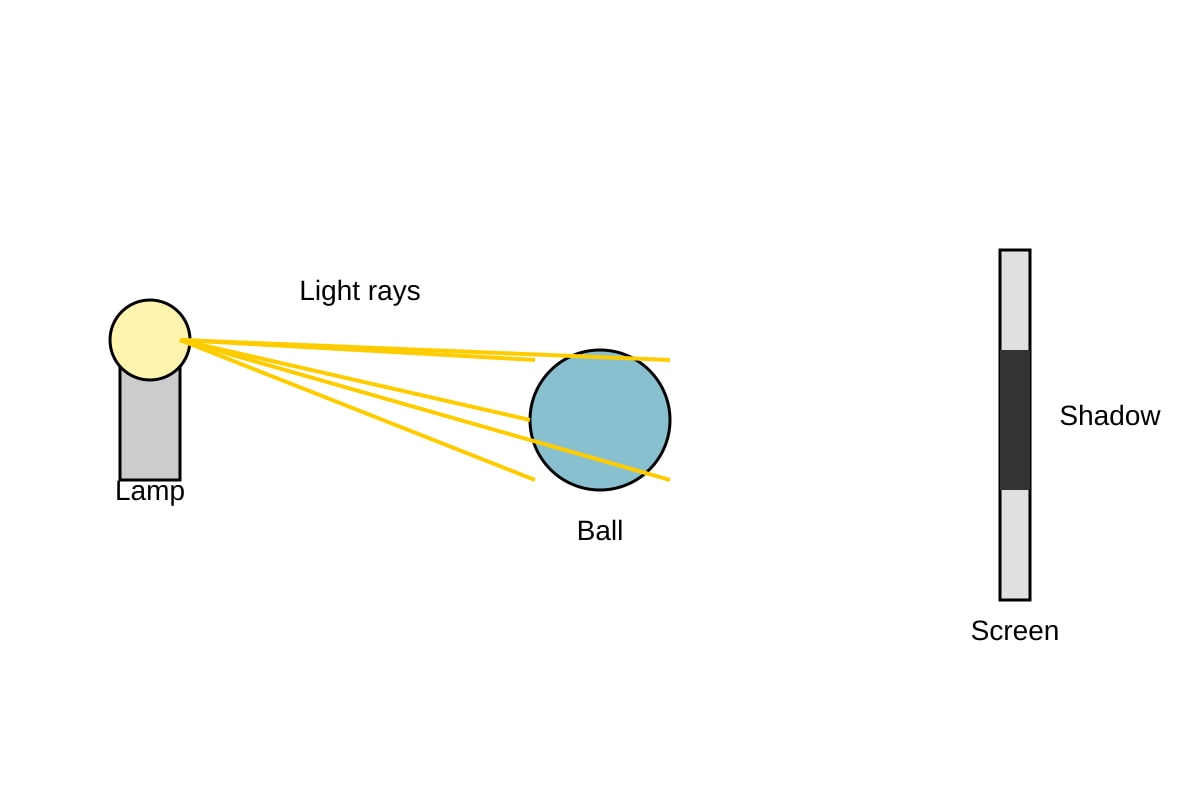
(a) [2] Diagram: lamp left, straight rays to ball, rays blocked, shadow on screen right. Award 1 for positions, 1 for straight rays + shadow region.
(b) [2] Light from lamp travels straight (1). Ball blocks light, so screen behind has unlit area = shadow (1).
Image note: Q18-fig1 must show straight rays stopped by ball, dark shadow on screen.
19. [4]
(a) [1] Reflection = light bounces off a surface.
(b) [2] Light hits mirror and bounces back / leaves at equal angle (1). Path changes direction, does not pass through (1).
(c) [1] Example: mirror to dress, periscope, reflector on bike.
20. [4]
(a) [1] Light bends / slows down / changes direction (refraction).
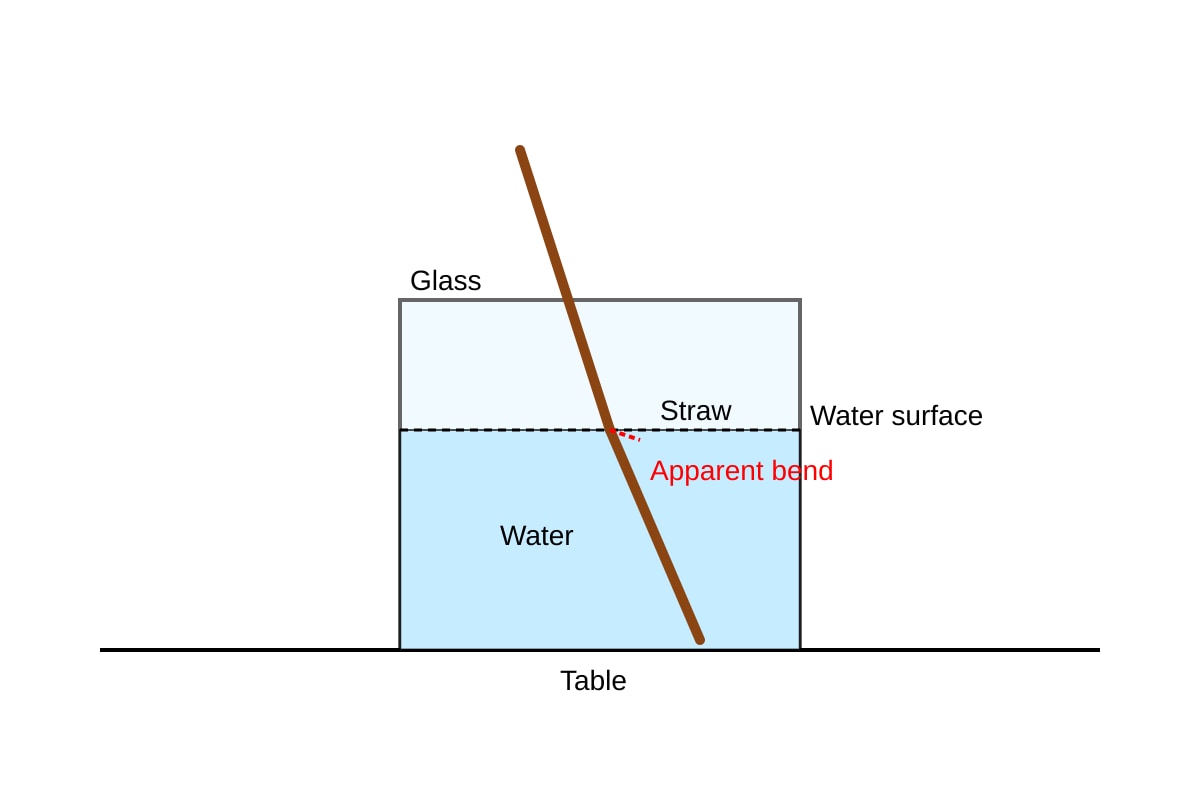
(b) [2] Light from straw in water travels to air and bends (1). Eyes see straw at shifted position, so it looks bent (1).
(c) [1] No, straw is whole; only light path changed.
Image note: Q20-fig1 must show straw straight above water, apparent bend at surface.