AI Generated Quiz

Primary 5 Science Life Cycles Quiz

Free AI-Generated NVIDIA Nemotron 3 Ultra 550B A55B Free Primary 5 Science Life Cycles quiz with questions and answers for Singapore students. This page is rendered as a direct URL so the questions and answers can be discovered without pressing in-page buttons.

These static practice materials are generated from the site's syllabus and paper-generation workflow, with source and model context shown so students and parents can evaluate the material before use.

Primary 5 Science AI Generated Generated by NVIDIA Nemotron 3 Ultra 550B A55B Free Updated 2026-06-07

Questions

<!-- TuitionGoWhere generation metadata: stage=5-1; model=nvidia/nemotron-3-ultra-550b-a55b:free; model_label=NVIDIA Nemotron 3 Ultra 550B A55B Free; generated=2026-06-05; Sources: Stage 4-0 LLM templates, syllabus context, and Stage 2 evidence where available. -->

Primary 5 Science Quiz - Life Cycles

Name: ___________________________
Class: Primary 5 _______
Date: ___________________________
Score: _______ / 40

Duration: 45 minutes
Total Marks: 40

Instructions:

  1. Answer all questions.
  2. Write your answers in the spaces provided.
  3. For multiple-choice questions, shade the correct oval (1, 2, 3, or 4) in the Answer Sheet.
  4. For open-ended questions, write your answers clearly in complete sentences.
  5. Diagrams are not drawn to scale unless stated.

Section A: Multiple-Choice Questions (10 × 1 mark = 10 marks)

For each question, choose the correct answer and write its number (1, 2, 3, or 4) in the brackets provided.

1. Which of the following organisms reproduces by spores?
(1) Mango tree
(2) Fern
(3) Butterfly
(4) Chicken
[_____]

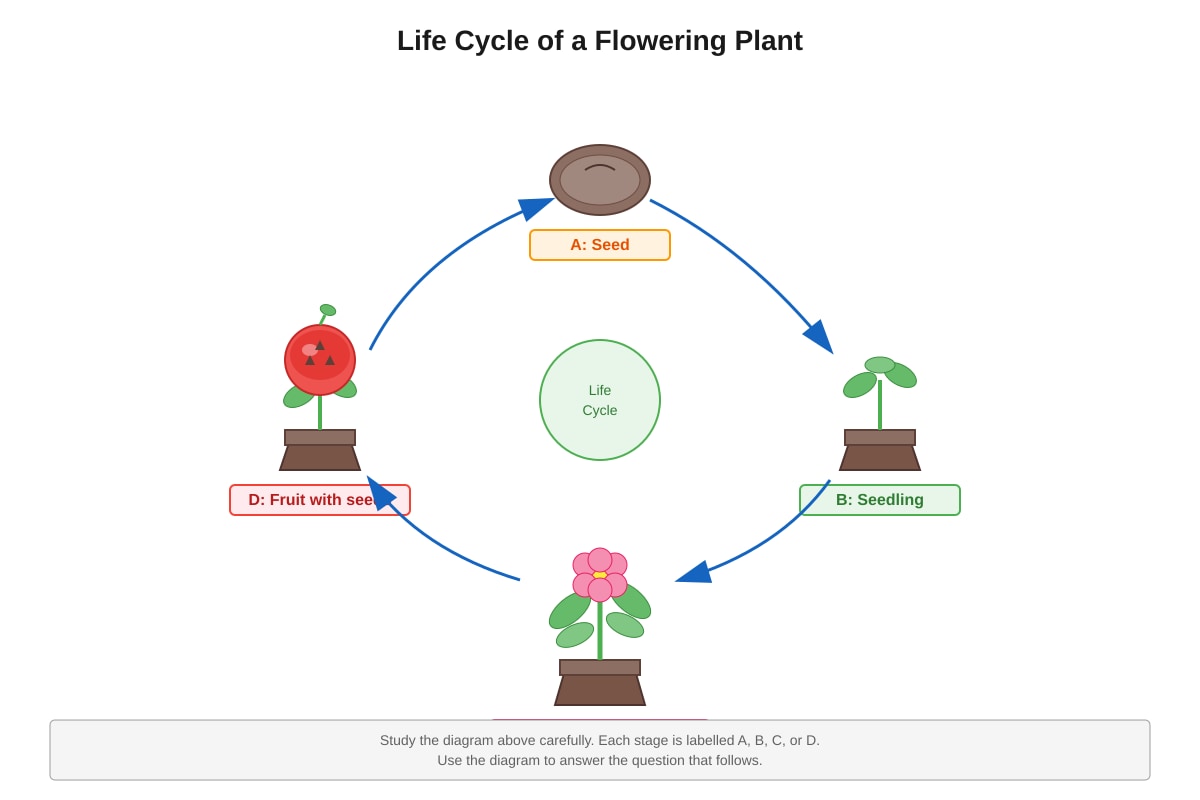
2. The diagram below shows the life cycle of a flowering plant.
<image_placeholder> id: Q2-fig1 type: diagram linked_question: Q2 description: Life cycle of a flowering plant with four stages labelled A, B, C, D in a circular arrangement. Stage A shows a seed, Stage B shows a seedling, Stage C shows an adult plant with flowers, Stage D shows a fruit with seeds. labels: A: Seed, B: Seedling, C: Adult plant with flowers, D: Fruit with seeds values: None must_show: Arrows showing direction of cycle from A→B→C→D→A </image_placeholder>

At which stage does fertilisation occur?
(1) Stage A
(2) Stage B
(3) Stage C
(4) Stage D
[_____]

3. Study the life cycles of the butterfly and the grasshopper below.
<image_placeholder> id: Q3-fig1 type: diagram linked_question: Q3 description: Two life cycle diagrams side by side. Left: Butterfly life cycle with 4 stages - Egg, Larva (caterpillar), Pupa, Adult. Right: Grasshopper life cycle with 3 stages - Egg, Nymph, Adult. Arrows show progression. labels: Butterfly: Egg, Larva, Pupa, Adult. Grasshopper: Egg, Nymph, Adult values: None must_show: Clear distinction between 4-stage (complete metamorphosis) and 3-stage (incomplete metamorphosis) cycles </image_placeholder>

Which statement correctly compares the two life cycles?
(1) Both have a pupa stage.
(2) Both undergo incomplete metamorphosis.
(3) The butterfly has four stages while the grasshopper has three stages.
(4) The young of both organisms look like the adult.
[_____]

4. In the human reproductive system, where does fertilisation usually take place?
(1) Ovary
(2) Fallopian tube
(3) Uterus
(4) Vagina
[_____]

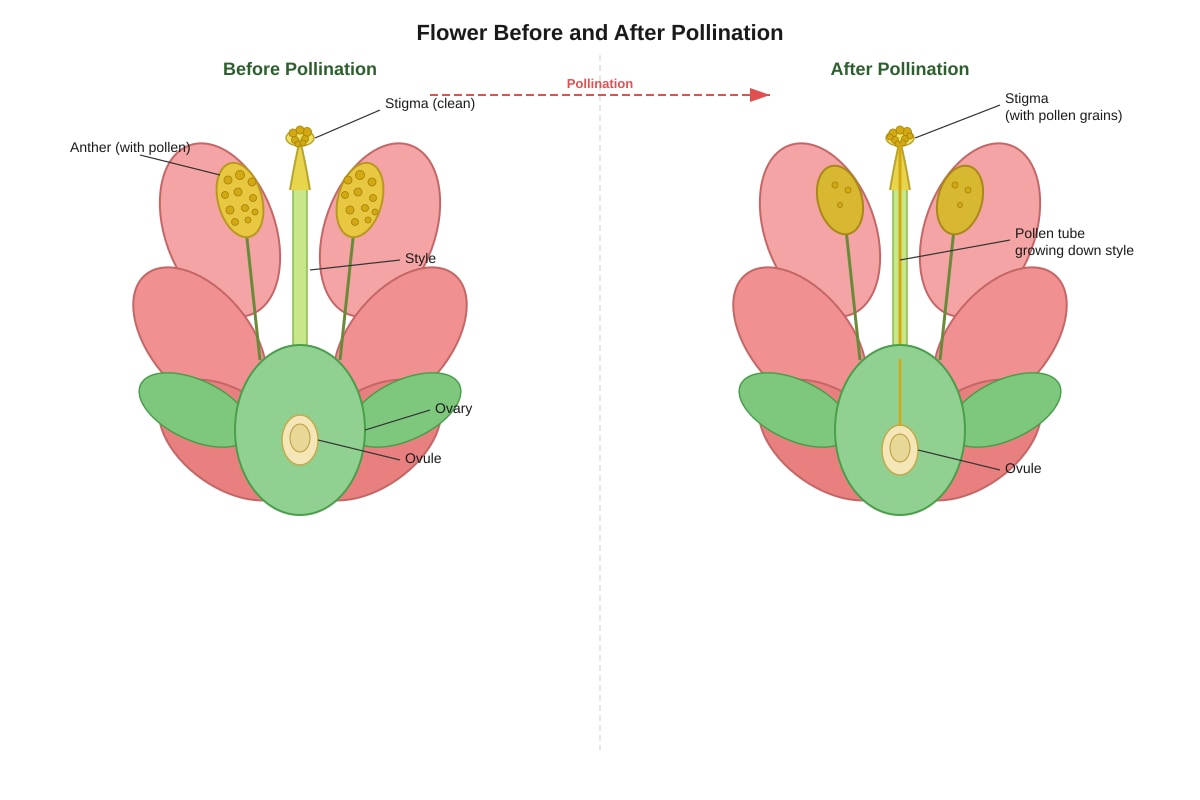
5. The diagram below shows a flower.
<image_placeholder> id: Q5-fig1 type: diagram linked_question: Q5 description: Cross-section of a typical flower showing sepals, petals, stamens (anther and filament), and pistil (stigma, style, ovary with ovules). labels: Sepal, Petal, Anther, Filament, Stigma, Style, Ovary, Ovule values: None must_show: Clear labels of male (stamen) and female (pistil) reproductive parts </image_placeholder>

Which part produces the male reproductive cells?
(1) Stigma
(2) Ovary
(3) Anther
(4) Style
[_____]

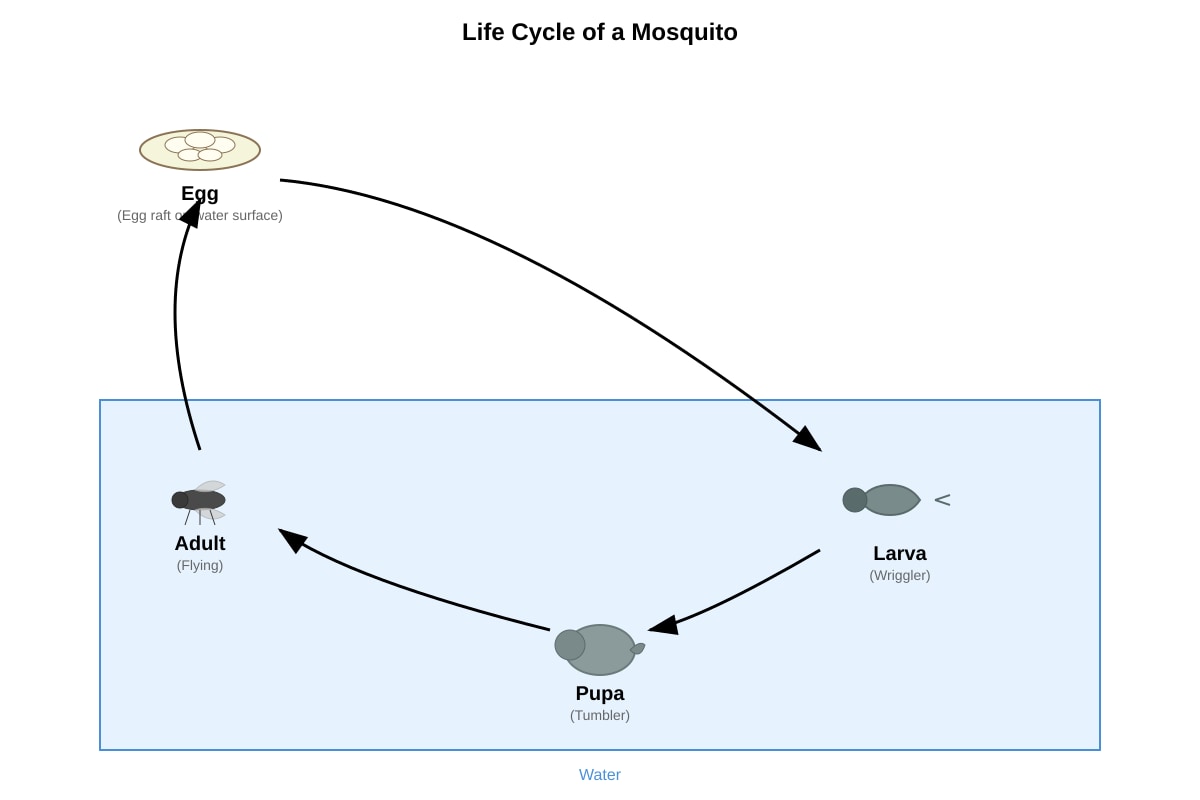
6. Which of the following shows the correct order of stages in the life cycle of a mosquito?
(1) Egg → Larva → Pupa → Adult
(2) Egg → Nymph → Pupa → Adult
(3) Egg → Pupa → Larva → Adult
(4) Egg → Adult → Larva → Pupa
[_____]

7. Pollination is the transfer of pollen grains from the ________ to the ___.
(1) stigma; anther
(2) anther; stigma
(3) ovary; stigma
(4) anther; ovary
[
]

8. A student observed that a young cockroach (nymph) moults several times before becoming an adult. What is the main reason for moulting?
(1) To change its diet
(2) To allow its body to grow larger
(3) To develop wings for flying
(4) To reproduce
[_____]

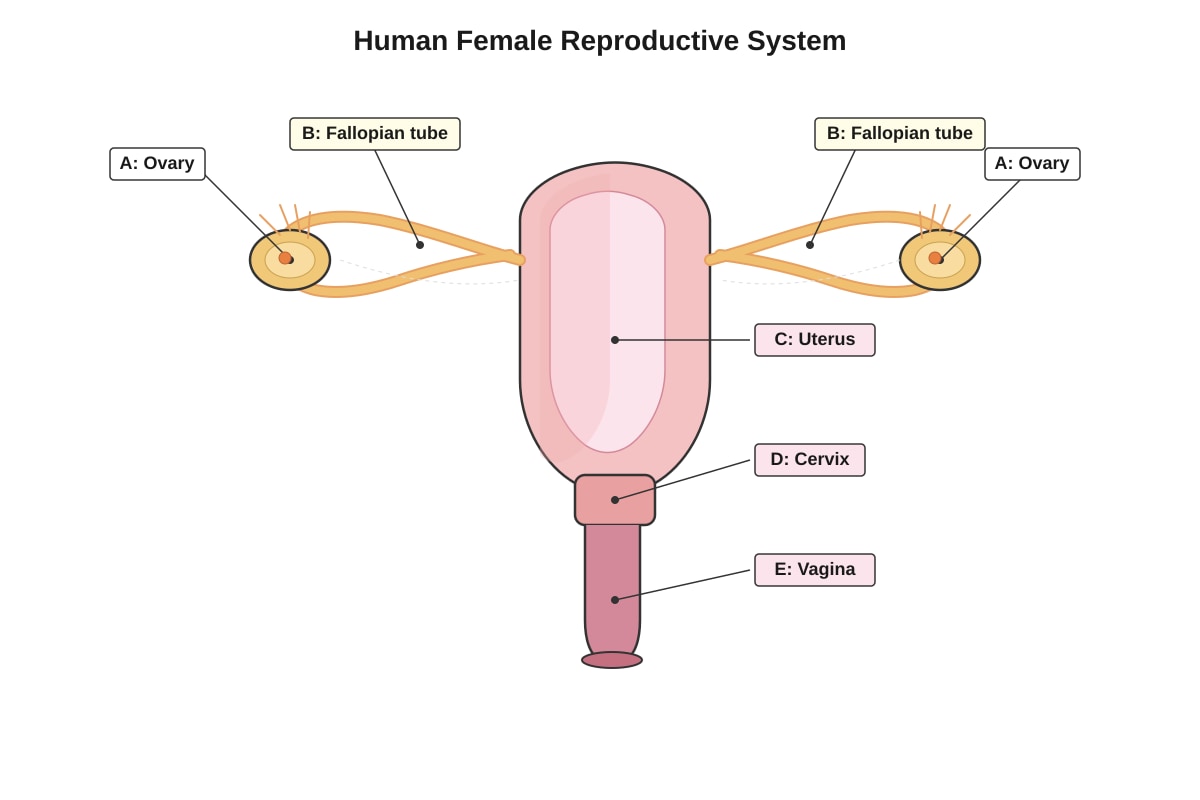
9. The diagram below shows the human female reproductive system.
<image_placeholder> id: Q9-fig1 type: diagram linked_question: Q9 description: Diagram of human female reproductive system showing ovaries, fallopian tubes, uterus, cervix, and vagina. labels: Ovary, Fallopian tube, Uterus, Cervix, Vagina values: None must_show: Relative positions of all parts, fallopian tube connecting ovary to uterus </image_placeholder>

Where does the fertilised egg develop into a baby?
(1) Ovary
(2) Fallopian tube
(3) Uterus
(4) Vagina
[_____]

10. Which of the following is a similarity between the reproduction of flowering plants and humans?
(1) Both involve pollination.
(2) Both involve fertilisation.
(3) Both produce spores.
(4) Both lay eggs outside the body.
[_____]


Section B: Short-Answer Questions (5 × 2 marks = 10 marks)

Write your answers in the spaces provided. Show your working or reasoning where necessary.

11. The diagram below shows the life cycle of a frog.
<image_placeholder> id: Q11-fig1 type: diagram linked_question: Q11 description: Life cycle of a frog with 4 stages: Egg, Tadpole (with gills), Tadpole (with legs), Adult frog. Arrows show progression. labels: Egg, Tadpole (gills), Tadpole (legs), Adult frog values: None must_show: Clear progression from aquatic to terrestrial stages </image_placeholder>

(a) Name the stage labelled X in the diagram.
[______________________________________] (1 mark)

(b) State one difference between the young (tadpole) and the adult frog in terms of breathing.
[______________________________________] (1 mark)

12. The table below shows the number of days for each stage in the life cycle of a mealworm beetle at 25°C.

StageNumber of Days
Egg10
Larva60
Pupa14
Adult90

(a) How many days does it take for the mealworm beetle to develop from an egg to an adult?
[______________________________________] (1 mark)

(b) The mealworm beetle undergoes complete metamorphosis. Explain what this means.
[______________________________________] (1 mark)

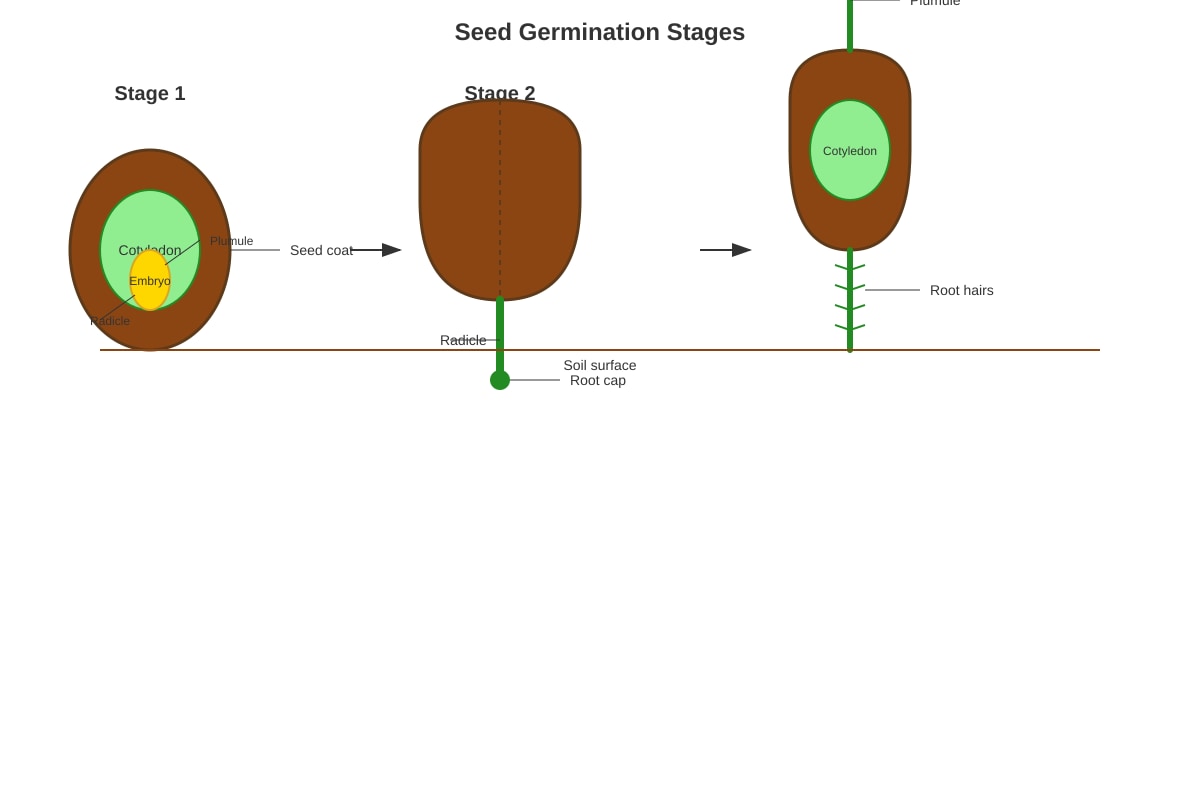
13. The diagram below shows a seed germinating.
<image_placeholder> id: Q13-fig1 type: diagram linked_question: Q13 description: Three diagrams showing seed germination stages: (i) Dry seed with seed coat, cotyledons, embryo; (ii) Seed with radicle emerging; (iii) Seedling with shoot and root, cotyledons above ground. labels: Seed coat, Cotyledon, Embryo, Radicle, Plumule, Root, Shoot values: None must_show: Clear progression from dormant seed to seedling </image_placeholder>

(a) Name the part labelled Y that grows downwards into the soil.
[______________________________________] (1 mark)

(b) State the function of the cotyledon during germination.
[______________________________________] (1 mark)

14. The diagram below shows the male human reproductive system.
<image_placeholder> id: Q14-fig1 type: diagram linked_question: Q14 description: Diagram of human male reproductive system showing testes, scrotum, sperm duct, urethra, penis. labels: Testes, Scrotum, Sperm duct, Urethra, Penis values: None must_show: Relative positions, testes in scrotum outside body </image_placeholder>

(a) Name the part that produces sperm.
[______________________________________] (1 mark)

(b) State one function of the scrotum.
[______________________________________] (1 mark)

15. A farmer wants to grow a new mango tree that has the same desirable traits as his best mango tree. He decides to use grafting instead of planting seeds.

(a) State one advantage of grafting over growing from seeds.
[______________________________________] (1 mark)

(b) Explain why the new tree produced by grafting will have the same traits as the parent tree.
[______________________________________] (1 mark)


Section C: Structured and Free-Response Questions (4 × 5 marks = 20 marks)

Answer all questions in the spaces provided.

16. The diagram below shows the life cycles of a chicken and a butterfly.
<image_placeholder> id: Q16-fig1 type: diagram linked_question: Q16 description: Two life cycle diagrams. Left: Chicken - Egg, Chick, Adult hen/rooster (3 stages). Right: Butterfly - Egg, Caterpillar (larva), Pupa, Adult butterfly (4 stages). labels: Chicken: Egg, Chick, Adult. Butterfly: Egg, Larva, Pupa, Adult values: None must_show: Clear contrast between 3-stage (no metamorphosis) and 4-stage (complete metamorphosis) cycles </image_placeholder>

(a) State one similarity between the life cycles of the chicken and the butterfly.
[______________________________________] (1 mark)

(b) State two differences between the life cycles of the chicken and the butterfly.
[______________________________________] (2 marks)

(c) The butterfly undergoes complete metamorphosis but the chicken does not. Explain what complete metamorphosis means.
[______________________________________] (2 marks)

17. The diagram below shows a flowering plant.
<image_placeholder> id: Q17-fig1 type: diagram linked_question: Q17 description: Flowering plant with roots, stem, leaves, and flower. Flower shows stigma, style, ovary with ovules, anther, filament. Pollen grains shown on anther. labels: Root, Stem, Leaf, Stigma, Style, Ovary, Ovule, Anther, Filament, Pollen grains values: None must_show: Pollen on anther, ovules in ovary, clear path for pollen tube growth </image_placeholder>

(a) On the diagram, draw an arrow to show the direction of pollen tube growth after pollination. Label the arrow P.
[______________________________________] (1 mark)

(b) Describe what happens during fertilisation in a flowering plant.
[______________________________________] (2 marks)

(c) After fertilisation, the ovary develops into the fruit and the ovules develop into seeds. State one function of the fruit.
[______________________________________] (1 mark)

(d) Some plants rely on wind for pollination. State two characteristics of wind-pollinated flowers.
[______________________________________] (1 mark)

18. The diagram below shows the human female reproductive system.
<image_placeholder> id: Q18-fig1 type: diagram linked_question: Q18 description: Female reproductive system with ovary, fallopian tube, uterus, cervix, vagina. An egg is shown in the fallopian tube, sperm shown entering vagina and moving up. labels: Ovary, Fallopian tube, Uterus, Cervix, Vagina, Egg, Sperm values: None must_show: Egg in fallopian tube, sperm path from vagina to fallopian tube </image_placeholder>

(a) Fertilisation occurs in the fallopian tube. Explain why the fallopian tube is a suitable place for fertilisation.
[______________________________________] (2 marks)

(b) After fertilisation, the fertilised egg moves to the uterus. Describe two ways the uterus is adapted for the development of the baby.
[______________________________________] (2 marks)

(c) State one way the developing baby is protected inside the mother's body.
[______________________________________] (1 mark)

19. A student conducted an experiment to find out how temperature affects the hatching of mealworm beetle eggs. She placed 50 eggs at each of four different temperatures and recorded the percentage of eggs that hatched after 14 days.

Temperature (°C)Percentage of Eggs Hatched (%)
1520
2055
2585
3060

(a) Based on the results, what is the most suitable temperature for hatching mealworm beetle eggs?
[______________________________________] (1 mark)

(b) Explain why the percentage of eggs hatched decreases at 30°C compared to 25°C.
[______________________________________] (2 marks)

(c) The student concluded: "Higher temperature always increases the hatching rate." Is this conclusion correct? Explain your answer using the data.
[______________________________________] (2 marks)

20. The diagram below shows the life cycle of a fern.
<image_placeholder> id: Q20-fig1 type: diagram linked_question: Q20 description: Fern life cycle showing alternation of generations: Sporophyte (adult fern) produces spores on underside of fronds → Spores released → Spores grow into gametophyte (prothallus) → Gametophyte produces male and female gametes → Fertilisation occurs in water → Zygote grows into new sporophyte. labels: Sporophyte (adult fern), Spores, Gametophyte (prothallus), Male gametes, Female gametes, Fertilisation, Zygote, Young sporophyte values: None must_show: Alternation of generations, water needed for fertilisation, spores not seeds </image_placeholder>

(a) Ferns reproduce by spores, not seeds. State one difference between a spore and a seed.
[______________________________________] (1 mark)

(b) The diagram shows that fertilisation in ferns requires water. Explain why water is needed.
[______________________________________] (2 marks)

(c) Compare the reproduction of ferns and flowering plants. State one similarity and one difference.
[______________________________________] (2 marks)


End of Quiz

Answers

<!-- TuitionGoWhere generation metadata: stage=5-1; model=nvidia/nemotron-3-ultra-550b-a55b:free; model_label=NVIDIA Nemotron 3 Ultra 550B A55B Free; generated=2026-06-05; Sources: Stage 4-0 LLM templates, syllabus context, and Stage 2 evidence where available. -->

Primary 5 Science Quiz - Life Cycles (Answer Key)

Total Marks: 40


Section A: Multiple-Choice Questions (10 × 1 mark = 10 marks)

1. Answer: (2) Fern
Explanation: Ferns are non-flowering plants that reproduce by spores, not seeds. Mango trees are flowering plants that reproduce by seeds. Butterflies and chickens are animals that reproduce sexually.
Mark: 1

2. Answer: (3) Stage C
Explanation: Fertilisation in flowering plants occurs in the flower (Stage C), where the male reproductive cell from the pollen grain fuses with the female reproductive cell in the ovule. Stage A is the seed, Stage B is the seedling, and Stage D is the fruit containing seeds (after fertilisation).
Mark: 1

3. Answer: (3) The butterfly has four stages while the grasshopper has three stages.
Explanation: Butterflies undergo complete metamorphosis with 4 stages: Egg → Larva → Pupa → Adult. Grasshoppers undergo incomplete metamorphosis with 3 stages: Egg → Nymph → Adult. The nymph resembles a smaller version of the adult and there is no pupa stage.
Mark: 1

4. Answer: (2) Fallopian tube
Explanation: Fertilisation in humans typically occurs in the fallopian tube (oviduct), where the sperm meets the egg after ovulation. The fertilised egg then travels to the uterus for implantation and development.
Mark: 1

5. Answer: (3) Anther
Explanation: The anther is the part of the stamen (male reproductive organ) that produces pollen grains, which contain the male reproductive cells. The stigma receives pollen, the ovary contains ovules (female reproductive cells), and the style connects the stigma to the ovary.
Mark: 1

6. Answer: (1) Egg → Larva → Pupa → Adult
Explanation: Mosquitoes undergo complete metamorphosis with four distinct stages: Egg → Larva (wriggler) → Pupa (tumbler) → Adult. There is no nymph stage in complete metamorphosis.
Mark: 1

7. Answer: (2) anther; stigma
Explanation: Pollination is the transfer of pollen grains from the anther (male part) to the stigma (female part) of a flower. This can occur via wind, insects, or other agents.
Mark: 1

8. Answer: (2) To allow its body to grow larger
Explanation: Insects have a hard exoskeleton that does not grow. To increase in size, they must shed (moult) their old exoskeleton and expand a new soft one before it hardens. This process is repeated several times during the nymph/larval stages.
Mark: 1

9. Answer: (3) Uterus
Explanation: After fertilisation in the fallopian tube, the fertilised egg (zygote) travels to the uterus, implants in the thick uterine lining, and develops into an embryo and then a foetus. The uterus provides protection and nutrients via the placenta.
Mark: 1

10. Answer: (2) Both involve fertilisation.
Explanation: Both flowering plants and humans reproduce sexually, which involves the fusion of male and female reproductive cells (fertilisation). Pollination is unique to plants. Humans do not produce spores or lay eggs outside the body (human fertilisation is internal).
Mark: 1


Section B: Short-Answer Questions (5 × 2 marks = 10 marks)

11.
(a) Answer: Tadpole (with gills) / Tadpole stage
Explanation: The diagram shows the frog life cycle: Egg → Tadpole (with gills) → Tadpole (with legs) → Adult frog. Stage X is the early tadpole with gills for breathing underwater.
Mark: 1

(b) Answer: The tadpole breathes through gills in water, while the adult frog breathes through lungs on land (and also through moist skin).
Explanation: Tadpoles are aquatic and have gills for extracting oxygen from water. Adult frogs are amphibious and use lungs for breathing air, supplemented by cutaneous (skin) respiration.
Mark: 1

12.
(a) Answer: 84 days
Working: Egg (10) + Larva (60) + Pupa (14) = 84 days
Explanation: The time from egg to adult includes the egg, larva, and pupa stages. The adult stage duration (90 days) is the lifespan of the adult, not part of the development time.
Mark: 1

(b) Answer: Complete metamorphosis means the insect has four distinct life stages (egg, larva, pupa, adult) and the young (larva) looks very different from the adult.
Explanation: In complete metamorphosis, the larva (e.g., caterpillar, mealworm) is worm-like and very different from the adult. It undergoes a dramatic transformation during the pupa stage. Examples: butterflies, beetles, mosquitoes, flies.
Mark: 1

13.
(a) Answer: Radicle / Embryonic root
Explanation: The radicle is the first part of the embryo to emerge during germination. It grows downwards (positive geotropism) to anchor the seedling and absorb water and minerals from the soil.
Mark: 1

(b) Answer: The cotyledon stores food (starch, proteins, oils) for the developing embryo/seedling until it can photosynthesise on its own.
Explanation: In many dicot seeds, the cotyledons (seed leaves) contain stored nutrients. During germination, they provide energy and building materials for growth. In some plants, they also emerge above ground and become the first photosynthetic leaves.
Mark: 1

14.
(a) Answer: Testes
Explanation: The testes (singular: testis) are the male gonads that produce sperm (male reproductive cells) and the hormone testosterone. They are located in the scrotum outside the body cavity.
Mark: 1

(b) Answer: The scrotum holds the testes outside the body at a temperature lower than body temperature, which is necessary for sperm production.
Explanation: Sperm production (spermatogenesis) requires a temperature about 2–3°C lower than core body temperature (37°C). The scrotum regulates this by contracting or relaxing to move the testes closer to or further from the body.
Mark: 1

15.
(a) Answer: The new tree will bear fruit faster / earlier than a tree grown from seed. (Accept: The new tree will have exactly the same desirable traits as the parent tree.)
Explanation: Grafting joins a scion (bud/shoot) from a desirable parent tree onto a rootstock. The scion is genetically identical to the parent, so it retains all its traits and can fruit in 1–3 years, whereas seed-grown trees take 5–8 years and show genetic variation.
Mark: 1

(b) Answer: Grafting is a form of asexual reproduction where the scion is genetically identical to the parent tree, so it inherits the same genetic information and traits.
Explanation: No fusion of gametes occurs in grafting. The scion is a clone of the parent plant, carrying identical DNA. Seeds result from sexual reproduction (fertilisation), which mixes genetic material from two parents, leading to variation.
Mark: 1


Section C: Structured and Free-Response Questions (4 × 5 marks = 20 marks)

16.
(a) Answer: Both life cycles begin with an egg stage. / Both involve sexual reproduction. / Both have a young stage that grows into an adult.
Mark: 1

(b) Answer:

  1. The butterfly has four stages (egg, larva, pupa, adult) while the chicken has three stages (egg, chick, adult).
  2. The butterfly undergoes complete metamorphosis (young looks very different from adult), while the chicken does not undergo metamorphosis (chick resembles a smaller version of the adult).
    Mark: 2 (1 mark per difference)

(c) Answer: Complete metamorphosis is a type of insect development where there are four distinct stages (egg, larva, pupa, adult) and the larva looks very different from the adult. The larva undergoes a dramatic transformation inside the pupa to become the adult.
Explanation: Key points: 4 stages, larva ≠ adult, pupa stage present, dramatic restructuring of body tissues during pupal stage. Examples: butterflies, beetles, mosquitoes, flies.
Mark: 2 (1 mark for "4 stages" or "larva very different from adult", 1 mark for "pupa stage" or "dramatic transformation")

17.
(a) Answer: Arrow drawn from stigma down the style into the ovary, entering an ovule. Labelled P.
Explanation: After pollination, the pollen grain germinates on the stigma and grows a pollen tube down the style into the ovary, where it enters the ovule through the micropyle to release male gametes for fertilisation.
Mark: 1

(b) Answer: The male reproductive cell from the pollen grain fuses with the female reproductive cell in the ovule to form a zygote.
Explanation: Double fertilisation occurs in flowering plants: one male gamete fuses with the egg cell to form the zygote (develops into embryo), and the other male gamete fuses with the two polar nuclei to form the triploid endosperm (food store). For P5 level, describing the fusion of male and female gametes in the ovule is sufficient.
Mark: 2 (1 mark for "male and female reproductive cells fuse", 1 mark for "in the ovule" or "forms zygote")

(c) Answer: The fruit protects the seeds / helps in seed dispersal.
Explanation: Fruits develop from the ovary after fertilisation. Their functions include: (1) protecting developing seeds, (2) aiding seed dispersal (by wind, water, animals, splitting/explosion).
Mark: 1

(d) Answer:

  1. Small, dull-coloured petals (or no petals)
  2. Large, feathery / branched stigma to catch pollen
  3. Long, exposed stamens / anthers that hang outside the flower
  4. Light, smooth pollen grains produced in large quantities
  5. No nectar / no scent
    (Any two)
    Explanation: Wind-pollinated flowers do not need to attract pollinators, so they lack showy petals, nectar, and scent. Instead, they have adaptations to release and catch airborne pollen efficiently.
    Mark: 1 (0.5 marks per characteristic, or 1 mark for two correct)

18.
(a) Answer: The fallopian tube is where the egg is released during ovulation and where sperm can meet the egg soon after intercourse. Its funnel-shaped opening (infundibulum) with cilia helps capture the egg and move it along, while muscular contractions help move both egg and sperm.
Explanation: Key adaptations: (1) Fimbriae/funnel catches ovulated egg, (2) Cilia and peristalsis move egg towards uterus, (3) Site where sperm typically meet egg (ampulla), (4) Provides suitable environment for fertilisation and early embryo development before reaching uterus.
Mark: 2 (1 mark for "egg and sperm meet here" or "captures egg", 1 mark for "cilia/muscular contractions move egg" or "suitable environment")

(b) Answer:

  1. The uterus has a thick, muscular wall that expands to accommodate the growing baby.
  2. The uterus lining (endometrium) is rich in blood vessels to supply oxygen and nutrients to the developing embryo/foetus via the placenta.
    Explanation: The uterus is a muscular organ (myometrium) that stretches enormously during pregnancy. The endometrium thickens under hormonal influence to support implantation and placental development.
    Mark: 2 (1 mark per adaptation with brief explanation)

(c) Answer: The baby is protected by the amniotic sac filled with amniotic fluid (which cushions against physical shocks) and the muscular wall of the uterus.
Explanation: The amniotic fluid acts as a shock absorber, maintains temperature, allows movement for muscle development, and prevents adhesion. The thick uterine wall provides physical protection.
Mark: 1

19.
(a) Answer: 25°C
Explanation: At 25°C, 85% of eggs hatched, which is the highest percentage among the four temperatures tested.
Mark: 1

(b) Answer: At 30°C, the temperature is too high and may damage the developing embryos or cause them to dehydrate/die, reducing the hatching rate.
Explanation: Enzymes and metabolic processes in the embryo have an optimal temperature range. Temperatures above the optimum can denature proteins, increase metabolic rate excessively, cause water loss, or lead to developmental abnormalities, reducing survival.
Mark: 2 (1 mark for "too high/above optimum", 1 mark for "damages embryos/denatures enzymes/dehydration")

(c) Answer: No, the conclusion is not correct. The data shows that hatching rate increases from 15°C to 25°C (20% → 85%), but decreases at 30°C (60%). Higher temperature does not always increase hatching rate; there is an optimal temperature (25°C).
Explanation: The relationship is not linear. It increases to an optimum then decreases. Students should cite specific data points: 25°C (85%) > 30°C (60%).
Mark: 2 (1 mark for "No/incorrect", 1 mark for correct explanation using data)

20.
(a) Answer: A spore is a single cell (unicellular) and does not contain a food store / embryo, while a seed is multicellular and contains an embryo and food store (cotyledon/endosperm) protected by a seed coat.
Explanation: Spores are microscopic, single-celled reproductive units produced by ferns, mosses, fungi. Seeds are complex structures containing a multicellular embryo, food supply, and protective coat, produced by flowering plants and gymnosperms.
Mark: 1

(b) Answer: Ferns produce flagellated (swimming) male gametes (sperm) that need water to swim to the female gamete (egg) in the archegonium for fertilisation to occur.
Explanation: The gametophyte (prothallus) produces motile sperm in antheridia. These sperm must swim through a film of water to reach the egg in the archegonium. Without water, fertilisation cannot occur. This is why ferns thrive in moist environments.
Mark: 2 (1 mark for "male gametes swim", 1 mark for "need water to reach female gamete/egg")

(c) Answer:
Similarity: Both involve fertilisation (fusion of male and female gametes) / Both produce offspring through sexual reproduction.
Difference: Ferns reproduce by spores and need water for fertilisation, while flowering plants reproduce by seeds and do not need water for fertilisation (pollen tube grows to ovule).
Explanation: Both have alternation of generations (though reduced in flowering plants). Key difference: ferns are seedless vascular plants requiring water for sperm motility; flowering plants have pollen tubes for sperm delivery, enabling terrestrial reproduction.
Mark: 2 (1 mark for similarity, 1 mark for difference)


End of Answer Key